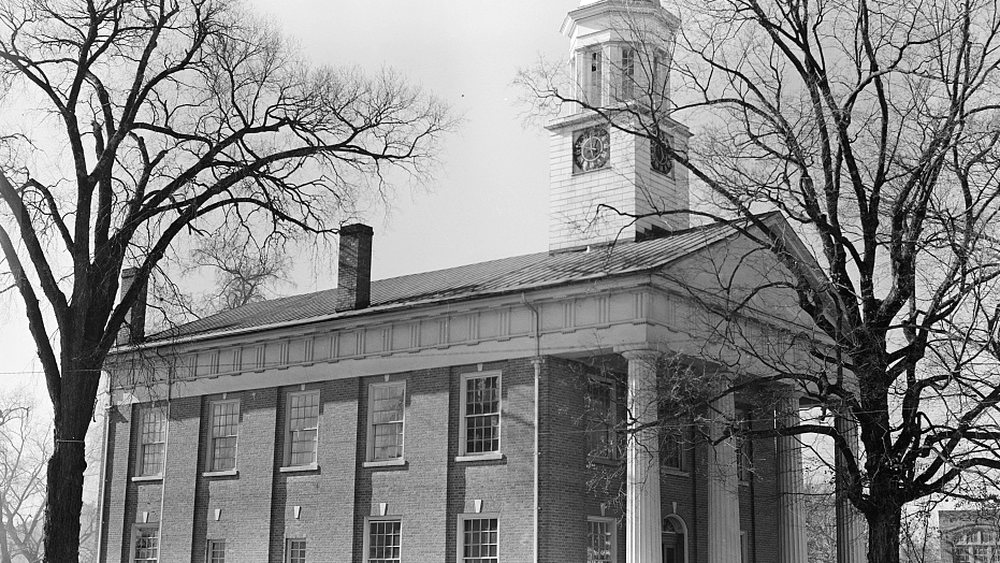
Elections, courthouse politics, town councils, and the county's long habit of arguing in public.
In briefHillsborough hosted the Third Provincial Congress in 1775, sessions of the General Assembly during the Revolution and the 1788 convention that declined to ratify the Constitution, and the county has argued in public ever since, through the Kirk-Holden War, the Speaker Ban and the elections that brought Howard Lee and Carrboro’s firsts. The storylines follow those arguments from the courthouse to the town halls.
1,425 indexed works are connected with this theme. 15 held at OCPL →
Related works found in catalogs and archives across North Carolina, the most widely held first, novels aside. Each links to the institution that holds or provides it.
Narrow these works. Each link opens the search already limited to this theme. Counts are indexed works, not copies on a shelf; a work can carry more than one period or place.
Biography of William C. Friday, president of the University of North Carolina system, by historian William A. Link, published by UNC Press in 1995 with the subtitle power, purpose, and American higher education. It covers Friday's career and the history of the university at Chapel Hill and statewide. Part of the Rebecca B. Wall Local History Collection.
Why this is here: The record names this subject alongside a heading for the county or its towns.
The Story of the Institute of Government, The University of North Carolina at Chapel Hill
Coates, Albert McKinley · 1981
Albert Coates's own account of the Institute of Government at the University of North Carolina, which he founded, subtitled 'out of a classroom in Chapel Hill' and published in 1981. The 303 pages trace the institute's history and its role in educating North Carolina's public officials.
Why this is here: Catalog heading in the UNC record: Coates, Albert, 1896-1989.
Billingsley, William J. · 1999 · University of Georgia Press
William J. Billingsley's history of the Speaker Ban Law, the 1963 North Carolina statute that barred known Communists from speaking on state campuses, and the fight over it at the University of North Carolina in Chapel Hill. The subtitle sets the scope: race, politics and the public university in sixties North Carolina. It treats academic freedom, anti-communist movements and free speech in the state. University of Georgia Press, 1999, 308 pages with eight pages of plates.
Why this is here: Catalog heading in the NCCU record: Universities and colleges -- Law and legislation.
Frank Porter Graham and the 1950 Senate Race in North Carolina
Pleasants, Julian M.; Burns, Augustus M., III · 1990 · UNC Press
Julian M. Pleasants and Augustus M. Burns III on the 1950 Democratic Senate primary in North Carolina, in which Frank Porter Graham, the former president of the University of North Carolina, lost to Willis Smith after a campaign marked by race-baiting. Primaries, elections and race relations in the state are its subjects. Published by UNC Press in 1990, 356 pages with illustrations.
Why this is here: Catalog heading in the NCCU record: Elections.
The Age of Orange: Political and Intellectual Leadership in North Carolina, 1752-1861
Blackwelder, Ruth · 1961
Ruth Blackwelder's study of political and intellectual leadership in Orange County and North Carolina from 1752 to 1861, published in Charlotte by W. Loftin in 1961. Topics include state politics and government, intellectual life before the Civil War, and county genealogy. It runs 216 pages with illustrations and a bibliography. Part of the Wall Local History Collection.
Why this is here: Catalog heading in the Durham record: North Carolina -- Politics and government -- 1775-1865.
Francis Nash's history of Hillsborough in colonial and Revolutionary times, first published in 1903 and reprinted in 1953 by Edwards & Broughton with an index and a sketch of the author. Topics include the Regulator Insurrection of 1766 to 1771, the Revolution and local genealogy.
Why this is here: The record names this subject alongside a heading for the county or its towns.
Howard E. Covington Jr.'s biography of Albert Coates (1896-1989), the law professor who founded the Institute of Government at the University of North Carolina and led it through its early years. Topics include Coates as a law teacher and the institute's history as a center for the study of public administration in Chapel Hill. Published in 2010 by the University Library at Chapel Hill, 322 pages with 32 pages of plates.
Why this is here: Catalog heading in the UNC record: Public administration.
Warren Ashby's biography of Frank Porter Graham (1886-1972), president of the University of North Carolina from 1930 to 1949 and later a United States senator. Published by Blair in 1981, x and 386 pages with sixteen leaves of plates and a bibliography.
Why this is here: Catalog heading in the NCCU record: Legislators.
Books in OCPL’s Rebecca B. Wall Local History Collection whose titles, catalog subjects, or descriptions match this theme. The Friends’ recommended starting points are labelled. Books marked Wider context cover the broader subject rather than this theme itself.
The papers of Willie Person Mangum, 1792 to 1861, a lawyer, judge and United States senator from the part of Orange County that later became Durham County. Five volumes of correspondence published by the State Department of Archives and History beginning in 1950, arranged by date from 1807 to 1894, with illustrations, portraits and folding maps. A source for antebellum North Carolina and national politics, the Whig Party and the Mangum family.
North Carolina politics from the late 1940s, when Kerr Scott won the governorship, to the election of Pat McCrory in 2012. Tom Eamon contends that the state's remaking as a modern democracy was a revolution won through politics, pushed forward by movements and individuals who wanted change. Published by the University of North Carolina Press in 2014; 402 pages with illustrations, maps, portraits, notes and an index.
Paul Luebke, a political sociologist at UNC Greensboro who won a Durham seat in the state House in 1990, tests popular beliefs about North Carolina politics since the 1950s against elections and party competition, reading the state's public life as a contest between traditionalists and modernizers. He followed it with 'Tar Heel Politics 2000' in 1998. Published by UNC Press; 238 pages with notes and an index.
Julian M. Pleasants and Augustus M. Burns III on the 1950 Democratic Senate primary in North Carolina, in which Frank Porter Graham, the former president of the University of North Carolina, lost to Willis Smith after a campaign marked by race-baiting. Primaries, elections and race relations in the state are its subjects. Published by UNC Press in 1990, 356 pages with illustrations.
A. Roger Ekirch's study of politics and society in colonial North Carolina between 1729, when the Crown bought the colony from the Lords Proprietors, and 1776. Published by the University of North Carolina Press in 1981, 305 pages with maps, it treats economic conditions, social structure and government in the decades when Orange County was created and Hillsborough became its seat.
William S. Powell, for years librarian and curator of the North Carolina Collection at Chapel Hill and later a professor of history there, wrote this one-volume history of the state across four centuries, covering its politics and government. It won the Mayflower Cup for nonfiction in 1989. Published by UNC Press; 652 pages, illustrated, with a 23-page bibliography and an index.
Journalist Rob Christensen follows a century of North Carolina politics, from the Simmons machine and the Shelby dynasty through the Jessecrats and Jim Hunt's Democratic revival, asking how one state could send Jesse Helms and John Edwards to the Senate. He credits party competition with the state's rise from poverty. This 2010 second edition adds the Edwards and Easley scandals, Elizabeth Dole's defeat, Beverly Perdue's election and Barack Obama's 2008 win in the state.
Colonial government in North Carolina, studied by Charles Lee Raper through the governor, council and assembly and the reach of their powers from proprietary rule through the royal period. First published by Macmillan in New York in 1904, it appears here in the Reprint Company's 1973 edition from Spartanburg, South Carolina; xiii and 260 pages, with a bibliography.
Henson P. Barnes, a Goldsboro lawyer, wrote this history of the North Carolina General Assembly soon after leaving the state Senate, where he served from 1977 to 1992 and was president pro tempore in his last two terms. The legislature published it in Raleigh in 1993; xxv and 439 illustrated pages with a bibliography and index.
In the chronology
Other storylines that include this theme, earliest first. Each has its own page.
Dated events connected with this theme: sixteen of 882, the highlights and a sample of the rest spread across the years, in date order. See all 882 dated events in the chronology →
Earliest first. Scroll sideways, or use the arrows.
The second session of the 1778 General Assembly met at Hillsborough, elected Whitmell Hill and Thomas Burke as additional delegates to the Continental Congress, and authorized 850,000 pounds in bills of credit to pay the state's war debts. The House adjourned to meet next at Halifax in January 1779.
After driving Nathanael Greene's army across the Dan River, Lord Cornwallis reached Hillsborough on February 20, 1781, raised the royal standard and issued a proclamation calling loyalists to join him. Short of food and forage, and told that Greene had recrossed the Dan, he left on February 26, crossing the Haw toward Alamance Creek.
Meeting at St. Matthew's Church in Hillsborough, delegates defeated a motion to ratify the Constitution 184 to 84 on August 1, 1788. On August 2 they voted to neither ratify nor reject it until a declaration of rights and amendments went before Congress.
Orange County's 1790 tax list returned 2,272 polls and 406,106 acres across its eight districts, with a separate list for Hillsborough town showing 36 white polls against 82 black polls. William Hooper was charged for 22 of them, John Taylor for 10 and Francis Childs for 5.
Thomas Ruffin of Hillsborough, newly seated on the North Carolina Supreme Court, wrote the opinion in State v. Mann, overturning the conviction of John Mann of Edenton for shooting Lydia, an enslaved woman he had hired, as she fled a whipping. Ruffin held that a master's power must be absolute, and abolitionists later cited the ruling widely.
Early on August 7, 1869, about 100 disguised white men took Washington Morrow and his brother Nelson from the Hillsborough jail, where they were held on barn-burning charges, and shot Washington as they fled; he died of the wound. On October 14 a mob hanged their father, Thomas Jefferson Morrow, and their uncle, Daniel Morrow.
Manly McCauley, an 18-year-old Black farmhand, left Milton Brewer's farm west of Chapel Hill with Brewer's wife on October 26, 1898. A posse caught them beyond Jonesboro, and on the way back masked men took McCauley from the officer holding him and hanged him. His body was found on November 6, about three miles west of Chapel Hill.
Federal relief crews began a new library on Churton Street in Hillsborough in December 1933, with local money, including $7,000 from the Hillsborough United Daughters of the Confederacy, paying for materials. The cornerstone of the Confederate Memorial Public Library was laid on July 13, 1934, and the building became the Orange County Historical Museum in 1983.
Interracial riders testing segregation on interstate buses reached Chapel Hill on April 12, 1947. The next day police arrested four of them at the bus station and a white cab driver struck rider James Peck. Convicted in Orange County, Bayard Rustin, Igal Roodenko and Joe Felmet surrendered at the Hillsborough courthouse on March 21, 1949 to serve chain-gang sentences.
Residents who had begun organizing in 1965 against plans to dam the Eno for a water-supply reservoir formed the Association for the Preservation of the Eno River Valley on October 14, 1966. Led by Margaret and Holger Nygard, it began the campaign that preserved the river corridor in Durham and Orange counties.
Braxton Foushee was elected to the Carrboro Board of Aldermen in 1969, the first Black member of the town's governing board, and served until 1981. He pressed for paved roads and sidewalks in Black neighborhoods and counted bringing bus service to Carrboro as his proudest achievement.
Howard N. Lee defeated Roland Giduz by about 400 votes on May 6, 1969, in the largest turnout for a Chapel Hill election to that date, becoming the town's first Black mayor. He was the first African American elected mayor of a predominantly white Southern town since Reconstruction.
After years of citizen opposition to damming the Eno for a reservoir, Governor James Holshouser accepted the first tracts for Eno River State Park in June 1973, including 90 acres donated by Dr. and Mrs. Frederick Bernheim. The first 1,000 acres opened to the public in 1975 along the river in Orange and Durham counties.
A drought from August 1976 to January 1977 forced Chapel Hill and UNC to buy more water from Durham, ban unnecessary water use and cut campus services. By August 1977 University Lake was lower still, and the new Orange Water and Sewer Authority kept conservation rules and used federal drought aid to buy Durham water.
Robert "Bob" Drakeford, a Carrboro alderman since 1975 and a Carrboro Community Coalition candidate, won the mayor's race on November 8, 1977, with 57 percent of the vote over John Boone. He was the town's first Black mayor and served until 1983.
Buildings, schools, churches and other sites named in the dated events on this page, the most often named first. The map shows the 54 with a known location.
Town of Chapel Hill: Archive of 1870 MinutesTown or county website
Related to the chronology entry “Rival claimants to Chapel Hill's town offices are told to stand down” (March 30–April 1, 1870).
NC LIVE: prepared search for Politics & GovernmentNC LIVE
An advanced search of the state’s shared databases already scoped to Orange County’s places and this subject; edit it freely, and sign in through your North Carolina library to read
Additional research sources
Other catalogs to search and local organizations that can help.
Places to visit:Alliance for Historic Hillsborough: Warner ComplexAlliance for Historic Hillsborough
Related to the chronology entry “Roosevelt Warner Is Elected the First Black Member of the Hillsboro Board of Commissioners” (May 7, 1963).
Ask locally:Local History Help Hours and request formOCPL Local History Liaison
The library’s Local History Liaison helps in person most Mondays, 12 to 3, at the Main Library, or by the online request form