Indexed works
Works about or by David Fanning. Each links to the institution that holds or provides it. Background reading appears below.
The Battle at Lindley's Mill
Dunaway, Stewart E. · 2009
Stewart E. Dunaway's account of the Battle of Lindley's Mill, fought in September 1781 after the Loyalist David Fanning raided Hillsborough and carried off Governor Thomas Burke. Burke, Fanning and the Lindley family, whose mill gave the fight its name, are the people at its center, with the Revolutionary campaigns in North Carolina as the frame. Published in 2009.
Included because: Catalog heading in the Durham record: Fanning, David, 1756?-1825.
Governors' Papers: Thomas Burke, Correspondence, April 1782
Burke, Thomas, approximately 1747-1783 · 1782
Thomas Burke, the state's third governor, wrote and received these letters in April 1782, after his return from British captivity. Seized at Hillsborough by the Loyalist raider David Fanning in 1781, he had been paroled to James Island before making his way home. The 49 images mention the Cape Fear River and Hillsborough.
Included because: Their name appears in the record.
NC Digital Collections record courtesy of the North Carolina Department of Natural and Cultural Resources.
Governors' Papers: Thomas Burke, Correspondence, March 1782
Burke, Thomas, approximately 1747-1783 · 1782
Thomas Burke's papers as governor from March 1782, 88 images, written after he came back to North Carolina from captivity. Hillsborough, where the Loyalist David Fanning had seized him in 1781, is named, along with Camden, Chatham and Halifax counties.
Included because: Their name appears in the record.
NC Digital Collections record courtesy of the North Carolina Department of Natural and Cultural Resources.
Governors' Papers: Thomas Burke, Correspondence, August 1781
Caswell, Winston · 1781
Governor Thomas Burke's correspondence for August 1781, a heavy month of 168 images from his first summer in office. Winston Caswell is among the writers. Places named include Hillsborough, the Deep River and Chatham, Granville, Halifax, Richmond and Wake counties, all against the backdrop of the Revolutionary War.
Included because: Their name appears in the record.
NC Digital Collections record courtesy of the North Carolina Department of Natural and Cultural Resources.
Governors' Papers: Thomas Burke, Correspondence, July 1781
Caswell, Richard, 1729-1789 · 1781
July 1781 letters of Thomas Burke, elected governor the month before. Richard Caswell is among the writers, and across 137 images the papers reach Hillsborough and Bladen, Chatham, Cumberland, Duplin, Halifax, Richmond and Wake counties during the Revolutionary War.
Included because: Their name appears in the record.
NC Digital Collections record courtesy of the North Carolina Department of Natural and Cultural Resources.
Governors' Papers: Thomas Burke, Correspondence, July 28, 1781 to August 29, 1781
Burke, Thomas, approximately 1747-1783 · 1781
A run of Governor Thomas Burke's letters dated 28 July to 29 August 1781, in 63 images. The correspondence reaches Hillsborough and Anson, Bladen, Cumberland, Franklin, Granville, Northampton, Wake and Warren counties. Burke had been elected the state's third governor that June.
Included because: Their name appears in the record.
NC Digital Collections record courtesy of the North Carolina Department of Natural and Cultural Resources.
Show 4 more
Governors' Papers: Thomas Burke, Correspondence, September 1781
Burke, Thomas, approximately 1747-1783 · 1781
Letters of Governor Thomas Burke from September 1781, in 71 images. Burke was captured at Hillsborough by the Loyalist David Fanning that year and later resumed his duties. Bertie and Chatham counties are also named in the month's papers.
Included because: Their name appears in the record.
NC Digital Collections record courtesy of the North Carolina Department of Natural and Cultural Resources.
Governors' Papers: Thomas Burke, Correspondence, September 9, 1781 to September 11, 1781
Burke, Thomas, approximately 1747-1783 · 1781
A short run of Thomas Burke's correspondence, 9 to 11 September 1781, in 12 images. Granville County and Hillsborough are named. Burke, the state's third governor, fell into Loyalist hands at Hillsborough later in 1781.
Included because: Their name appears in the record.
NC Digital Collections record courtesy of the North Carolina Department of Natural and Cultural Resources.
Governors' Papers: Thomas Burke, Correspondence, not dated
Mask, William · 1763
Undated letters from the papers of Thomas Burke, governor of North Carolina in 1781 and 1782. William Mask is among the writers, and Hillsborough is named. Ten images.
Included because: Their name appears in the record.
NC Digital Collections record courtesy of the North Carolina Department of Natural and Cultural Resources.
Fanning, David: photographs (Chapel Hill Historical Society)
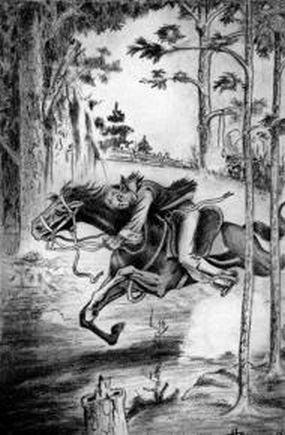
Undated image of David Fanning, the Loyalist partisan of the Revolutionary War, shown escaping from captivity. Fanning led the 1781 raid on Hillsborough that captured Governor Thomas Burke.
Included because: Its title names this person.
Research sources
Sources and research tools for this person. For ready-made searches of other catalogs, see Search further. Research guide: Trace a family through historical records.
Records of the time 6
- State Archives catalog: 42 collections naming David FanningState Archives of North Carolina Collection descriptions for manuscripts, county records, and state records held by the State Archives of North Carolina
- DigitalNC newspapers: 62 Orange County pages naming David Fanning Searchable pages from historic Orange County newspapers
- NCpedia: Fanning, David, Loses the Bay Doe (public-domain image) During the summer of 1782, although the majority of the King’s Men had been driven from the Carolinas, David Fanning continued his assault against North Carolinians. “Good men were either shot or hanged with as little show of feelings as if they had been dogs, while women and children,…
- State Records of North Carolina, volume 17 (1781–1785)Colonial and State Records of North Carolina Reports of Fanning's 1781 raids in the state papers
- NC Digital Collections: Revolutionary War EraNorth Carolina Digital Collections State records from the Revolution, including the Hillsborough sessions
- Southern Campaigns Revolutionary War Pension Statements Transcribed pension applications, searchable by county and name
Collections and databases
- NC LIVE: prepared search for David Fanning Library card Search NC LIVE for this subject and Orange County. You can change the search terms. Sign in through your North Carolina library to access the materials.
- Ancestry Library Edition In the libraryOrange County Public Library Census, birth, death and marriage records, and more, free on the public computers at OCPL libraries