Skip to content

Storyline · 1829–1859

Chapel Hill's town government and its codes, 1829–1859

Chapel Hill's early town codes governed its streets and policed its Black residents, enslaved and free. On February 19, 1829 the commissioners adopted fifteen ordinances that divided white men into patrol companies, made white and Black men liable to work the streets, and barred enslaved people from the streets on Sundays and at night without a written pass. An act of 1851 incorporated the town under five elected commissioners. A revised code of March 19, 1859 fixed the village limits at about 839 acres, ordered officers to check the status of Black residents who claimed to be free, and barred Black people from the country from the streets after 4 p.m. on tax and election days.

1829–1859 Filed under Politics & Government 17 dated events

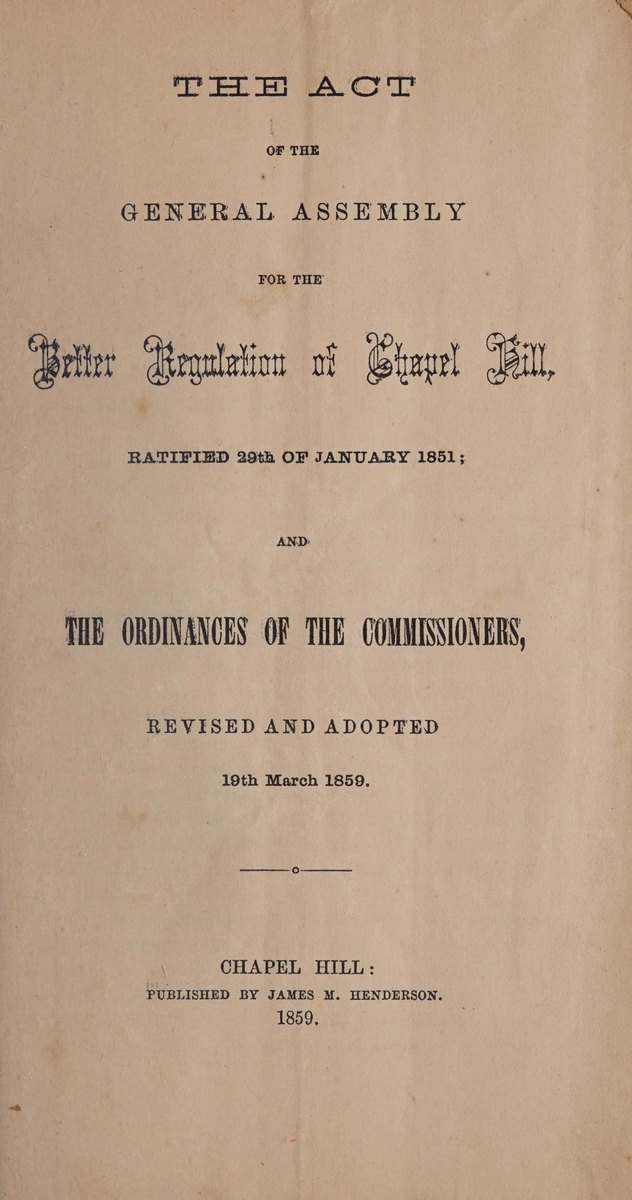
Chapel Hill's incorporation act and revised town ordinances, title page, 1859
Chapel Hill's incorporation act and revised town ordinances, title page, 1859North Carolina General Assembly, printed by James M. Henderson, 1859; Internet Archive · Public domain · Source

On February 19, 1829 Chapel Hill's commissioners adopted fifteen ordinances. The code created a yearly town constable, treasurer and clerk, divided white men aged 21 to 50 into patrol companies, and made white men aged 18 to 45 and Black men aged 16 to 50 liable to work the streets. It barred enslaved people from the streets on Sundays and at night without a written pass and forbade them to hire out their own time. A state law of 1832 put the streets under an overseer named by the county court. On February 6, 1834 voters elected five commissioners, among them Professor Elisha Mitchell, and the board laid a tax of 25 cents a poll. An act ratified January 29, 1851 incorporated the town under five commissioners, Manuel Fetter, Jesse Hargrave, Patterson H. McDade, Mitchell and Jones Watson, to be elected each February. In 1857, with E. J. Mallett as intendant (the town's chief officer), the town graded its streets and sidewalks and banned carts and riders from the walks. On March 19, 1859 the commissioners adopted a revised code that fixed the village limits at about 839 acres, ordered officers to check the status of Black residents who claimed to be free, and barred Black people from the country from the streets after 4 p.m. on tax and election days.

Towns
Chapel Hill
People with pages
10

The events, date by date

Every statement above comes from these dated entries in the chronology. Each links to its source.

  1. Chapel Hill forbids enslaved people to hire their own time or live on their own The 1829 town code made it unlawful for an enslaved person to hire out his or her own time or live apart from the direct care of a free white person in Chapel Hill. Those found doing so could be whipped or jailed in the Orange County jail as runaways. Place: Chapel Hill · Also mentions: Orange County jailOrdinances Passed by the Board of Commissioners for the Town of Chapel Hill (1829), scan p. 6
  2. Chapel Hill orders its white men into patrol companies The first town ordinance divided the white men of Chapel Hill aged 21 to 50, other than the sitting commissioners, into patrol classes. Each captain had to turn out his company two nights a week from 8 or 9 in the evening and report under oath to the magistrate of police, with fines for captains and members who failed. Place: Chapel HillOrdinances Passed by the Board of Commissioners for the Town of Chapel Hill (1829), scan p. 5
  3. Chapel Hill requires its men to work on the town streets All white men of Chapel Hill aged 18 to 45, except the commissioners, and all Black men aged 16 to 50 were made liable to work on the town streets when called. The commissioners could hire an overseer paid by the day from town funds, and anyone who skipped a call was fined up to fifty cents. Place: Chapel HillSearch the index · Ordinances Passed by the Board of Commissioners for the Town of Chapel Hill (1829), scan p. 8
  4. Chapel Hill requires written passes for enslaved people on its streets A town ordinance barred enslaved people from the streets, lanes and lots of Chapel Hill on Sundays and between 8 at night and 5 in the morning unless they carried a written pass from an owner or overseer. They also needed written permission to sell anything in town. The patrol could whip offenders or take a one-dollar fine. Place: Chapel HillOrdinances Passed by the Board of Commissioners for the Town of Chapel Hill (1829), scan p. 6
  5. Chapel Hill's board creates the offices of town constable, treasurer and clerk The 1829 code had the commissioners appoint a town constable each year, paid the same fees as county constables, along with a yearly treasurer and clerk. Fines collected under the ordinances went to the treasurer for town use, and the board set a quorum of three commissioners with the magistrate of police and fined members who missed meetings. Place: Chapel HillSearch the index · Ordinances Passed by the Board of Commissioners for the Town of Chapel Hill (1829), scan p. 9
  6. Chapel Hill's commissioners pass a code of town ordinances The board of commissioners for Chapel Hill adopted fifteen ordinances for the government of the town and had them printed by Dennis Heartt at Hillsborough. The last section repealed all earlier town ordinances and resolutions on the same matters. People: Dennis Heartt Place: Chapel HillSearch the index · Ordinances Passed by the Board of Commissioners for the Town of Chapel Hill (1829), scan p. 3
  7. A state law puts Chapel Hill's streets under an overseer named by the Orange County Court The law of 1832 directed the Orange County Court to appoint an overseer for the streets of Chapel Hill and required every person over twenty-one in the village to work on them, replacing the old plan under which the town commissioners could levy a tax for street repairs. By August 1834 villagers were complaining of the change, and the Harbinger urged Orange's legislators to seek its repeal. Place: Streets of Chapel HillSearch the index · The Harbinger (Chapel Hill), August 9, 1834, p. 3
  8. Chapel Hill elects its town commissioners for 1834 Village voters chose five commissioners: Professor Elisha Mitchell, a doctor, T. H. Taylor, William McCauley and John Hutchins. People: Elisha Mitchell, Thomas H. Taylor, William McCauley Place: Chapel Hill · Also named: John HutchinsSearch the index · The Harbinger (Chapel Hill), February 13, 1834, p. 3
  9. Chapel Hill's new board names its officers and lays the town tax Meeting the evening of the election, the new commissioners made John W. McGee magistrate of police, I. C. Patridge clerk, A. M. Henderson treasurer and Henry Hutchins town constable. The board set the town tax for the year at 25 cents a poll and 10 cents on each $100 of property. People: Isaac C. Patridge Place: Chapel Hill · Also named: John W. McGee, A. M. Henderson, Henry HutchinsSearch the index · The Harbinger (Chapel Hill), February 13, 1834, p. 3
  10. The General Assembly passes an act incorporating Chapel Hill under five commissioners Chapter 330 of the 1850-51 session laws, ratified January 29, 1851, made Manuel Fetter, Jesse Hargrave, Patterson H. McDade, Elisha Mitchell and Jones Watson the commissioners of Chapel Hill, with five commissioners to be elected each February after. They were to choose a magistrate of police, treasurer, constable and clerk and fix the town's bounds. People: Elisha Mitchell, Jones Watson, Manuel Fetter, Jesse Hargrave, Patterson H. McDade Place: Chapel HillSearch the index · Laws of the State of North Carolina, session of 1850-51 (1851), chapter 330, pp. 730-731 · Also: Lefler and Wager, Orange County, 1752-1952; The Daily Tar Heel, October 12, 1993, p. 18
  11. E. J. Mallett serves as intendant of Chapel Hill over five commissioners Chapel Hill's town government in April 1857 was led by Intendant E. J. Mallett, with commissioners P. H. McDade, Calvin Scott, Elisha Mitchell, John H. Watson and a fifth whose name the print garbles. J. Watson was town constable. People: Patterson H. McDade, Elisha Mitchell, John H. Watson Place: Chapel Hill · Also named: E. J. Mallett, Calvin ScottSearch the index · The Chapel Hill Gazette, April 18, 1857, p. 2
  12. Chapel Hill's town authorities level the streets and sidewalks In the spring of 1857 the town authorities were grading Chapel Hill's streets and sidewalks, filling some places and cutting down others. At the same time property holders were putting up new buildings across the village and painting and repairing older houses. Place: Chapel HillSearch the index · The Chapel Hill Gazette, April 18, 1857, p. 2
Show all 17 dated events
  1. Chapel Hill bans carts, wagons and horseback riders from its sidewalks The commissioners barred hand carts, wheelbarrows, wagons and other vehicles from the sidewalks of the village and forbade riding on them on horseback. Rolling a vehicle on the walk cost fifty cents and riding there a dollar. Place: Chapel HillSearch the index · Act of the General Assembly for the Better Regulation of Chapel Hill, and the Ordinances of the Commissioners (1859), scan p. 17
  2. Chapel Hill bars Black people from the countryside from gathering in town on tax and election days An ordinance made it unlawful for Black people from the country to gather or linger in the streets of Chapel Hill after 4 p.m. on tax-collecting or election days, and let the town constable whip those who did. Place: Chapel HillAct of the General Assembly for the Better Regulation of Chapel Hill, and the Ordinances of the Commissioners (1859), scan p. 17
  3. Chapel Hill fixes its village limits as a rectangle of 839 acres The first ordinance of the 1859 code set the town limits from Franklin Street, which ran 2,622 yards from the road to Purefoy's Mill on John Craig's land to the university's land line, with Raleigh and Hillsborough streets marking the north-south reach. Lines through these points formed a rectangle of about 839 acres. Place: Franklin Street, Chapel Hill · Also named: John CraigSearch the index · Act of the General Assembly for the Better Regulation of Chapel Hill, and the Ordinances of the Commissioners (1859), scan p. 13
  4. Chapel Hill orders its officers to check the status of Black residents who claim to be free The 1859 code made it the duty of the magistrate of police and the town constable to find out the true condition of every person of color living in the village who claimed to be free. Place: Chapel HillAct of the General Assembly for the Better Regulation of Chapel Hill, and the Ordinances of the Commissioners (1859), scan p. 16
  5. Chapel Hill's commissioners adopt a revised code of ordinances The commissioners of Chapel Hill revised and adopted the village ordinances and printed them with the 1851 act of incorporation in a pamphlet published at Chapel Hill by James M. Henderson. Place: Chapel Hill · Also named: James M. HendersonSearch the index · Act of the General Assembly for the Better Regulation of Chapel Hill, and the Ordinances of the Commissioners (1859), scan p. 7

People in this storyline

People with a page of their own whom the dated events above name, those named most often first.

Reading on the places and people in this storyline

No indexed work is about this storyline itself yet. These are about the sites and people its dated events name, those named most often first, so they may discuss the storyline only in part. Follow a link to find a copy or view the material.

About Elisha Mitchell · named in 3 of this story’s entries

Chapel Hill and Elisha Mitchell the Botanist

McVaugh, Rogers; McVaugh, Michael R.; Ayers, Mary · 1996

Elisha Mitchell, the University of North Carolina professor for whom Mount Mitchell is named, as botanist and as observer of early Chapel Hill, in a study by Rogers McVaugh, Michael R. McVaugh and Mary Ayers. It covers Mitchell's botanical knowledge, the plants of Chapel Hill and the town's historical geography. Published by the Botanical Garden Foundation in Chapel Hill in 1996, 122 pages with illustrations and maps.

A memoir of the Rev. Elisha Mitchell ... : together with the tributes of respect to his memory, by various public meetings and literary associations, and the addresses delivered at the re-interment of his remains

1858 · J. M. Henderson

Printed at Chapel Hill in 1858 by J. M. Henderson, this memorial volume for Elisha Mitchell, the university professor who died in 1857, gathers tributes paid by public meetings and literary associations together with the addresses given when his remains were reinterred. A memoir by Professor Charles Phillips opens the book at pages 5 to 12. Eighty eight pages with a portrait plate.

Putting Down Roots

Burk, William R. · 2023

William R. Burk's history of botany at the University of North Carolina, from its early natural scientists such as Denison Olmsted and Elisha Mitchell through later figures including George Francis Atkinson, Joseph Austin Holmes and Henry Van Peters Wilson, closing with a chapter on the Department of Botany itself. Published in Fort Worth in 2023.

Elisha Mitchell centennial : UNC-Chapel Hill, April 8-9, 1983

1983

Program for the meeting that convened in Chapel Hill on April 8 and 9, 1983, marking the centennial of the Elisha Mitchell Scientific Society, the state scientific society named for the university professor who died surveying the mountain that now carries his name.

UNC
Wider background: Politics & Government · the most widely held histories of the theme this storyline is filed under; they may not discuss it

William Friday

Link, William A. · 1995

Biography of William C. Friday, president of the University of North Carolina system, by historian William A. Link, published by UNC Press in 1995 with the subtitle power, purpose, and American higher education. It covers Friday's career and the history of the university at Chapel Hill and statewide. Part of the Rebecca B. Wall Local History Collection.

The Story of the Institute of Government, The University of North Carolina at Chapel Hill

Coates, Albert McKinley · 1981

Albert Coates's own account of the Institute of Government at the University of North Carolina, which he founded, subtitled 'out of a classroom in Chapel Hill' and published in 1981. The 303 pages trace the institute's history and its role in educating North Carolina's public officials.

Communists on Campus

Billingsley, William J. · 1999 · University of Georgia Press

William J. Billingsley's history of the Speaker Ban Law, the 1963 North Carolina statute that barred known Communists from speaking on state campuses, and the fight over it at the University of North Carolina in Chapel Hill. The subtitle sets the scope: race, politics and the public university in sixties North Carolina. It treats academic freedom, anti-communist movements and free speech in the state. University of Georgia Press, 1999, 308 pages with eight pages of plates.

Reviewed in Academe (2000), The American Historical Review (2001), The Journal of Southern History (2001), Journal of American History (2001), The Journal of Politics (2001).

Frank Porter Graham and the 1950 Senate Race in North Carolina

Pleasants, Julian M.; Burns, Augustus M., III · 1990 · UNC Press

Julian M. Pleasants and Augustus M. Burns III on the 1950 Democratic Senate primary in North Carolina, in which Frank Porter Graham, the former president of the University of North Carolina, lost to Willis Smith after a campaign marked by race-baiting. Primaries, elections and race relations in the state are its subjects. Published by UNC Press in 1990, 356 pages with illustrations.

Reviewed in Choice Reviews Online (1991), The American Historical Review (1991), Journal of American History (1991), The Journal of Southern History (1992).

The Age of Orange: Political and Intellectual Leadership in North Carolina, 1752-1861

Blackwelder, Ruth · 1961

Ruth Blackwelder's study of political and intellectual leadership in Orange County and North Carolina from 1752 to 1861, published in Charlotte by W. Loftin in 1961. Topics include state politics and government, intellectual life before the Civil War, and county genealogy. It runs 216 pages with illustrations and a bibliography. Part of the Wall Local History Collection.

Show 6 more

The Good Government Man

Covington, Jr., Howard E. · 2010

Howard E. Covington Jr.'s biography of Albert Coates (1896-1989), the law professor who founded the Institute of Government at the University of North Carolina and led it through its early years. Topics include Coates as a law teacher and the institute's history as a center for the study of public administration in Chapel Hill. Published in 2010 by the University Library at Chapel Hill, 322 pages with 32 pages of plates.

Orange County, 1752-1952

Lefler, Hugh Talmage; Wager, Paul W. · 1953

Hugh Talmage Lefler and Paul W. Wager's history of Orange County across its first two centuries, 1752 to 1952, prepared for the county's bicentennial. It covers government and politics, biography and the county's families, and doubles as a genealogical reference. Published in Chapel Hill by the Orange Printshop in 1953, 389 pages with illustrations and an index; this copy is a later reprint.

Reviewed in The Journal of Southern History (1954).

A Traitor and a Scoundrel: Benjamin Hedrick and the Cost of Dissent

Smith, Michael Thomas · 2003 · University of Delaware Press ; London : Associated University Presses

Michael Thomas Smith's biography of Benjamin Sherwood Hedrick, the University of North Carolina chemistry professor dismissed in 1856 after he declared support for the antislavery presidential candidate John C. Fremont. Published by University of Delaware Press in 2003, 216 pages with illustrations. Topics include abolitionists and dissenters in North Carolina, the antislavery movement in the state, and the university's biography before 1962.

Reviewed in The Journal of Southern History (2005).

The Papers Of Willie Person Mangum

Mangum, Willie Person · 1950 · State Dept. of Archives and History

The papers of Willie Person Mangum, 1792 to 1861, a lawyer, judge and United States senator from the part of Orange County that later became Durham County. Five volumes of correspondence published by the State Department of Archives and History beginning in 1950, arranged by date from 1807 to 1894, with illustrations, portraits and folding maps. A source for antebellum North Carolina and national politics, the Whig Party and the Mangum family.

Reviewed in The Journal of Southern History (1951), Journal of American History (1951), The Journal of Southern History (1953), Journal of American History (1953), The Journal of Southern History (1954), The Journal of Southern History (1955), The Journal of Southern History (1957), Journal of American History (1957), The American Historical Review (1957).

An Historical Address Delivered in Saint Matthew's Church, Hillsboro, N.C., on Sunday, August 24, 1924

Cheshire, Joseph Blount · 1925

Address by Bishop Joseph Blount Cheshire at St. Matthew's Church in Hillsborough on 24 August 1924, marking the parish's hundredth anniversary. Printed in Durham in 1925 at the vestry's order, with a foreword by the rector. Cheshire discusses George Micklejohn, William Mercer Green and Moses Ashley Curtis.

Research this storyline

Each dated event above names its source, the place to start. For finding more on an event across newspapers, records and histories, see the research guide Follow an event across several accounts. Ask at the North Carolina Room of the Orange County Public Library for help with local sources.

Cite or share

Friends of the Orange County Public Library. “Chapel Hill's town government and its codes, 1829–1859.” Orange County Indexed, https://focplnc.org/orange-county-books/storylines/chapel-hill-town-government-1829-1859-storyline-1829/. Accessed October 22, 2026.

How to cite what you find

Suggest a correction or a source →

See these events in the full chronology All storylines

Two mice reading back to back against a leaf, with the hand-lettered words Friends of the Orange County Public Library
Illustration by Caldecott Medalist Matthew Cordell, gifted to the Friends 2026
