Skip to content

Named event or history

Hillsborough ratification convention, 1788

North Carolina’s first convention on the federal Constitution, which declined to ratify without a bill of rights (the Fayetteville convention of 1789 ratified).

From the state marker

“Delegates debated U.S. Constitution, July 21-Aug. 4, 1788, & voted to delay ratification until bill of rights was added. Met 100 yards S.W.”

State historical marker: G-131: Constitutional Convention, 1788

21 indexed works are connected with this event. 1 held at OCPL →

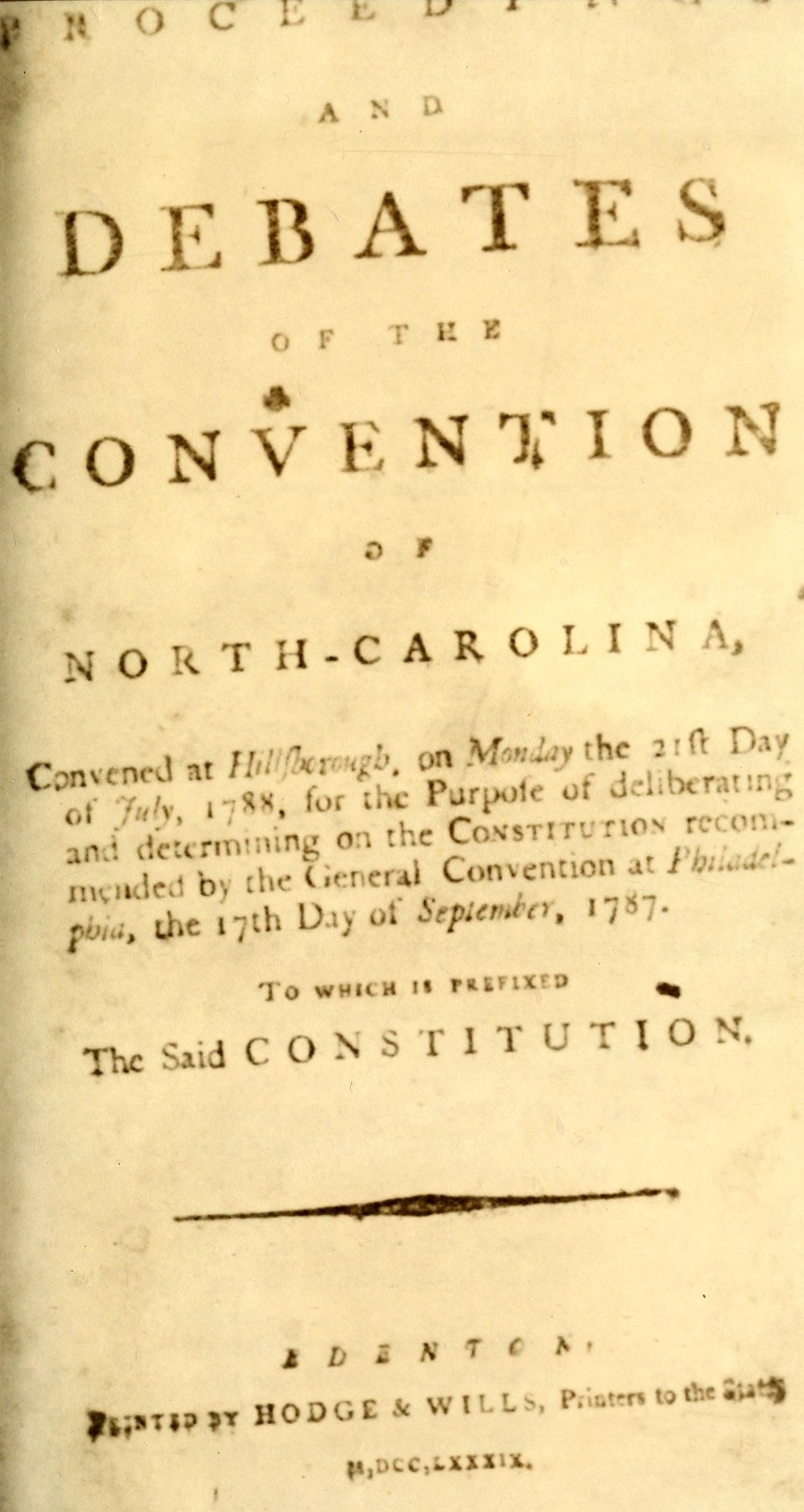
Title page of the Proceedings and Debates of the Convention of North-Carolina

Indexed works

Related works found in catalogs and archives across North Carolina. Each links to the institution that holds or provides it.

The Twelfth Lantern

Henderson, Nancy Wallace · 1990

Nancy Wallace Henderson's play, staged and filmed as a dramatic reenactment for the bicentennial of the 1788 convention at Hillsborough, where North Carolina's delegates met from July 21 to August 4 to consider the new federal Constitution and declined to ratify it without a bill of rights. The 1990 recording is a filmed performance on constitutional history and Hillsborough's part in it.

Why this is here: Catalog heading in the OCPL record: North Carolina. Constitutional Convention (1788) -- Drama.

The Ratification of the Federal Constitution in North Carolina

Trenholme, Louise Irby · 1932 · Columbia University Press; P. S. King

Louise Irby Trenholme's study of how North Carolina came to ratify the United States Constitution, covering the Hillsborough convention of 1788, which declined to ratify, and the Fayetteville convention of 1789, which did. Published in 1932 by Columbia University Press as number 363 in its studies in the social sciences and also issued as her Columbia thesis. 282 pages with two folding maps and a bibliography.

Why this is here: Catalog heading in the NCCU record: North Carolina Constitutional Convention (1788).

Reviewed in Journal of American History (1932), Social Forces (1933).

Governor Samuel Johnston Correspondence: December 29, 1878-December 10, 1789, n.d.

Robertson, Elijah · 1789

Samuel Johnston's correspondence as governor, December 1787 to 10 December 1789, with undated items, in 109 images. Johnston presided over the 1789 convention at which North Carolina ratified the federal Constitution. Topics include commerce, tobacco, debts, enemy property and Indian wars. Elijah Robertson is among the correspondents, and Hillsborough and Orange County appear.

Why this is here: Its title names this subject.

NC Digital Collections record courtesy of the North Carolina Department of Natural and Cultural Resources.

Governors' Papers: Samuel Johnston, Correspondence, April 1789

McDowell, Charles · 1789

Correspondence of Samuel Johnston, the state's sixth governor, for April 1789, the year he presided over the convention that ratified the federal Constitution. Charles McDowell is among the writers, and Cherokee, Chickasaw and Creek affairs and the State of Franklin recur. Hillsborough is named. Fourteen images.

Why this is here: Its title names this subject.

NC Digital Collections record courtesy of the North Carolina Department of Natural and Cultural Resources.

Governors' Papers: Samuel Johnston, Correspondence, January 1789

Philips, Etheldred · 1789

Samuel Johnston, governor of North Carolina from late 1787 to late 1789, received and wrote these letters in January 1789. Etheldred Philips is among the writers. Topics include the State of Franklin and the Cherokee, Chickasaw and Creek nations, and Hillsborough is named. Sixteen images.

Why this is here: Its title names this subject.

NC Digital Collections record courtesy of the North Carolina Department of Natural and Cultural Resources.

Governors' Papers: Samuel Johnston, Correspondence, June 1789

Child, Francis · 1789

Governor Samuel Johnston's correspondence for June 1789, 14 images. Francis Child is among the writers, and George Washington, newly inaugurated as president, is named. Bertie County, Hillsborough, the State of Franklin and Cherokee, Chickasaw and Creek matters also appear.

Why this is here: Its title names this subject.

NC Digital Collections record courtesy of the North Carolina Department of Natural and Cultural Resources.

Show 6 more

Governors' Papers: Samuel Johnston, Correspondence, March 1789

Williamson, Hugh, 1735-1819 · 1789

Hugh Williamson, one of North Carolina's delegates in Congress, writes in these March 1789 letters of Governor Samuel Johnston. The 18 images also concern the State of Franklin and the Cherokee, Chickasaw and Creek nations, with Hillsborough among the places named.

Why this is here: Its title names this subject.

NC Digital Collections record courtesy of the North Carolina Department of Natural and Cultural Resources.

Certificate of Election, North Carolina Convention of 1788

North Carolina. Convention (1788) · 1788

Certificates of election for delegates to the North Carolina convention of 1788, which met at Hillsborough to consider ratifying the federal Constitution. The group also takes in records of the 1787 federal convention and journals and ordinances of the Hillsborough and 1789 Fayetteville conventions. 57 images.

Why this is here: Its title names this subject.

NC Digital Collections record courtesy of the North Carolina Department of Natural and Cultural Resources.

Committee of Election Reports, Dobbs County Election Returns Only, North Carolina Convention of 1788

North Carolina. Convention (1788) · 1788

Election returns from Dobbs County sent to the Committee of Election Reports of North Carolina's 1788 convention, which met at Hillsborough to consider ratifying the federal Constitution. 19 images.

Why this is here: Its title names this subject.

NC Digital Collections record courtesy of the North Carolina Department of Natural and Cultural Resources.

Draft of Rules Committee Report, North Carolina Convention of 1788

North Carolina. Convention (1788) · 1788

Draft report of the rules committee of North Carolina's 1788 convention, which met at Hillsborough to consider the federal Constitution and adjourned without ratifying it. Part of the state's papers from the Hillsborough and Fayetteville ratification conventions of 1788 and 1789. Two images.

Why this is here: Its title names this subject.

NC Digital Collections record courtesy of the North Carolina Department of Natural and Cultural Resources.

Future Meetings Ordinance, North Carolina Convention of 1788

North Carolina. Convention (1788) · 1788

Ordinance of the North Carolina Convention of 1788, which met at Hillsborough to consider the federal Constitution, fixing the place where future meetings would be held. Eight pages, part of the state's papers on the 1788 and 1789 ratification conventions at Hillsborough and Fayetteville.

Why this is here: Its title names this subject.

NC Digital Collections record courtesy of the North Carolina Department of Natural and Cultural Resources.

Governors' Papers: Samuel Johnston, Correspondence, April 1788

Johnston, Samuel, 1733-1816 · 1788

Governor Samuel Johnston's letters from April 1788, a few months into his term. Frontier matters run through them: the Cherokee, Chickasaw and Creek nations, the breakaway State of Franklin, Joseph Martin, Alexander McGillivray and the Spanish envoy Diego de Gardoqui. Surry County and Hillsborough are named. Twenty-four images.

Why this is here: Its title names this subject.

NC Digital Collections record courtesy of the North Carolina Department of Natural and Cultural Resources.

Search all 21 indexed works →

Start at OCPL

Books in OCPL’s Rebecca B. Wall Local History Collection whose titles, catalog subjects, or descriptions match this event. The Friends’ recommended starting points are labelled. Books marked Wider context cover the broader subject rather than this event itself.

Show 2 more
  • Rebecca Wall Collection · NC 812.54 HEN The Twelfth Lantern Henderson, Nancy Wallace · 1990

    Nancy Wallace Henderson's play, staged and filmed as a dramatic reenactment for the bicentennial of the 1788 convention at Hillsborough, where North Carolina's delegates met from July 21 to August 4 to consider the new federal Constitution and declined to ratify it without a bill of rights. The 1990 recording is a filmed performance on constitutional history and Hillsborough's part in it.

  • Wider context · NC 973.313 MIT North Carolina's Signers: Brief Sketches of the Men Who Signed the Declaration of Independence and the Constitution Mitchell, Memory F. · 1964

    Six North Carolinians signed the Declaration of Independence or the Constitution, and Memory F. Mitchell gives each a short illustrated sketch: William Hooper, Joseph Hewes and John Penn for the Declaration, William Blount, Richard Dobbs Spaight and Hugh Williamson for the Constitution. Hooper's home, the Nash-Hooper House, stands in Hillsborough. Published by the state archives agency in Raleigh in 1964, 61 pages with portraits and a brief bibliography.

In the chronology

Dated events connected with this event, earliest first. See these 23 dated events in the chronology →

  1. Hillsborough Convention declines to ratify the Constitution Meeting at St. Matthew's Church in Hillsborough, delegates defeated a motion to ratify the Constitution 184 to 84 on August 1, 1788. On August 2 they voted to neither ratify nor reject it until a declaration of rights and amendments went before Congress. People: Samuel Johnston, Richard Dobbs Spaight, Willie Jones, James IredellColonial and State Records of North Carolina, vol. 22, pp. 1-35: Minutes of the North Carolina Constitutional Convention at Hillsborough
  2. The convention appoints a committee of privileges and elections with three members from each district The convention set up a 27-member committee of privileges and elections, three from each district, which went on to rule on the disputed returns. Alexander Mebane of Orange County sat on it with Thomas Person, William R. Davie and James Iredell. People: Thomas Person, James Iredell, William Richardson DavieDocumenting the American South: Proceedings and Debates of the Convention of North-Carolina, Hillsborough, 1788, p. 20
  3. The convention names a select committee to draft its rules of debate On its first day the convention asked William R. Davie, Thomas Person, James Iredell, Elisha Battle, Richard Dobbs Spaight, Samuel Spencer and a member named McDonald to propose rules for its discussion of the Constitution. People: Thomas Person, James Iredell, Richard Dobbs Spaight, William Richardson DavieDocumenting the American South: Proceedings and Debates of the Convention of North-Carolina, Hillsborough, 1788, p. 19
  4. The ratification convention opens at Hillsborough and elects Governor Samuel Johnston its president A majority of the elected delegates met at the church in Hillsborough and chose Governor Samuel Johnston president without a dissenting vote. They then named John Hunt and James Taylor clerks and appointed doorkeepers. People: Samuel JohnstonDocumenting the American South: Proceedings and Debates of the Convention of North-Carolina, Hillsborough, 1788, p. 19
  5. The convention adopts eighteen rules for the conduct of its members The rules committee reported and the convention agreed to its rules with one article left out. The rules let any two members call for a recorded yea-and-nay vote and excused Quaker members from the ban on wearing hats in the house.Documenting the American South: Proceedings and Debates of the Convention of North-Carolina, Hillsborough, 1788, p. 20
  6. William Lenoir brings a petition against the Dobbs County election before the convention On Lenoir's motion the convention read the Dobbs County return and a petition from county residents complaining of an illegal election, and sent both to the committee of elections. Richard Dobbs Spaight and Stephen Cabarrus added depositions and the sheriff's copy of the poll. People: William Lenoir, Richard Dobbs SpaightDocumenting the American South: Proceedings and Debates of the Convention of North-Carolina, Hillsborough, 1788, p. 21
  7. The convention has the state and federal founding documents read and receives news of two states' ratifications On James Galloway's motion, seconded by Macon, the clerks read the state Bill of Rights and constitution, the Articles of Confederation, the act naming North Carolina's deputies to Philadelphia and the resolve of Congress sending the Constitution to the states. Johnston then laid before the members official accounts of ratification by Massachusetts and South Carolina. People: Samuel JohnstonDocumenting the American South: Proceedings and Debates of the Convention of North-Carolina, Hillsborough, 1788, p. 23
  8. The convention unseats the Dobbs County delegates and voids both of the county's elections The committee of elections reported that a riot at the first Dobbs poll had carried off the ballot box before all the ballots were counted, and that a majority of the county had not approved the second election the governor recommended. The convention agreed that the sitting members vacate their seats and that both elections were void.Documenting the American South: Proceedings and Debates of the Convention of North-Carolina, Hillsborough, 1788, p. 22
  9. Willie Jones moves that the Hillsborough Convention vote on the Constitution at once Jones moved that the question on the federal Constitution be put immediately, arguing that members had long since made up their minds and that a long sitting would waste public money. Thomas Person seconded him and James Iredell objected. The convention took up the Constitution clause by clause instead, debating it for eleven days. People: James Iredell, Thomas PersonSearch the index · Documenting the American South: Proceedings and Debates of the Convention of North-Carolina, Convened at Hillsborough, on Monday the 21st Day of July, 1788
  10. The convention resolves itself into a committee of the whole with Elisha Battle in the chair After David Caldwell's attempt to fix governing maxims for the debate was set aside, the delegates went into committee of the whole, Elisha Battle presiding, and began reading the proposed Constitution clause by clause. The committee sat each day through July 31 except Sunday, July 27. People: James Iredell, Willie Jones, David CaldwellDocumenting the American South: Proceedings and Debates of the Convention of North-Carolina, 1788
  11. The convention rules that Fayetteville has no right to a delegate and seats Thomas Devane for New Hanover Adopting a second report from the committee of elections, the convention held that the town of Fayetteville had no right of representation, so John Ingram, returned for the town, could not sit. It seated Thomas Devane Sr. for New Hanover County, finding that ballots for him written two ways were meant for the same man.Documenting the American South: Proceedings and Debates of the Convention of North-Carolina, Hillsborough, 1788, p. 58
  12. Governor Johnston moves in committee that the convention ratify and propose amendments afterward When the committee of the whole reached the seventh article, read without objection, Johnston moved that North Carolina ratify the Constitution and at the same time propose amendments to be made by one of the methods it provides. His motion put the question of ratification before the committee for the first time. People: Samuel JohnstonDocumenting the American South: Proceedings and Debates of the Convention of North-Carolina, Hillsborough, 1788, p. 227
  13. Willie Jones's previous question carries 183 to 84, setting aside Johnston's ratification motion Jones answered Johnston by moving the previous question, meaning to bring in his own resolution calling for amendments before North Carolina adopted the Constitution. After long argument the committee carried it 183 to 84, and its chairman, James Kenan, reported resolutions not yet put in form. People: Willie Jones, Samuel JohnstonDocumenting the American South: Proceedings and Debates of the Convention of North-Carolina, Hillsborough, 1788, p. 250
  14. The committee of the whole adopts Willie Jones's resolution for a declaration of rights and amendments before ratification After a day of debate on the resolution, Davie asked that the amendments be taken one at a time, but the committee approved the resolution as it stood by a large majority. Kenan reported it to the convention, which ordered it to lie on the table overnight. People: Willie Jones, William Richardson DavieDocumenting the American South: Proceedings and Debates of the Convention of North-Carolina, Hillsborough, 1788, p. 268
  15. Iredell's motion to ratify and recommend amendments afterward is defeated 184 to 84 Declaring all debate at an end and the majority irresistible, James Iredell moved that the convention ratify the Constitution and recommend amendments afterward, so that the minority's view would stand on the journal. The yeas and nays were taken and the motion lost, 84 to 184. People: James Iredell, Willie JonesDocumenting the American South: Proceedings and Debates of the Convention of North-Carolina, 1788
  16. Orange County's delegates vote against ratifying the Constitution before amendments In the 184 to 84 roll call that defeated Iredell's amendment to ratify, Alexander Mebane, William Mebane, William McCauley, Jonathan Lindley and William Shepperd of Orange all voted no, as did A. Tatom. The next day the same members voted to concur in the declaration of rights and amendments.Documenting the American South: Proceedings and Debates of the Convention of North-Carolina, Hillsborough, 1788, p. 278
  17. The majority votes to keep Iredell's ratification motion off the journal, then agrees to let it be offered as an amendment When Samuel Spencer moved to concur with the committee's report, Iredell moved to postpone it for his own resolution, and the house fell into confusion, with Whitmill Hill warning that the minority would secede. Willie Jones carried a motion that Iredell's motion had no right to a place on the journal, but while the yeas and nays were being taken the two sides agreed that Spencer would withdraw and Iredell would offer his resolution as an amendment. People: James Iredell, Willie JonesDocumenting the American South: Proceedings and Debates of the Convention of North-Carolina, Hillsborough, 1788, p. 275
  18. The convention adopts a declaration of rights and twenty-six amendments to be laid before Congress before ratification On Thomas Person's motion the convention concurred with its committee of the whole, resolving that a declaration of rights of twenty articles and twenty-six amendments to the most ambiguous and exceptionable parts of the Constitution be laid before Congress and a convention of the states before North Carolina would ratify. On Willie Jones's motions it also recommended a state impost matching whatever Congress laid, urged redemption of the paper currency, and ordered the resolutions sent to Congress and the twelve other states. People: Willie Jones, Archibald Maclaine, Thomas Person, William Richardson DavieDocumenting the American South: Proceedings and Debates of the Convention of North-Carolina, 1788
  19. The convention directs its president to send its resolutions to Congress and the other twelve states A unanimous resolution asked Samuel Johnston to forward the resolution on the Constitution, with the impost and paper money resolutions, to Congress and to the executives of the twelve other states. People: Samuel Johnston, Willie JonesDocumenting the American South: Proceedings and Debates of the Convention of North-Carolina, Hillsborough, 1788, p. 280
  20. The convention recommends that North Carolina collect an impost for the use of Congress Having neither ratified nor rejected the Constitution, the convention adopted by a large majority Willie Jones's resolution asking the legislature to lay a duty on goods imported into North Carolina whenever Congress laid an impost in the ratifying states, and to pay the money to Congress. People: Willie JonesDocumenting the American South: Proceedings and Debates of the Convention of North-Carolina, Hillsborough, 1788, p. 279
  21. The convention unanimously urges the Assembly to redeem the state's paper currency On Willie Jones's motion, seconded by James Galloway, the convention asked the General Assembly to retire the state's paper currency as quickly as the people's circumstances allowed. People: Willie JonesDocumenting the American South: Proceedings and Debates of the Convention of North-Carolina, Hillsborough, 1788, p. 280
  22. The convention adjourns sine die after fixing the seat of government at Isaac Hunter's in Wake County With the Constitution neither ratified nor rejected, the convention turned to its second charge, the seat of government. A ballot on August 2 fixed it at Isaac Hunter's in Wake County, and on Monday, August 4, after approving the ordinance for it, the convention adjourned sine die. People: Samuel JohnstonDocumenting the American South: Minutes of the North Carolina Constitutional Convention at Hillsborough
  23. A second convention at Fayetteville ratifies the Constitution 195 to 77 Sixteen months after the Hillsborough convention withheld ratification, a second convention that opened at Fayetteville on the third Monday of November 1789 voted to adopt and ratify the Constitution, 195 to 77, and adjourned the next day. Congress had by then sent the states the amendments that became the Bill of Rights. People: Samuel Johnston, Willie JonesDocumenting the American South: Minutes of the North Carolina Constitutional Convention at Fayetteville

Places in this history

Buildings, schools, churches and other sites named in the dated events on this page, the most often named first. The map shows them all.

Map tiles © OpenStreetMap contributors. Site locations from the N.C. State Historic Preservation Office survey, Open Orange and OpenStreetMap; town and community pins mark the middle of their mapped buildings.

All places and the county map →

Research sources

Background context 6

Background from selected state and local sources

Read contemporary evidence 5

Newspapers, photographs, and records of the time

Additional research sources

Other catalogs to search and local organizations that can help.

Picture: Title page of the Proceedings and Debates of the Convention of North-Carolina. Public domain. Proceedings and Debates of the Convention of North-Carolina, Hillsborough, 1788 (Edenton, 1789); via the Internet Archive

More to discover

Keep Reading Local

The Friends connect people with new library materials, local writers and publishers, and resources documenting Orange County.

Two mice reading back to back against a leaf, with the hand-lettered words Friends of the Orange County Public Library
Illustration by Caldecott Medalist Matthew Cordell, gifted to the Friends 2026