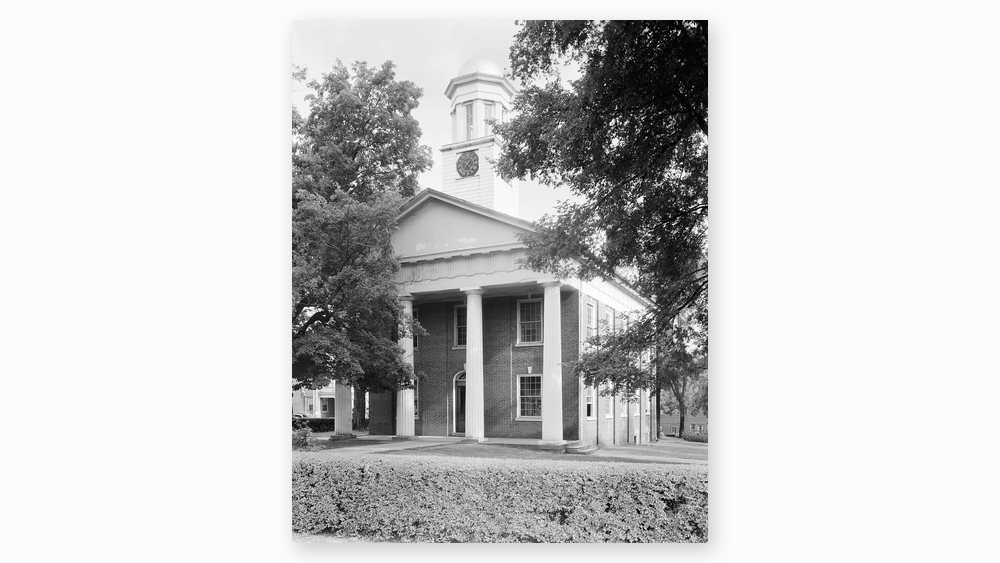
The courthouse at Hillsborough, its judges and lawyers, the trials that drew crowds, and the jail behind them.
In briefThe courthouse at Hillsborough saw the Regulators riot in 1770 and hang in 1771, Thomas Ruffin’s State v. Mann decision, the Kirk-Holden War arrests and lynchings that never came to trial, and in the 20th century the desegregation suits, Dickson v. Sitterson and the killing of James Cates. The storylines follow those cases and the jail behind them.
Related works found in catalogs and archives across North Carolina, the most widely held first, novels aside. Each links to the institution that holds or provides it.
Narrow these works. Each link opens the search already limited to this theme. Counts are indexed works, not copies on a shelf; a work can carry more than one period or place.
Rick Jackson's true crime history of Chapel Hill, published by The History Press in 2023, in 28 short chapters. Cases include the Efland bank robbery, the execution of John Henry Breeze, the unsolved murder of Suellen Evans, the killing at the Internationalist Bookstore and the death of Eve Carson.
The Story of the Institute of Government, The University of North Carolina at Chapel Hill
Coates, Albert McKinley · 1981
Albert Coates's own account of the Institute of Government at the University of North Carolina, which he founded, subtitled 'out of a classroom in Chapel Hill' and published in 1981. The 303 pages trace the institute's history and its role in educating North Carolina's public officials.
Kemp Plummer Battle's memoir, published by the University of North Carolina Press in 1945, 296 pages with plates and portraits. Battle, a lawyer, state treasurer and president of the university from 1876 to 1891, recalls North Carolina manners, customs and public life across the nineteenth century, with Chapel Hill and the university's reopening after Reconstruction at the center.
Billingsley, William J. · 1999 · University of Georgia Press
William J. Billingsley's history of the Speaker Ban Law, the 1963 North Carolina statute that barred known Communists from speaking on state campuses, and the fight over it at the University of North Carolina in Chapel Hill. The subtitle sets the scope: race, politics and the public university in sixties North Carolina. It treats academic freedom, anti-communist movements and free speech in the state. University of Georgia Press, 1999, 308 pages with eight pages of plates.
Francis Nash's history of Hillsborough in colonial and Revolutionary times, first published in 1903 and reprinted in 1953 by Edwards & Broughton with an index and a sketch of the author. Topics include the Regulator Insurrection of 1766 to 1771, the Revolution and local genealogy.
Howard E. Covington Jr.'s biography of Albert Coates (1896-1989), the law professor who founded the Institute of Government at the University of North Carolina and led it through its early years. Topics include Coates as a law teacher and the institute's history as a center for the study of public administration in Chapel Hill. Published in 2010 by the University Library at Chapel Hill, 322 pages with 32 pages of plates.
African Americans of Durham and Orange counties : an oral history
Bolduc, Jean · 2016 · The History Press
Jean Bolduc's collection of oral history interviews with Black residents of Durham and Orange counties, published by The History Press in 2016, 125 pages with photographs and portraits. The narrators are the poet Jaki Shelton Green, civil rights lawyer Floyd McKissick, Walter Jackson, Nate Davis, Brenda Stephens, Diane Wright, Jackie Wagstaff and Michelle Johnson, and a closing chapter deals with the Ku Klux Klan. The interviews document Black life and race relations in the two counties across the twentieth century.
Abstracts of the Minutes of the Inferior Court of Pleas & Quarter Sessions of Orange County, N.C
1966
Abstracts of the minutes of Orange County's Inferior Court of Pleas and Quarter Sessions for 1777 to 1788, the county court of justices of the peace in the Revolutionary years. The abstracts name the people who came before the court. First published in Charlotte in 1966 and later reprinted from Greenville, South Carolina, in three paginated sections with a map.
Books in OCPL’s Rebecca B. Wall Local History Collection whose titles, catalog subjects, or descriptions match this theme. The Friends’ recommended starting points are labelled.
Weynette Parks Haun's edition of the Orange County court minutes, published by the compiler in Durham in 1991 in five books covering 1752 to 1761, 1762 to 1766, 1777 to 1786, 1787 to 1793 and 1794 to 1797, with maps. Minutes of the colonial and early federal county court give the names of jurors, officers, litigants, road hands, apprentices and estate administrators.
Abstracts of the minutes of Orange County's Inferior Court of Pleas and Quarter Sessions for 1777 to 1788, the county court of justices of the peace in the Revolutionary years. The abstracts name the people who came before the court. First published in Charlotte in 1966 and later reprinted from Greenville, South Carolina, in three paginated sections with a map.
Stewart E. Dunaway's abstracts of civil suits over land heard in the Hillsborough District Superior Court between 1778 and 1806. The district covered Orange, Wake, Granville, Caswell, Person, Chatham and Randolph counties, and the papers concern boundaries, ownership and disputed tracts. Published through Lulu in 2011, 337 pages with illustrations, maps and facsimiles.
Abstracts of civil actions concerning land heard in the Orange County Superior Court between 1778 and 1832, the disputes over grants, titles and boundaries that followed the Revolution. Published in 2011. Suits of this kind name parties, neighbors and watercourses.
Weynette Parks Haun's edition of the minutes of the Superior Court of Law and Equity for the Hillsborough District, the court that sat at Hillsborough and heard cases from several surrounding counties in the colonial and early statehood years. Three books cover 1768 to 1791, 1789 to 1798 and 1794 to 1802, and the names recorded make the set a source for Orange County genealogy. Self-published in 1993 in three volumes.
Second volume of abstracts of civil actions concerning land in the Orange County Superior Court, covering 1835 to 1869, published in 2012. Suits over titles, grants and boundaries name parties, tracts and neighbors.
Deed transcripts for the town lots of Chapel Hill and adjoining land from 1790 to the 1930s, compiled by Stewart E. Dunaway. Each transcript keeps only the working facts: grantor and grantee, price, acreage and the metes and bounds of the parcel. Self-published in 2014 as Issue 1G, 702 pages with maps and facsimiles.
Stewart E. Dunaway worked through Hillsborough, N.C., lot by lot, giving each town lot a synopsis of its history, a plat showing where it sits and transcripts of the deeds he could locate for it. The second issue runs to 720 pages with illustrations, maps and facsimiles.
In the chronology
Other storylines that include this theme, earliest first. Each has its own page.
Dated events connected with this theme: sixteen of 503, the highlights and a sample of the rest spread across the years, in date order. See all 503 dated events in the chronology →
Earliest first. Scroll sideways, or use the arrows.
As Orange County's first sheriff, Mebane returned 1,113 tithables for 1752 and 1753. The book reckons this at about 4,000 people when the county was formed.
About 150 Regulators crowded the Hillsborough Superior Court, beat the lawyer John Williams, Edmund Fanning and others, and forced Judge Richard Henderson to adjourn; he fled that night. The next day the crowd tore down Fanning's house and wrote mocking judgments on the court docket.
Meeting at St. Matthew's Church in Hillsborough, delegates defeated a motion to ratify the Constitution 184 to 84 on August 1, 1788. On August 2 they voted to neither ratify nor reject it until a declaration of rights and amendments went before Congress.
Thomas Ruffin of Hillsborough, newly seated on the North Carolina Supreme Court, wrote the opinion in State v. Mann, overturning the conviction of John Mann of Edenton for shooting Lydia, an enslaved woman he had hired, as she fled a whipping. Ruffin held that a master's power must be absolute, and abolitionists later cited the ruling widely.
Early on August 7, 1869, about 100 disguised white men took Washington Morrow and his brother Nelson from the Hillsborough jail, where they were held on barn-burning charges, and shot Washington as they fled; he died of the wound. On October 14 a mob hanged their father, Thomas Jefferson Morrow, and their uncle, Daniel Morrow.
Three men hanged for a string of Chapel Hill burglaries
Violence or armed conflict · Chapel Hill
In 1877 a band of four broke into six houses in and near Chapel Hill and wounded the widow Margaret Hendon with an axe blade while trying to rob her. Albert Atwater, a Black man held for a lesser offense, confessed and named two white men and a Black man, who were convicted in Orange Superior Court and hanged on April 16, 1878 after Governor Jarvis refused clemency.
Manly McCauley, an 18-year-old Black farmhand, left Milton Brewer's farm west of Chapel Hill with Brewer's wife on October 26, 1898. A posse caught them beyond Jonesboro, and on the way back masked men took McCauley from the officer holding him and hanged him. His body was found on November 6, about three miles west of Chapel Hill.
Interracial riders testing segregation on interstate buses reached Chapel Hill on April 12, 1947. The next day police arrested four of them at the bus station and a white cab driver struck rider James Peck. Convicted in Orange County, Bayard Rustin, Igal Roodenko and Joe Felmet surrendered at the Hillsborough courthouse on March 21, 1949 to serve chain-gang sentences.
James Lewis Cates Jr., 22, a Black Chapel Hill resident, was stabbed outside the UNC Student Union shortly before 2 a.m. during an all-night dance, in a clash with members of Durham's Storm Troopers motorcycle gang, and died at North Carolina Memorial Hospital. Three white men charged in his death were acquitted by an all-white jury in 1971.
Law, policy or court · Orange and Alamance counties
Following the 2001 appeals ruling, the Occaneechi Band of the Saponi Nation became the eighth tribe officially recognized by the State of North Carolina through the Commission of Indian Affairs.
Eve Marie Carson, 22, UNC's student body president and a Morehead-Cain Scholar from Athens, Georgia, was abducted from her Chapel Hill home early on March 5, 2008, robbed and shot on Hillcrest Road near campus. Demario Atwater pleaded guilty in 2010, and a Hillsborough jury convicted Laurence Lovette on December 20, 2011.
On February 10, 2015, neighbor Craig Hicks shot and killed Deah Barakat, 23, his wife Yusor Abu-Salha, 21, and her sister Razan Abu-Salha, 19, in the couple's Chapel Hill condominium. Hicks pleaded guilty to three counts of first-degree murder in June 2019 and received three consecutive life sentences without parole.
On August 28, 2023, Zijie Yan, an associate professor, was shot and killed in UNC's Caudill Labs, and the campus locked down for about three hours. Graduate student Tailei Qi was arrested that afternoon and charged with first-degree murder; the case had not come to trial by March 2026.
Kleinschmidt received the Isabella Award at the National Probate Judges Conference for his contributions to guardianship and probate law. The award is named for judge Isabella Horton Grant and goes to people whose leadership improves guardianship laws, court administration and practice.
Places in this theme
Buildings, schools, churches and other sites named in the dated events on this page, the most often named first. The map shows the 40 with a known location.
National Register: Nash Law OfficeNational Register nomination
Nomination (9/28/1971), Hillsborough: history, description, and sources for the property
NCpedia: Thomas RuffinNCpedia
The Hillsborough jurist whose 1829 opinion in State v. Mann defined the law of slavery
Read contemporary evidence 6
Newspapers, photographs, and records of the time
North Carolina Reports, full textCaselaw Access Project (Harvard)
Every published opinion of the state’s Supreme Court from 1778, free and searchable; the county’s cases appear by party name
NC LIVE: prepared search for Law, Courts & JusticeNC LIVE
An advanced search of the state’s shared databases already scoped to Orange County’s places and this subject; edit it freely, and sign in through your North Carolina library to read
Ask locally 3
Local organizations that preserve the story and can help you go further
NC Courts: Orange CountyTown or county website
The county courthouse today, its clerk, and how to request records
Local History Help Hours and request formOCPL Local History Liaison
The library’s Local History Liaison helps in person most Mondays, 12 to 3, at the Main Library, or by the online request form
Background reading at OCPL
Held in OCPL’s Rebecca B. Wall Local History Collection. Selected because their titles or catalog subjects provide wider historical context for this theme; they may not discuss the Orange County theme directly.
Chapel Hill writer Manly Wade Wellman retells ten notorious North Carolina murders committed between 1808 and 1914, among them the case of Tom Dula, the Tom Dooley of the ballad. The victims range from a Confederate general and an orphan girl to a small boy and a political boss. Published by the University of North Carolina Press in 1954, 190 pages, it won the Edgar Award for best fact crime book.
Subjects in the Library of Congress catalog record: Murder -- North Carolina; Crime -- North Carolina OCPL call number: NC 364 WEL
Griffith J. McRee's life of James Iredell, the North Carolinian whom George Washington appointed to the first United States Supreme Court, where he served from 1790 until his death in 1799, combining a narrative of his career with his correspondence. Published by D. Appleton of New York in two volumes, the first dated 1857.
Subjects in the Library of Congress catalog record: Iredell, James, 1751-1799 OCPL call number: NC BIO IREDELL MCR
Paul M. McCain traces North Carolina's county courts from the founding of the colony to 1750, including the years when counties were still called precincts. The courts governed the counties as well as judging cases. Duke University Press published the study in 1954 as series 31 of the Trinity College Historical Society's Historical Papers; 163 pages with a map and a bibliography.
Subjects in the Library of Congress catalog record: North Carolina -- County courts OCPL call number: NC 347.756 MCC
Minutes of the Wake County Court of Pleas and Quarter Sessions from 1771 to 1811, published by Weynette Parks Haun of Durham in eight books between 1977 and 1995, with a gap for 1785 and 1786; each book is indexed. Wake was cut from Cumberland, Johnston and Orange counties in 1771, and its first court met that same year.
Subjects in the Library of Congress catalog record: Court records -- North Carolina -- Wake County OCPL call number: NC 347.756 NORTH