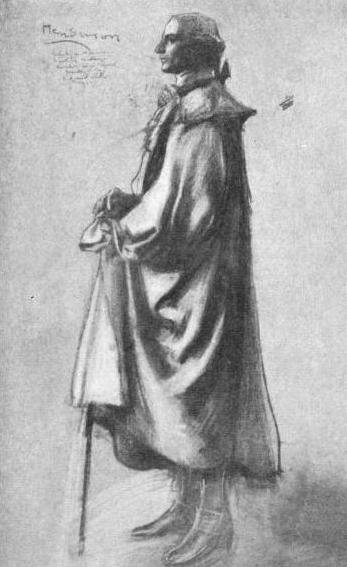
An act of 1767 divided the province into six districts, each with a superior court, and set the court for the District of Hillsborough, covering Orange and Granville, to sit at Hillsborough each March and September for ten days. The superior court, held by judges who rode from one court town to the next, heard the gravest criminal cases and the larger suits. Orange had lain first in the Halifax and then in the Salisbury district, and Nash records no superior court at Hillsborough before March 1768.
With Governor Tryon's militia in town for the September 1768 term, Chief Justice Martin Howard and Justices Maurice Moore and Richard Henderson tried the Regulator cases. Herman Husband was acquitted; William Butler was fined 50 pounds and sentenced to six months, but Tryon released him and suspended the fines. On September 27 a jury found Edmund Fanning guilty on the King's indictment, and the term acquitted Dennis Bradley of burning the Granville jail. In March 1769 Regulators came to prosecute the officers with little success, though Fanning was formally convicted on the old fee charge. A Regulator petition said that at the September 1769 term the grand jury was hand-picked and the bills against officers were thrown out, and in 1770 justices with suits pending chose the whole jury for the next court. On September 22, 1770 James Hunter handed Henderson a Regulator petition; two days later about 150 Regulators crowded the court, beat the lawyer John Williams and Fanning, and forced Henderson to adjourn. Threats kept the court from sitting in March 1771. It met again that September with about 300 cases on its dockets and entered a suit by James Few against Francis Nash as abated by the plaintiff's hanging. In August 1772 Governor Josiah Martin called the judges to Hillsborough to ask whether the outlawed Regulators could still be tried.
The quarrel between Martin and the Assembly over the court law then shut the courts. Early in 1777 a special court for the district failed to sit when John Penn did not come and John Kinchen would not sit alone. The court law of 1777 again made Hillsborough one of six superior court towns, and on March 24, 1778 Judges Samuel Ashe and James Iredell opened the first term there in five years. Suitors and witnesses often travelled long distances until an 1806 act ordered a session in every county; Hillsborough gave Orange's members a dinner for opposing it.
Reading on the places and people in this storyline
No indexed work is about this storyline itself yet. These are about the sites and people its dated events name, those named most often first, so they may discuss the storyline only in part. Follow a link to find a copy or view the material.
Account for Guarding One Prisoner in the Goal
North Carolina. Office of Archives and History. Division of Archives and Records Management · 1768
Account from 1768 for the cost of guarding one prisoner in the jail, a document from the Regulator troubles in Orange County, when backcountry settlers rose against royal officials they accused of extortionate fees and false records. Two images.
NC Digital Collections record courtesy of the North Carolina Department of Natural and Cultural Resources.
Session of November-December 1796: House Bills: December 13
North Carolina. General Assembly · 1796
House bills of 13 December 1796, among them a rejected bill for a district jail in the town of Hillsborough and a bill for separate elections and general musters in Orange County. Others concern inspectors, clearing the Yadkin River, and sheriffs. Thirty images.
NC Digital Collections record courtesy of the North Carolina Department of Natural and Cultural Resources.
Session of November-December, 1771: Bills; December 7, Bill for erecting in the town of Hillsborough a public jail and jailer's house or the District of Hillsborough in this province
1771
A bill of December 7, 1771 proposing a public jail and a jailer's house at Hillsborough for the Hillsborough District, four images among the bills of the colonial assembly session of November and December 1771 in the State Archives of North Carolina.
NC Digital Collections record courtesy of the North Carolina Department of Natural and Cultural Resources.
Index to Orange County Courthouse murals : completed in 2004 for Orange County's 250th anniversary observance by Chapel Hill artist Michael Brown and sponsored by attorneys in Orange and Chatham county : Joe Buckner, chief judge, District Court
2004 · Chapel Hill Historical Society
Folded guide to the six mural panels painted in the Orange County Courthouse at Hillsborough by Chapel Hill artist Michael Brown for the county's 250th anniversary in 2004, three on the east wall and three on the west. Sponsored by attorneys practicing in Orange and Chatham counties and issued by the Chapel Hill Historical Society, the sheet describes the county history and social customs each panel depicts. One illustrated sheet of six pages.
A note on the Hillsborough tower clock.
1976 · National Association of Watch and Clock Collectors, Inc
Four pages on the tower clock at the Orange County courthouse in Hillsborough, printed with illustrations in the bulletin of the National Association of Watch and Clock Collectors for August 1976. The compilers credit information from J. M. Atwater of Greensboro and Frank Albright, the retired curator of Old Salem.
The Orange County bond issue concerns you.
1949
Campaign literature from 1949 urging Orange County voters to back a bond issue covering courthouse and school buildings. Eight unnumbered pages with illustrations, some in color, and a map, 21 cm.
More about the Hillsboro clock
Nash, Frank, 1855-1932 · 1932
Frank Nash's short piece on the Hillsborough town clock, pages 88 and 89 of a 1932 publication. Nash, a Hillsborough lawyer and local historian who died that year, adds to the story of the town's famous eighteenth-century clock, now in the courthouse cupola.
Correspondence of the Earl of Hillsborough and Governor Martin concerning ammunitions at Fort Johnston, the Powder Act of South Carolina, and insurgents approaching New Bern
1771
Letters between the Earl of Hillsborough and Governor Josiah Martin, dated 1771, on the ammunition stored at Fort Johnston, South Carolina's Powder Act, and reports of insurgents moving toward New Bern. A second letter in the file turns to routine state business, Treasury bills and the birth of a royal prince. Herman Husbands is named. Hillsborough town in Orange County carries the Earl's title.
Journal of the North Carolina assembly, 5 December 1770 - 26 January 1771
1770
The journal of the North Carolina assembly from 5 December 1770 to 26 January 1771, covering appointments, prices, public revenue, grievances, trade, rebellion and the courts. Herman Husbands, Richard Caswell and John Burgwin are among the names, and the session fell in the Regulator years, when the unrest centred on Hillsborough and the Orange County courts.
The sword of peace : Hermon Husbands and Quaker heritage
Couch, Jack · 1974
Jack Couch's 1974 account of Hermon Husbands, the Quaker associated with the Regulator movement, set against the heritage of Cane Creek Monthly Meeting in what is now Alamance County. The Regulator Insurrection of 1766 to 1771 turned on Hillsborough, then the seat of Orange County, where the Regulators broke up the court. Topics include Alamance County history in the eighteenth century.
A church quarrel and what resulted
White, Julia S. · 1900
Julia S. White's short piece on a quarrel at the Cane Creek Monthly Meeting of Friends and what followed from it, printed in 1900 as pages 90 to 98 of a larger work. The account includes Herman Husbands, 1724 to 1795, and Rachel Wright, linking the episode to the Regulator Insurrection of 1766 to 1771, centered on Hillsborough when Cane Creek still lay in Orange County.
Dispatches from William Tryon to the Earl of Hillsborough numbered 59-67, enclosing documents concerning the Regulators
2019 · Adam Matthew Digital
Numbered dispatches 59 through 67 from Governor William Tryon to the Earl of Hillsborough, with enclosures about the Regulators, whose protests broke into riot at Hillsborough in 1770. Reproduced by Adam Matthew Digital in 2019 from Colonial Office CO 5/302. The papers touch on the council and assembly, naval stores and trade, oaths, militia and provincial troops, judges, sheriffs and juries, voting, currency, Cherokee affairs, clergy, quitrents and land, and name officials such as Richard Caswell, Richard Henderson, Maurice Moore and Hugh Waddell.
Letters and Dispatches from Josiah Martin to the Earl of Hillsborough and the Lords Commissioners
2019 · Adam Matthew Digital
Dispatches from Josiah Martin, the last royal governor of North Carolina, to Wills Hill, Earl of Hillsborough, the secretary of state for the colonies for whom the Orange County seat is named, and to the Lords Commissioners in London. Adam Matthew Digital reproduced the file, Colonial Office CO 5/303 part 1, in 2019. Topics include women, medicine and health, land grants, the courts and litigation, German and Protestant migration to the frontier, the Regulators, riot and treason, salt and alcohol imports, Spanish shipping and crime.
Letters from William Tryon to the Lords Commissioners, enclosing legislation and accounts of the ship 'Brigantine Fox'
2019 · Adam Matthew Digital
Letters from Governor William Tryon to the Lords Commissioners in London, with enclosed legislation and the accounts of the ship Brigantine Fox, reproduced by Adam Matthew Digital in 2019 from Colonial Office file CO 5/300. They show the range of a governor's business: council appointments, judges and courts, assembly acts, cotton manufacturing, poverty, naval stores, rice, tobacco and indigo, currency, the Tuscarora, education, marriage, debt and customs. Hillsborough is among the places named, and people include William Johnston, Richard Henderson, Cornelius Harnett and Samuel Strudwick.
The Star of empire
Henderson, Archibald · 1919 · The Seeman printery
Phases of the westward movement in the Old Southwest, as Archibald Henderson set them out in 1919: the Transylvania colony, Richard Henderson's land company and the career of Isaac Shelby. The Seeman Printery produced the volume, 86 pages with two portraits. Its author held a professorship at Chapel Hill.
Wider background: Law, Courts & Justice · the most widely held histories of the theme this storyline is filed under; they may not discuss it
Chapel Hill Murder and Mayhem
Jackson, Rick · 2023
Rick Jackson's true crime history of Chapel Hill, published by The History Press in 2023, in 28 short chapters. Cases include the Efland bank robbery, the execution of John Henry Breeze, the unsolved murder of Suellen Evans, the killing at the Internationalist Bookstore and the death of Eve Carson.
The Story of the Institute of Government, The University of North Carolina at Chapel Hill
Coates, Albert McKinley · 1981
Albert Coates's own account of the Institute of Government at the University of North Carolina, which he founded, subtitled 'out of a classroom in Chapel Hill' and published in 1981. The 303 pages trace the institute's history and its role in educating North Carolina's public officials.
Memories of an Old-Time Tar Heel
Battle, Kemp Plummer · 1945
Kemp Plummer Battle's memoir, published by the University of North Carolina Press in 1945, 296 pages with plates and portraits. Battle, a lawyer, state treasurer and president of the university from 1876 to 1891, recalls North Carolina manners, customs and public life across the nineteenth century, with Chapel Hill and the university's reopening after Reconstruction at the center.
Reviewed in Journal of American History (1946), The Journal of Southern History (1946).
Communists on Campus
Billingsley, William J. · 1999 · University of Georgia Press
William J. Billingsley's history of the Speaker Ban Law, the 1963 North Carolina statute that barred known Communists from speaking on state campuses, and the fight over it at the University of North Carolina in Chapel Hill. The subtitle sets the scope: race, politics and the public university in sixties North Carolina. It treats academic freedom, anti-communist movements and free speech in the state. University of Georgia Press, 1999, 308 pages with eight pages of plates.
Reviewed in Academe (2000), The American Historical Review (2001), The Journal of Southern History (2001), Journal of American History (2001), The Journal of Politics (2001).
Hillsboro, Colonial and Revolutionary
Nash, Frank · 1953
Francis Nash's history of Hillsborough in colonial and Revolutionary times, first published in 1903 and reprinted in 1953 by Edwards & Broughton with an index and a sketch of the author. Topics include the Regulator Insurrection of 1766 to 1771, the Revolution and local genealogy.
The Good Government Man
Covington, Jr., Howard E. · 2010
Howard E. Covington Jr.'s biography of Albert Coates (1896-1989), the law professor who founded the Institute of Government at the University of North Carolina and led it through its early years. Topics include Coates as a law teacher and the institute's history as a center for the study of public administration in Chapel Hill. Published in 2010 by the University Library at Chapel Hill, 322 pages with 32 pages of plates.
Show 6 more
African Americans of Durham and Orange counties : an oral history
Bolduc, Jean · 2016 · The History Press
Jean Bolduc's collection of oral history interviews with Black residents of Durham and Orange counties, published by The History Press in 2016, 125 pages with photographs and portraits. The narrators are the poet Jaki Shelton Green, civil rights lawyer Floyd McKissick, Walter Jackson, Nate Davis, Brenda Stephens, Diane Wright, Jackie Wagstaff and Michelle Johnson, and a closing chapter deals with the Ku Klux Klan. The interviews document Black life and race relations in the two counties across the twentieth century.
Abstracts of the Minutes of the Inferior Court of Pleas & Quarter Sessions of Orange County, N.C
1966
Abstracts of the minutes of Orange County's Inferior Court of Pleas and Quarter Sessions for 1777 to 1788, the county court of justices of the peace in the Revolutionary years. The abstracts name the people who came before the court. First published in Charlotte in 1966 and later reprinted from Greenville, South Carolina, in three paginated sections with a map.
Dark Tales of the Eno River
Cook, David · 2025 · The History Press
David Cook collects the grim side of the Eno River's past in Orange and Durham counties: ghost stories, crimes, train wrecks and accidents, including the hanging of rebels near the river in 1771, a sawmill accident said to have started a run of hauntings, and a dance one Valentine's Day that ended badly. Published by The History Press in 2025, 141 pages with illustrations.
Jane Crow: The Life of Pauli Murray
Rosenberg, Rosalind · 2017
Rosalind Rosenberg's 2017 biography of Pauli Murray (1910-1985), lawyer, poet and Episcopal priest, raised in Durham. Its six parts follow a Southern childhood, the move to New York, the 1938 application to the University of North Carolina that was refused because Murray was Black (the chapter is titled 'Members of your race are not admitted'), law school and the coining of the phrase Jane Crow, the Cold War years, the push toward 'an NAACP for women', and a late-life ordination. 494 pages with portraits.
Reviewed in The Journal of Southern History (2018).
Chapel Hill, N.C. History of Town Lots (1790-1930s)
Dunaway, Stewart E. · 2014
Deed transcripts for the town lots of Chapel Hill and adjoining land from 1790 to the 1930s, compiled by Stewart E. Dunaway. Each transcript keeps only the working facts: grantor and grantee, price, acreage and the metes and bounds of the parcel. Self-published in 2014 as Issue 1G, 702 pages with maps and facsimiles.
Time of Death
Gaskin, Nora · 2013
Nora Gaskin's short true account of a murder investigation in 1960s Chapel Hill and the judicial error that followed, centered on Frank Rinaldi (1929 to 2009). Published in 2013 by Lystra Books, 52 pages with references.