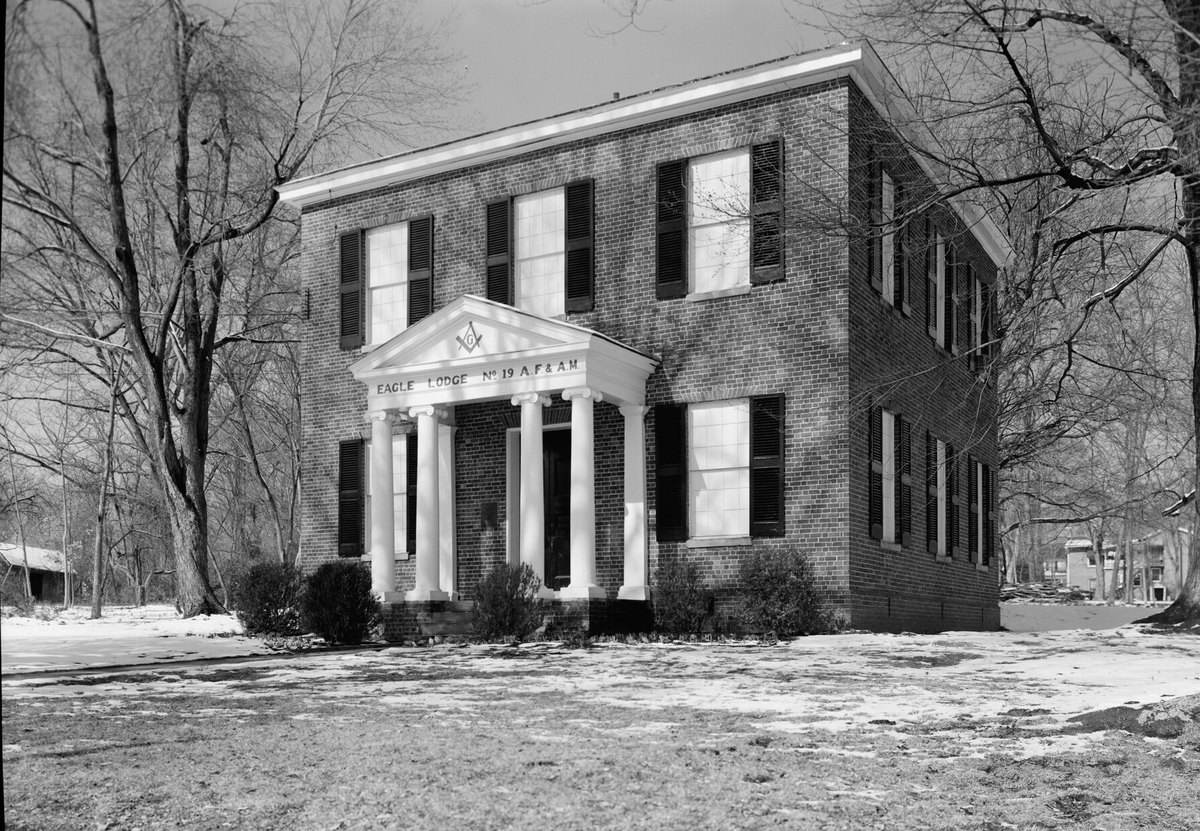
The Grand Lodge of North Carolina, organized at Tarboro seven months before, held its first regular meeting at Hillsborough on July 23, 1788, while the ratification convention was in session there. Eagle Lodge No. 19 was chartered at Hillsborough in 1791, among the first lodges under the Grand Lodge, with George Doherty as its first secretary. On April 14, 1798 a special Grand Lodge of Masons met at the university to lay the cornerstone of its principal building, the Main, later South, Building, and that year Eagle Lodge, by special dispensation, met in Chapel Hill and made Masons of Joseph Caldwell, then presiding professor of the university, and three other faculty members.
Eagle Lodge, silent since 1799, was revived at Hillsborough in 1819 under a new number, 71. In 1820 the lodge voted money toward building a male academy in the town. From 1821 it ran a lottery, held over eleven years, to pay for a Masonic Hall. By June 12, 1822 the managers of the Hillsborough Masonic Lottery had held the first day's drawing of five hundred numbers and published the prizes, with the second day's drawing set for July 5. In July 1823 commissioners James S. Smith, Thomas Clancy and J. P. Sneed advertised in the Hillsborough Recorder for proposals to build a brick Masonic Hall. The cornerstone was laid on November 23, 1823 at what is now 142 West King Street, for a Greek Revival hall designed by the state architect William Nichols and believed built by the brickmasons John Berry and Samuel Hancock. The lot was deeded to the lodge in 1824, after the building went up. The Grand Lodge restored the lodge's original number, 19, in 1932.
Reading on the places and people in this storyline
No indexed work is about this storyline itself yet. These are about the sites and people its dated events name, those named most often first, so they may discuss the storyline only in part. Follow a link to find a copy or view the material.
About Eagle Lodge · named in 7 of this story’s entries
The history of Eagle Lodge No. 19, A.F. & A.M
R.B. Studebaker, J. Frank Ray. · 1993
History of Eagle Lodge No. 19 of the Ancient Free and Accepted Masons in Hillsborough, by R. B. Studebaker and J. Frank Ray. Three volumes bound as one carry the lodge's story from 1791 to 2022; the first volume originally appeared in 1937. Illustrated with portraits.
History of Eagle Lodge : Ancient, Free and Accepted Masons, Hillsboro, N. C., 1791-1937
Studebaker, Robert B. · 1937
Robert B. Studebaker's history of Eagle Lodge No. 19, the Masonic lodge in Hillsborough, from its chartering in 1791 to 1937. Published in 1937, 104 pages with three leaves of plates and illustrations.
Masonic Temple, Hillsboro, Orange County, North Carolina
Johnston, Frances Benjamin, 1864-1952 · 1938
The Masonic Temple in Hillsborough, with its brickwork and columned portico, photographed by Frances Benjamin Johnston in 1938 for the Carnegie Survey of the Architecture of the South. One 8 by 10 inch safety film negative.
Eagle Lodge, 142 West King Street, Hillsborough, Orange County, NC
Historic American Buildings Survey · 1933
Eagle Lodge at 142 West King Street, Hillsborough, a brick Masonic building, in Historic American Buildings Survey documentation compiled after 1933: three photographs, five data pages and a caption page. Names connected with it include Edmund Fanning, William Nichols, John Berry, Samuel Hancock and members of the Lytle family. Topics include fraternal organizations and the building's use as an assembly and lecture hall.
South Building
1903
Photograph from about 1903 of South Building on the university campus in Chapel Hill. Work on the building started in 1798 under Samuel Hopkins, was later carried on by John Clare, and finished in 1814. Part of the Images of North Carolina collection.
Draft Proceeding Minutes of the Grand Lodge of North Carolina
1798
Draft minutes of the Grand Lodge of North Carolina for 14 April 1798, recording the Masonic ceremony for laying the cornerstone of the University of North Carolina's Old South Building in Chapel Hill.
South Building, UNC-Chapel Hill, April 22, 1987
Morton, Hugh M. · 1987
South Building at UNC on 22 April 1987, showing its columns with flowers in bloom, in a Hugh Morton color photograph. Mounted 35 mm slide.
South Building, UNC-Chapel Hill, circa 1946-1947
Morton, Hugh M. · 1946
South Building on the UNC-Chapel Hill campus, probably shot on infrared film by Hugh Morton in late 1946 or early 1947. Morton gave six photographs to the Alumni Office that autumn, and this one ran on page 216 of the April 1947 Alumni Review. Black-and-white sheet film negative.
Dr. John Rogers, 1794-1832
Rogers, Ellen Stanley · 1966
Ellen Stanley Rogers's family history centered on Dr. John Rogers (1794-1832) and his connection to Hillsborough Academy. Compiled in 1966, 49 pages with bibliographical footnotes.
Miss Mary's Money
Jones, H. G. · 2014 · McFarland & Co.
H. G. Jones follows the fortune of Mary Ruffin Smith (1814-1885), the unmarried heiress whose Orange and Chatham County lands passed at her death to the University of North Carolina and the Episcopal Church. Chapters profile her grandfather Francis Jones, then trace the bequest through a quarrel among Episcopalians over Price Creek, the Chapel of the Cross and the university's buildings. A December 1885 New York Times report called the gift money; Jones shows it was land. Published by McFarland in 2014, 231 pages.
James S. Smith account books, 1822-1839.
Smith, James S. (James Strudwick), 1787-1852 · 1822
Five account books kept by the physician James Strudwick Smith, 1787 to 1852, between 1822 and 1839, in the Southern Historical Collection at UNC, collection 2930-z. Topics include medical practice and its accounting in nineteenth century North Carolina, along with Hillsborough history and social life, so the volumes track a Hillsborough doctor's charges over nearly two decades.
About John Berry · named in 2 of this story’s entries
A program and plaque dedication ceremony honoring John Berry of Hillsborough (1798-1870) : builder, architect, legislator, humanitarian.
1964 · Hillsborough Historical Society?
The printed program for a ceremony held on the evening of 11 September 1964 at the new courthouse in Hillsborough, where the Hillsborough Historical Society and Eagle Lodge No. 19 unveiled a plaque honoring John Berry, the builder, architect and legislator who lived from 1798 to 1870. One folded sheet of four pages with a portrait.
John Berry of Hillsboro, North Carolina
1951 · Society of Architectural Historians
Eva Ingersoll Gatling's article on John Berry (1798 to 1870), the Hillsborough builder and architect, detached from the Journal of the Society of Architectural Historians, volume 10, number 1, pages 18 to 22, with illustrations. It concerns the history of North Carolina architecture and the historic buildings of Hillsborough. Published by the society in Philadelphia in 1951.
Substance of the testimony concerning the voters about whom the committee disagree.
1849
Testimony gathered in an 1849 contested election case from Orange County, summarizing the evidence about the individual voters whose eligibility the committee could not agree on. John Berry and Hugh Waddell were the candidates in the case before the North Carolina Senate committee on privileges and elections. Eight pages, useful to anyone studying who could vote in the county and on what terms.
To the citizens of Orange County : I have been for many years your Sheriff, and trust I have established some character among my fellow citizens for uprightness in the discharge of the duites of my office.
Turrentine, James · 1844
James C. Turrentine, for many years sheriff of Orange County, addressed his fellow citizens in this 1844 broadside, answering John Berry's charge that he had acted improperly in casting the deciding vote for Berry's opponent at a recent election. Thirty by nineteen centimeters, signed at the end.
Wider background: Community & Civic Organizations · the most widely held histories of the theme this storyline is filed under; they may not discuss it
African Americans of Durham and Orange counties : an oral history
Bolduc, Jean · 2016 · The History Press
Jean Bolduc's collection of oral history interviews with Black residents of Durham and Orange counties, published by The History Press in 2016, 125 pages with photographs and portraits. The narrators are the poet Jaki Shelton Green, civil rights lawyer Floyd McKissick, Walter Jackson, Nate Davis, Brenda Stephens, Diane Wright, Jackie Wagstaff and Michelle Johnson, and a closing chapter deals with the Ku Klux Klan. The interviews document Black life and race relations in the two counties across the twentieth century.
African Americans of Durham & Orange Counties
Bolduc, Jean · 2016
Jean Bolduc's 2016 collection of interviews with African American residents of Durham and Orange counties, presented as short biographies. The subjects are Floyd McKissick (1922-1991), the first African American admitted to UNC's law school, Walter Jackson, Brenda Stephens, Nate Davis, poet Jaki Shelton Green, Jackie Wagstaff, Diane Wright and Michelle Johnson, with a closing chapter on the Ku Klux Klan. 125 pages with illustrations.
"Whites only" : a pastor's retrospective on signs of the new South
Seymour, Robert E. (Robert Edward), 1925-2020 · 2011 · Chapel Hill Press
Robert E. Seymour, a Baptist pastor in Chapel Hill associated with Olin T. Binkley Memorial Baptist Church, looks back on segregation and race relations in the South from the pulpit. A clergyman's memoir covering church history in the town, Baptists in North Carolina and the segregation of African Americans. Published by Chapel Hill Press in 2011, 204 pages.
A history of Epsilon Beta Chapter of Chi Omega at the University of North Carolina at Chapel Hill, North Carolina, 1923-1999.
Clark, Blanche (Blanche R.) · 1999 · Epsilon Beta of Chi Omega House Corp.?
Chapter history of Epsilon Beta of Chi Omega at the University of North Carolina, covering 1923 to 1999 and written by Blanche Clark with Ann Thornburgh. Twenty nine unnumbered leaves with illustrations and a portrait, issued in Chapel Hill in 1999. Guion Griffis Johnson is among the people discussed.
House Joint Resolutions, April 17 - May 2
North Carolina. General Assembly · 1782
Joint resolutions of the House of Commons from April 17 to May 2, 1782, with messages, petitions and depositions. Among them are thanks to Thomas Burke, the Hillsborough lawyer who had been governor, a land dispute involving James Taylor and Edmund Pendleton of Virginia, and a poll tax exemption for Francis Falkner. 87 images.
NC Digital Collections record courtesy of the North Carolina Department of Natural and Cultural Resources.
Joint Select Committees: Reports and Papers, May 8 - May 18
North Carolina. General Assembly · 1782
From the 1782 session of the General Assembly, joint select committee reports and papers of 8 to 18 May, in 134 images. Captain James Reed, James Houston of Rowan County and George Meek are among those whose cases came before the committees. Other matters include State Legion officers, disabled veterans, price regulation, Cherokee affairs, Thomas Burke, and Hillsborough and Orange County.
NC Digital Collections record courtesy of the North Carolina Department of Natural and Cultural Resources.
Show 6 more
Senate Joint Resolutions, May 16 - May 18
North Carolina. General Assembly · 1782
Resolutions of the North Carolina Senate from 16 to 18 May 1782: naming Thomas Davis public printer, favoring Joseph Pitman of Edgecombe County, obtaining clothing for Continental officers and soldiers, and answering a memorial of John Huske. Nathanael Greene, Jethro Sumner and the Battle of Eutaw Springs are among the names. 51 images, with Hillsborough tied to the session.
NC Digital Collections record courtesy of the North Carolina Department of Natural and Cultural Resources.
August-September, 1780: Joint Select Committees (Reports of and messages concerning)
North Carolina. General Assembly · 1780
Reports and messages of joint select committees from August and September 1780, when the General Assembly met at Hillsborough after the defeat at Camden. Committees worked on supplies and provisions for the army and the adjustment of public claims. Horatio Gates, Richard Caswell, Abner Nash, William Hooper, hospitals, surgeons, cavalry and wagons all appear. 88 pages.
NC Digital Collections record courtesy of the North Carolina Department of Natural and Cultural Resources.
Chapel Hill Historical Society's Generations of Carrboro Mill Families oral histories, 1974-1978.
Chapel Hill Historical Society · 1974
Oral histories recorded between 1974 and 1978 for the Chapel Hill Historical Society's Generations of Carrboro Mill Families project, forty items across 1.5 linear feet in the Southern Historical Collection at UNC, collection 4205. The interviews concern textile workers and mill families in Carrboro, African American life in Carrboro and Chapel Hill, schooling, the depression that began in 1929, and women's work and family customs.
Eno River Association Mailings and Publications
1973
Mailings and publications of the Eno River Association, beginning in 1973. Subjects include the Association for the Preservation of the Eno River Valley, citizens' associations and community organizing in Durham, conservation of natural resources with citizen participation, and local environmentalists. Part of the North Carolina Collection at Durham County Library.
John Kenyon Chapman papers, 1969-2009.
Chapman, John Kenyon · 1969
The activist John Kenyon Chapman left papers covering 1969 to 2009, about 11,200 items across 21.5 linear feet in the Southern Historical Collection at UNC, collection 5441. The papers document civil rights and community organizing in North Carolina, African American life in Chapel Hill, student political activity at the university, anti-apartheid work, and the Greensboro Massacre of 1979.
Chapel Hill Historical Society Records (Chapel Hill Historical Society)
1966
Institutional records of the Chapel Hill Historical Society from 1966 onward, filling six crates: the Society's own files as an organization, collection CHHS.000.