Skip to content

Named event or history

David Fanning’s raid on Hillsborough, September 1781

The Loyalist raid that seized the town and its Patriot leaders; David Fanning is not Edmund Fanning.

11 indexed works are connected with this event. 1 held at OCPL →

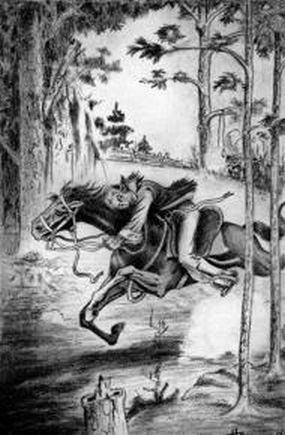
David Fanning loses the Bay Doe, from a 1913 illustration

Indexed works

Related works found in catalogs and archives across North Carolina. Each links to the institution that holds or provides it.

The Battle at Lindley's Mill

Dunaway, Stewart E. · 2009

Stewart E. Dunaway's account of the Battle of Lindley's Mill, fought in September 1781 after the Loyalist David Fanning raided Hillsborough and carried off Governor Thomas Burke. Burke, Fanning and the Lindley family, whose mill gave the fight its name, are the people at its center, with the Revolutionary campaigns in North Carolina as the frame. Published in 2009.

Why this is here: Catalog heading in the Durham record: Fanning, David, 1756?-1825.

William Johnston Paper

Johnston, William · 1783

Letter of 2 December 1783 from William Johnston, Orange County legislator and agent for the loyalist Edmund Fanning, to Adlai Osborn of Rowan County, about selling Fanning's Rowan lands to satisfy a judgment. Johnston also remarks on the death of former governor Thomas Burke. A photocopy. State Archives of North Carolina, PC.644.

Why this is here: The record names this subject alongside a heading for the county or its towns.

Governors' Papers: Thomas Burke, Correspondence, August 1781

Caswell, Winston · 1781

Governor Thomas Burke's correspondence for August 1781, a heavy month of 168 images from his first summer in office. Winston Caswell is among the writers. Places named include Hillsborough, the Deep River and Chatham, Granville, Halifax, Richmond and Wake counties, all against the backdrop of the Revolutionary War.

Why this is here: Its title names this subject.

NC Digital Collections record courtesy of the North Carolina Department of Natural and Cultural Resources.

Governors' Papers: Thomas Burke, Correspondence, July 1781

Caswell, Richard, 1729-1789 · 1781

July 1781 letters of Thomas Burke, elected governor the month before. Richard Caswell is among the writers, and across 137 images the papers reach Hillsborough and Bladen, Chatham, Cumberland, Duplin, Halifax, Richmond and Wake counties during the Revolutionary War.

Why this is here: Its title names this subject.

NC Digital Collections record courtesy of the North Carolina Department of Natural and Cultural Resources.

Governors' Papers: Thomas Burke, Correspondence, July 28, 1781 to August 29, 1781

Burke, Thomas, approximately 1747-1783 · 1781

A run of Governor Thomas Burke's letters dated 28 July to 29 August 1781, in 63 images. The correspondence reaches Hillsborough and Anson, Bladen, Cumberland, Franklin, Granville, Northampton, Wake and Warren counties. Burke had been elected the state's third governor that June.

Why this is here: Its title names this subject.

NC Digital Collections record courtesy of the North Carolina Department of Natural and Cultural Resources.

Governors' Papers: Thomas Burke, Correspondence, September 1781

Burke, Thomas, approximately 1747-1783 · 1781

Letters of Governor Thomas Burke from September 1781, in 71 images. Burke was captured at Hillsborough by the Loyalist David Fanning that year and later resumed his duties. Bertie and Chatham counties are also named in the month's papers.

Why this is here: Its title names this subject.

NC Digital Collections record courtesy of the North Carolina Department of Natural and Cultural Resources.

Show 5 more

Governors' Papers: Thomas Burke, Correspondence, September 9, 1781 to September 11, 1781

Burke, Thomas, approximately 1747-1783 · 1781

A short run of Thomas Burke's correspondence, 9 to 11 September 1781, in 12 images. Granville County and Hillsborough are named. Burke, the state's third governor, fell into Loyalist hands at Hillsborough later in 1781.

Why this is here: Its title names this subject.

NC Digital Collections record courtesy of the North Carolina Department of Natural and Cultural Resources.

James Webb (1774-1855) Papers

Webb, James, 1774-1855 · 1781

Dr. James Webb was a Hillsborough physician, a university trustee and the local agent for the Bank of Cape Fear. Most of his papers, 1781 to 1846, concern the bank: letters of 1827 to 1846 with other agents, cashiers and State Bank officers about discounts, the value of currency, the bank failures of 1839 and daily business. Revolutionary War supply and land grant papers also appear. State Archives of North Carolina, PC.127.

Why this is here: The record names this subject alongside a heading for the county or its towns.

Senate Joint Resolutions: February 8-9

North Carolina. General Assembly · 1781

Senate joint resolutions of 8 and 9 February 1781, 24 images, on tax gatherers in counties without treasurers, a rejected resolution for Samuel Ashe, a rejected allowance for corn supplied to the army, and an order sending Brigadier General John Butler to raise some or all of the Hillsborough District militia.

Why this is here: The record names this subject alongside a heading for the county or its towns.

NC Digital Collections record courtesy of the North Carolina Department of Natural and Cultural Resources.

Miscellaneous Collection

State Archives of North Carolina. Private Manuscripts Archivists · 1689

The State Archives' Miscellaneous Collection: letters, deeds, land grants, surveys, wills, leases and other single items dating from 1689 to 2017, some as photocopies or transcripts from other repositories. Writers and subjects vary widely, governors and generals among them, and Orange County figures among the many places touched.

Why this is here: The record names this subject alongside a heading for the county or its towns.

Fanning, David: photographs (Chapel Hill Historical Society)

Undated image of David Fanning, the Loyalist partisan of the Revolutionary War, shown escaping from captivity. Fanning led the 1781 raid on Hillsborough that captured Governor Thomas Burke.

Why this is here: Its title names this subject.

Start at OCPL

Books in OCPL’s Rebecca B. Wall Local History Collection whose titles, catalog subjects, or descriptions match this event. The Friends’ recommended starting points are labelled. Books marked Wider context cover the broader subject rather than this event itself.

  • Rebecca Wall Collection · NC 973.3 FAN The Narrative of Colonel David Fanning (a Tory in the Revolutionary War With Great Britain): Giving An Account of His Adventures in North Carolina From 1775 to 1783, as Written by Himself Fanning, David · 1865

    David Fanning's own account of his years as a Loyalist partisan in North Carolina, 1775 to 1783, including his 1781 raid on Hillsborough, where he captured Governor Thomas Burke. Edited by Thomas H. Wynne and first printed privately at Richmond in 1861, it was reissued in 1865 by Joseph Sabin of New York with an introduction by John H. Wheeler and notes partly by former governor David L. Swain; 86 pages.

  • Rebecca Wall Collection · NC BIO FANNING DUN Life and Times of Edmund Fanning (1739-1818), Hillsborough, N.C Dunaway, Stewart E. · 2013

    Stewart E. Dunaway's life of Edmund Fanning (1739-1818), the colonial officeholder in Hillsborough whom the Regulators singled out and who left North Carolina as a loyalist, together with the Fanning family's genealogy. Self-published through Lulu in 2011, 223 pages with illustrations, facsimiles, genealogical tables and maps. Topics include American loyalists and Hillsborough and Orange County biography and genealogy.

  • Wider context · NC 973.314 DEM The Loyalists in North Carolina During the Revolution DeMond, Robert Orley · 1979

    The North Carolinians who stayed loyal to the Crown during the Revolution are the subject of Robert O. DeMond's study, first written as his 1938 thesis at Duke University and published by Duke University Press in 1940. This 1979 reprint from the Genealogical Publishing Company of Baltimore has 286 pages with a bibliography and an index.

Show 6 more
  • Wider context · NC 973.309 JOHNSON Uzal Johnson, Loyalist Surgeon: A Revolutionary War Diary Johnson, Uzal · 2000

    The Revolutionary War diary of Uzal Johnson (1757? to 1827), surgeon to the New Jersey Volunteers, a Loyalist regiment, kept during the British campaign in the Carolinas, where he served with Major Patrick Ferguson's troops; he later practiced medicine in Newark. Bobby Gilmer Moss edited it with maps, notes, a long bibliography and an index. Scotia Hibernia Press, Blacksburg, South Carolina, 2000; xxiv, 215 pages.

  • Foundational · NC BIO BENTON BEN Jesse Benton Letters (1780-1790), Hartford, Hillsborough, NC Benton, Jesse · 2007

    Stewart E. Dunaway's transcription of letters exchanged between Jesse Benton and Thomas Hart from 1780 to 1790, concerning Hart's affairs at Hartford, his place at Hillsborough. The letters concern the economic and social conditions of Hillsborough in the eighteenth century and the Revolution in North Carolina. Self-published through lulu.com in 2009, 68 pages with illustrations and facsimiles, and part of the library's Wall Local History Collection.

  • Start here · NC 975.602 COL The Colonial Records of North Carolina, 1963

    The second series of the Colonial Records of North Carolina, the documentary edition begun in 1963 to follow William L. Saunders's ten volumes of 1886 to 1890. Its first volume, Mattie Erma Edwards Parker's edition of the charters and constitutions of 1578 to 1698, came from the Carolina Charter Tercentenary Commission; later volumes, starting with the colony's higher-court records of 1670 to 1696, were issued in Raleigh by the state's archives and history agency.

  • Wider context · NC 975.602 LAND North Carolina Land Confiscation Records 2010

    Land that North Carolina confiscated from Loyalists under its Revolutionary War laws, documented by Stewart E. Dunaway from originals in the State Archives in three volumes issued from 2010 with maps, facsimiles and indexes. Volume 1 covers 1782 to 1788 in Chatham, Granville, Guilford, Montgomery, Orange, Randolph and Wake counties; volumes 2 and 3 cover 1779 to 1803 in some thirty counties from Anson and Beaufort to Surry and Tyrrell.

  • Foundational · NC 975.6 BUT North Carolina and the Coming of the Revolution, 1763-1776 Butler, Lindley S. · 1976

    North Carolina politics from 1763 to 1776, and the disputes with Britain that carried the colony into the Revolution, in a short study by Lindley S. Butler. It was number 6 in the Bicentennial pamphlet series of the state's Division of Archives and History, published in 1976, 81 pages with illustrations and a bibliography.

  • Foundational · NC 975.603 CRO A Chronicle of North Carolina During the American Revolution, 1763-1789 Crow, Jeffrey J. · 1975

    A dated chronology of North Carolina's Revolutionary era by Jeffrey J. Crow, running from Britain's new colonial policy of 1763 to the state's ratification of the federal Constitution in 1789, with each event explained in a short paragraph. The first of the North Carolina Bicentennial Pamphlets, published by the Division of Archives and History in 1975; 63 illustrated pages.

In the chronology

Episodes in this history, earliest first. Each has its own page.

Other dated events here, earliest first. See these 12 dated events in the chronology →

  1. Thomas Freeland is killed when Hillsborough is taken In a story John Strayhorn told John A. Freeland, Whig militia were gathering at the public spring when Hillsborough was taken and the governor captured, and Thomas Freeland was shot through the head by a Tory. He was buried on the hill south of the Eno near Kirkland's old tan yard, where Strayhorn had been posted.NC Digital Collections: D. I. Craig, Historical Sketch of New Hope Church in Orange County, N.C. (1891), p. 42
  2. Tradition says parts of the town clock were hidden in the Eno during Fanning's raid According to local tradition, parts of the clock were thrown into the river so that the Loyalist raiders under David Fanning and Hector McNeill could not turn them into war material. People: David FanningLefler and Wager, Orange County, 1752-1952 (1953), p. 22
  3. David Fanning raids Hillsborough and captures Governor Burke Fanning’s Loyalists captured Governor Thomas Burke during a surprise raid on Hillsborough. People: David Fanning, Thomas BurkeNCpedia — David Fanning
  4. Butler's militia ambushes Fanning's Loyalists at Lindley's Mill The day after David Fanning's raid carried Governor Thomas Burke out of Hillsborough, John Butler rode with about four hundred militia to the ford where the Wilmington road crossed Cane Creek at Lindley's Mill and laid an ambush with Colonel Robert Mebane. The opening volley killed Colonel Hector McNeil, but Fanning organized a flanking attack that drove the militia from the field, and the prisoners went on to Wilmington. People: David Fanning, Thomas BurkeSearch the index · NCpedia: Lindley's Mill, Battle of
  5. Governor Burke returns to Hillsborough and raises a company against the Loyalists Hearing that Loyalists were plundering in southern Orange and that David Fanning was active again, Burke came to Hillsborough and formed a mixed infantry and cavalry company under a Captain Allen of New Hope to guard the area's Whigs. People: Thomas Burke, David FanningLefler and Wager, Orange County, 1752-1952 (1953), p. 58-59
  6. Alexander Martin takes the oath as acting governor while Burke is in enemy hands Three weeks after Fanning carried Governor Burke out of Hillsborough, Alexander Martin, Speaker of the Senate, qualified before the Council of State at Colonel Williams's in Granville County and took up the administration. He told the council that the government must be supported and the most vigorous and decisive measures taken against so daring an enemy. People: Alexander Martin, Thomas BurkeDocumenting the American South: Minutes of the North Carolina Council of State (Jul 23, 1781 - Dec 20, 1781)
  7. Burke is admitted to parole as a prisoner of war on James Island Held first as a prisoner of state after Fanning's men delivered him to Major Craig at Wilmington, Burke was admitted to parole on James Island outside Charleston. Loyalist refugees on the island, outlaws from the state he had governed, left him in what he called hourly danger of assassination. People: Thomas Burke, James Henry CraigDocumenting the American South: Letter from Thomas Burke to Nathanael Greene (Jan 19, 1782)
  8. Burke escapes from his parole on James Island Having written General Leslie on December 30 asking for a parole within American lines, Burke slipped off James Island on the night of January 16. Two days later he offered Leslie to return within British lines if guaranteed the treatment of a Continental officer, and on January 19 he asked Greene that men of honor judge the act. People: Thomas Burke, Nathanael GreeneDocumenting the American South: Letter from Thomas Burke to Nathanael Greene (Jan 19, 1782)
  9. Thomas Burke returns to Hillsborough and takes up the governorship again After leaving his parole on James Island, Burke resumed his duties at Hillsborough. His breach of parole drew criticism from many constituents and a dispute between Greene and the British. People: Thomas Burke, Nathanael GreeneLefler and Wager, Orange County, 1752-1952 (1953), p. 61
  10. Three of David Fanning's men are hanged at Hillsborough Seven captured raiders were tried before Judge John Williams, with Alfred Moore prosecuting and William R. Davie defending in his first case. Three were hanged despite Fanning's threats, and Burke commuted the other four sentences to a year in the Continental army. People: Thomas Burke, David Fanning, William Richardson DavieLefler and Wager, Orange County, 1752-1952 (1953), p. 61
  11. General Assembly at Hillsborough elects Alexander Martin governor and grants western land to Continental soldiers The Assembly met at Hillsborough, heard Governor Thomas Burke's message about his capture, and elected Alexander Martin governor on April 22. Its laws granted land in a western military reservation to officers and soldiers of the Continental line and directed the sale of confiscated Loyalist estates. People: Alexander Martin, Thomas Benbury, Hugh Williamson, Thomas BurkeColonial and State Records of North Carolina: Minutes of the North Carolina Senate, Apr 15 to May 18, 1782 (vol. 19, pp. 1–128)
  12. The General Assembly at Hillsborough votes its thanks to Thomas Burke A day after choosing his successor, both houses resolved that the thanks of the General Assembly be given to Burke for his steady and constant attention to the duties of his office and his vigorous dispatch of the public business while he was governor. The resolution passes over his capture and parole in silence. People: Thomas BurkeDocumenting the American South: Resolution of thanks from the North Carolina General Assembly to Thomas Burke (Apr 23, 1782)

Research sources

Read contemporary evidence 6

Newspapers, photographs, and records of the time

Additional research sources

Other catalogs to search and local organizations that can help.

Picture: David Fanning loses the Bay Doe, from a 1913 illustration. Public domain. Hill, William Laurie. "Fanning Loses the Bay Doe." Illustration located between pages 254 and 255. The master of the Red Buck and the Bay Doe; a story of Whig and Tory warfare in North Carolina in 1781-83. Charlotte: Stone Publishing Co., 1913. From Internet Archive

More to discover

Keep Reading Local

The Friends connect people with new library materials, local writers and publishers, and resources documenting Orange County.

Two mice reading back to back against a leaf, with the hand-lettered words Friends of the Orange County Public Library
Illustration by Caldecott Medalist Matthew Cordell, gifted to the Friends 2026