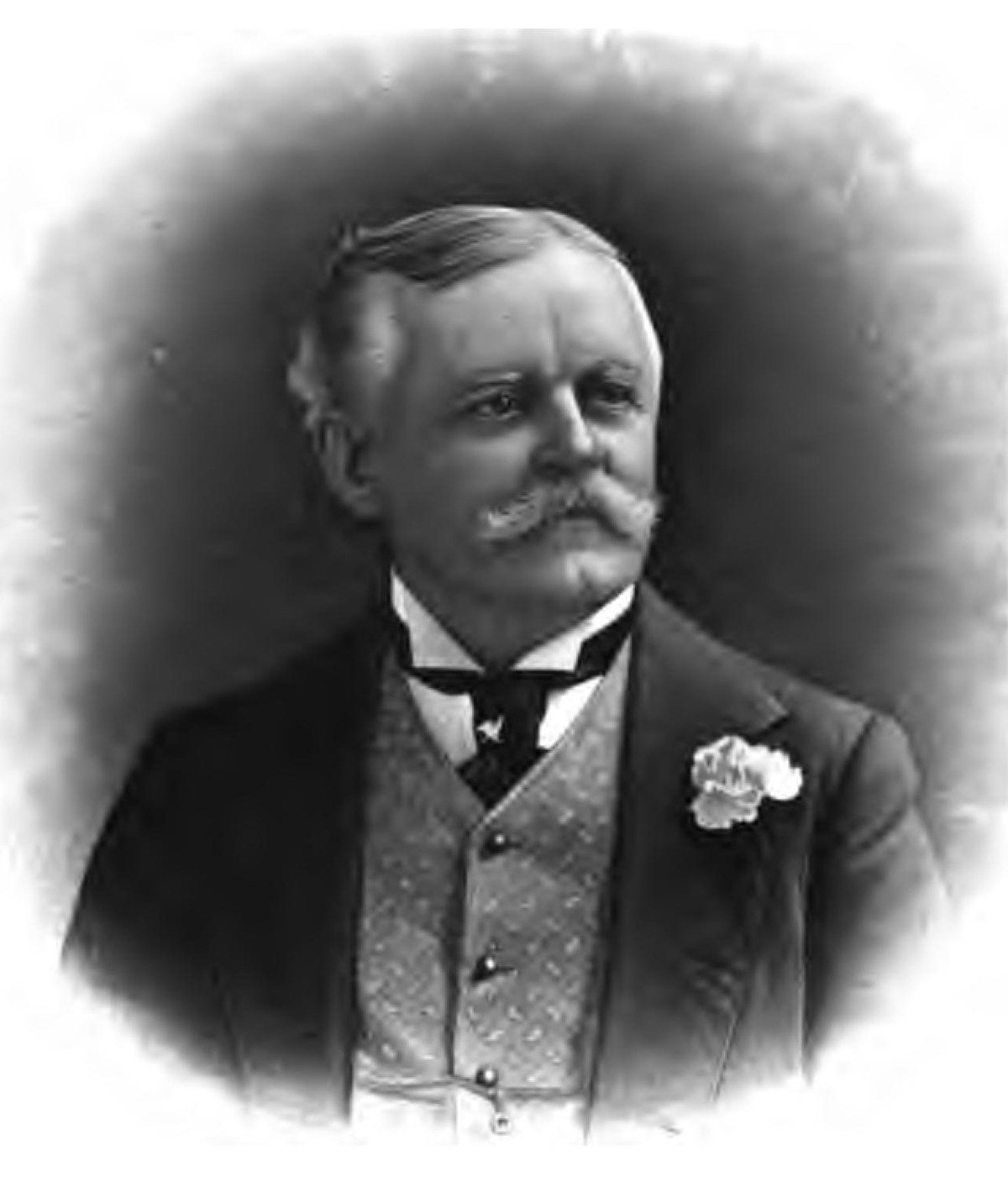
Julian Shakespeare Carr (1845–1924), a Durham tobacco and textile industrialist whose Carr Mill stood in Carrboro, the town renamed for him in 1913 at his request, was an admitted Reconstruction-era Ku Klux Klan member. At the 1913 dedication of UNC's Confederate monument he told the crowd he had horse-whipped a Black woman "until her skirts hung in shreds" a hundred yards away.
Works in the index that concern this person directly, or were written by them. Each links to the institution that holds or provides it; background reading with wider context sits further down.
By Julian S. Carr
Local taxation : Col. J.S. Carr's letter
Carr, Julian Shakespeare · 1897 · J.S. Carr
A public letter from Julian Shakespeare Carr of Durham, dated 8 July 1897 and addressed to C.H. Mebane and the executive committee of the campaign for local taxation, making the case for local taxes to pay for schools. Carr published it himself.
Papers of Julian Shakespeare Carr, 1892 to 1923, a Durham industrialist in tobacco, textiles and banking, a Methodist active in Sunday schools, and a figure in the finances of the university at Chapel Hill. They also cover Confederate veterans, race relations, white supremacy campaigns, and the Chapel Hill war memorial by John A. Wilson known as Silent Sam. Southern Historical Collection at UNC, collection 141.
Greetings from Cottenboro : Julian Carr has got to go
Goldstein, Bob, 1967- · 2020 · Bob Goldstein
Poster by Bob Goldstein from 2020 arguing that Carrboro should stop carrying the name of Julian Shakespeare Carr, and proposing Cottenboro after the musician Elizabeth Cotten. A single sheet measuring 30 by 31 centimeters. Topics include Carr, Cotten and the question of the town's name, placing the poster with the local debate over commemoration.
Why this is here: Catalog heading in the UNC record: Carr, Julian Shakespeare.
Four leaves printed out in 2020, in which James V. Porto, Jr. gives his opinion on changing the name of Carrboro. The piece is signed at the end by Jim Porto. Subjects include the town name itself and Julian Shakespeare Carr, the man the town is named for. Part of UNC's North Carolina Collection.
Why this is here: Catalog heading in the UNC record: Carr, Julian Shakespeare.
The Carrboro Citizen (Carrboro, N.C.) · 2011 · Robert Dickson
Special stand-alone issue of the Carrboro Citizen published in April 2011 for the town's hundredth anniversary, with Robert Dickson as publisher. Its stories range from profiles of residents going about their day to a piece on Julian Shakespeare Carr, the industrialist for whom Carrboro is named.
Why this is here: Catalog heading in the DPLA record: Carr, Julian Shakespeare.
Books in OCPL’s Rebecca B. Wall Local History Collection whose titles, catalog subjects, or descriptions match this person. The Friends’ recommended starting points are labelled.
Mena Webb's biography of Julian S. Carr (1845 to 1924), the Durham industrialist of Bull Durham tobacco, banker and philanthropist. UNC Press published it in 1987: 306 pages with illustrations, portraits, a bibliography and an index.
Life and Orange County connections
Storylines this person is part of, earliest first. Each has its own page.
Dated events connected with this person: sixteen of 30, the highlights and a sample of the rest spread across the years, in date order. See all 30 dated events in the chronology →
Earliest first. Scroll sideways, or use the arrows.
Migration or settlement · Poplar Hill, south of the Eno
Hogg, who owned the land along the south bank of the Eno opposite the town, lived east of Hillsborough on the later Cameron property until 1793 or 1794. He then moved across the river to Poplar Hill, later the site of Julian S. Carr's Occoneechee Farm.
Julian S. Carr was born in Chapel Hill on October 12, 1845, the son of the Franklin Street merchant John Wesley Carr, and later studied at the university. He built tobacco, banking and textile fortunes in Durham, and his Durham Hosiery Mills went on to own both Carrboro mills; the town took his name in 1913.
Person Hall, the old chapel finished in 1798 and recently given to the chemistry department, burned on February 6, 1877, apparently from a stovepipe set too close to a roof rafter. The thick walls stood, the loss came to about $1,000, and gifts from A. F. Redd, J. S. Carr and others paid to restore it.
After the dancing ban, a chartered Gymnasium Association sold $10 shares to alumni and built a hall 110 by 45 feet on its own land, rented to the university for exercise and used for the 1885 commencement ball. The building later became Commons Hall, the student dining hall.
Julian S. Carr buys Poplar Hill south of the Eno and renames the estate Occoneechee Farm
Property or economic transaction · Poplar Hill (Occoneechee Farm), south bank of the Eno River, Hillsborough
John Wall Norwood sold Poplar Hill, the house James Hogg had built about 1794 on the south bank of the Eno, to the Durham industrialist Julian S. Carr, who renamed the property Occoneechee Farm. Carr enlarged and altered the house over the next three decades.
Julian S. Carr nearly finishes a large stock barn at Occoneechee Farm
Construction or physical change · Occoneechee Farm, Hillsborough
Carr's new stock barn at his Occoneechee plantation near Hillsboro was a brick and frame building 42 by 155 feet, with stalls for horses, mares and foals, storage for 500 tons of hay and an elevator.
Julian S. Carr's new club house at Occoneechee Farm is shown to an excursion from Raleigh
Founding or opening · Occoneechee Farm club house, near Tuscarora Drive, Hillsborough
Julian S. Carr hosted students of the A. and M. College and their friends at Occoneechee Farm with a barbecue. The visitors toured his new rustic club house, with its stone fireplace, pool table, piano and a clock that played "Carolina."
Lloyd built the Alberta Cotton Mill beside the railroad in West End in 1898 and 1899, the brick mill that later became Durham Hosiery Mill No. 4 and then Carr Mill Mall.
Founded in 1899 with $10,000 authorized and $2,500 paid in, it was the county's first bank after the Civil War. Julian S. Carr was its first president, and by 1953 it held $8,500,000 in assets.
Disaster or outbreak · Occoneechee Farm, Hillsborough
During an electrical storm, lightning struck the "Pocahontas" or race track barn on Julian Carr's Occoneechee Farm, destroying it with its feed and farm machinery. No livestock were inside, and the loss was insured.
At the 1909 alumni luncheon, classes and local alumni groups promised to endow forty-one scholarships of $1,000 each. Julian S. Carr gave five named for J. Johnston Pettigrew for sons of Confederate soldiers, and Edgar Love two named for Cornelia Phillips Spencer.
A 1913 act of the General Assembly changed the name of the Town of Venable to Carrboro. Julian S. Carr, owner of the local mill since 1909, had asked UNC president Francis Venable's consent in January 1913, and the town's own history says Carr agreed to supply the community with electricity.
On the second day of commencement Major H. A. London introduced Governor Craig; Mrs. London presented the monument to the trustees for the UDC, President Francis P. Venable accepted it for the university, and Julian S. Carr spoke for the students of 1861. Carr's speech, which praised the Confederate army and recounted his horsewhipping of a Black woman in the village in 1865, is the part now most remembered.
Disaster or outbreak · Occoneechee Farm, Hillsborough
A storm on a Friday night damaged every building on Julian Carr's Occoneechee Farm and demolished the dairy barn, killing a number of blooded cows. Carr began rebuilding at once.
On July 16, 1919, about 15,000 people came to Hillsborough to welcome home Orange County's soldiers and sailors, with a parade, Gov. Bickett's address at the court house and a dinner for about a thousand guests in Cameron Park. J. Cheshire Webb chaired the celebration, and the county Red Cross voted $300 toward its cost, money the celebration fund turned out not to need.
On July 29, 2020 the UNC-Chapel Hill Board of Trustees voted 11 to 2 to remove four names from campus buildings, among them Josephus Daniels. The Daniels Building became UNC Student Stores, and the names of Charles Brantley Aycock, Julian Shakespeare Carr and Thomas Ruffin Sr. were removed at the same meeting.
People named in the same dated entries as Julian S. Carr, those sharing the most entries first. Each line links one of the shared entries in the chronology, where its source is cited. A shared entry shows these people in the same event, not how well they knew each other.
Searched by name (Carr, Julian Shakespeare). The catalogs give no dates for this person, so results may include other people with the same name. Each link opens that catalog’s own results in a new tab. The Friends have not reviewed what they return.
Other catalogs to search and local organizations that can help.
Read contemporary evidence:State Archives catalog: 1 collection naming Julian S. CarrState Archives of North Carolina
Collection descriptions for manuscripts, county records, and state records held by the State Archives of North Carolina
Search beyond the index:NC LIVE: prepared search for Julian S. CarrNC LIVE
An advanced search of the state’s shared databases already scoped to Orange County’s places and this subject; edit it freely, and sign in through your North Carolina library to read
Ask locally:Local History Help Hours and request formOCPL Local History Liaison
The library’s Local History Liaison helps in person most Mondays, 12 to 3, at the Main Library, or by the online request form
Picture: Julian S. Carr, engraving, 1905. Public domain. Samuel A. Ashe, ed., Biographical History of North Carolina, vol. II (1905); via the Internet Archive
More to discover
Keep Reading Local
The Friends connect people with new library materials, local writers and publishers, and resources documenting Orange County.