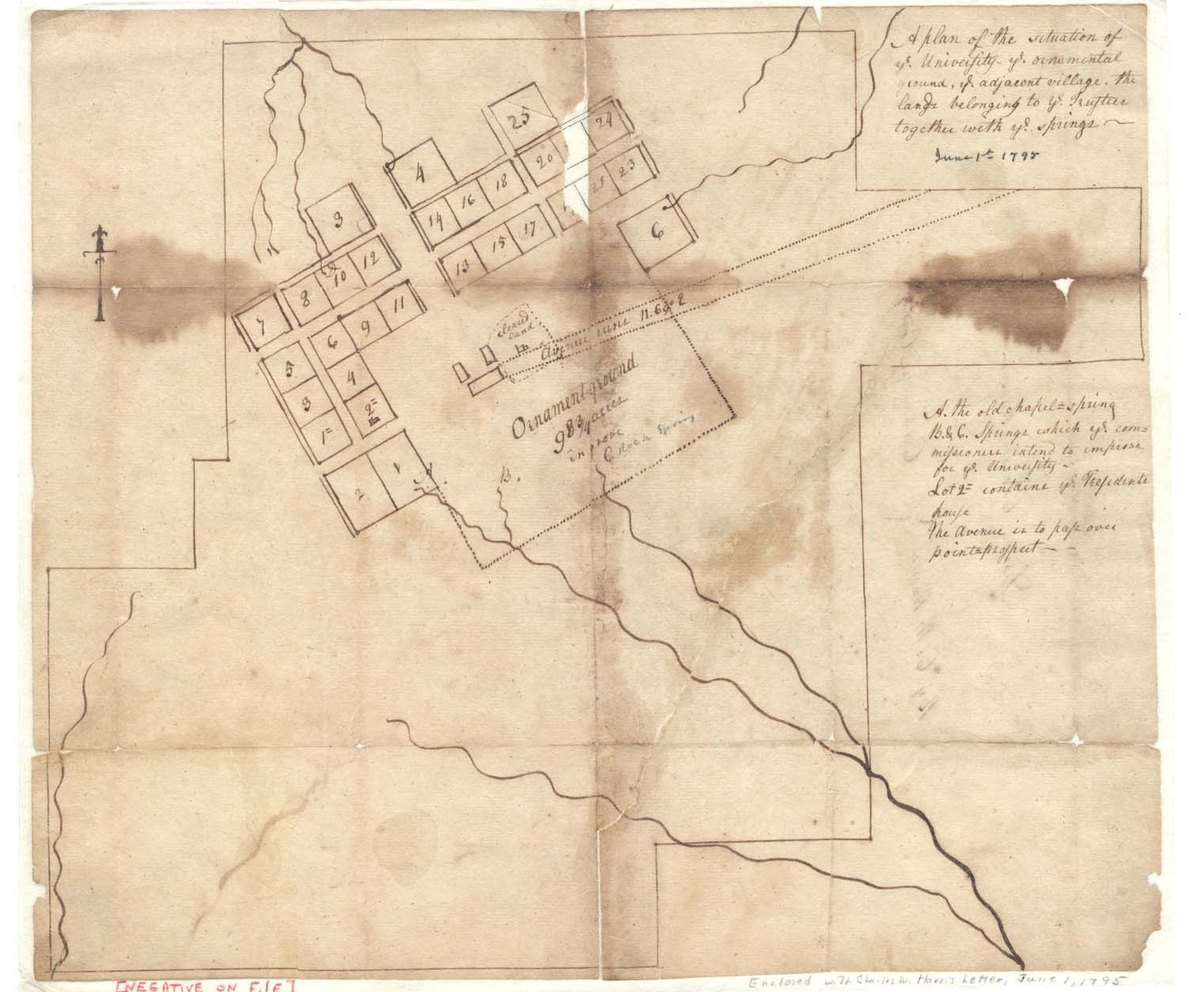
On May 29, 1800 the county court licensed John Taylor to keep a tavern at his house at the University, with William McCauley as surety. By 1803 John McCauley had a store, one of the village's first, on the northeast corner of Lot #11 on Franklin Street. In 1804 James Hogg, who acquired the eastern half of that lot from William R. Davie when his son Gavin entered the university, built a ten-room house there; debts forced him to sell in 1806, though he kept living in it, and it later became the core of the Central Hotel. About 1805 Betsy Nunn carried on the tavern and inn of her late husband, William Nunn.
More shops followed. Between 1809 and 1813 Thomas H. Taylor, son of John Taylor Sr., put up a shoe store on the western half of Lot #14. In 1814 he bought Lot #17 from Frances Benton, enlarged the log cabin on it and later built the much larger Tom Taylor house around it, moving in about 1817. Between 1814 and 1818 Christopher Barbee, the university's largest land donor, rented a corner of Matthew McCauley's Lot #8 for a smithy, and James Thompson and George Trice put up a store on another piece of the lot. Edward Robson kept a store and the village post office on Lot #10 until he sold the property to Taylor in 1816. In 1817 William and Lucy Walker Hilliard moved their family, including their daughter Nancy, from Granville County; she later kept the village's main hotel. That May the court licensed James Thompson and Taylor to retail spirits at their stores and Christopher Moring at his house, and in May 1818 it licensed Thompson and Trice at theirs. Writing in 1853, William D. Moseley of the class of 1818 remembered about a dozen houses on the main street, with Trice's and Tom Taylor's stores and Hilliard's tavern.
In 1819 the General Assembly named Joseph Caldwell, Pleasant Henderson, Thomas Taylor, Ezekiel Trice and William Barbee commissioners for the town of Chapel Hill, with power to fix its boundaries and make bylaws. Elected commissioners and a corporate charter followed in the 1850-51 session.
Reading on the places and people in this storyline
No indexed work is about this storyline itself yet. These are about the sites and people its dated events name, those named most often first, so they may discuss the storyline only in part. Follow a link to find a copy or view the material.
Central Hotel: photographs (Chapel Hill Historical Society)
Left front view of the Central Hotel in Chapel Hill with people standing outside and a church steeple rising behind. Undated, from the Chapel Hill Historical Society's photographs of town businesses.
About James Hogg · named in 2 of this story’s entries
Hillsborough's James Hogg
Cheshire, Lucius McGehee · 1970
Lucius McGehee Cheshire's typescript on James Hogg of Hillsborough, 1729 to 1805, prepared for delivery to the Hillsborough Historical Society and dated 12 March 1970. It runs to 26 pages with ten further unnumbered leaves. The account connects Hogg's life in Hillsborough with the early University of North Carolina. Part of UNC's North Carolina Collection.
Joint Select Committees: Reports and Papers, May 8 - May 18
North Carolina. General Assembly · 1782
From the 1782 session of the General Assembly, joint select committee reports and papers of 8 to 18 May, in 134 images. Captain James Reed, James Houston of Rowan County and George Meek are among those whose cases came before the committees. Other matters include State Legion officers, disabled veterans, price regulation, Cherokee affairs, Thomas Burke, and Hillsborough and Orange County.
NC Digital Collections record courtesy of the North Carolina Department of Natural and Cultural Resources.
Commissary Correspondence, April 1781
1781
Commissary letters of April 1781 under the state Board of War, dealing with provisions and supplies for the army. James Hogg complains that the military destroyed his plantation. Hillsborough, Halifax County and Warren County appear in the letters. 18 images.
NC Digital Collections record courtesy of the North Carolina Department of Natural and Cultural Resources.
Session of December 1793-January 1794: Senate Committee Reports
North Carolina. General Assembly · 1793
Reports of North Carolina Senate committees, December 1793 to January 1794, 91 images, on the militia bill, public bills, a petition from Blackledge, disease in Fayetteville and the work of a Committee of Emancipation. Quakers, sheriffs and Richard Dobbs Spaight figure in the papers, with Hillsborough among the places tied to them.
NC Digital Collections record courtesy of the North Carolina Department of Natural and Cultural Resources.
Wider background: Business, Shops & Commerce · the most widely held histories of the theme this storyline is filed under; they may not discuss it
Papa D
Danziger, Edward G. · 1967
Edward G. Danziger's memoir of love and cooking, published by J. F. Blair in 1967. Danziger (1893 to 1972) ran Danziger's Old World Restaurant in Chapel Hill, and the book tells his life as a restaurateur in the town.
The Research Triangle: From Tobacco Road to Global Prominence
Rohe, William M. · 2011 · University of Pennsylvania Press
William M. Rohe's history of Research Triangle Park and the region around it, published by the University of Pennsylvania Press in 2011. Topics include regional planning and the economic and social conditions of the Research Triangle Park region, one corner of which is Chapel Hill and the university. 298 pages with illustrations and maps.
The Black family in slavery and freedom, 1750-1925
Gutman, Herbert G. (Herbert George), 1928-1985 · 1976 · Pantheon Books
Herbert G. Gutman's 1976 history of African American families from 1750 to 1925, published by Pantheon Books in New York, 664 pages with 38 leaves of plates. Its Orange County connection is the Bennehan and Cameron family plantations, Stagville and Fairntosh: the book discusses the people enslaved by Richard Bennehan (1743-1825) and the Camerons, and follows family ties among them under slavery and after emancipation. Subjects include African American families and enslaved persons in Orange County.
Reviewed in The Journal of Southern History (1977), The William and Mary Quarterly (1977), The American Historical Review (1977), Journal of American History (1977), The History Teacher (1977), Political Science Quarterly (1977), Journal of Black Psychology (1978), Journal of Social History (1978), Civil War history (1978), Signs (1978).
William Terry Couch and the Politics of Academic Publishing
Shiflett, Orvin Lee · 2015 · McFarland & Company, Inc., Publishers
Orvin Lee Shiflett's biography of William Terry Couch, 1901 to 1988, the editor who built up UNC Press at Chapel Hill over four decades in publishing, with a subtitle that calls his career a lightning rod for controversy. Chapters treat culture in the South, a case history in book publishing, objectivity and social science and 'The Sainted Book Burners'. It bears on scholarly publishing and university presses in the twentieth century. McFarland, 2015, 268 pages with illustrations.
A Generosity of Spirit: The Early History of the Research Triangle Park
Link, Albert N. · 1995 · Research Triangle Foundation of North Carolina
Albert N. Link's early history of Research Triangle Park, published in 1995 by the Research Triangle Foundation of North Carolina. Topics include research parks, research institutes and industrial research in the state, with the park's own history at the center. 149 pages with illustrations and maps.
The recipe : have a seat at our table
Council, Annette Marie · 2005 · NP Press
Annette Marie Council's book about her family and Mama Dip's Country Kitchen, the Chapel Hill restaurant, published by NP Press in 2005. Subjects include African Americans in Chapel Hill, the restaurant's history and family biography. Fourteen introductory pages and 223 pages of text with illustrations, part local history and part family account.
Show 6 more
From seed to harvest
Link, Albert N. · 2002 · Research Triangle Foundation of North Carolina
Albert N. Link's history of the Research Triangle Park, the research park founded to draw on the universities at Chapel Hill, Durham and Raleigh, published in 2002 by the Research Triangle Foundation of North Carolina in 278 pages with illustrations. Topics include research parks, research institutes and industrial research in North Carolina and the history of the park itself.
Many Missions: Research Triangle Institute's First 31 Years
Larrabee, Charles X. · 1991
Charles X. Larrabee's history of the Research Triangle Institute over its first thirty one years, published in 1991. Topics include research institutes and research parks in North Carolina and the history of Research Triangle Park, the research district that lies between Chapel Hill, Durham and Raleigh.
Brain magnet
Cummings, Alex Sayf · 2020
Alex Sayf Cummings's 2020 book on the knowledge economy of the Research Triangle, technology research and the history of Research Triangle Park. Chapel Hill and its university form one corner of the Triangle.
Bright leaf culture and Thomas Day : Orange and Caswell counties
Vernacular Architecture Forum (U.S.). Conference (2016 : Durham, N.C.) · 2016 · Vernacular Architecture Forum
A tour guidebook prepared for the 2016 Vernacular Architecture Forum conference in Durham, leading visitors through buildings in Orange and Caswell counties. It takes in the architecture of the bright leaf tobacco economy and the work of Thomas Day, the free Black cabinetmaker of Caswell County who worked in the middle of the nineteenth century.
I raised my hand to volunteer : students protest in 1960s Chapel Hill.
2007 · University of North Carolina at Chapel Hill
Account of student protest in 1960s Chapel Hill, published by the University of North Carolina at Chapel Hill in 2007 with illustrations. It draws together the civil rights movement and segregation in the town, discrimination in restaurants, academic freedom and university autonomy, protest against the Vietnam War, Students for a Democratic Society and the Black Student Movement on campus.
James J. Freeland
Freeland, Maxine · 1999
Maxine Freeland's biography of James John Freeland (1918-1999), a Hillsborough man of the twentieth century, compiled in 1999.