Skip to content

Named event or history

Speaker Ban controversy, 1963–1968

The law barring “visiting speakers” from state campuses, the 1966 wall speeches and Dickson v. Sitterson.

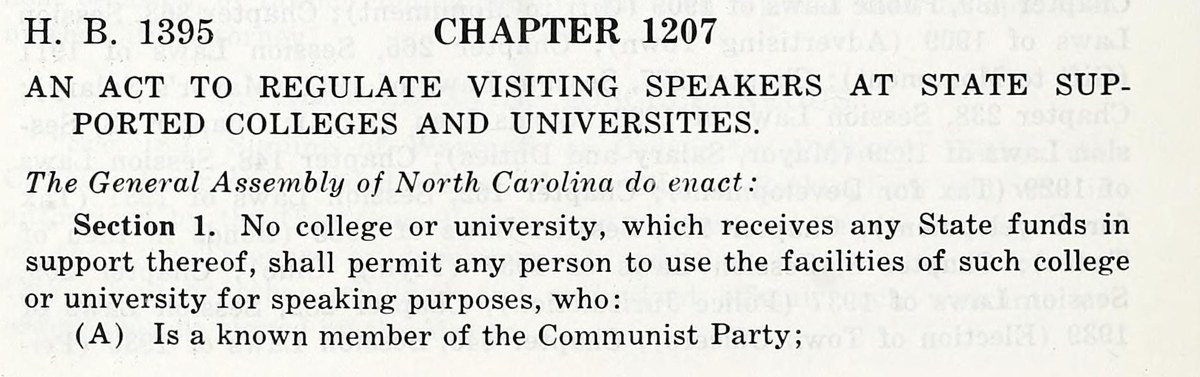
The General Assembly passed the Speaker Ban on June 26, 1963, barring known Communists and people who had pleaded the Fifth Amendment from speaking on state campuses. In March 1966 Frank Wilkinson and Herbert Aptheker spoke to UNC students from the Franklin Street side of the wall, and a federal court struck the law down on February 19, 1968.

84 indexed works are connected with this event.

The Act to Regulate Visiting Speakers, in the Session Laws of 1963

Indexed works

Related works found in catalogs and archives across North Carolina. Each links to the institution that holds or provides it.

Narrow these works. Each link opens the search already limited to this event. Counts are indexed works, not copies on a shelf; a work can carry more than one period or place.

Oral history interview with Daniel H. Pollitt, April 5, 1991: interview L-0064-7, Southern Oral History Program Collection (#4007)

Pollitt, Daniel H. · 2008 · University Library, UNC-Chapel Hill

Seventh of nine Southern Oral History Program interviews with Daniel H. Pollitt, a professor at the UNC School of Law. Recorded April 5, 1991, by Ann McColl, this session of just under an hour is devoted to the Speaker Ban Law, the 1963 act of the General Assembly that barred Communists and certain other speakers from state campuses, and to the fight over it at Chapel Hill in the mid-1960s, in which Pollitt took part. Published online in 2008 in Documenting the American South.

I raised my hand to volunteer: students protest in 1960s Chapel Hill : an exhibit of the Manuscripts Department in the Wilson Library

Hollingsworth, Biff · 2007

Catalog of an exhibit mounted by the Manuscripts Department of Wilson Library from January 23 to May 31, 2007, on student protest in Chapel Hill during the 1960s. Topics include civil rights demonstrations, the Speaker Ban Law, the Black Student Movement, restaurant strikes and Vietnam War protests at the university. Compiled by Biff Hollingsworth, 59 pages with illustrations and facsimiles, published by the university library.

Oral history interview with Ashley Davis, April 12, 1974: interview E-0062, Southern Oral History Program Collection (#4007)

Davis, Ashley · 2007 · University Library, UNC-Chapel Hill

Ashley Davis, who entered UNC in 1968 and joined the Black Student Movement, recalls the 1969 strike by the university's cafeteria workers and the BSM's decision to stand with them when the workers asked. Recorded April 12, 1974, by Russell Rymer for the Southern Oral History Program, the hour-and-a-half interview touches on Chancellor J. Carlyle Sitterson, the Southern Student Organizing Committee and race relations among students on campus. Published online in 2007 by the UNC-Chapel Hill Library in Documenting the American South.

Oral history interview with William C. Friday, November 26, 1990: interview L-0145, Southern Oral History Program Collection (#4007)

Friday, William C. · 2007 · University Library, UNC-Chapel Hill

In this session with William Link, recorded in November 1990, William C. Friday concentrates on the Speaker Ban Law. The 1963 law barred Communists and certain others from speaking on state campuses, and Friday, as UNC system president, spent five years working to undo it. He discusses the law's origins, the fight over academic freedom and free speech at Chapel Hill, and relations between the university and the state. About eighty minutes; electronic edition from the UNC library, 2007, through Documenting the American South.

Communists on Campus

Billingsley, William J. · 1999 · University of Georgia Press

William J. Billingsley's history of the Speaker Ban Law, the 1963 North Carolina statute that barred known Communists from speaking on state campuses, and the fight over it at the University of North Carolina in Chapel Hill. The subtitle sets the scope: race, politics and the public university in sixties North Carolina. It treats academic freedom, anti-communist movements and free speech in the state. University of Georgia Press, 1999, 308 pages with eight pages of plates.

Reviewed in Academe (2000), The American Historical Review (2001), The Journal of Southern History (2001), Journal of American History (2001), The Journal of Politics (2001).

Progress and protests : UNC-Chapel Hill leaders during "the Long Sixties" (1957-1972) : covering chancellors William Brantley Aycock, Paul F. Sharp, and J. Carlyle Sitterson

Roundtree, Lynn · 2024 · Lynn Roundtree

Lynn Roundtree covers the University of North Carolina at Chapel Hill between 1957 and 1972 through its three chancellors, William Brantley Aycock, Paul F. Sharp and J. Carlyle Sitterson, set against the student movements of those years. Part of the Coates university leadership series, published by the author in 2024 and running to 926 pages. It is twentieth century campus history.

UNC
Show 6 more

Speaking freely : UNC-CH administrators respond to freedom of expression, 1963-1970

Floren, Gillian Dae · 1989

Gillian Dae Floren examined how University of North Carolina administrators at Chapel Hill answered questions of free expression between 1963 and 1970, the years of the Speaker Ban Law, the 1969 food service employees' strike and the 1970 student strike. Completed in 1989 with a bibliography on leaves 101 to 104, it reaches to the General Assembly act regulating visiting speakers at state supported colleges.

UNC

The coy mistress caper.

1966 · Time Inc

A four page article clipped from Life, volume 61, number 20, dated November 11, 1966, on a dispute over academic freedom at the University of North Carolina at Chapel Hill. The article concerns the instructor Michael Paull, Chancellor J. Carlyle Sitterson, Jesse Helms and Andrew Marvell's poem 'To His Coy Mistress'. Illustrated, with portraits.

UNC

Campus censorship : the North Carolina "visiting speakers" law

Pollitt, Daniel H. · 1963 · D.H. Pollitt

Daniel H. Pollitt's paper on the North Carolina visiting speakers law, the 1963 statute restricting who could speak on the state's public campuses. Prepared for distribution to the university's chapter of the American Association of University Professors and scheduled for the North Carolina Law Review of December 1963, it treats academic freedom and censorship at Chapel Hill.

UNC

Commencement address.

Knight, Douglas M., 1921-2005 · 1965

A sound recording: Douglas M. Knight's commencement address at the University of North Carolina at Chapel Hill on June 7, 1965, broadcast by radio station WUNC and preserved on one analog audiocassette. Knight took as his subject the Speaker Ban Law, the 1963 statute limiting who could speak on North Carolina campuses, and with it academic freedom and freedom of speech in the state.

UNC

Office of Chancellor of the University of North Carolina at Chapel Hill: Carol L. Folt records, 2013-2018

University of North Carolina at Chapel Hill. Office of the Chancellor · 2013

Chancellor's office records from the tenure of Carol L. Folt at Chapel Hill, 2013 to 2018, 8 linear feet in the University Archives at UNC, collection 40024. Topics include university administration and educational fund raising, curriculum planning, health occupations schools and medical education, and race relations and college integration in North Carolina. Holden Thorp and Christopher C. Fordham also appear.

UNC

Rebellion in black and white : southern student activism in the 1960s

Morrow, Kelly; Sellers, Cleveland, 1944- · 2013 · The Johns Hopkins University Press

Southern student activism in the 1960s, taking in civil rights organizing, Black Power in Greensboro, the Speaker Ban Law and student movements at North Carolina Agricultural and Technical State University and at the University of North Carolina at Chapel Hill. It also concerns student sexual freedom and sexual ethics in Chapel Hill. Kelly Morrow and Cleveland Sellers contribute; published by the Johns Hopkins University Press in Baltimore in 2013.

UNC

Search all 84 indexed works →

In the chronology

Episodes in this history, earliest first. Each has its own page.

Other dated events here: sixteen of 29, the highlights and a sample of the rest spread across the years, in date order. See all 29 dated events in the chronology →

Earliest first. Scroll sideways, or use the arrows.

16 dated events
  1. Daniel Pollitt's law review article calls the Speaker Ban constitutionally suspect

    Publication, speech or performance · UNC campus, Chapel Hill

    Pollitt's article Campus Censorship: The North Carolina Visiting Speakers Law, written for the December 1963 North Carolina Law Review, argued that the Speaker Ban raised serious problems of free speech, self-incrimination and due process. The Daily Tar Heel called it the first known legal analysis of the law by a lawyer outside the attorney general's office.

  2. Paul F. Sharp serves as chief administrator of UNC at Chapel Hill

    Appointment, election or service · Chapel Hill

    Sharp was chief administrative officer of the university at Chapel Hill from September 1, 1964 to February 15, 1966. His records document the state's speaker ban law and programs in medical education, and he left to become president of Drake University.

  3. Students for a Democratic Society invites Frank Wilkinson and Herbert Aptheker to speak at UNC

    Protest or organizing · Chapel Hill

    The UNC chapter of Students for a Democratic Society invited Frank Wilkinson, who had pleaded the Fifth Amendment when questioned in California about Communist activities, and the Communist theoretician Herbert Aptheker to speak on campus. After the trustees barred both men, Student Government under Paul Dickson, the Daily Tar Heel, the Carolina Forum, the YMCA and YWCA, the Di-Phi and the Carolina Political Union joined SDS in renewing the invitations.

    People: Frank Wilkinson · Paul Dickson III · Herbert Aptheker

    Subject: Dialectic and Philanthropic Societies · University YMCA

  4. Gary Waller joins a student panel on the Speaker Ban in Memorial Hall

    Publication, speech or performance · Chapel Hill

    The Daily Tar Heel reported that student body president Paul Dickson presided over a noon meeting of students and faculty in Memorial Hall, with a panel of four that included Waller, Carolina Conservative Club president Wilson Clark and the SDS faculty advisers Joseph Straley and Lewis Lipsitz. The meeting adopted a resolution about four and a half hours before the trustees' executive committee voted 8 to 3 to bar Herbert Aptheker from speaking.

    People: Paul Dickson III

    Subject: Memorial Hall

  5. Nicholson criticizes SDS over the Aptheker invitation while backing the principle

    Publication, speech or performance · UNC, Chapel Hill

    The Carolina Forum chairman called the Students for a Democratic Society invitation to Herbert Aptheker ill-timed and planned for sensationalism, and said the Forum had joined the invitation only in support of the principle of free speech.

    People: Herbert Aptheker

  6. Stuart Matthews and Gary Waller write to Chancellor Sitterson inviting Herbert Aptheker

    Protest or organizing · Chapel Hill

    On the day the full board of trustees adopted new speaker regulations, Matthews and Waller wrote to Acting Chancellor J. Carlyle Sitterson for the UNC Chapel Hill chapter of Students for a Democratic Society, asking that Herbert Aptheker be allowed to speak on campus about the war in Vietnam on March 9. The letter set out his publications, speaking engagements and his Supreme Court passport case.

    Part of Wall speeches at the campus line, 1966 · 19 events

    People: Gary Waller · J. Carlyle Sitterson · Herbert Aptheker

  7. Barred from campus by the Speaker Ban, Frank Wilkinson addressed UNC students from the Chapel Hill side of the wall

    Publication, speech or performance · Chapel Hill

    After Acting Chancellor J. Carlyle Sitterson refused him campus speaking privileges, Frank Wilkinson spoke for about 10 minutes from the Franklin Street sidewalk while about 1,200 students and faculty stood across the low stone wall on McCorkle Place. Student body president Paul Dickson introduced him and predicted a court case.

    People: Frank Wilkinson · J. Carlyle Sitterson · Paul Dickson III

    Subject: McCorkle Place (with the Davie Poplar)

  8. Herbert Aptheker speaks to students across the McCorkle Place wall

    Publication, speech or performance · McCorkle Place wall at Franklin Street, Chapel Hill

    At noon Paul Dickson led Aptheker, invited by SDS and the Committee for Free Inquiry, onto McCorkle Place near the Confederate monument, where campus police chief Arthur Beaumont halted Dickson's introduction and warned of arrest. Aptheker crossed the low stone wall to the Franklin Street sidewalk and spoke to a crowd estimated at 2,000 to 3,000 on the campus side.

    People: Paul Dickson III · Herbert Aptheker

    Subject: McCorkle Place (with the Davie Poplar)

  9. Student leaders ask the chancellor to let Wilkinson and Aptheker speak on campus

    Protest or organizing · Chapel Hill

    Paul Dickson and the heads of Carolina Forum, the YMCA, the YWCA, Di-Phi, the Carolina Political Union and SDS wrote to Chancellor J. Carlyle Sitterson asking that Wilkinson speak on March 23 and Aptheker on March 25, or on later dates.

    People: J. Carlyle Sitterson · Paul Dickson III · George E. Nicholson III · Robert S. Powell Jr. · James A. Medford · Eunice H. Milton · John E. Greenbacker Jr. · Eric Van Loon · Gary Waller · Stuart Matthews

    Subject: Dialectic and Philanthropic Societies · University YMCA

  10. Students and the two speakers file Dickson v. Sitterson against the Speaker Ban

    Law, policy or court · U.S. District Court, Greensboro

    Minutes after Sitterson refused the students' request, Paul Dickson and eleven other student leaders, joined by Wilkinson and Aptheker as plaintiffs, sued Sitterson, President William C. Friday and the trustees in the U.S. District Court for the Middle District of North Carolina. Attorney McNeill Smith took the case without fee.

    People: J. Carlyle Sitterson · Paul Dickson III · Herbert Aptheker · William C. Friday · George E. Nicholson III · Robert S. Powell Jr. · James A. Medford · Eunice H. Milton · John E. Greenbacker Jr. · Eric Van Loon · Gary Waller · Stuart Matthews · Frank Wilkinson

  11. Powell is named to the student-faculty committee on visiting speakers

    Appointment, election or service · UNC, Chapel Hill

    The Daily Tar Heel listed Bob Powell first among the members of the student-faculty committee on visiting speakers, in the same story that printed the students' request to the chancellor.

  12. A federal court struck down the Speaker Ban law in Dickson v. Sitterson

    Law, policy or court · Chapel Hill

    A three-judge federal court in Greensboro ruled North Carolina's Speaker Ban law unconstitutional because it was too vague. The suit had been filed in March 1966 by UNC student leaders and the two barred speakers, Frank Wilkinson and Herbert Aptheker, and UNC's leaders hoped the ruling ended the long controversy.

    People: J. Carlyle Sitterson · Paul Dickson III

  13. The UNC trustees adopt six temporary speaker rules in place of the voided regulations

    Law, policy or court · Chapel Hill

    A week after the ruling the trustees approved, over Senator Tom White's plea to proceed calmly, six interim rules on the manner of a speaker's appearance (a senior faculty member presiding at the chancellor's request, public forums, balanced views, audience questions, sponsorship by recognized student groups), with the items the court had struck removed, pending further study by the executive committee on March 8.

    People: William C. Friday · J. Carlyle Sitterson

  14. Frank Wilkinson speaks on the UNC campus in Howell Hall

    Publication, speech or performance · Howell Hall, UNC

    Three months after the ruling, Wilkinson gave his first permitted talk on the UNC campus, speaking on HUAC in Howell Hall at the invitation of the Carolina Political Union to about 35 people.

    People: Frank Wilkinson

  15. Herbert Aptheker returns to speak at UNC in Greenlaw Hall

    Publication, speech or performance · Greenlaw Hall, UNC

    Twenty-five years after he was kept off campus, Aptheker spoke to students and faculty in Greenlaw Hall in a visit arranged by anthropology professor Don Nonini.

    People: Herbert Aptheker

  16. Speaker Ban marker dedicated at the McCorkle Place wall

    Naming or commemoration · McCorkle Place wall at Franklin Street, Chapel Hill

    On University Day a bronze marker naming the twelve student plaintiffs was dedicated at the wall where Wilkinson and Aptheker spoke, a gift of Anne Dickson Fogleman and Robert Dickson.

    People: Holden Thorp

    Subject: McCorkle Place (with the Davie Poplar)

Places in this history

Buildings, schools, churches and other sites named in the dated events on this page, the most often named first. The map shows the 3 with a known location.

Map tiles © OpenStreetMap contributors. Site locations from the N.C. State Historic Preservation Office survey, Open Orange and OpenStreetMap; town and community pins mark the middle of their mapped buildings.

All places and the county map →

Research sources

Background context 4

Background from selected state and local sources

Read contemporary evidence 4

Newspapers, photographs, and records of the time

Search beyond the index 4

Other catalogs, databases, and guides worth searching

Additional research sources

Other catalogs to search and local organizations that can help.

Picture: The Act to Regulate Visiting Speakers, in the Session Laws of 1963. Public domain. Session Laws and Resolutions of North Carolina, 1963; via the Internet Archive

More to discover

Keep Reading Local

The Friends connect people with new library materials, local writers and publishers, and resources documenting Orange County.

Two mice reading back to back against a leaf, with the hand-lettered words Friends of the Orange County Public Library
Illustration by Caldecott Medalist Matthew Cordell, gifted to the Friends 2026