The Regulators, the Revolution, and the county’s first century.
In briefOrange County was created in 1752 with Hillsborough as its seat, rose against its courthouse officers in the Regulator crisis of 1766 to 1771, hosted the Provincial Congress and the General Assembly during the Revolution, was occupied by Cornwallis and raided by David Fanning in 1781, and declined to ratify the Constitution in 1788. The storylines follow those events from the Occaneechi town to the founding of the university.
Related works found in catalogs and archives across North Carolina, the most widely held first, novels aside. Each links to the institution that holds or provides it.
Narrow these works. Each link opens the search already limited to this theme. Counts are indexed works, not copies on a shelf; a work can carry more than one period or place.
Breaking Loose Together: The Regulator Rebellion in Pre-Revolutionary North Carolina
Kars, Marjoleine · 2002 · University of North Carolina Press
Marjoleine Kars's history of the Regulator Rebellion of 1766 to 1771, the backcountry uprising against corrupt county officials that ended at the Battle of Alamance. Hillsborough, the Orange County seat, was a center of the Regulators' protests and the scene of their 1770 court riot. Published by the University of North Carolina Press in 2002, 286 pages with illustrations and maps.
Francis Nash's history of Hillsborough in colonial and Revolutionary times, first published in 1903 and reprinted in 1953 by Edwards & Broughton with an index and a sketch of the author. Topics include the Regulator Insurrection of 1766 to 1771, the Revolution and local genealogy.
Cameron, Annie Sutton · 1964 · Orange County Historical Museum
Annie Sutton Cameron's short account of Hillsborough during the Regulator uprising of 1766 to 1771, when backcountry farmers protested colonial officials and courts and Hillsborough, as the seat of Orange County, stood at the center of the conflict. Published by the Orange County Historical Museum in Hillsborough in 1964, 36 pages with illustrations.
Farming Dissenters: The Regulator Movement in Piedmont North Carolina
Troxler, Carole Watterson · 2011
Carole Watterson Troxler's history of the Regulator movement in Piedmont North Carolina, from land speculation and backcountry resentment through Herman Husband and the Sandy Creek network to the petitions, court proceedings and rioting in Hillsborough and Salisbury, the Battle of Alamance in 1771 and the movement's afterlife in the Revolution. An appendix compiles names in a Regulator context. Published by the North Carolina Department of Cultural Resources in 2011, 221 pages with illustrations, maps and an index.
The Regulators in North Carolina: A Documentary History, 1759-1776
Powell, William Stevens; Huhta, James K.; Farnham, Thomas J. · 1971 · State Dept. of Archives and History
Documentary history of the Regulator movement of 1766 to 1771, the backcountry protest against corrupt county officials that centered on Hillsborough and ended at the Battle of Alamance, compiled by William S. Powell, James K. Huhta and Thomas J. Farnham. The volume prints primary sources from 1759 to 1776. Published by the State Department of Archives and History in 1971, xxxix and 626 pages with illustrations.
Church in the Old Fields: Hawfields Presbyterian Church and Community in North Carolina
Turner, Herbert Snipes · 1962
Herbert Snipes Turner's history of Hawfields Presbyterian Church and its community from 1738 to 1960. Hawfields lies in what is now Alamance County, land that was part of Orange County until 1849, and the book gives a place to Henry Pattillo, the congregation's eighteenth-century minister. Published by the University of North Carolina Press in 1962, 297 pages with illustrations.
Some Neglected History of North Carolina: Being an Account of the Revolution of the Regulators
Fitch, William Edward · 1905 · Neale Pub. Co.
William Edward Fitch's account of the Regulator movement and the Battle of Alamance of 1771, which his subtitle calls the first battle of the American Revolution, published by Neale in 1905 in a second edition. Hillsborough, the Orange County seat, was the scene of the Regulators' 1770 courthouse riot and of the hangings that followed Alamance. 307 pages with nine leaves of plates, folding maps and a portrait.
An Historical Address Delivered in Saint Matthew's Church, Hillsboro, N.C., on Sunday, August 24, 1924
Cheshire, Joseph Blount · 1925
Address by Bishop Joseph Blount Cheshire at St. Matthew's Church in Hillsborough on 24 August 1924, marking the parish's hundredth anniversary. Printed in Durham in 1925 at the vestry's order, with a foreword by the rector. Cheshire discusses George Micklejohn, William Mercer Green and Moses Ashley Curtis.
Books in OCPL’s Rebecca B. Wall Local History Collection whose titles, catalog subjects, or descriptions match this theme. The Friends’ recommended starting points are labelled. Books marked Wider context cover the broader subject rather than this theme itself.
Carole Watterson Troxler's history of the Regulator movement in Piedmont North Carolina, from land speculation and backcountry resentment through Herman Husband and the Sandy Creek network to the petitions, court proceedings and rioting in Hillsborough and Salisbury, the Battle of Alamance in 1771 and the movement's afterlife in the Revolution. An appendix compiles names in a Regulator context. Published by the North Carolina Department of Cultural Resources in 2011, 221 pages with illustrations, maps and an index.
Marjoleine Kars's history of the Regulator Rebellion of 1766 to 1771, the backcountry uprising against corrupt county officials that ended at the Battle of Alamance. Hillsborough, the Orange County seat, was a center of the Regulators' protests and the scene of their 1770 court riot. Published by the University of North Carolina Press in 2002, 286 pages with illustrations and maps.
Annie Sutton Cameron's short account of Hillsborough during the Regulator uprising of 1766 to 1771, when backcountry farmers protested colonial officials and courts and Hillsborough, as the seat of Orange County, stood at the center of the conflict. Published by the Orange County Historical Museum in Hillsborough in 1964, 36 pages with illustrations.
The second series of the Colonial Records of North Carolina, the documentary edition begun in 1963 to follow William L. Saunders's ten volumes of 1886 to 1890. Its first volume, Mattie Erma Edwards Parker's edition of the charters and constitutions of 1578 to 1698, came from the Carolina Charter Tercentenary Commission; later volumes, starting with the colony's higher-court records of 1670 to 1696, were issued in Raleigh by the state's archives and history agency.
Amanda Boyd's stories of the Colonial Inn in Hillsborough, gathered as anecdotes of the inn and of the town's social life. The inn on West King Street is one of Hillsborough's landmarks. Published in Durham in 2021, 120 pages with illustrations, facsimiles, maps and portraits, many in color.
Hugh T. Lefler and William S. Powell's history of North Carolina in the colonial period, written for Scribner's A History of the American Colonies series and published in 1973; 318 pages, illustrated, with a bibliography and index. Lefler taught the state's history at Chapel Hill from 1935; Powell, curator of the North Carolina Collection at the university library from 1958, later edited the Dictionary of North Carolina Biography.
Piracy on the North Carolina coast in colonial times, including the career of Stede Bonnet, told in 71 illustrated pages by Hugh F. Rankin. The State Department of Archives and History first issued it in 1960, with a bibliography, and the state's archives office reprinted it many times, with a third printing in 1965 and another as late as 2008.
Elizabeth A. Fenn and Peter H. Wood wrote this illustrated social history of North Carolina before 1770, covering its Native peoples and the newcomers who arrived among them, with research and marginal notes by Jean B. Anderson and pointers to historic sites. It opens the five-book series 'The Way We Lived in North Carolina', edited by Sydney Nathans and published for the Department of Cultural Resources by UNC Press in 1983.
Eighteenth-century North Carolina seen through historical geography, with particular attention to the colony's economy, in a study by Harry Roy Merrens. The University of North Carolina Press published it in 1964, 293 pages with maps, charts and a bibliography, and reissued it in 2012.
In the chronology
Dated events connected with this theme: sixteen of 268, the highlights and a sample of the rest spread across the years, in date order. See all 268 dated events in the chronology →
Earliest first. Scroll sideways, or use the arrows.
After leaving the Roanoke River valley in 1676, the Occaneechi built a town on the Eno River near present-day Hillsborough and lived there from about 1680 to 1710. It was a small stockaded village of ten or twelve houses and probably fewer than 75 people, and it was the town John Lawson visited in 1701. Archaeologists dug the whole village between 1983 and 1986 at a place they named the Fredricks site, and they call this period of Occaneechi life on the Eno the Fredricks phase.
Life event · Occaneechi Town, on the Eno near Hillsborough
Within two hours of John Lawson's arrival at Occaneechi Town on the Eno, Enoe Will came into the king's cabin and agreed to guide Lawson's party to the English, leaving his pay to their discretion. The next morning they set out for Adshusheer, his town about 14 miles east, which Lawson described as Shoccories mixed with Eno and Adshusheer people with Will as their chief man.
Thomas Hart began his second term as sheriff of Orange County in 1768. The same year he was made a captain in the Orange County militia and commissary for the troops of Orange and Granville counties.
With Governor Tryon's militia in Hillsborough for the September 1768 term, the superior court tried the Regulator cases. Herman Husband was acquitted; William Butler was found guilty on two counts and sentenced to a fine of 50 pounds and six months in prison, but Tryon released him and suspended the fines.
About 150 Regulators crowded the Hillsborough Superior Court, beat the lawyer John Williams, Edmund Fanning and others, and forced Judge Richard Henderson to adjourn; he fled that night. The next day the crowd tore down Fanning's house and wrote mocking judgments on the court docket.
Violence or armed conflict · near Alamance Creek (then Orange County)
On the morning before the battle, some of the Regulators caught Colonel John Ashe and Captain Walker while they were out scouting, whipped them severely and held them prisoner. Many Regulators condemned the act, and some threatened to leave the cause if it happened again.
Meeting at Hillsborough, the Congress appointed Samuel Johnston treasurer for the Northern District and Richard Caswell treasurer for the Southern District, giving them the powers the colony's treasurers had held under a 1773 act of Assembly.
The second session of the 1778 General Assembly met at Hillsborough, elected Whitmell Hill and Thomas Burke as additional delegates to the Continental Congress, and authorized 850,000 pounds in bills of credit to pay the state's war debts. The House adjourned to meet next at Halifax in January 1779.
At daybreak about 45 North Carolina cavalry under Captain Joseph Graham and mounted riflemen under Captain Richard Simmons, sent out by General Andrew Pickens, surprised the British guard of about 26 regulars and two Loyalists that was keeping Thomas Hart's mill on the Eno grinding for Cornwallis's army. Graham's accounts report the whole guard killed, wounded or captured with no Patriot dead, and the party reached Pickens's camp with its prisoners ahead of pursuing British cavalry.
After driving Nathanael Greene's army across the Dan River, Lord Cornwallis reached Hillsborough on February 20, 1781, raised the royal standard and issued a proclamation calling loyalists to join him. Short of food and forage, and told that Greene had recrossed the Dan, he left on February 26, crossing the Haw toward Alamance Creek.
The April Assembly at Hillsborough appointed commissioners to deal with estates taken from Loyalists, electing William Moore for the Hillsborough District.
Meeting at St. Matthew's Church in Hillsborough, delegates defeated a motion to ratify the Constitution 184 to 84 on August 1, 1788. On August 2 they voted to neither ratify nor reject it until a declaration of rights and amendments went before Congress.
In 1963 the North Carolina Society of the Colonial Dames of America erected a marble slab monument to the six Regulators hanged at Hillsborough in June 1771, placing it next to the historic Hughes Academy schoolhouse in Hillsborough. The men's grave, thought to lie near the Eno, has never been found.
National Register: MoorefieldsNational Register nomination
Nomination (4/25/1972), Hillsborough vicinity: history, description, and sources for the property
Show all 8
ANCHOR: The RegulatorsANCHOR (NC history online resource)
A classroom introduction to the Regulator years
Related to the chronology entry “Orange County's First Regulator Paper Invokes the Stamp Act Resistance” (August 1766).
Read contemporary evidence 10
Newspapers, photographs, and records of the time
NCpedia: Petition of Orange County to Governor Tryon, 1768 (public-domain image)NCpedia
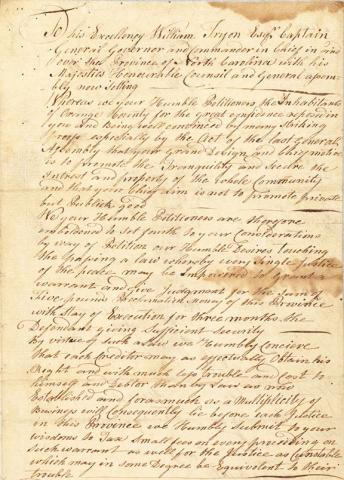
Image of the original Petition of Orange County to Governor Tryon, May 1768. In the petition, the signers apologize for the recent acts of violence by Regulators and ask the Governor to address the illegal fees demanded by court officials. The original petition is located in the collection of the…
NC LIVE: prepared search for Colonial Orange CountyNC LIVE
An advanced search of the state’s shared databases already scoped to Orange County’s places and this subject; edit it freely, and sign in through your North Carolina library to read
Additional research sources
Other catalogs to search and local organizations that can help.
Ask locally:Local History Help Hours and request formOCPL Local History Liaison
The library’s Local History Liaison helps in person most Mondays, 12 to 3, at the Main Library, or by the online request form
Background reading at OCPL
Held in OCPL’s Rebecca B. Wall Local History Collection. Selected because their titles or catalog subjects provide wider historical context for this theme; they may not discuss the Orange County theme directly.
J. Bryan Grimes, North Carolina's secretary of state from 1901 to 1923, who also chaired the North Carolina Historical Commission, wrote these notes on the colony between 1700 and 1750 for the North Carolina Booklet. The North Carolina Historical Association reprinted them in 1905 as a 69-page pamphlet with references to sources.
Subjects in the Library of Congress catalog record: North Carolina -- History -- Colonial period, ca. 1600-1775 OCPL call number: NC 975.602 GRI
The letters and papers of William Tryon, royal governor of North Carolina until 1771, edited by William S. Powell in two volumes, 1758 to 1767 and 1768 to 1818. They cover the Regulator troubles, from the riots at Hillsborough, the Orange County seat, to the battle of Alamance in 1771 and the hangings that followed. Tryon, builder of the New Bern palace, later governed New York. Division of Archives and History, 1980; indexed.
Subjects in the Library of Congress catalog record: North Carolina -- History -- Colonial period, ca. 1600-1775 -- Sources; North Carolina -- History -- Regulator Insurrection, 1766-1771 -- Sources; Tryon, William, 1729-1788 OCPL call number: NC BIO TRYON POW
Picture: Petition of Orange County to Governor Tryon, 1768. Public domain. [Governor William Tryon: Petition of Orange County, 1768.] 1768. Colonial Governors' Papers, State Archives of North Carolina.
More to discover
Keep Reading Local
The Friends connect people with new library materials, local writers and publishers, and resources documenting Orange County.