Skip to content

Storyline · 1752–1824

St. Matthew's Parish and Hillsborough's old church, 1752–1824

From 1752 St. Matthew's Parish was Orange County's established Anglican church, with chapels at New Hope and St. Mary's and, from about 1768, a church in Hillsborough. Its rector, George Micklejohn, preached to Tryon's troops in 1768 and stayed loyal to the Crown in 1776. Its church served as an army hospital, an academy and the meeting place of the 1788 convention, and in 1797 the Assembly ordered the ruinous building sold. Episcopal worship came back through St. Jude's and St. Mary's in 1818 and 1819, and in 1824 the reorganized parish left the old lot to the Presbyterians.

1752–1824 Part of St. Matthew’s Episcopal Church, Hillsborough, 1823–1854 26 dated events

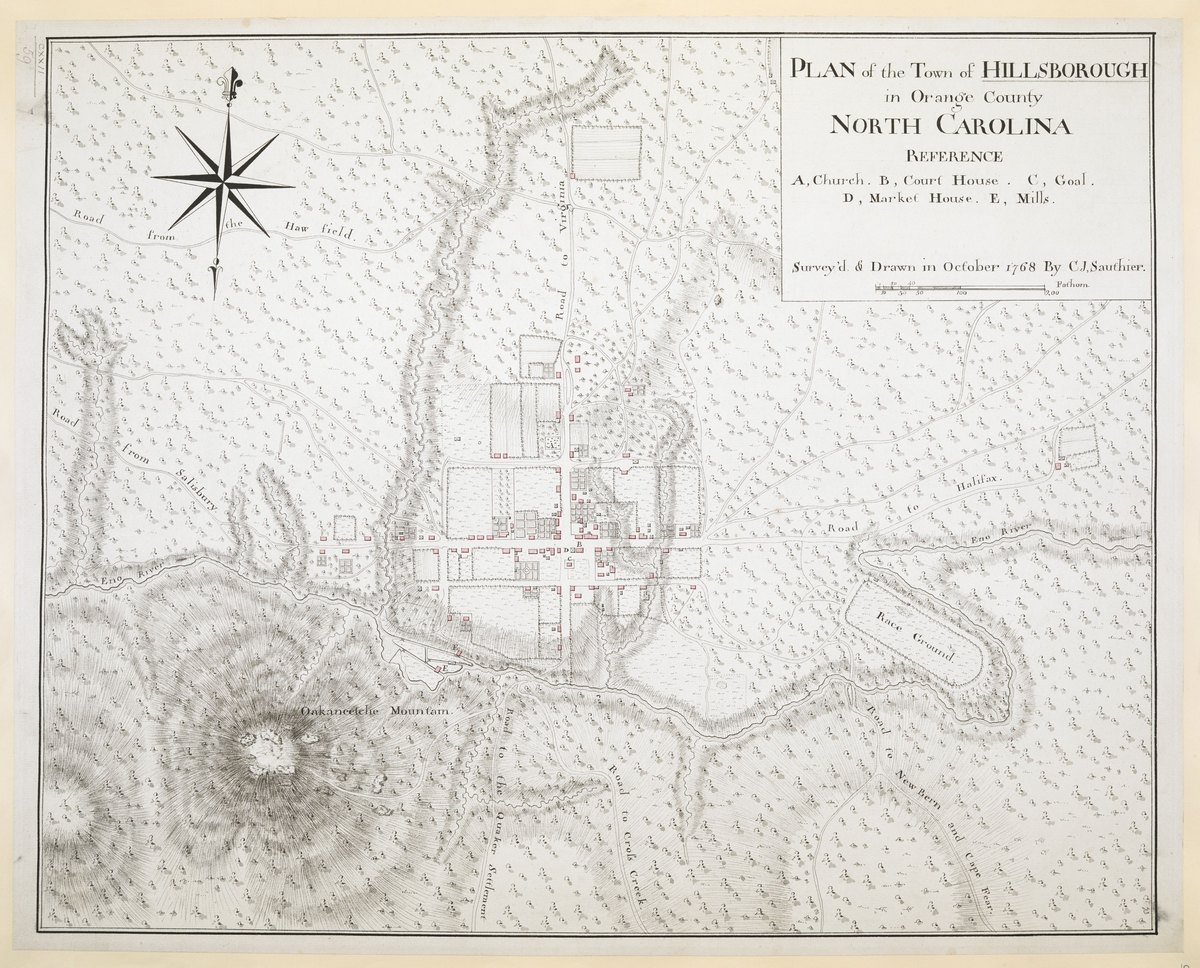
Sauthier's plan of Hillsborough, October 1768; the church ground is marked A
Sauthier's plan of Hillsborough, October 1768; the church ground is marked AClaude Joseph Sauthier; British Library, via Flickr Commons · No known copyright restrictions · Source

The act of the spring 1752 General Assembly that created Orange County also made it the Anglican Parish of St. Matthew, with its own vestry, and named John Patterson among the twelve vestrymen who were to serve until the first vestry election. In October 1754 the county court directed the vestry to divide the parish into districts so that each person's land lines could be walked and recorded between October and April; no report back appears in the minutes, but later records name parish districts, among them St. Mary's in the east. The 1752 act appears to have been voided by royal proclamation, so in 1756 the Assembly passed a fresh act setting up the county and the parish again. In 1757 a one-acre lot was bought in Hillsborough for the parish church. About 1759 Anglicans built chapels for worshipers far from town: New Hope Chapel in southern Orange, at the site of present Chapel Hill, and St. Mary's, on land given by Thomas Holden about seven miles northeast of Hillsborough.

By April 1767 Governor William Tryon had sent the Rev. George Micklejohn, a Society for the Propagation of the Gospel missionary, to the parish, and about 1768 or 1769 its members put up what the Lloyds' history of Hillsborough's churches calls the town's first church, at the corner of Churton and Tryon streets. During the unrest of 1768 Micklejohn carried messages several times between the Regulators and the authorities, seeking a peaceful settlement, and the Regulators called him "our Rector." On September 25, 1768 he preached to Tryon's troops at Hillsborough on the duty of subjection to the civil powers. Tryon had the sermon printed and distributed, the Assembly voted that November to repay Micklejohn for the printing, and Bassett, citing Foote, reports that the sermon said at least twenty Regulators ought to have been hanged; it cost Micklejohn favour with opponents of royal authority. On August 21, 1775, at the congress's request, he opened the Provincial Congress by reading prayers in the church. He stayed loyal to the Crown, was held among the Loyalist prisoners and paroled to Perquimans County on May 3, 1776, and on November 24 took the oath of allegiance to the state before the Halifax Congress and was discharged.

In the fall of 1780 the Board of War ordered the church repaired for use as a hospital. An act of the 1784 session ordered it repaired for a school and a free meeting house, and Hillsborough Academy, chartered as Science Hall, opened in it in 1785 and closed in 1790. Meeting at St. Matthew's Church from July 21 to August 4, 1788, the Hillsborough Convention declined to ratify the Constitution. In November 1792 the University's site commissioners wrote down the name of the rise where New Hope Chapel had stood, New Hope Chapel Hill, and the village laid out in 1793 kept the short form, Chapel Hill. In 1797 an act authorised the sheriff to sell the old church on Lot 98, ruinous and not used for worship for years; it went soon afterwards, and around 1800 the town had no church at all. In 1815 and 1816 a brick Presbyterian church went up near its site with money from a lottery the state authorized. In 1818 St. Jude's, meeting near Stony Creek, joined the new Diocese of North Carolina, and St. Mary's followed in 1819; Murphy counts St. Jude's as an old colonial mission revived. In the convention year 1819-20 G. T. Bedell, one of the first clergy Murphy found recorded as officiating in Hillsborough, preached in the Presbyterian church lent by its pastor John Witherspoon. A notice dated June 8, 1823 announced Bishop Ravenscroft at St. Mary's Chapel for June 22. In 1824, when St. Matthew's was reorganized under William Mercer Green, some vestrymen proposed claiming the old church lot, then used by the Presbyterians; Thomas Ruffin argued against it and offered his own land for a new church.

Towns
Hillsborough, Chapel Hill
Sites
5
People with pages
18

The events, date by date

Every statement above comes from these dated entries in the chronology. Each links to its source.

  1. John Patterson is named one of the first vestrymen of St. Matthew's Parish The act of the 1752 Assembly that created Orange County and the Parish of St. Matthew named John Patterson among the twelve vestrymen who were to serve until the first vestry election. People: John Patterson, Alexander Mebane, James Watson, Mark Morgan, John Gray Place: Orange CountySearch the index · Documenting the American South: Colonial and State Records of North Carolina, vol. 23: Acts of the General Assembly, March 31-April 15, 1752, ch. VI
  2. St. Matthew’s Parish is established The act of the spring 1752 General Assembly session that created Orange County also made it the Anglican Parish of St. Matthew, with its own vestry. The parish's first church stood in Hillsborough by about 1768, but today's St. Matthew's Episcopal Church descends from a congregation reorganized in 1824. Place: Hillsborough · Also mentions: St. Matthew's Episcopal ChurchSearch the index · Colonial and State Records of North Carolina, vol. 23: Acts of the General Assembly, March 31–April 15, 1752, ch. VI
  3. Orange County court orders St. Matthew's vestry to divide the parish into processioning districts The county court directed the vestry of St. Matthew's Parish to split the parish into districts so that each person's land lines could be walked and recorded between October and April. No report back appears in the minutes, but later records name parish districts in the county, among them St. Mary's in the east. Place: Orange County courthouse, HillsboroughSearch the index · Hugh Conway Browning, Information Related to St. Mary's Chapel (1996), scan p. 13
  4. The Assembly re-creates Orange County and St. Matthew's Parish by a new act The 1752 act that made Orange a county and the parish of St. Matthew's appears to have been voided by royal proclamation, so the colonial Assembly passed a fresh act in 1756 setting up both again. Place: Orange County · Also mentions: St. Matthew'sJoseph Blount Cheshire, An Historical Address Delivered in Saint Matthew's Church, Hillsboro, N.C. (1925), scan p. 14
  5. A one-acre lot is bought in Hillsborough for the St. Matthew's Parish church The lot was the building site for the established church of Orange County, created with the county in 1752. Place: St. Matthew's Parish church lot, HillsboroughSearch the index · A Celebration of 250 Years of Anglican and Episcopal Witness in Orange County (2003), scan p. 9
  6. Anglicans build New Hope Chapel in southern Orange County, at present Chapel Hill The chapel, like St. Mary's in northern Orange, served parish worshipers far from Hillsborough. The booklet places it at the site of present Chapel Hill. Place: New Hope Chapel, present Chapel HillSearch the index · A Celebration of 250 Years of Anglican and Episcopal Witness in Orange County (2003), scan p. 9
  7. St. Mary's congregation is established Anglicans established St. Mary's Chapel about 1759 on land given by Thomas Holden, about seven miles northeast of Hillsborough, to serve northern Orange County. The congregation joined the Episcopal convention in 1819 and built the present brick chapel, consecrated in 1859; regular services ended in the early 1930s. Place: St. Mary's community · Also named: Thomas HoldenSearch the index · NC Department of Natural and Cultural Resources: St. Mary's Chapel (G-90)
  8. George Micklejohn is sent to St. Matthew's Parish in Hillsborough Governor William Tryon sent the Rev. George Micklejohn, a Society for the Propagation of the Gospel missionary first assigned to Rowan County, to St. Matthew's Parish in Orange County. People: George Micklejohn, William Tryon Place: HillsboroughSearch the index · St. Matthew's Episcopal Church, Hillsborough: Allen Cronenberg, A Brief History of St. Matthew's Parish, 1752-2017 (2018)
  9. Episcopalians build Hillsborough's first church Members of the Church of England put up the town's first church at the corner of Churton and Tryon streets, under George Micklejohn, the parish minister Governor Tryon had appointed. It later held the 1788 convention and its lot passed to the Presbyterians. People: George Micklejohn Place: first Hillsborough church (St. Matthew's Parish), Churton and Tryon streets, HillsboroughSearch the index · Pauline O. Lloyd and Allen A. Lloyd, History of the Churches of Hillsborough, N.C., ca. 1766-1962 (1963), scan p. 19
  10. George Micklejohn carries messages between the Regulators and the authorities During the 1768 unrest the Hillsborough rector acted several times as a courier between the Regulators and the authorities, seeking a peaceful settlement. The Regulators called him "our Rector." People: George Micklejohn Place: HillsboroughSearch the index · NCpedia: Micklejohn, George (Dictionary of North Carolina Biography)
  11. George Micklejohn preaches to Tryon's militia at Hillsborough Before Governor Tryon and the troops raised against the Regulators, Micklejohn preached on the important duty of subjection to the civil powers. Tryon had the sermon printed and distributed, and it cost Micklejohn favour with opponents of royal authority. People: George Micklejohn, William Tryon Place: HillsboroughSearch the index · NCpedia: Micklejohn, George (Dictionary of North Carolina Biography)
  12. The Assembly pays for printing Micklejohn's sermon to the troops The Assembly voted to repay the Orange parish minister George Micklejohn for printing the sermon he had preached to the troops at Hillsborough. Bassett, citing Foote's Sketches, reports that the sermon said at least twenty Regulators ought to have been hanged. People: George Micklejohn Place: New Bern (Assembly)Internet Archive: Bassett, The Regulators of North Carolina (1765-1771) (1896), p. 186
Show all 26 dated events
  1. George Micklejohn opens the Provincial Congress with prayers At the request of the congress, delivered by Francis Nash, Micklejohn attended and opened the Provincial Congress by reading prayers in the church at Hillsborough. People: George Micklejohn, Francis Nash Place: HillsboroughSearch the index · Documenting the American South, Colonial and State Records: Minutes of the Provincial Congress of North Carolina, August 20-September 10, 1775
  2. Loyalist rector George Micklejohn is taken into custody With the outbreak of the Revolution Micklejohn remained loyal to the Crown and was held among the Loyalist prisoners; on May 3, 1776 the Provincial Congress at Halifax paroled him to Perquimans County. St. Matthew's Parish had no Episcopal rector again until 1825. People: George Micklejohn Place: HalifaxSearch the index · St. Matthew's Episcopal Church, Hillsborough: Allen Cronenberg, A Brief History of St. Matthew's Parish, 1752-2017 (2018)
  3. George Micklejohn swears allegiance to the state and is released from parole Taken prisoner after Moore's Creek, the Hillsborough rector was paroled on May 3, 1776 to Perquimans County, then ordered moved there in July when he was found still in Orange. On November 24 he took the oath of allegiance before the Halifax Congress and was discharged, and he later lived at Thomas Person's Goshen in Granville. People: George Micklejohn, Thomas Person, Willie Jones Place: Halifax (for Hillsborough's rector)Search the index · Nash, Hillsboro, Colonial and Revolutionary (1903), p. 53
  4. The Board of War makes the courthouse a storehouse and the church a hospital With supply wagons crowding every road into Hillsborough, the board designated the courthouse a storehouse and ordered the church repaired for use as a hospital. Place: HillsboroughSearch the index · Lefler and Wager, Orange County, 1752-1952 (1953), p. 51
  5. Hillsborough Academy opens in the old Anglican church The school chartered as Science Hall opened as Hillsborough Academy in the old Anglican church, which an act of the 1784 Hillsborough session had ordered repaired for a school and a free meeting house. It never thrived and closed in 1790. Place: Hillsborough · Also mentions: Hillsborough AcademyNC Department of Natural and Cultural Resources: Hillsborough Academy (G-37)
  6. Hillsborough Convention declines to ratify the Constitution Meeting at St. Matthew's Church in Hillsborough, delegates defeated a motion to ratify the Constitution 184 to 84 on August 1, 1788. On August 2 they voted to neither ratify nor reject it until a declaration of rights and amendments went before Congress. People: Samuel Johnston, Richard Dobbs Spaight, Willie Jones, James Iredell Place: Hillsborough · Also mentions: St. Matthew's ChurchColonial and State Records of North Carolina, vol. 22, pp. 1-35: Minutes of the North Carolina Constitutional Convention at Hillsborough
  7. The university village takes the name Chapel Hill from New Hope Chapel Before the Revolution a small Church of England chapel of ease in St. Matthew's Parish, New Hope Chapel, stood near the later site of the Carolina Inn, and the rise it stood on was called New Hope Chapel Hill. The university's site commissioners wrote that name on November 5, 1792 and the short form Chapel Hill the next day, and the village laid out and sold in lots in 1793 kept the shorter name. Place: Chapel Hill · Also mentions: Carolina InnSearch the index · Archibald Henderson, The Church of the Atonement and the Chapel of the Cross at Chapel Hill (1938), scan p. 21 · Also: Kemp P. Battle, History of the University of North Carolina, vol. 1
  8. The Assembly orders the sale of the ruinous St. Matthew's church building An act of 1797 authorised the sheriff to sell the old Anglican church on Lot 98, described as in a ruinous and decayed situation and not used for divine worship for a number of years. The building went soon afterwards, and around 1800 the town had no church at all. Place: HillsboroughSearch the index · Orange County Historical Museum (Churton Street): Lot 98
  9. The Hillsborough Presbyterian Church is built on the old St. Matthew's church lot with lottery money The brick church on West Tryon Street was built in 1815 and 1816 near the site of the colonial St. Matthew's church, lost in the 1790s, with money raised by a lottery the state authorized. The brickmasons John Berry and Samuel Hancock are credited with the work. People: John Berry, Samuel Hancock Place: Hillsborough Presbyterian Church, 102 West Tryon Street, Hillsborough · Also mentions: St. Matthew's, West Tryon StreetSearch the index · Hillsborough Historic District National Register Additional Documentation (2014), pdf p. 174
  10. St. Jude's Church on Stony Creek is admitted to the Episcopal diocesan convention A small Episcopal congregation meeting at the Union Meeting House near Stony Creek in Orange County, organized as St. Jude's Church, was received into union with the new Diocese of North Carolina at its 1818 convention, with Robert Davis seated as its lay delegate. Murphy counts it, with St. Mary's a year later, as an old colonial mission revived and long grouped with Hillsborough. Place: St. Jude's Church, Union Meeting House near Stony Creek, Orange County · Also named: Robert DavisSearch the index · Joseph W. Murphy, A Sermon-Sketch of the History of St. Matthew's Parish, Hillsboro, N.C. (1900), scan p. 14
  11. St. Mary's Chapel is admitted to the Episcopal convention The St. Mary's congregation in eastern Orange County was received into the Episcopal convention of North Carolina, two years after the diocese was formed. Place: St. Mary's ChapelSearch the index · Lefler and Wager, Orange County, 1752-1952 (1953), p. 293
  12. Visiting Episcopal clergy hold the first recorded services of the revived church in Hillsborough In the convention year 1819-20, John Phillips of Tarboro and G. T. Bedell of Fayetteville became the first clergy recorded as officiating in Hillsborough, Bedell preaching in the Presbyterian church lent by its pastor John Witherspoon and baptizing nine children in Orange County. Eight of the baptisms took place at Thomas Latta's house four miles from town and were entered in the Latta family Bible, which Murphy found still kept in the same room in 1890. People: John Knox Witherspoon Place: Hillsborough and the Thomas Latta house near Hillsborough · Also named: John Phillips, G. T. Bedell, Thomas LattaSearch the index · Joseph W. Murphy, A Sermon-Sketch of the History of St. Matthew's Parish, Hillsboro, N.C. (1900), scan p. 16
  13. Bishop Ravenscroft makes his first visitation to Orange County Newly elected and consecrated, the bishop came to Orange the year before St. Matthew's was reorganized under William Mercer Green. A notice in the Hillsborough Recorder dated June 8, 1823 announced that he and another clergyman (the name is garbled in the scan) would attend at St. Mary's Chapel on the fourth Sunday of the month, June 22, to hold confirmation and the Lord's Supper. People: William Mercer Green Place: Orange County · Also named: Bishop Ravenscroft · Also mentions: St. Matthew'sSearch the index · A Celebration of 250 Years of Anglican and Episcopal Witness in Orange County (2003), scan p. 10 · Also: Hillsborough Recorder, June 11, 1823, p. 3
  14. The new St. Matthew's vestry decides not to claim the old parish church from the Presbyterians When St. Matthew's was organized, some vestrymen proposed asserting the parish's colonial title to the old church lot at Churton and Tryon, then used by the Presbyterians. Thomas Ruffin argued that pressing the claim would set neighbors against each other and offered his own land for a new church and churchyard instead. People: Thomas Ruffin Place: St. Matthew's Episcopal Church, Hillsborough (old church lot at Churton and Tryon streets)Search the index · Joseph Blount Cheshire, An Historical Address Delivered in Saint Matthew's Church, Hillsboro, N.C. (1925), scan p. 25

Places in this storyline

Buildings, schools, churches and other sites named in the dated events on this page, the most often named first. The map shows them all.

Map tiles © OpenStreetMap contributors. Site locations from the N.C. State Historic Preservation Office survey, Open Orange, Orange County GIS, OpenStreetMap and a few other published sources named on each site’s page; town and community pins show approximate locations.

All places and the county map →

People in this storyline

People with a page of their own whom the dated events above name, those named most often first.

Reading on the places and people in this storyline

No indexed work is about this storyline itself yet. These are about the sites and people its dated events name, those named most often first, so they may discuss the storyline only in part. Follow a link to find a copy or view the material.

About St. Matthew’s Episcopal Church · named in 9 of this story’s entries

An Historical Address Delivered in Saint Matthew's Church, Hillsboro, N.C., on Sunday, August 24, 1924

Cheshire, Joseph Blount · 1925

Address by Bishop Joseph Blount Cheshire at St. Matthew's Church in Hillsborough on 24 August 1924, marking the parish's hundredth anniversary. Printed in Durham in 1925 at the vestry's order, with a foreword by the rector. Cheshire discusses George Micklejohn, William Mercer Green and Moses Ashley Curtis.

A sermon-sketch of the history of St. Matthew's Parish, Hillsboro, N.C

Murphy, Joseph W. · 1900 · Washington, D.C. : [s.n.]

Joseph W. Murphy's sermon on the history of St. Matthew's Episcopal parish in Hillsborough, preached at the church on 21 September and 5 October 1890 and printed in Washington, D.C., in 1900. Forty pages.

A celebration of 250 years of Anglican and Episcopal witness in Orange County : September 19 to 21, 2003

2003

A booklet from a three-day celebration, September 19 to 21, 2003, marking 250 years of Anglican and Episcopal presence in Orange County, North Carolina. A note summarizes its contents as the history of four congregations: St. Matthew's Church and St. Mary's Chapel in Hillsborough, and the Chapel of the Cross and the Church of the Holy Family in Chapel Hill. Sixteen unnumbered pages.

UNC

Ordination services, St. Matthews' Church, Hillsboro', N.C., Wednesday, August 7th, 1872

1872

A three-page printed program for the ordination services conducted at St. Matthew's Episcopal Church in Hillsborough on Wednesday, August 7, 1872, set in two columns. An ordination sermon and an 1872 Hillsborough imprint, it is a small record of the Episcopal parish in the town in the years after the Civil War.

UNC

About St. Mary’s Chapel · named in 3 of this story’s entries

Families of Saint Mary's Episcopal Chapel, Orange County, North Carolina: A Special Service Project by the Young Women of Chapel Hill First, Chapel Hill Second, and Durham First Wards of the Church of Jesus Christ of Latter-day Saints

Franklin, Ben · 2009

Compiled in 2009 by Ben Franklin from the records of Saint Mary's Episcopal Chapel in Orange County, this genealogy came out of a service project by the young women of three Latter-day Saint wards in Chapel Hill and Durham. Topics include church registers, cemeteries, registers of births and wills for the county, so the volume gathers burial and family data on Episcopal families there.

Information related to St. Mary's Chapel

Browning, Hugh Conway, 1896-1983 · 1996 · Polly Cabe Roberts?

Hugh Conway Browning's notes on the history of St. Mary's Chapel, the Episcopal chapel near Hillsborough, gathered into 31 unnumbered leaves with plans and issued in Orange County in 1996, after Browning's death in 1983, apparently by Polly Cabe Roberts, who added a biographical sketch of him. Topics include Episcopal church history in Orange County.

UNC

An archaeological assessment of St. Mary's Chapel Cemetary, Hillsborough vicinity, Orange County, North Carolina

Joy, Deborah · 1995 · Committee on St. Mary's Chapel

Deborah Joy's archaeological assessment of St. Mary's Chapel Cemetery outside Hillsborough, prepared for the Committee on St. Mary's Chapel in April 1995. The report documents what survives at the burial ground. One volume in various pagings with illustrations, of use to anyone researching graves and families locally.

UNC

Archaeological Assessment of St. Mary's Chapel Cemetery, Hillsborough Vicinity, Orange County, North Carolina

Joy, Deborah · 1995

Deborah Joy's archaeological assessment of St. Mary's Chapel Cemetery, a field report from 1995 on a burial ground in the Hillsborough vicinity of Orange County. It belongs with the cemetery and archaeological studies of the county and would interest anyone tracing burials at St. Mary's or the condition of the site.

About Hillsborough Presbyterian Church · named in 2 of this story’s entries

One hundred and fifty years of service, 1816-1966

1966 · Hillsborough Presbyterian Church

Anniversary history of Hillsborough Presbyterian Church marking its hundred and fiftieth year, from the congregation's founding in 1816 to 1966, published by the church in Hillsborough. 28 pages with illustrations, portraits and a facsimile. It includes Presbyterian experience of the Civil War.

Pipe Organ

Derrick and Felgemaker Pipe Organ Company · 1831

Pipe organ and bench by Derrick and Felgemaker of Erie, Pennsylvania, dated 1831, with the makers' name imprinted above the keys. The pewter pipes stand in three rows, and those on view are decorated with gold leaf and flowers. The organ served the Presbyterian church in Hillsborough.

Hillsborough Presbyterian Church, Churton & West Tryon Streets, Hillsborough, Orange County, NC

Historic American Buildings Survey · 1933

Historic American Buildings Survey documentation, compiled after 1933, of the brick Hillsborough Presbyterian Church at Churton and West Tryon Streets: three photographs, four data pages and a caption page. Names tied to the church's story include William Hooper, Archibald Murphy, William A. Graham, Frederick Nash, William J. Bingham and Edmund Strudwick, and its history touches on the Revolutionary War and slavery.

Hillsboro, N.C. Presbyterian Church, Built about 1810

1810 · Paul C. Koeber Co., New York, N.Y

About 1810, the date in this card's title, belongs to the Hillsborough Presbyterian church building; the postcard carries no date of its own. The Paul C. Koeber Company of New York published it.

Wider background: Churches & Faith · the most widely held histories of the theme this storyline is filed under; they may not discuss it

Miss Mary's Money

Jones, H. G. · 2014 · McFarland & Co.

H. G. Jones follows the fortune of Mary Ruffin Smith (1814-1885), the unmarried heiress whose Orange and Chatham County lands passed at her death to the University of North Carolina and the Episcopal Church. Chapters profile her grandfather Francis Jones, then trace the bequest through a quarrel among Episcopalians over Price Creek, the Chapel of the Cross and the university's buildings. A December 1885 New York Times report called the gift money; Jones shows it was land. Published by McFarland in 2014, 231 pages.

Church in the Old Fields: Hawfields Presbyterian Church and Community in North Carolina

Turner, Herbert Snipes · 1962

Herbert Snipes Turner's history of Hawfields Presbyterian Church and its community from 1738 to 1960. Hawfields lies in what is now Alamance County, land that was part of Orange County until 1849, and the book gives a place to Henry Pattillo, the congregation's eighteenth-century minister. Published by the University of North Carolina Press in 1962, 297 pages with illustrations.

Reviewed in The Journal of Southern History (1963).

A Historical Sketch of New Hope Church, in Orange County, N.C

Craig, D. I. · 1891

Rev. D. I. Craig's history of New Hope Church, a Presbyterian congregation in Chapel Hill Township, Orange County, printed at Reidsville in 1891. A closing family history section covers the Strayhorn, Craig, Blackwood and Kirkland families.

Jane Crow: The Life of Pauli Murray

Rosenberg, Rosalind · 2017

Rosalind Rosenberg's 2017 biography of Pauli Murray (1910-1985), lawyer, poet and Episcopal priest, raised in Durham. Its six parts follow a Southern childhood, the move to New York, the 1938 application to the University of North Carolina that was refused because Murray was Black (the chapter is titled 'Members of your race are not admitted'), law school and the coining of the phrase Jane Crow, the Cold War years, the push toward 'an NAACP for women', and a late-life ordination. 494 pages with portraits.

Reviewed in The Journal of Southern History (2018).

Journey to New Hope

Murphy, Barbara A. · 2006

A congregational history of New Hope Presbyterian Church in Orange County, written by Barbara A. Murphy and published in 2006 by Chapel Hill Press. Chapters take up the five successive church buildings, the land itself, the ministers who served, the cemeteries, members who went to war, the church's organization, its music, gifts and memorials, and its outreach to the surrounding community. It also covers Presbyterian experience of the Civil War. 126 pages with illustrations and portraits.

Facing Tomorrow, Understanding Yesterday

1992

A history of Orange United Methodist Church in Chapel Hill since 1832, prepared by the congregation's History Committee and edited by Margaret A. Blanchard with Julia Blackwood, Mildred Stout, Wiley Williams, Kay Creech, Andrea Stark and Shirley Mallard. Published by Taylor Publishing of Dallas in 1992, 161 pages with illustrations, some in color, a facsimile, maps and portraits.

Show 5 more

Binkley: A Congregational History

Gardner, Andrew · 2023 · The University of Tennessee Press

Andrew Gardner's history of Binkley Memorial Baptist Church in Chapel Hill, named for Olin T. Binkley, covering the years between the late 1950s and the 2010s and tracing how a congregation with Southern Baptist roots came to be known for liberal Christianity. Published by the University of Tennessee Press in 2023, 213 pages with illustrations.

Centennial Monograph

Habel, Samuel Tilden · 1954 · The Baptist Church

Samuel Tilden Habel's centennial monograph on the Baptist Church at Chapel Hill, covering its first hundred years from 1854 to 1954. It pairs a narrative of the congregation with membership lists. Published by the church in Chapel Hill in 1954, 58 pages plus sixteen pages of plates with illustrations, portraits and facsimiles.

A History of the Chapel Hill Baptist Church, 1854-1924

Howell, Almonte Charles · 1945

A. C. Howell's history of the Baptist church in Chapel Hill from 1854 to 1924, published in 1945. Thirty-two pages with one plate; the story touches the Baptist State Convention of North Carolina as well as the congregation itself.

The Church of the Atonement and the Chapel of the Cross at Chapel Hill

Henderson, Archibald · 1938

Archibald Henderson's history of the Episcopal congregation in Chapel Hill, the Church of the Atonement and the Chapel of the Cross, as the title names them. A short work of Chapel Hill church history and of the Episcopal Church in North Carolina, published in Hartford, Connecticut, by the Church Missions Publishing Company in 1938, 57 pages with illustrations and portraits. One copy carries the author's presentation inscription to the North Carolina State Library.

The first parish register of the Chapel of the Cross (1842-1881)

2024 · Chapel Hill Historical Society

Transcription of the first register kept by Chapel of the Cross, the Episcopal parish on Franklin Street in Chapel Hill, with its entries from 1842 to 1881. Published by the Chapel Hill Historical Society in 2024 with an introduction and a bibliography, 142 pages with illustrations and portraits.

Research this storyline

Each dated event above names its source, the place to start. For finding more on an event across newspapers, records and histories, see the research guide Follow an event across several accounts. Ask at the North Carolina Room of the Orange County Public Library for help with local sources.

Cite or share

Friends of the Orange County Public Library. “St. Matthew's Parish and Hillsborough's old church, 1752–1824.” Orange County Indexed, https://focplnc.org/orange-county-books/storylines/st-matthews-parish-storyline-1752/. Accessed October 22, 2026.

How to cite what you find

Suggest a correction or a source →

See these events in the full chronology All storylines

Two mice reading back to back against a leaf, with the hand-lettered words Friends of the Orange County Public Library
Illustration by Caldecott Medalist Matthew Cordell, gifted to the Friends 2026
