Skip to content

Named event or history

Creation of Orange County and Hillsborough, 1752–1766

The county formed in 1752, its seat surveyed by William Churton in 1754 where the Great Trading Path crossed the Eno, and the town’s names in turn: Orange, Corbinton, Childsburgh, and from 1766 Hillsborough.

The General Assembly created Orange County in 1752 from parts of Granville, Johnston and Bladen counties. William Churton laid out its county seat in 1754 where trading paths crossed the Eno. The town was called Orange, then Corbin Town, then Childsburgh from 1759, and took the name Hillsborough in 1766.

83 indexed works are connected with this event. 3 held at OCPL →

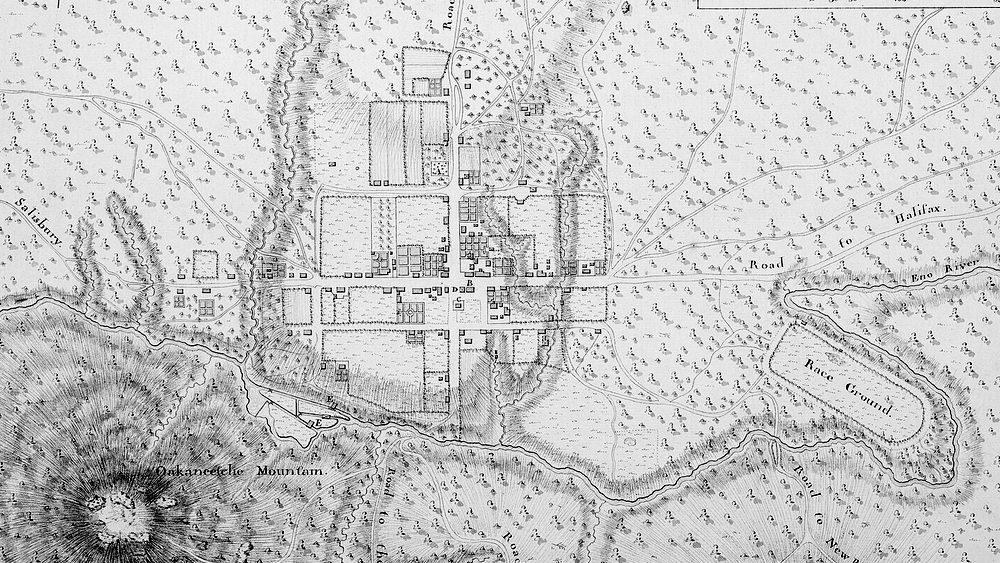
C. J. Sauthier’s plan of Hillsborough, 1768

Indexed works

Related works found in catalogs and archives across North Carolina. Each links to the institution that holds or provides it.

Narrow these works. Each link opens the search already limited to this event. Counts are indexed works, not copies on a shelf; a work can carry more than one period or place.

The Fullkersons in the Battle of King's Mountain : a revolutionary war story

Dunaway, Stewart E. · 2014 · Stewart E. Dunaway?

Stewart E. Dunaway's family history following the Fulkerson (spelled Fullkerson in the title) and Hilton families through the Revolutionary War, centered on the Battle of King's Mountain fought in South Carolina in October 1780. It traces the families in eighteenth-century Hillsborough and elsewhere in North Carolina and Virginia. Apparently self-published in North Carolina, 2014, 137 pages with illustrations, some in color, maps and portraits.

Why this is here: Catalog heading in the UNC record: Hillsborough (N.C.) -- History -- 18th century.

UNC

The Land Grant Atlas of Old Orange County

Chilton, Mark · 2012 · Hand Made Books

Mark Chilton's oversized atlas plotting eighteenth-century land grants across the original Orange County, which stretched well beyond today's boundaries into what became Alamance and Durham counties. Published in Carrboro by Hand Made Books beginning in 2012, the set was planned in four volumes: Henry McCulloh's great tract number 11 and the land north of it; the Saxapahaw old fields (volume 2); Chapel Hill, Hillsborough and the Johnston Tract; and Durham, Rougemont and McCulloh's tract number 12. Maps and color illustrations, 41 cm.

Why this is here: Catalog heading in the UNC record: Orange County (N.C.) -- History -- 18th century.

Jesse Benton Letters (1780-1790)

Dunaway, Stewart E. · 2009 · lulu.com

Stewart E. Dunaway's transcription of letters exchanged between Jesse Benton and Thomas Hart from 1780 to 1790, concerning Hart's affairs at Hartford, his place at Hillsborough. The letters concern the economic and social conditions of Hillsborough in the eighteenth century and the Revolution in North Carolina. Self-published through lulu.com in 2009, 68 pages with illustrations and facsimiles, and part of the library's Wall Local History Collection.

Why this is here: Catalog heading in the NC Cardinal record: Hillsborough (N.C.) -- History -- 18th century.

The Young Man From Mitre Court

Smith, Marshall L. · 1998 · M.L. Smith

Marshall L. Smith's brief life of William Churton, 1710 to 1767, the surveyor who laid out Hillsborough in the 1750s, with notes on the Churton family. Self-published in Hillsborough in 1998, 22 unnumbered pages with illustrations and maps.

Why this is here: Catalog heading in the Library of Congress record: Churton, William, 1710-1767.

The History Of Few's Ford (Eno V. 8, No. 1)

Anderson, Jean Bradley · 1989

Jean Bradley Anderson's history of Few's Ford, the Eno River crossing that gave its name to the Fews Ford section of Eno River State Park, published in 1989 as volume 8, number 1 of Eno, the journal of the Eno River Association. Topics include the Few family and eighteenth-century Orange and Durham county history.

Why this is here: Catalog heading in the NC Cardinal record: Orange County (N.C.) -- History -- 18th century.

Letters and dispatches from William Tryon to the Earl of Hillsborough, October 1768 - May 1769

2019 · Adam Matthew Digital

Governor William Tryon's correspondence with the Earl of Hillsborough for the months from October 1768 to May 1769, just after Tryon marched militia to Hillsborough to protect the court from the Regulators. Adam Matthew Digital reproduced the file, Colonial Office CO 5/301, in 2019. Topics include legislation, Anglican clergy, soldiers' wages, sheriffs, land and quitrents, trade and currency, taxes and education, the Catawba and the boundary line, roads, a murder case, punishment and prison, and people such as Richard Caswell, James Hasell and John Rutherford.

Why this is here: The record names this subject alongside a heading for the county or its towns.

Show 6 more

Jesse Benton letters (1780-1790) : Hartford, Hillsborough, NC.

Benton, Jesse · 2009 · S.E. Dunaway

Letters written between 1780 and 1790 by Jesse Benton, a lawyer at Hillsborough, to Thomas Hart, the owner of the Hartford mill complex, edited by Stewart Dunaway and published in 2009. Sixty eight pages with illustrations, facsimiles and a plan. The correspondence falls in the Revolutionary and early federal years.

Why this is here: Catalog heading in the UNC record: Hillsborough (N.C.) -- History -- 18th century.

UNC

Farmers in court : Orange County, North Carolina, 1750-1776

Bushman, Richard L. · 2001

Richard L. Bushman looks at the county court of Orange County and the farmers who came before it between 1750 and 1776, a period that in this county included the Regulator insurrection of 1766 to 1771. Published in 2001 as pages 388 to 413 of a larger volume. Topics include courts, farmers and eighteenth century law in the county.

Why this is here: Catalog heading in the UNC record: Orange County (N.C.) -- History -- 18th century.

UNC

The Orange County and Mecklenburg County instructions : the development of political individualism in backcountry North Carolina, 1740-1776

Blower, Daniel Frederick · 1984

Daniel Frederick Blower's two volume study of the instructions that voters in Orange and Mecklenburg counties gave their representatives, and of the growth of political individualism in the North Carolina backcountry between 1740 and 1776. Five hundred ninety-one leaves with a bibliography, completed in 1984. Topics include colonial politics and government and representative government in the province.

Why this is here: Catalog heading in the UNC record: Orange County (N.C.) -- History -- 18th century.

UNC

A map of Orange County, N.C.

Noble, M. C. S. (Marcus Cicero Stephens), 1855-1942 · 1915

Marcus Cicero Stephens Noble drew this 1915 map to show how Orange County's original territory was divided, tracing the formation of Caswell, Person, Alamance, Durham, Chatham, Randolph, Guilford and Rockingham counties out of it. Topics include county boundaries and the history of political divisions in the Piedmont. Surviving as a photocopy on a sheet 31 by 23 centimeters.

Why this is here: Catalog heading in the UNC record: Orange County (N.C.) -- Boundaries -- History -- Maps.

UNC

Towns of the Revolution - Hillsborough, N.C.

Colton, Henry E. · 1856

Henry E. Colton's account of Hillsborough as a town of the Revolution, dated 1856 and paginated 161 through 176, which marks it as a piece lifted from a larger volume. It concerns eighteenth century Hillsborough and the Revolutionary War in North Carolina.

Why this is here: Catalog heading in the UNC record: Hillsborough (N.C.) -- History -- 18th century.

UNC

Copy of The Journal of the Proceedings of the Provincial Congress of North Carolina, held at Hillsborough on the 20th of August, 1775

1775

The provincial congress of North Carolina met at Hillsborough on 20 August 1775, and this copy of its journal records the delegates and their proceedings as the colony moved toward war. Samuel Johnston, Richard Caswell, Samuel Spencer and Thomas Wade are among the men named, with delegates drawn from Anson, Rowan and other counties. The congress sat in Orange County. Reference CO 5/318.

Why this is here: The record names this subject alongside a heading for the county or its towns.

Search all 83 indexed works →

Start at OCPL

Books in OCPL’s Rebecca B. Wall Local History Collection whose titles, catalog subjects, or descriptions match this event. The Friends’ recommended starting points are labelled. Books marked Wider context cover the broader subject rather than this event itself.

  • Start here · NC 333.16 CHILTON The Land Grant Atlas of Old Orange County Chilton, Mark · 2012

    Mark Chilton's oversized atlas plotting eighteenth-century land grants across the original Orange County, which stretched well beyond today's boundaries into what became Alamance and Durham counties. Published in Carrboro by Hand Made Books beginning in 2012, the set was planned in four volumes: Henry McCulloh's great tract number 11 and the land north of it; the Saxapahaw old fields (volume 2); Chapel Hill, Hillsborough and the Johnston Tract; and Durham, Rougemont and McCulloh's tract number 12. Maps and color illustrations, 41 cm.

  • Rebecca Wall Collection · NC BIO CHURTON SMI The Young Man From Mitre Court: William Churton, Surveyor, 1710-1767 Smith, Marshall L. · 1998

    Marshall L. Smith's life of William Churton (1710 to 1767), the Granville District surveyor who in 1754 laid out the town that became Hillsborough. Named Orange County's first register of deeds in 1752, Churton sat for Orange in the colonial assembly, helped extend the Virginia boundary line in 1749 and worked from 1757 until his death on a map of the province. Issued by the author at Hillsborough in 1998; unpaged, with illustrations and maps.

  • Wider context · NC BIO CARTERET DUN Lord John Carteret - Earl Granville and the Granville Grants in N.C: A History Dunaway, Stewart E. · 2013

    John Carteret (1690 to 1763), the British statesman who inherited the title Earl Granville in 1744, and the land grants issued in his North Carolina proprietary are Stewart E. Dunaway's subject. The Granville District, a strip about sixty miles wide along the Virginia line, took in nearly half the colony's land after 1729. Privately published in 2013; 243 pages with maps, facsimiles, a genealogical table, a bibliography and an index.

Show 3 more
  • Rebecca Wall Collection · NC 929.2 DUNAWAY William Churton, Colonial Surveyor of North Carolina (1711-1768) Dunaway, Stewart E. · 2004

    William Churton, surveyor for Earl Granville, came to the colonies around 1749 and in 1754 laid out the town that became Hillsborough, the Orange County seat. Stewart E. Dunaway's life history of him follows his surveying career and his family, illustrated with maps and facsimiles and closing with a bibliography and an index. Published by the author in Hillsborough in 2017 through Lulu; 166 pages.

  • Rebecca Wall Collection · NC 920 CON Revolutionary Leaders of North Carolina Connor, R. D. W. · 1971

    Lectures on North Carolina's Revolutionary generation that R. D. W. Connor gave at the State Normal and Industrial College in the spring of 1913. A survey of the colony and state from 1765 to 1790 is followed by studies of four leaders: John Harvey, Cornelius Harnett, Richard Caswell and Samuel Johnston. Published in 1916 as the college's Historical Publications no. 2; reprinted in 1971, 125 pages.

  • Wider context · NC 929.375 HOF Province of North Carolina, 1663-1729: Abstracts of Land Patents Hofmann, Margaret M. · 1979

    Land patents issued in North Carolina from 1663 to 1729, the years the Lords Proprietors held the colony, abstracted by Margaret M. Hofmann. Proprietary rule ended in 1729, when every Proprietor except the Earl of Granville sold out to the Crown. The Roanoke News Company of Weldon published the 384 pages in 1979, with a map and indexes; the last four pages are left blank for notes.

In the chronology

Dated events connected with this event, earliest first. See these 35 dated events in the chronology →

  1. The Great Trading Path across the Eno becomes the settlers' wagon road The Indian route that Virginia traders had used since the 1670s crossed the Flat and Little rivers, forded the Eno at the place where the county town was laid out, and crossed the Haw near Swepsonville. After colonists reached the Piedmont in the mid eighteenth century the path was widened into a wagon road, and it is drawn on the colonial maps of Moseley, Collet and Mouzon.Search the index · NCpedia: Great Trading Path
  2. Alexander Mebane, the first sheriff, returns 1,113 taxables As Orange County's first sheriff, Mebane returned 1,113 tithables for 1752 and 1753. The book reckons this at about 4,000 people when the county was formed.Lefler and Wager, Orange County, 1752-1952 (1953), p. 14
  3. John Patterson is named one of the first vestrymen of St. Matthew's Parish The act of the 1752 Assembly that created Orange County and the Parish of St. Matthew named John Patterson among the twelve vestrymen who were to serve until the first vestry election. People: Alexander Mebane, James Watson, Mark Morgan, John GraySearch the index · Documenting the American South: Colonial and State Records of North Carolina, vol. 23: Acts of the General Assembly, March 31-April 15, 1752, ch. VI
  4. Orange County is created The colonial assembly formed Orange County from portions of Bladen, Granville, and Johnston counties. Its original boundaries were far larger than those of present-day Orange County. It has long been said to be named for William of Orange, King William III of England; William S. Powell's North Carolina Gazetteer, quoted in the supplementary notes to later printings of Corbitt's Formation of the North Carolina Counties, argues for the infant William V of Orange, then stadholder and a grandson of George II. People: William S. PowellNCpedia
  5. The act creating Orange County names James Watson a boundary commissioner and vestryman The 1752 act that created Orange County named James Watson one of three commissioners to run the dividing line between Orange and Granville, Johnston and Bladen counties, and one of the twelve first vestrymen of St. Matthew's Parish. Another act of the same session made him the county's receiver of the impost duty.Search the index · Documenting the American South, Colonial and State Records: Acts of the North Carolina General Assembly, 1752 (vol. 23, pp. 371-386)
  6. St. Matthew’s Parish is established The act of the spring 1752 General Assembly session that created Orange County also made it the Anglican Parish of St. Matthew, with its own vestry. The parish's first church stood in Hillsborough by about 1768, but today's St. Matthew's Episcopal Church descends from a congregation reorganized in 1824.Search the index · Colonial and State Records of North Carolina, vol. 23: Acts of the General Assembly, March 31–April 15, 1752, ch. VI
  7. The Orange County court holds its first session at John Gray's house Eight justices of the peace held the county's first Court of Pleas and Quarter Sessions at John Gray's house near the Eno River, with Alexander Mebane as sheriff and Richard Caswell as clerk. They named fifteen road commissioners and several constables and laid a poll tax of one shilling on each tithable. People: John Patterson, John Gray, Richard CaswellLefler and Wager, Orange County, 1752-1952 (1953), p. 19
  8. The county court contracts for a courthouse and prison near Piney Ford The justices chose a site north of the Haw River within two miles of Piney Ford and gave Marmaduke Kimbrough the contract for a frame courthouse and a log prison. They met at the site in December, but the buildings were probably never finished.Lefler and Wager, Orange County, 1752-1952 (1953), p. 19
  9. William Churton presents his commission as public register At the December court, Lord Granville's surveyor William Churton showed the governor's commission naming him the county's public register, the office later called register of deeds. He went on to lay out the county seat. People: William ChurtonLefler and Wager, Orange County, 1752-1952 (1953), p. 167
  10. Richard Caswell serves as the first clerk of the Orange County court Caswell, a deputy clerk in Johnston County, became the first clerk of the court of the newly formed Orange County. He held the post only briefly and resigned on being appointed high sheriff of Johnston.Search the index · NCpedia: Caswell, Richard
  11. The Assembly redraws Orange County's line with Granville A year after creating Orange, the Assembly replaced the eastern line the 1752 act had set, which ran from the Virginia line near Hico Creek to the bend of the Eno below the Occaneechi town and then down the Eno and the Neuse. Finding a new line more convenient for the county's inhabitants, it ordered one run from the Virginia line twenty miles west of Granville Court House due south to the Neuse River, then down the Neuse to the mouth of Horse Creek.Internet Archive: David Leroy Corbitt, The Formation of the North Carolina Counties, 1663-1943 (1950; 1975 printing), p. 28, quoting the act (State Records of North Carolina, vol. 23, p. 390)
  12. The creation of Rowan County gives Orange a western boundary Orange had no fixed western line until Rowan was formed. The new county also left the planned courthouse site at Piney Ford only fifteen miles from Orange's western edge.Lefler and Wager, Orange County, 1752-1952 (1953), p. 17
Show all 35 dated events
  1. Hillsborough is laid out William Churton laid out a town and common on a 400-acre tract on the north side of the Eno that was granted to him in 1754, where the trading path crossed the river. Known as Corbinton by 1755, it was incorporated as Childsburg by an act of the 1759–60 session and renamed Hillsborough in 1766. People: William ChurtonColonial and State Records of North Carolina, vol. 25: Acts of the General Assembly, 1759–1760, ch. XIII (town of Childsburg)
  2. The Assembly moves the county seat to the Eno crossing of the Western path Judging the Piney Ford site too far west, the Assembly directed that the courthouse, prison and stocks stand where the Western path crossed the Eno, on land where James Watson lived. The site, just east of the present courthouse, was the start of Hillsborough. People: James WatsonLefler and Wager, Orange County, 1752-1952 (1953), p. 169
  3. The Orange County court moves to the new town on the Eno Nash dates the county court's first sitting at the new county town to 1754, the year Churton laid off the town.Nash, Hillsboro, Colonial and Revolutionary (1903), p. 6
  4. The burying ground beside the town church lot is laid out The cemetery next to the site of the present Presbyterian church, later called the Old Town Cemetery, was laid out in 1754, the year the town itself was laid off.Pauline O. Lloyd and Allen A. Lloyd, History of the Churches of Hillsborough, N.C., ca. 1766-1962 (1963), scan p. 133
  5. The county court names trustees for Corbin Town James Watson, Josiah Dixon and Lawrence Thompson became commissioners and trustees of the county seat, then called Corbin Town after Francis Corbin, Earl Granville's land agent. People: James Watson, Lawrence ThompsonLefler and Wager, Orange County, 1752-1952 (1953), p. 19
  6. Town treasurer John Patterson is told to hold back ten shillings a lot for public use The county court directed Patterson to keep ten shillings sterling from the price of each Corbin Town lot for public purposes. People: John PattersonLefler and Wager, Orange County, 1752-1952 (1953), p. 19
  7. Alexander Mebane, Josiah Dixon and William Churton lay out Hillsborough's first prison Lot No. 1 in the town was set aside for the market house, courthouse, prison, pillory and stocks. People: William ChurtonSearch the index · Lefler and Wager, Orange County, 1752-1952 (1953), p. 23
  8. James Watson succeeds Richard Caswell as clerk of the Orange County court Watson, one of the town's first residents, was the second clerk of the county court from 1755 to 1763. He was named register of the county in 1772 and was reappointed under the state government shortly before his death. People: Richard Caswell, James WatsonNash, Hillsboro, Colonial and Revolutionary (1903), p. 6
  9. The first Orange County courthouse is built at Hillsborough A frame courthouse went up at the new county seat in 1755. Until then the court had met in private homes.Lefler and Wager, Orange County, 1752-1952 (1953), p. 169
  10. Herman Husband buys two town lots from William Churton Years before he became a Regulator leader, Herman Husband bought two lots in Corbinton from William Churton and built a house on them. He lived in the town only a few months. People: Herman Husband, William ChurtonNash, Hillsboro, Colonial and Revolutionary (1903), p. 19
  11. The Assembly re-creates Orange County and St. Matthew's Parish by a new act The 1752 act that made Orange a county and the parish of St. Matthew's appears to have been voided by royal proclamation, so the colonial Assembly passed a fresh act in 1756 setting up both again.Joseph Blount Cheshire, An Historical Address Delivered in Saint Matthew's Church, Hillsboro, N.C. (1925), scan p. 14
  12. Hillsborough's first courthouse is ready for use Until it opened, the county court met at the home of James Watson. It was the first of the four courthouses Hillsborough has had. People: James WatsonLefler and Wager, Orange County, 1752-1952 (1953), p. 20
  13. The town on the Eno is incorporated as Childsburg The town William Churton had laid out in 1754 as Corbin Town or Corbinton was incorporated by act of assembly in 1759 as Childsburg, named for Thomas Child, the colony's attorney general. It was renamed Hillsborough in 1766. People: William ChurtonSearch the index · NCpedia: Orange County
  14. Part of southeastern Orange is annexed to Johnston County An act of 1761 moved part of Orange into Johnston County, setting the line from the southwest corner of Granville County due south to whichever it met first of the Johnston or Cumberland county lines.Internet Archive: David Leroy Corbitt, The Formation of the North Carolina Counties, 1663-1943 (1950; 1975 printing), p. 167, quoting the act (State Records of North Carolina, vol. 23, p. 647)
  15. Abner Nash settles briefly in Hillsborough and builds the town's first mill on the Eno The Virginia lawyer Abner Nash moved to Hillsborough, then called Childsburgh, in 1762 or early 1763 with his younger brother Francis. He bought town lots, dammed the Eno River and built the town's first mill before moving to Halifax by 1764. People: Francis NashSearch the index · NCpedia: Nash, Abner (Dictionary of North Carolina Biography)
  16. Francis Nash becomes clerk of the Orange County court Having settled at Childsburgh (Hillsborough), where he kept a store and a law practice, Francis Nash became clerk of the Orange County court in 1763. A superior court clerkship at Hillsborough was possible only after the 1767-68 act made the town a district court seat, with its first term in March 1768.Search the index · NCpedia: Nash, Francis
  17. The county town becomes a courthouse village of stores, ordinaries and public buildings William Few recalled that in 1764 the town was the metropolis of the county, where the courts were held and all public business done, a village of thirty or forty inhabitants with two or three small stores and two or three ordinary taverns, and that Scottish merchants then opened stores of European goods and a church, courthouse and jail were built. Claude Joseph Sauthier's 1768 plan of the town marks Canby's Ordinary, Nunn's Ordinary, McNair's Store, the market house, the first courthouse and the second jail. People: William FewSearch the index · Orange County Historical Museum (Churton Street): 1768
  18. Childsburgh is renamed Hillsborough Childsburgh was renamed Hillsborough in honor of Wills Hill, Earl of Hillsborough. People: Wills Hill, Earl of HillsboroughNCpedia
  19. Town lot owners are required to build, and taxable men to work the streets Building requirements enacted in 1766 gave the purchaser of a town lot two years to put up a brick, stone or frame house at least twenty feet long, sixteen feet wide and nine feet pitch in the clear, with a brick or stone chimney. A separate ordinance made all taxable males liable for street service under a penalty of two shillings eight pence for each day neglected.Search the index · Orange County Historical Museum (Churton Street): 1768
  20. The Assembly fixes the Orange County court at Hillsborough for good Twelve years after the county court first sat at the town, the colonial Assembly made that location permanent in November 1766, the same month the town took the name Hillsborough.Nash, Hillsboro, Colonial and Revolutionary (1903), p. 6
  21. Governor Tryon reports that Hillsborough has hardly twenty families Writing to the colonial secretary about the town's new name, Tryon put its resident households at scarcely twenty but predicted it would soon be the leading inland town of the province. People: William TryonNash, Hillsboro, Colonial and Revolutionary (1903), p. 9
  22. Hillsborough's town commissioners sign the earliest town deed on record James Watson, William Nunn, Edmund Fanning and Francis Nash, acting as commissioners for the town, sign the earliest of the Hillsborough town deeds kept by the Orange County register of deeds. People: Edmund Fanning, Francis Nash, James Watson, William NunnLefler and Wager, Orange County, 1752-1952 (1953), p. 367
  23. Fire destroys the greater part of Hillsborough A letter written at Hillsborough early in March 1790 reported that the greatest part of the town had been destroyed by fire a few days earlier, news that reached New Bern by March 18 and was printed in the State Gazette of North Carolina on March 27. The district and county courthouse was among the buildings lost, the courts moved into a private house, and the General Assembly ordered a replacement built on the same lot before the year was out.North Carolina Newspapers (DigitalNC): The State gazette of North-Carolina, March 27, 1790, Page 3

Places in this history

Buildings, schools, churches and other sites named in the dated events on this page, the most often named first. The map shows them all.

Map tiles © OpenStreetMap contributors. Site locations from the N.C. State Historic Preservation Office survey, Open Orange and OpenStreetMap; town and community pins mark the middle of their mapped buildings.

All places and the county map →

The county’s shape through time

Orange County as the legislature drew and redrew it, from the vast county of 1752 to the county of today. Choose a date to see its outline then; the dashed lines are its other shapes.

County outlines: Atlas of Historical County Boundaries, The Newberry Library. Map tiles © OpenStreetMap contributors.

Research sources

Resources picked for this event, each with a note on what it holds.

Background 7

Show all 7

Historic sites, markers, and maps

Records of the time

Collections and databases

Local help

Picture: C. J. Sauthier’s plan of Hillsborough, 1768. Public domain. C. J. Sauthier, 1768

More to discover

Keep Reading Local

The Friends connect people with new library materials, local writers and publishers, and resources documenting Orange County.

Two mice reading back to back against a leaf, with the hand-lettered words Friends of the Orange County Public Library
Illustration by Caldecott Medalist Matthew Cordell, gifted to the Friends 2026