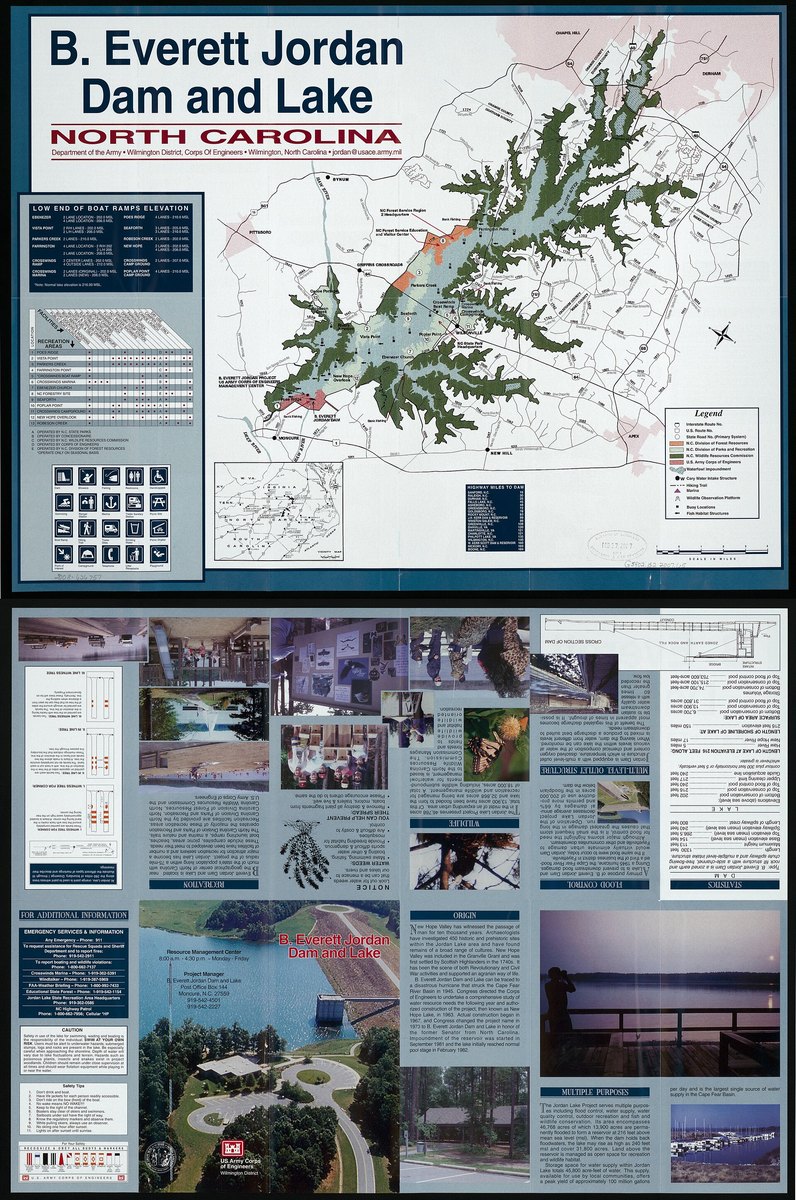
A week after Governor Bob Scott broke ground for the New Hope Dam at Moncure in December 1970, the Chapel Hill aldermen unanimously asked the Army Corps of Engineers to study its environmental effects. In August 1971 ECOS joined conservationists' suit against the Corps to halt the dam, and in September the aldermen asked the state to spell out the water-quality standards the town would have to meet after it ordered sharp cuts in phosphorus discharges; Town Manager Robert Peck put the town's capital cost at about $130,000. At a hearing the board called on January 31, 1972, with Mayor Howard Lee presiding, speakers from ECOS and the League of Women Voters criticized the dam, the Chamber of Commerce backed it, and a standing vote ran about 3 to 1 against it. On February 4 the aldermen voted 3 to 1 to ask to join the suit, protesting that towns above the reservoir would bear the cost of cleaning their water to lake standards.
On September 11, 1976 the Army Corps of Engineers filed notice in federal court that it intended to fill the B. Everett Jordan (New Hope) reservoir, and on September 27 the aldermen authorized the town attorney to challenge it. Chapel Hill and Durham feared the lake would bring stricter treatment standards for their sewage plants, and the town had helped block a similar Corps motion in 1973. After U.S. District Judge Eugene A. Gordon ruled on July 28, 1977 that the Corps could fill the 14,300-acre lake, the town, an intervening plaintiff beside the original plaintiffs (the Conservation Council of North Carolina, ECOS and several landowners), gave notice of appeal to the Fourth Circuit after a special meeting of the board. On October 24, 1977, answering a citizen's petition that the town change its stand, the aldermen voted 6 to 2 to keep opposing the filling, with Edward Vickery and Thomas Gardner voting to end the legal fight. On January 30, 1979 they decided not to carry on the suit, after Town Attorney Emery Denny Jr. said an appeal was unlikely to succeed and would be very costly.
At 11 a.m. on September 1, 1981 the Army Corps of Engineers lowered the gates of the B. Everett Jordan dam near Moncure, and the reservoir at the meeting of the Haw and New Hope rivers, a project of about 47,000 acres reaching into southeastern Orange County, began to fill, 18 years after Congress approved it as New Hope Lake. On September 26, 1983 the Chapel Hill Town Council voted unanimously to recommend that the state Environmental Management Commission classify the reservoir as class B, fit for boating and swimming, rather than class A for drinking water. Mayor Joe Nassif, who had told the Triangle J Council of Governments on September 22 that the lake should not yet be used for drinking, said about 75 percent of its water came from the Haw River, where a UNC study had found 37 known and 15 unknown chemicals.
Reading on the places and people in this storyline
No indexed work is about this storyline itself yet. These are about the sites and people its dated events name, those named most often first, so they may discuss the storyline only in part. Follow a link to find a copy or view the material.
The Courage to Lead: One Man's Journey in Public Service
Lee, Howard N. · 2008 · Cotton Patch Press
Howard N. Lee (born 1934) tells his own story, from a farm childhood in Lithonia, Georgia, through college, army service in Korea at Camp Casey and the move from Savannah that planted him in Chapel Hill, to his election as mayor of Chapel Hill in 1969 and his later run for Congress and years in the state legislature. Published by Cotton Patch Press of Chapel Hill in 2008, 199 pages with plates.
Oral history interview with Edwin Caldwell, March 2, 2001: interview K-0202, Southern Oral History Program Collection (#4007)
Caldwell, Edwin · 2006 · University Library, UNC-Chapel Hill
Edwin Caldwell, Jr. reviews a life in Chapel Hill politics in a three-hour Southern Oral History Program interview recorded March 2, 2001, by Oliver White. A skilled organizer, Caldwell worked in the campaign that made Howard Lee the town's first Black mayor in 1969, ran for office more than once without winning, and became a local political power. The conversation also covers race relations, the Chapel Hill-Carrboro school board and the Church of Reconciliation. Published online in 2006 in Documenting the American South.
Oral history interview with Rebecca Clark, June 21, 2000: interview K-0536, Southern Oral History Program Collection (#4007)
Clark, Rebecca · 2006 · University Library, UNC-Chapel Hill
Interview recorded June 21, 2000 with Rebecca Clark (1915-2009), a Black Chapel Hill resident, for the Southern Oral History Program at UNC. Clark, educated in Chapel Hill's segregated schools, describes working life under segregation and the economic discrimination she met in it. Topics also include Lincoln High School, school integration, and Howard Lee, elected mayor of Chapel Hill in 1969. Interview K-0536 in collection #4007.
My life of breaking barriers, building bridges, and making history
Lee, Howard, 1934- · 2021 · North Caroliniana Society
Howard N. Lee's account of his own career, published in 2021 by the North Caroliniana Society with the society award given to him that year, together with tributes from Angela Lee, Valerie Foushee and others. Lee became mayor of Chapel Hill in 1969, the town's first Black mayor.
Wider background: Eno & Environment · the most widely held histories of the theme this storyline is filed under; they may not discuss it
Chapel Hill and Elisha Mitchell the Botanist
McVaugh, Rogers; McVaugh, Michael R.; Ayers, Mary · 1996
Elisha Mitchell, the University of North Carolina professor for whom Mount Mitchell is named, as botanist and as observer of early Chapel Hill, in a study by Rogers McVaugh, Michael R. McVaugh and Mary Ayers. It covers Mitchell's botanical knowledge, the plants of Chapel Hill and the town's historical geography. Published by the Botanical Garden Foundation in Chapel Hill in 1996, 122 pages with illustrations and maps.
Carrboro, N.C
Brown, Claudia Roberts · 1983
Architectural and historical inventory of Carrboro by Claudia Roberts Brown, published in 1983 by the Carrboro Appearance Commission and the town. The 48-page survey, with illustrations and maps, documents the town's historic buildings and their conservation.
Ribbons of Color Along the Eno River
2021
Collected first-hand and second-hand stories from the Eno River valley as told from the standpoint of African Americans and Native people who have lived along the river in Orange and Durham counties, from prehistory to the present day. Issued by the Eno River Association in Durham as volume 10, number 2 of the Eno Journal, 2021, 106 pages with illustrations.
Rogers Road
Pearce, Emily Eidenier · 2009
Emily Eidenier Pearce's history of Rogers Road, the historically African American neighborhood on the edge of Chapel Hill and Carrboro, and of what happened to it after Orange County opened its landfill next door in 1972. Drawing on interviews with residents, the book records the neighborhood's origins, family life, churches and customs, and then the environmental and social burdens of decades beside the landfill. Privately issued in 2009, 298 pages with illustrations, maps and portraits.
Dark Tales of the Eno River
Cook, David · 2025 · The History Press
David Cook collects the grim side of the Eno River's past in Orange and Durham counties: ghost stories, crimes, train wrecks and accidents, including the hanging of rebels near the river in 1771, a sawmill accident said to have started a run of hauntings, and a dance one Valentine's Day that ended badly. Published by The History Press in 2025, 141 pages with illustrations.
Johnston and Robson Mill History, New Hope Creek (Orange Co., N.C.)
Dunaway, Stewart E. · 2010
Stewart E. Dunaway's history of the two mills George Johnston built on New Hope Creek in Orange County, the first in 1793 and the second in 1820, the earlier of which he sold to the Englishman William Robson. Self-published in 2010, 256 pages with illustrations, maps and facsimiles. Topics include gristmills in Orange County and the Blackwood, Johnston, Robinson and Robson families, so the volume serves both mill history and genealogy.
Show 6 more
An Historical Address Delivered in Saint Matthew's Church, Hillsboro, N.C., on Sunday, August 24, 1924
Cheshire, Joseph Blount · 1925
Address by Bishop Joseph Blount Cheshire at St. Matthew's Church in Hillsborough on 24 August 1924, marking the parish's hundredth anniversary. Printed in Durham in 1925 at the vestry's order, with a foreword by the rector. Cheshire discusses George Micklejohn, William Mercer Green and Moses Ashley Curtis.
History of Patterson Mill, New Hope Creek, Orange County, NC
Dunaway, Stewart E. · 2010
Stewart E. Dunaway's 2010 study of Patterson Mill, a gristmill site on New Hope Creek where Orange County meets Chatham County. The book pairs a short genealogy of the Patterson family with a close survey of what remains of the mill on land now inside Duke Forest, supported by maps, facsimile documents and illustrations across 176 pages. Self-published in a second issue dated October 10, 2010.
Obstetrics and gynecology at the University of North Carolina at Chapel Hill : the first half century
2000
Departmental history of obstetrics and gynecology at the University of North Carolina at Chapel Hill covering its first fifty years, published by the department in 2000. The history covers medical schools, medical education and the teaching of obstetrics in North Carolina. First edition, xvii and 366 pages with illustrations and portraits.
A Generosity of Spirit: The Early History of the Research Triangle Park
Link, Albert N. · 1995 · Research Triangle Foundation of North Carolina
Albert N. Link's early history of Research Triangle Park, published in 1995 by the Research Triangle Foundation of North Carolina. Topics include research parks, research institutes and industrial research in the state, with the park's own history at the center. 149 pages with illustrations and maps.
Eno: Reflections on Eno River State Park
McIntyre, Michael · 1993
Michael McIntyre's 23-minute documentary video on the Eno River and Eno River State Park, produced in Durham in 1993 with support from the Duke University Institute of the Arts. It covers the river's past, its geology and the effort to preserve it, including the Indigenous peoples of the Eno River region. The container credits it with the 1993 Hal Kammerer Film and Video Award at Duke. VHS videocassette, color with sound.
Early Quakers in the Eno River Valley
Engstrom, Mary Claire · 1989 · Association for the Preservation of the Eno River Valley
Mary Claire Engstrom's history of the Quaker settlers of the Eno River valley from about 1750 to 1847, in the country that is now Orange and Durham counties. Published by the Association for the Preservation of the Eno River Valley in Durham in 1989, 73 pages with illustrations, maps and portraits.