Skip to content

Storyline · 1825–1859

Temperance and the liquor question in Orange County, 1825–1859

Treating voters with liquor, and the liquor trade itself, drew organized opposition in Orange County from 1825 to 1859. In 1825 a court house meeting declared treating injurious to morality, and about 1827 the university trustees won a law against distilling or selling liquor at or near Chapel Hill. Temperance societies spread from 1829; by 1834 the Hawfields and Cross Roads society counted 437 members, and at least nine or ten distilleries had stopped. In 1841 Hillsborough men formed a Washington Temperance Society. In 1854 the county voted against the liquor 'Reform' question, but the 1855 Revised Code barred liquor sales within two miles of Chapel Hill, and in 1859 the village banned traveling liquor sellers.

1825–1859 Filed under Community & Civic Organizations 14 dated events

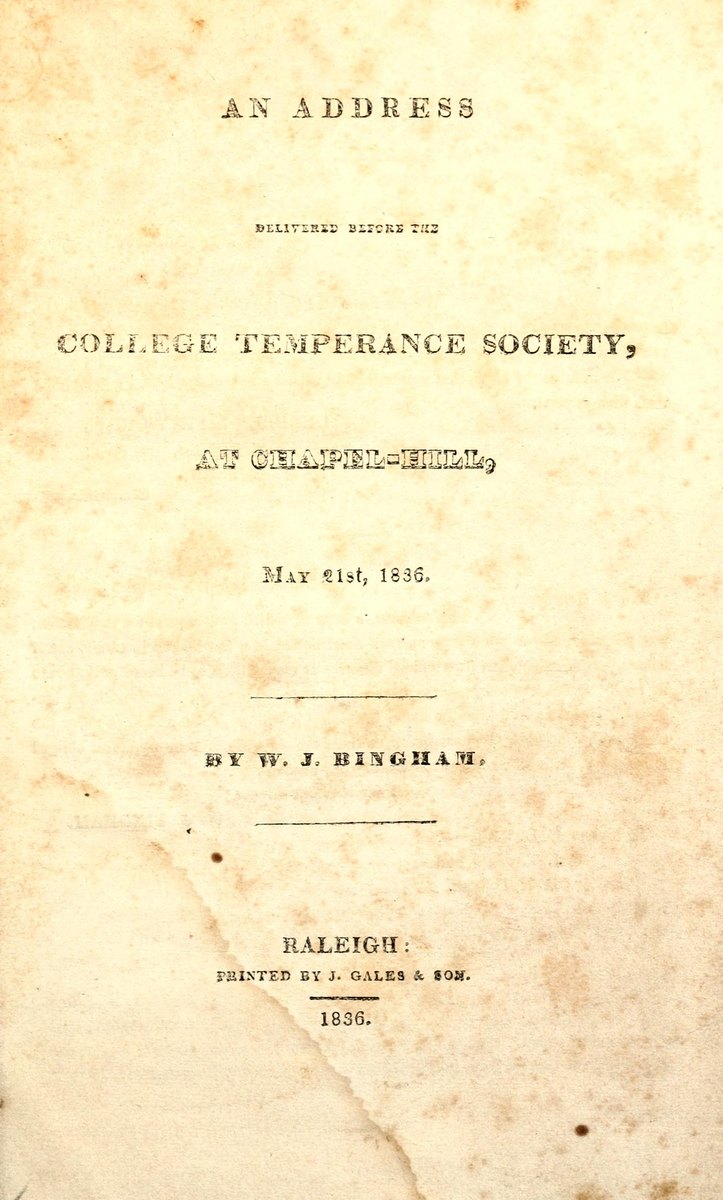
Title page of William J. Bingham's address to the College Temperance Society at Chapel Hill, 1836
Title page of William J. Bingham's address to the College Temperance Society at Chapel Hill, 1836William James Bingham, printed by J. Gales & Son, 1836; Internet Archive · Public domain · Source

On May 26, 1825 a meeting at the Orange court house under Dr. James S. Smith declared candidates' treating of voters with liquor injurious to morality. About 1827 the university trustees sought a law against distilling or selling liquor at or near Chapel Hill, and it passed. In 1828 the Orange Peace Society called any candidate who treated voters unfit for public trust. In 1829 students formed a temperance society, citizens organized the Orange County Temperance Society, and the Hawfields and Cross Roads Temperance Society was organized; by 1834 it counted 437 members and at least nine or ten distilleries stopped. In 1841 a debate at Mount Zion meeting house voted for the societies by more than three to one, and Hillsborough men formed a Washington Temperance Society, whose pledge about half the town's adult men signed. In May 1842 delegates formed a county society auxiliary to the state society, and in 1845 a convention asked the justices to shut down grog shops. In 1854 Orange's Whig and Democratic conventions agreed to put the liquor question to the voters, and in August the county voted against the liquor 'Reform' question. In 1855 the Revised Code barred liquor sales within two miles of Chapel Hill, and in 1859 Chapel Hill banned traveling liquor sellers from the village.

Towns
Hillsborough, Chapel Hill
People with pages
21

The events, date by date

Every statement above comes from these dated entries in the chronology. Each links to its source.

  1. Orange citizens resolve to stop candidates from treating voters with liquor A meeting of Orange County citizens at the court house, with Dr. James S. Smith in the chair, declared that candidates' custom of treating voters with liquor was injurious to morality. It asked each militia captain to call his company together to choose two delegates to a convention at Hillsborough during the next county court to devise a plan against the practice. A first meeting on May 24 under Gen. Jehu Byrd had called it. People: James Strudwick Smith, John Wall Norwood Place: Court house, Hillsborough · Also named: Jehu ByrdSearch the index · Hillsborough Recorder, May 25, 1825, p. 3 · Also: Hillsborough Recorder, June 15, 1825, p. 3
  2. Trustees name Badger, Yancey and Moore to draft a law against liquor and student credit at Chapel Hill On President Caldwell's motion the trustees named Bartlett Yancey, George E. Badger and Alfred Moore to prepare a bill forbidding the distilling or selling of spirituous liquors at or near Chapel Hill and barring village merchants from trading with students. It became law; Battle says the liquor ban still stood in 1907 while the trading ban was ignored and later repealed. People: George E. Badger, Alfred Moore, Joseph Caldwell Place: Chapel Hill · Also named: Bartlett YanceySearch the index · Documenting the American South: Kemp P. Battle, History of the University of North Carolina, vol. I (1907), p. 304
  3. The Orange Peace Society condemns party spirit and treating at elections Meeting on March 28, the Orange Peace Society resolved that any candidate who stirred sectional feeling or treated voters with liquor to win their votes was unfit for public trust, and that men who scoffed at neighbors who voted differently acted against the peace of the republic. It asked editors to print the resolutions over the name of its secretary, Joshua Lindley. Place: Orange County · Also named: Joshua LindleySearch the index · Hillsborough Recorder, May 7, 1828, p. 3
  4. Students organize a temperance society Some students formed a Temperance Society in the summer of 1829, and Battle credits it with reducing drinking of spirits at the college. At its request Elisha Mitchell gave an address on intemperance in 1831 that was printed. People: Elisha Mitchell Place: Chapel HillSearch the index · Documenting the American South: Kemp P. Battle, History of the University of North Carolina, vol. I (1907), p. 340
  5. Citizens form the Orange County Temperance Society Citizens of Hillsborough and the county met at the court house and organized the Orange County Temperance Society, auxiliary to the American Temperance Society, whose members pledged to give up distilled spirits except as medicine and neither to make nor sell them. Place: Court house, HillsboroughSearch the index · Hillsborough Recorder, September 23, 1829, p. 3
  6. The Hawfields and Cross Roads Temperance Society is organized After a first meeting on September 5, 1829 at which twenty-five people took the total-abstinence pledge, the Hawfields and Cross Roads Temperance Society organized on December 25, 1829. Its report of July 4, 1834 counted 437 members, at least nine or ten distilleries stopped since 1829 and two merchants who had quit selling spirits. Place: Hawfields and Cross Roads, Orange County (now Alamance County)Search the index · Hillsborough Recorder, July 23, 1834, p. 3
  7. A public debate at Mount Zion meeting house votes that temperance societies do good A meeting at Mount Zion meeting house, near several distilleries, debated whether temperance societies had benefited the community, with Frederick Stafford in the chair and Eli Eulis as secretary. After an afternoon of argument by ministers and others on both sides, the crowd, drawn from Orange, Randolph, Chatham and Guilford, voted for the societies by more than three to one. Place: Mount Zion meeting house, Orange County · Also named: Frederick Stafford, Eli EulisSearch the index · Hillsborough Recorder, July 22, 1841, p. 2
  8. Hillsborough men form the Washington Temperance Society of Orange County Meeting at the court house, Hillsborough men organized a Washington Temperance Society on the total-abstinence pledge, adopted a constitution and elected Col. Henry Webb president. The drive followed talks in the village by John F. Carey of the Baltimore Washingtonians, and about half the adult men of Hillsborough signed the pledge. People: James C. Turrentine, William Bingham (1835-1873), George Laws, Lemuel Lynch, Walter A. Norwood, Stephen Moore Place: Court house, Hillsborough · Also named: Henry Webb, John F. CareySearch the index · Hillsborough Recorder, November 18, 1841, p. 3
  9. Delegates form the Orange County Temperance Society at Hillsborough A convention of delegates from the county's temperance societies met at the court house and organized the Orange County Temperance Society, auxiliary to the state society, with every member of a local society counted a member. It elected Thomas Clancy president, James C. Turrentine recording secretary and William J. Bingham corresponding secretary, and set an annual meeting in Hillsborough each August. People: James C. Turrentine, Walter A. Norwood Place: Court house, Hillsborough · Also named: Thomas Clancy, William J. BinghamSearch the index · Hillsborough Recorder, May 26, 1842, p. 3
  10. An Orange County temperance convention asks the justices to shut down grog shops Delegates of the county's temperance societies met in convention at Hillsborough during May court and asked the justices to use their power against retail liquor shops, to follow the Supreme Court's decision on retail licenses, and to refuse licenses except for public convenience. The convention also condemned treating voters at elections and agreed to meet each year on the Tuesday of May court. People: John Hancock Place: Masonic Hall, HillsboroughSearch the index · Hillsborough Recorder, June 5, 1845, p. 3
  11. Orange's Whig and Democratic conventions agree to put the liquor question to the voters A joint committee of the Whig and Democratic conventions agreed, and both conventions adopted, that their nominees would follow the majority of Orange voters on liquor legislation, that the question would be decided by ballots for and against at the August election with the sheriff opening polls for it, and that nominees would not treat voters. People: Edmund Strudwick, John Wesley Carr Place: HillsboroughSearch the index · Hillsborough Recorder, May 31, 1854, p. 3
  12. Orange elects William A. Graham to the state Senate and Phillips and Turner to the Commons Orange County voters elected the Whig ticket: William A. Graham to the state Senate over Cadwallader Jones Jr., and Samuel F. Phillips and Josiah Turner Jr. to the House of Commons over John F. Lyon and William Nelson. The county gave Alfred Dockery, the Whig candidate for governor, 1,080 votes to Thomas Bragg's 963, and voted against the liquor 'Reform' question. People: William A. Graham, Samuel (Samuel Field) Phillips, Josiah Turner Jr., William Nelson, Thomas Bragg, Cadwallader Jones Place: Orange County · Also named: John F. Lyon, Alfred DockerySearch the index · Hillsborough Recorder, August 9, 1854, p. 2
Show all 14 dated events
  1. Revised Code tightens the laws around the university The state's Revised Code barred the sale of liquor within two miles of Chapel Hill, public gaming tables within five, and shows, concerts and performances within five miles without seven days' written leave from the president or faculty. It also voided students' contracts with merchants made without faculty permission and restored escheated real estate to the university. Place: Chapel HillSearch the index · Documenting the American South: Kemp P. Battle, History of the University of North Carolina, vol. I (1907), p. 645
  2. Chapel Hill bans peddlers of liquor from the village The 1859 code fined any traveling seller five dollars each time he offered spirituous liquor or other prohibited goods for sale in any amount within the village limits. The constable was told to arrest such sellers found on the streets by day or night. Place: Chapel HillSearch the index · Act of the General Assembly for the Better Regulation of Chapel Hill, and the Ordinances of the Commissioners (1859), scan p. 15

People in this storyline

People with a page of their own whom the dated events above name, those named most often first.

Reading on the places and people in this storyline

No indexed work is about this storyline itself yet. These are about the sites and people its dated events name, those named most often first, so they may discuss the storyline only in part. Follow a link to find a copy or view the material.

About James C. Turrentine · named in 2 of this story’s entries

To the citizens of Orange County : I have been for many years your Sheriff, and trust I have established some character among my fellow citizens for uprightness in the discharge of the duites of my office.

Turrentine, James · 1844

James C. Turrentine, for many years sheriff of Orange County, addressed his fellow citizens in this 1844 broadside, answering John Berry's charge that he had acted improperly in casting the deciding vote for Berry's opponent at a recent election. Thirty by nineteen centimeters, signed at the end.

Papers,

Turrentine, Michael H. · 1800

Michael H. Turrentine of Hillsborough, an officer in the 31st North Carolina Regiment, wrote many of these 45 items while posted at Fort Caswell and Gatling's Battery during the Civil War. Earlier papers, from about 1838 to 1840, follow James Turrentine's work as Orange County sheriff, mostly on the land of Phillips and Elizabeth Moore. Other topics include a governor's race, prices paid for enslaved people, and Charleston and Savannah in wartime.

Wider background: Community & Civic Organizations · the most widely held histories of the theme this storyline is filed under; they may not discuss it

African Americans of Durham and Orange counties : an oral history

Bolduc, Jean · 2016 · The History Press

Jean Bolduc's collection of oral history interviews with Black residents of Durham and Orange counties, published by The History Press in 2016, 125 pages with photographs and portraits. The narrators are the poet Jaki Shelton Green, civil rights lawyer Floyd McKissick, Walter Jackson, Nate Davis, Brenda Stephens, Diane Wright, Jackie Wagstaff and Michelle Johnson, and a closing chapter deals with the Ku Klux Klan. The interviews document Black life and race relations in the two counties across the twentieth century.

African Americans of Durham & Orange Counties

Bolduc, Jean · 2016

Jean Bolduc's 2016 collection of interviews with African American residents of Durham and Orange counties, presented as short biographies. The subjects are Floyd McKissick (1922-1991), the first African American admitted to UNC's law school, Walter Jackson, Brenda Stephens, Nate Davis, poet Jaki Shelton Green, Jackie Wagstaff, Diane Wright and Michelle Johnson, with a closing chapter on the Ku Klux Klan. 125 pages with illustrations.

"Whites only" : a pastor's retrospective on signs of the new South

Seymour, Robert E. (Robert Edward), 1925-2020 · 2011 · Chapel Hill Press

Robert E. Seymour, a Baptist pastor in Chapel Hill associated with Olin T. Binkley Memorial Baptist Church, looks back on segregation and race relations in the South from the pulpit. A clergyman's memoir covering church history in the town, Baptists in North Carolina and the segregation of African Americans. Published by Chapel Hill Press in 2011, 204 pages.

A history of Epsilon Beta Chapter of Chi Omega at the University of North Carolina at Chapel Hill, North Carolina, 1923-1999.

Clark, Blanche (Blanche R.) · 1999 · Epsilon Beta of Chi Omega House Corp.?

Chapter history of Epsilon Beta of Chi Omega at the University of North Carolina, covering 1923 to 1999 and written by Blanche Clark with Ann Thornburgh. Twenty nine unnumbered leaves with illustrations and a portrait, issued in Chapel Hill in 1999. Guion Griffis Johnson is among the people discussed.

UNC

House Joint Resolutions, April 17 - May 2

North Carolina. General Assembly · 1782

Joint resolutions of the House of Commons from April 17 to May 2, 1782, with messages, petitions and depositions. Among them are thanks to Thomas Burke, the Hillsborough lawyer who had been governor, a land dispute involving James Taylor and Edmund Pendleton of Virginia, and a poll tax exemption for Francis Falkner. 87 images.

NC Digital Collections record courtesy of the North Carolina Department of Natural and Cultural Resources.

Joint Select Committees: Reports and Papers, May 8 - May 18

North Carolina. General Assembly · 1782

From the 1782 session of the General Assembly, joint select committee reports and papers of 8 to 18 May, in 134 images. Captain James Reed, James Houston of Rowan County and George Meek are among those whose cases came before the committees. Other matters include State Legion officers, disabled veterans, price regulation, Cherokee affairs, Thomas Burke, and Hillsborough and Orange County.

NC Digital Collections record courtesy of the North Carolina Department of Natural and Cultural Resources.

Show 6 more

Senate Joint Resolutions, May 16 - May 18

North Carolina. General Assembly · 1782

Resolutions of the North Carolina Senate from 16 to 18 May 1782: naming Thomas Davis public printer, favoring Joseph Pitman of Edgecombe County, obtaining clothing for Continental officers and soldiers, and answering a memorial of John Huske. Nathanael Greene, Jethro Sumner and the Battle of Eutaw Springs are among the names. 51 images, with Hillsborough tied to the session.

NC Digital Collections record courtesy of the North Carolina Department of Natural and Cultural Resources.

August-September, 1780: Joint Select Committees (Reports of and messages concerning)

North Carolina. General Assembly · 1780

Reports and messages of joint select committees from August and September 1780, when the General Assembly met at Hillsborough after the defeat at Camden. Committees worked on supplies and provisions for the army and the adjustment of public claims. Horatio Gates, Richard Caswell, Abner Nash, William Hooper, hospitals, surgeons, cavalry and wagons all appear. 88 pages.

NC Digital Collections record courtesy of the North Carolina Department of Natural and Cultural Resources.

Chapel Hill Historical Society's Generations of Carrboro Mill Families oral histories, 1974-1978.

Chapel Hill Historical Society · 1974

Oral histories recorded between 1974 and 1978 for the Chapel Hill Historical Society's Generations of Carrboro Mill Families project, forty items across 1.5 linear feet in the Southern Historical Collection at UNC, collection 4205. The interviews concern textile workers and mill families in Carrboro, African American life in Carrboro and Chapel Hill, schooling, the depression that began in 1929, and women's work and family customs.

UNC

Eno River Association Mailings and Publications

1973

Mailings and publications of the Eno River Association, beginning in 1973. Subjects include the Association for the Preservation of the Eno River Valley, citizens' associations and community organizing in Durham, conservation of natural resources with citizen participation, and local environmentalists. Part of the North Carolina Collection at Durham County Library.

John Kenyon Chapman papers, 1969-2009.

Chapman, John Kenyon · 1969

The activist John Kenyon Chapman left papers covering 1969 to 2009, about 11,200 items across 21.5 linear feet in the Southern Historical Collection at UNC, collection 5441. The papers document civil rights and community organizing in North Carolina, African American life in Chapel Hill, student political activity at the university, anti-apartheid work, and the Greensboro Massacre of 1979.

UNC

Chapel Hill Historical Society Records (Chapel Hill Historical Society)

1966

Institutional records of the Chapel Hill Historical Society from 1966 onward, filling six crates: the Society's own files as an organization, collection CHHS.000.

Research this storyline

Each dated event above names its source, the place to start. For finding more on an event across newspapers, records and histories, see the research guide Follow an event across several accounts. Ask at the North Carolina Room of the Orange County Public Library for help with local sources.

Cite or share

Friends of the Orange County Public Library. “Temperance and the liquor question in Orange County, 1825–1859.” Orange County Indexed, https://focplnc.org/orange-county-books/storylines/temperance-1825-1859-storyline-1825/. Accessed October 22, 2026.

How to cite what you find

Suggest a correction or a source →

See these events in the full chronology All storylines

Two mice reading back to back against a leaf, with the hand-lettered words Friends of the Orange County Public Library
Illustration by Caldecott Medalist Matthew Cordell, gifted to the Friends 2026
