
Historic Moorefields : Unique Event Space In Hillsborough, NC
A short promotional piece from 2017 presenting Moorefields, the historic house near Hillsborough, as a venue for events. Of interest mainly as a record of the property's recent use.
Storyline · 1780–1799
When Thomas Hart left Orange in 1780, Hartford and its mills passed to Jesse Benton, and his letters to Hart show what the war and the drought of 1782 cost the place. Benton backed the Science Hall academy and claimed 23,931 acres in the west, but he died in 1790 with his estate heavily in debt, and his will let his executors sell Hartford and its mills. His son Thomas Hart Benton, born in 1782 and later a U.S. senator from Missouri, left Hartford for the university and was expelled from the Philanthropic Society in March 1799 for taking his roommates' money.
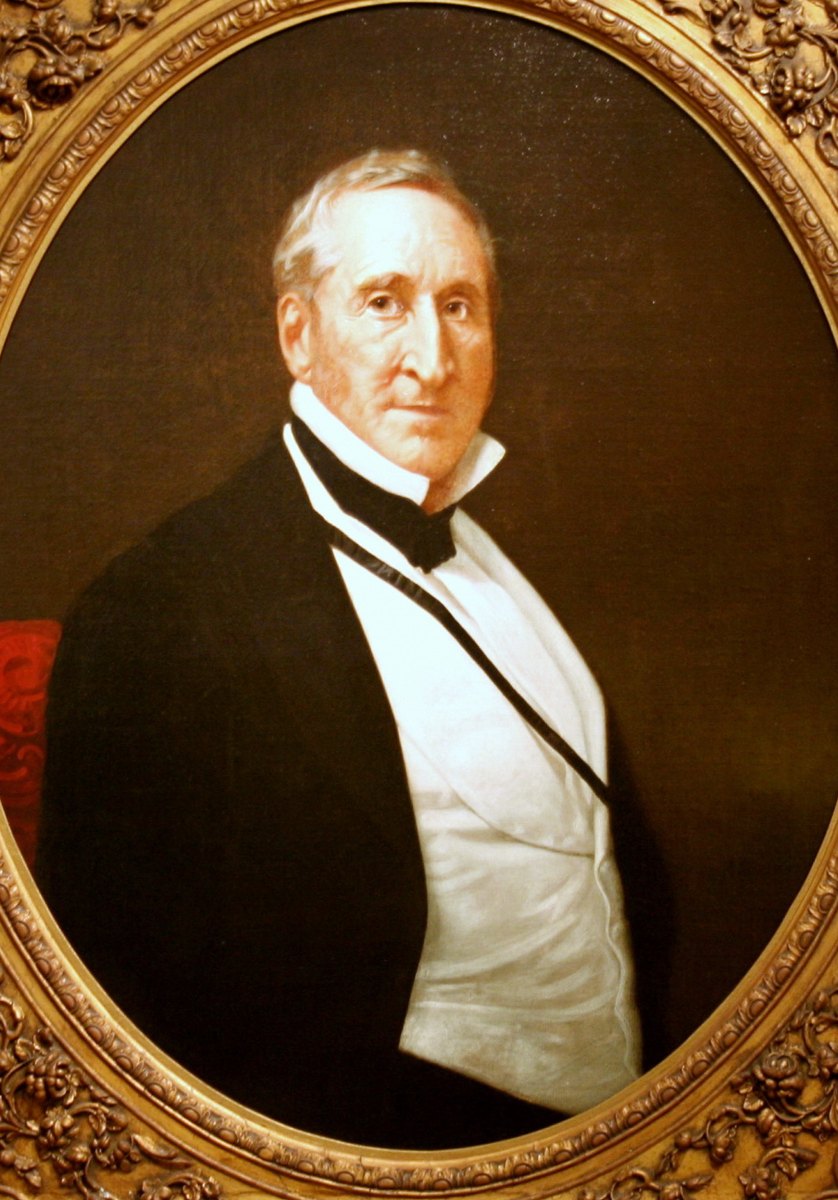
In the fall of 1780, before moving his family to Maryland, Thomas Hart let Hartford go to Jesse Benton, husband of his niece, for a payment and a note. When Cornwallis's army held Hillsborough in February 1781, Benton saved everything from the troops but 110 gallons of brandy, 60 pounds of brown sugar and some jugs and bottles. On March 14, 1782 Jesse and Ann Gooch Benton's son Thomas Hart Benton, later a U.S. senator from Missouri, was born; his biographer William N. Chambers placed the birth in a house on the Benton land about three miles west of Hillsborough, while the state highway marker gives Hart's Mill. Benton wrote Hart in December 1782 that drought had left no water to run the mills or bring up the crops, and in March 1783 that many families had to go fifty or sixty miles for bread; he was letting many of Hart's small debtors wait. In 1783 he also wrote Hart about legal disputes and the pursuit of enslaved people.
In 1784 Benton was secretary-treasurer of the trustees of Science Hall, an academy trying to get started at Hillsborough. In 1788 he listed claims to 23,931 acres west of the mountains, and the county court, with his brother Samuel Benton Jr. as clerk, ruled that because none had been surveyed he owed no tax on them that year. He died of consumption late in 1790, leaving a large estate heavily in debt. His will left his widow, Nancy, the Meadow Place plantation, divided the enslaved people and western lands among the children, and let his executors sell Hartford and its mills to pay his debts.
Shortly after Christmas 1798 the sixteen-year-old Thomas Hart Benton rode from Hartford to Chapel Hill and entered the university that January. On March 19, 1799, after his roommates traced a marked bill to him, he confessed to taking money from their trunks, and the Philanthropic Society expelled him, ending his time there.
Every statement above comes from these dated entries in the chronology. Each links to its source.
Buildings, schools, churches and other sites named in the dated events on this page, the most often named first. The map shows the 1 with a known location.
Map tiles © OpenStreetMap contributors. Site locations from the N.C. State Historic Preservation Office survey, Open Orange, Orange County GIS, OpenStreetMap and a few other published sources named on each site’s page; town and community pins show approximate locations.
People with a page of their own whom the dated events above name, those named most often first.
No indexed work is about this storyline itself yet. These are about the sites and people its dated events name, those named most often first, so they may discuss the storyline only in part. Follow a link to find a copy or view the material.
A short promotional piece from 2017 presenting Moorefields, the historic house near Hillsborough, as a venue for events. Of interest mainly as a record of the property's recent use.
Deeds, plats and surveys, 1779 to about 1835, for the Orange County property called Grayfields and later Moorefields, the estate near Hillsborough, associated with James Iredell Waddell (1824 to 1886). Twenty-four images.
NC Digital Collections record courtesy of the North Carolina Department of Natural and Cultural Resources.
Moorefields, a wooden manor house off State Route 1135 near Hillsborough built by Alfred Moore, later a justice of the U.S. Supreme Court. Historic American Buildings Survey documentation compiled after 1933: five photographs, five data pages and a caption page. Other names attached include Augusta and Sarah Louisa Moore, Henry Clay and Thomas Hart Benton. Topics include domestic life, law, African Americans and restoration.
Brian Brigman's short illustrated pamphlet on the Dialectic and Philanthropic Societies, the debating societies founded at the University of North Carolina in 1795, with the Latin phrase virtus, libertas et scientia in its subtitle. Published by the societies themselves in Chapel Hill in 1988, eleven unnumbered pages with portraits.
Joseph K. L. Reckford's honors essay in American Studies at the University of North Carolina, submitted in 1981, reproduces the portraits acquired between 1795 and 1868 by the Dialectic and Philanthropic Societies, the university's two debating societies, and adds selected biographical data on the sitters. 211 pages with a short bibliography.
Kevin Cherry's lecture on 215 years of the Dialectic and Philanthropic Societies, the student debating societies at the University of North Carolina, delivered on April 7, 2011 in Wilson Library for the Gladys Hall Coates University History Lecture series. Seventeen pages as published online, covering student oratory and society life at Chapel Hill from the 1790s onward.
Evangeline Burbank Murphy traces the growth of the library built up by the Philanthropic Society at the University of North Carolina between 1797 and 1822, in a thesis the university issued in 1979. Subjects include academic libraries in Chapel Hill and the society and the university library of the 1793 to 1962 period. Seventy three leaves.
Stewart E. Dunaway's transcription of letters exchanged between Jesse Benton and Thomas Hart from 1780 to 1790, concerning Hart's affairs at Hartford, his place at Hillsborough. The letters concern the economic and social conditions of Hillsborough in the eighteenth century and the Revolution in North Carolina. Self-published through lulu.com in 2009, 68 pages with illustrations and facsimiles, and part of the library's Wall Local History Collection.
History of Maddock's Mill at Hillsborough and of its owners Thomas Hart, Rev. James Frazier, Jesse Benton and Catlett Campbell. Stewart E. Dunaway published it in 2022 through Lulu, 174 pages with illustrations, maps and facsimiles, appending Benton and Hart family histories.
Letters written between 1780 and 1790 by Jesse Benton, a lawyer at Hillsborough, to Thomas Hart, the owner of the Hartford mill complex, edited by Stewart Dunaway and published in 2009. Sixty eight pages with illustrations, facsimiles and a plan. The correspondence falls in the Revolutionary and early federal years.
Stewart E. Dunaway's earlier compilation of the Jesse Benton papers from Hartford at Hillsborough, covering 1780 to 1790, self-published in 1991, 68 pages with illustrations. Alongside the correspondence of Benton and Thomas Hart, it covers the Revolutionary War campaigns in North Carolina, including the battles of Hart's Mill and Lindley's Mill in 1781, both fought in what was then Orange County. Dunaway reissued the letters in 2009.
Mary Claire Engstrom's article on the Hartford mill complex on the Eno and its fortunes during the Revolution, centered on Thomas Hart, who died in 1808. Nine pages with a facsimile and a portrait, printed in 1979.
Accounts of the Orange County detachment under Thomas Hart, May 1771, kept during the government's campaign against the Regulators. The Regulator Movement was a backcountry revolt against officials the settlers accused of charging excessive fees and falsifying records. Four images.
NC Digital Collections record courtesy of the North Carolina Department of Natural and Cultural Resources.
Letter of 1783 from Jesse Benton of Orange County, father of Senator Thomas Hart Benton, to Thomas Hart of Maryland about lawsuits and efforts to recover enslaved people who had escaped. The back of the sheet carries property valuations. Dated 1781 and 1783. State Archives of North Carolina, PC.322.
North Carolina Senate bill of 26 October 1779 to vest title to certain lands in Abner Nash, later governor. It touches confiscated property, surveys, wills and executors, with lands in Granville, Guilford, Randolph and Jones counties. Edmund Fanning, the Hillsborough loyalist, and Thomas Hart figure in it. Seven images.
NC Digital Collections record courtesy of the North Carolina Department of Natural and Cultural Resources.
Sydney Nathans's biography of Mary Walker, an enslaved woman from Orange County who escaped to the North in the mid nineteenth century and spent the following decades in Cambridge, Massachusetts, working to free the family she had left behind. Chapter titles trace her flight, her years among Northern friends, a rescue plot, a long silence, and the reunion that gives the book its close. Published 2012 by Harvard University Press, 330 pages with 20 pages of plates, illustrations and maps.
Reviewed in Choice Reviews Online (2012), Civil War Book Review (2012).
H. G. Jones follows the fortune of Mary Ruffin Smith (1814-1885), the unmarried heiress whose Orange and Chatham County lands passed at her death to the University of North Carolina and the Episcopal Church. Chapters profile her grandfather Francis Jones, then trace the bequest through a quarrel among Episcopalians over Price Creek, the Chapel of the Cross and the university's buildings. A December 1885 New York Times report called the gift money; Jones shows it was land. Published by McFarland in 2014, 231 pages.
Robert C. Kenzer's study of kinship and neighborhood in Orange County between 1849 and 1881, the decades before and after the Civil War, tracing family ties and neighborhood networks through the county's records. Published by the University of Tennessee Press in 1987, 251 pages with illustrations, maps, portraits and a bibliography. Topics include kinship, neighborhoods and social conditions in the county in the nineteenth century.
Reviewed in Choice Reviews Online (1988), Journal of American History (1988), The American Historical Review (1989), The Journal of Southern History (1989), Civil War history (1989), Journal of Social History (1989).
Jean Bradley Anderson's history of the Bennehan and Cameron families and their plantations, Stagville and Fairntosh, on lands that lay in Orange County until Durham County was formed from it in 1881. Published by the Historic Preservation Society of Durham in 1985, the book follows plantation life and ownership across several generations, with genealogical tables, a map, portraits, a bibliography and an index; 227 pages plus plates.
Reviewed in South Atlantic Quarterly (1987).
Ruth Blackwelder's study of political and intellectual leadership in Orange County and North Carolina from 1752 to 1861, published in Charlotte by W. Loftin in 1961. Topics include state politics and government, intellectual life before the Civil War, and county genealogy. It runs 216 pages with illustrations and a bibliography. Part of the Wall Local History Collection.
Francis Nash's history of Hillsborough in colonial and Revolutionary times, first published in 1903 and reprinted in 1953 by Edwards & Broughton with an index and a sketch of the author. Topics include the Regulator Insurrection of 1766 to 1771, the Revolution and local genealogy.
Hugh Talmage Lefler and Paul W. Wager's history of Orange County across its first two centuries, 1752 to 1952, prepared for the county's bicentennial. It covers government and politics, biography and the county's families, and doubles as a genealogical reference. Published in Chapel Hill by the Orange Printshop in 1953, 389 pages with illustrations and an index; this copy is a later reprint.
Reviewed in The Journal of Southern History (1954).
Anne R. Keene's history of the Cloudbusters, the baseball team of the Navy Pre-Flight School at the University of North Carolina in Chapel Hill during the Second World War, on which Ted Williams played in 1943. The chapters move from a batboy's trunk of keepsakes through the pre-flight training program to the players' lives after the war, and Keene's own family is part of the story. Published by Sports Publishing in New York in 2018, 340 pages with sixteen pages of plates.
Abstracts of the minutes of Orange County's Inferior Court of Pleas and Quarter Sessions for 1777 to 1788, the county court of justices of the peace in the Revolutionary years. The abstracts name the people who came before the court. First published in Charlotte in 1966 and later reprinted from Greenville, South Carolina, in three paginated sections with a map.
Rev. D. I. Craig's history of New Hope Church, a Presbyterian congregation in Chapel Hill Township, Orange County, printed at Reidsville in 1891. A closing family history section covers the Strayhorn, Craig, Blackwood and Kirkland families.
Deed transcripts for the town lots of Chapel Hill and adjoining land from 1790 to the 1930s, compiled by Stewart E. Dunaway. Each transcript keeps only the working facts: grantor and grantee, price, acreage and the metes and bounds of the parcel. Self-published in 2014 as Issue 1G, 702 pages with maps and facsimiles.
Mark Chilton's oversized atlas plotting eighteenth-century land grants across the original Orange County, which stretched well beyond today's boundaries into what became Alamance and Durham counties. Published in Carrboro by Hand Made Books beginning in 2012, the set was planned in four volumes: Henry McCulloh's great tract number 11 and the land north of it; the Saxapahaw old fields (volume 2); Chapel Hill, Hillsborough and the Johnston Tract; and Durham, Rougemont and McCulloh's tract number 12. Maps and color illustrations, 41 cm.
Each dated event above names its source, the place to start. For finding more on an event across newspapers, records and histories, see the research guide Follow an event across several accounts. Ask at the North Carolina Room of the Orange County Public Library for help with local sources.
Friends of the Orange County Public Library. “The Bentons at Hartford: Jesse Benton and the young Thomas Hart Benton, 1780–1799.” Orange County Indexed, https://focplnc.org/orange-county-books/storylines/bentons-hartford-storyline-1780/. Accessed October 22, 2026.
