
Historic Moorefields : Unique Event Space In Hillsborough, NC
A short promotional piece from 2017 presenting Moorefields, the historic house near Hillsborough, as a venue for events. Of interest mainly as a record of the property's recent use.
Storyline · 1785–1972
Built about 1785 near Hillsborough as the summer home of Alfred Moore, whom President John Adams later appointed to the U.S. Supreme Court, Moorefields stayed with Moore's descendants for more than a century. Local tradition held that Thomas Hart Benton and Mrs. Henry Clay were born there, though both were born before the house was built. On Moore's death in 1810 it passed to his son Alfred, a speaker of the House of Commons, and in 1837 to the younger Moore's son-in-law, Francis Nash Waddell. It was advertised for public sale in 1913. Edward T. Draper-Savage, related to the family by marriage, restored it from 1949, and it entered the National Register in 1972.
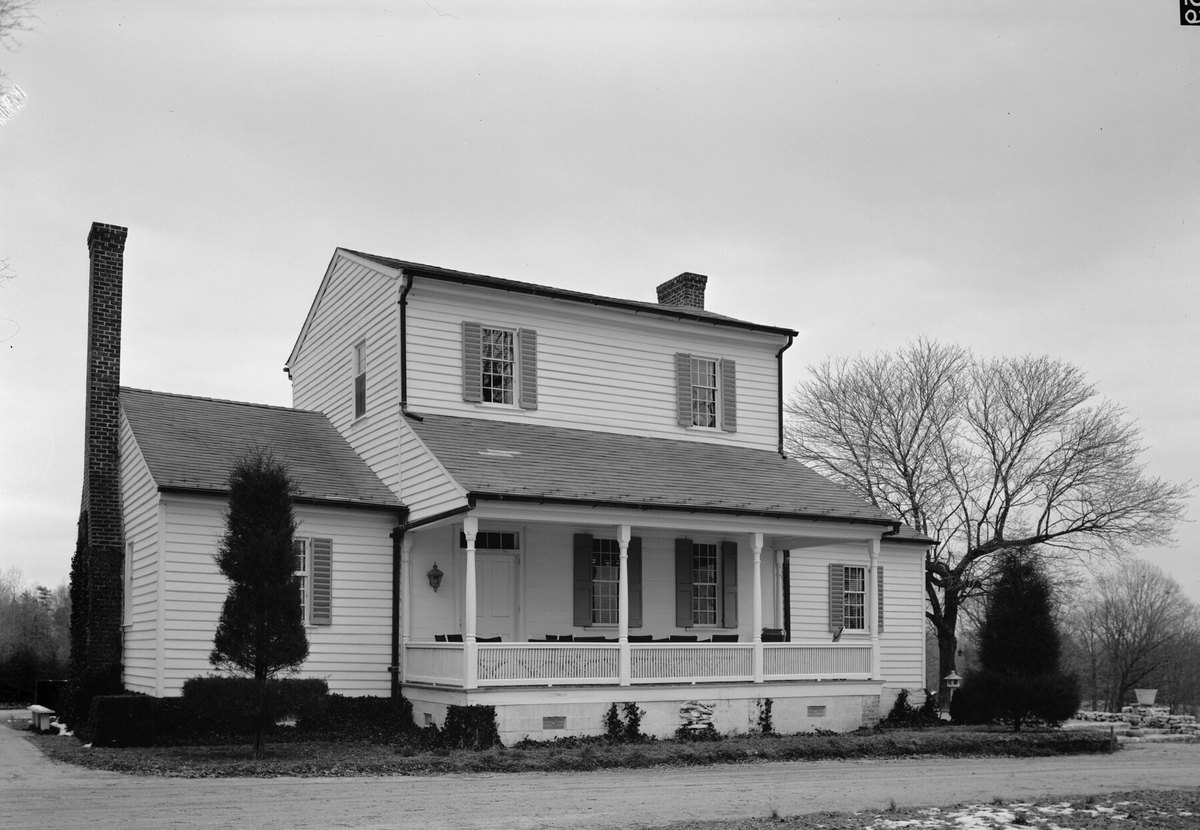
About 1785 Alfred Moore of Wilmington, whom President John Adams later appointed to the U.S. Supreme Court, built Moorefields near Hillsborough as his summer home. Local tradition held that Senator Thomas Hart Benton and Mrs. Henry Clay were born there, but both were born before the house was built. When Moore died on October 15, 1810, he left the house to his son Alfred, a lawyer who served in the House of Commons and as its speaker in 1823-1824. The younger Alfred Moore died at his home in Orange on July 25, 1837, and Moorefields passed to his son-in-law, Francis Nash Waddell. In 1847 the lands were divided, and the tract with the house went to Augusta, a daughter of the younger Moore. The family kept it until 1913, when Moorefields was advertised for public sale after more than a century with Alfred Moore's descendants. In 1949 Edward T. Draper-Savage, related to the Moore family by marriage, acquired the house and began restoring it, and on December 2, 1960 the North Carolina Society for the Preservation of Antiquities gave him one of its Cannon Awards for the restoration. Moorefields was entered in the National Register of Historic Places on April 25, 1972, the earliest listing among the six rural Orange County properties the 1993 county survey found on the Register.
Every statement above comes from these dated entries in the chronology. Each links to its source.
Buildings, schools, churches and other sites named in the dated events on this page, the most often named first. The map shows them all.
Map tiles © OpenStreetMap contributors. Site locations from the N.C. State Historic Preservation Office survey, Open Orange, Orange County GIS, OpenStreetMap and a few other published sources named on each site’s page; town and community pins show approximate locations.
People with a page of their own whom the dated events above name, those named most often first.
No indexed work is about this storyline itself yet. These are about the sites and people its dated events name, those named most often first, so they may discuss the storyline only in part. Follow a link to find a copy or view the material.
A short promotional piece from 2017 presenting Moorefields, the historic house near Hillsborough, as a venue for events. Of interest mainly as a record of the property's recent use.
Deeds, plats and surveys, 1779 to about 1835, for the Orange County property called Grayfields and later Moorefields, the estate near Hillsborough, associated with James Iredell Waddell (1824 to 1886). Twenty-four images.
NC Digital Collections record courtesy of the North Carolina Department of Natural and Cultural Resources.
Moorefields, a wooden manor house off State Route 1135 near Hillsborough built by Alfred Moore, later a justice of the U.S. Supreme Court. Historic American Buildings Survey documentation compiled after 1933: five photographs, five data pages and a caption page. Other names attached include Augusta and Sarah Louisa Moore, Henry Clay and Thomas Hart Benton. Topics include domestic life, law, African Americans and restoration.
Lucile Noell Dula's guidebook to Hillsborough and its historic buildings, published by Pelican in 1989. It pairs a tour of the town with notes on its history, in 128 illustrated pages with a bibliography. Part of the Wall Local History Collection.
Robert Watson Winston's biography of Henry Horace Williams (1858-1940), who taught philosophy at the University of North Carolina for half a century, subtitled gadfly of Chapel Hill. Published by the University of North Carolina Press in 1942, 309 pages with frontispiece and portraits; this copy is autographed. Topics include educators in Chapel Hill and the university's history.
Reviewed in Social Forces (1943).
Margaret Ruth Little-Stokes's survey of Chapel Hill's town and campus buildings from 1795 to 1975, published by the Preservation Society of Chapel Hill in 2006. Chapters run from the first campus buildings through David Swain's romantic campus to midcentury modernism, followed by area surveys of the campus, east and west Chapel Hill, downtown, Northside and the suburbs.
Maurice M. Bursey's biography of Francis Preston Venable (1856 to 1934), chemist and president of the University of North Carolina, published by the Chapel Hill Historical Society in 1989. It also covers the history of the university's chemistry department. Illustrated, 111 pages, with bibliographies.
Reviewed in Isis (1992).
Architectural and historical inventory of Carrboro by Claudia Roberts Brown, published in 1983 by the Carrboro Appearance Commission and the town. The 48-page survey, with illustrations and maps, documents the town's historic buildings and their conservation.
John V. Allcott's history of the architecture of the University of North Carolina campus across two centuries, from the first buildings of the 1790s to the 1980s, published by the Chapel Hill Historical Society in 1986. A 108-page illustrated survey with a bibliography. Allcott taught art history at the university.
A history of the buildings on the University of North Carolina campus by John V. Allcott and JJ Bauer, published by the Chapel Hill Historical Society in 2019. It follows campus construction from the 1790s forward: the plans behind each building campaign, the architects, and the university figures who pushed projects through. 132 pages with photographs, maps and plans.
Jill Ridky-Blackburn's history of Coker Hills, a neighborhood in Chapel Hill, published by the Chapel Hill Historical Society in 2016. Chapters describe the land before the subdivision, the Coker who gave it its name, how the neighborhood began, the architects, builders and houses that shaped it, its legacy, memories of growing up there and the residents' later advocacy. Subjects include historic buildings in Chapel Hill. 242 pages with illustrations, portraits and a map.
Sarah Brandes Madry's history of the Old Well at the University of North Carolina at Chapel Hill, treating both its architecture and the ideas attached to it. It takes in drinking fountains and water use in Chapel Hill and the university's history, with a chapter on Edwin Anderson Alderman, the president under whom the well took its present form in 1897, and one on water at the university. Published by iUniverse in 2003, 399 pages with illustrations.
Allen Alexander Lloyd's history of Hillsborough from the town's founding in 1754 to 1966, published by the author in Hillsborough in 1966. 306 pages with illustrations, maps and portraits, dedicated to the best interest of our town. Topics include Hillsborough's history and biography, its historic buildings and Orange County history.
Brian Burns's collection of lesser-known episodes from Chapel Hill's past, published by The History Press of Charleston, South Carolina, in 2023. Topics include the town's history, its buildings and structures, and the history of civil rights in Chapel Hill. 158 pages with illustrations and portraits.
Kemp P. Battle's University Day address of 1883, delivered as president of the University of North Carolina on the day marking the laying of the Old East cornerstone. Battle goes building by building through the Chapel Hill campus, telling how each was named and why it stands where it does. Fifteen pages. Electronic edition issued 2005 by the UNC University Library for Documenting the American South.
Each dated event above names its source, the place to start. For finding more on an event across newspapers, records and histories, see the research guide Follow an event across several accounts. Ask at the North Carolina Room of the Orange County Public Library for help with local sources.
Friends of the Orange County Public Library. “Moorefields, from Alfred Moore to the National Register.” Orange County Indexed, https://focplnc.org/orange-county-books/storylines/moorefields-storyline-1785/. Accessed October 22, 2026.
