Skip to content

Theme

Farms & Rural Life

Tobacco barns, sorghum mills, granges, and the people who have worked the county’s land.

Tobacco barns, sorghum mills, granges, tenant farms and the families who worked the land before the county turned suburban; the 1930 census counted tenants on about a third of the county’s farms. The storylines follow Cedar Grove and rural northern Orange and farm labor.

298 indexed works are connected with this theme. 10 held at OCPL →

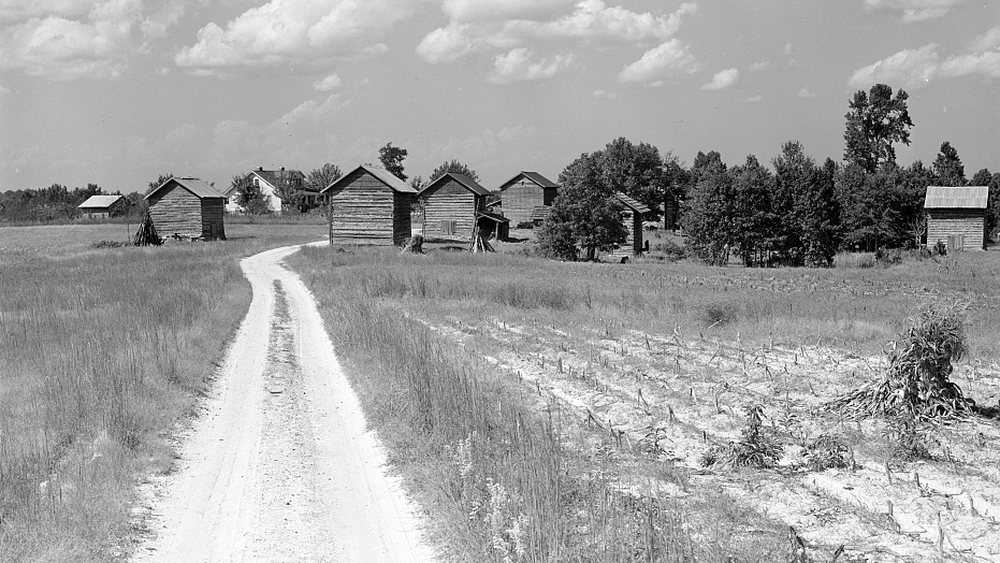
Tobacco barns along a farm road.

Indexed works

Related works found in catalogs and archives across North Carolina, the most widely held first, novels aside. Each links to the institution that holds or provides it.

Widely held

Miss Mary's Money

Jones, H. G. · 2014 · McFarland & Co.

H. G. Jones follows the fortune of Mary Ruffin Smith (1814-1885), the unmarried heiress whose Orange and Chatham County lands passed at her death to the University of North Carolina and the Episcopal Church. Chapters profile her grandfather Francis Jones, then trace the bequest through a quarrel among Episcopalians over Price Creek, the Chapel of the Cross and the university's buildings. A December 1885 New York Times report called the gift money; Jones shows it was land. Published by McFarland in 2014, 231 pages.

Why this is here: Catalog heading in the UNC record: Plantations.

Piedmont Plantation: The Bennehan-Cameron Family and Lands in North Carolina

Anderson, Jean Bradley · 1985 · Historic Preservation Society of Durham

Jean Bradley Anderson's history of the Bennehan and Cameron families and their plantations, Stagville and Fairntosh, on lands that lay in Orange County until Durham County was formed from it in 1881. Published by the Historic Preservation Society of Durham in 1985, the book follows plantation life and ownership across several generations, with genealogical tables, a map, portraits, a bibliography and an index; 227 pages plus plates.

Why this is here: Catalog heading in the NCCU record: Plantations.

Reviewed in South Atlantic Quarterly (1987).

A Mind to Stay: White Plantation, Black Homeland

Nathans, Sydney · 2017

Sydney Nathans's history of a Black community in Hale County, Alabama, whose founders were enslaved people sent there before the Civil War from the Cameron family's plantations in Orange County, North Carolina. Instead of following the Great Migration out of the South, this group stayed, moved from bondage to owning the land they had worked, and held onto it across generations. Published 2017, 342 pages with plates and maps; this is the e-book edition.

Why this is here: Catalog heading in the Duke record: Plantation owners.

Reviewed in Journal of American History (2017), Journal of Social History (2017), London review of books (2017), The Journal of the Civil War Era (2018), The Journal of Southern History (2018), Environmental History (2018), ˜The œAlabama review (2019), The Oral History Review (2019), ˜The œRegister - Kentucky Historical Society/˜The œregister of the Kentucky Historical Society (2020).

The Black family in slavery and freedom, 1750-1925

Gutman, Herbert G. (Herbert George), 1928-1985 · 1976 · Pantheon Books

Herbert G. Gutman's 1976 history of African American families from 1750 to 1925, published by Pantheon Books in New York, 664 pages with 38 leaves of plates. Its Orange County connection is the Bennehan and Cameron family plantations, Stagville and Fairntosh: the book discusses the people enslaved by Richard Bennehan (1743-1825) and the Camerons, and follows family ties among them under slavery and after emancipation. Subjects include African American families and enslaved persons in Orange County.

Why this is here: Catalog heading in the NCCU record: Stagville Plantation (N.C.).

Reviewed in The Journal of Southern History (1977), The William and Mary Quarterly (1977), The American Historical Review (1977), Journal of American History (1977), The History Teacher (1977), Political Science Quarterly (1977), Journal of Black Psychology (1978), Journal of Social History (1978), Civil War history (1978), Signs (1978).

The Couch tract of the Durham division of the Duke Forest: a history of agricultural land-use patterns, 1750-1950

Frankel, Rachel · 1984 · Rachel Frankel (attributed)

Rachel Frankel's Duke University honors paper of 1984 on the Couch tract in the Durham Division of Duke Forest, a history of agricultural land use from 1750 to 1950. The Couch family, family farms and rural land use in Orange County are its subjects. A photocopied typescript, 97 leaves with maps and a bibliography.

Why this is here: Catalog heading in the NC Cardinal record: Agriculture -- North Carolina -- Orange County -- History.

Cedar Grove, 1939 : revisiting Marion Post's photos of a Black rural neighborhood

Bennett, Evan P. · 2025 · Historical Research Office, Office of Archives and History

Evan P. Bennett returns to the photographs Marion Post Wolcott made in 1939 in Cedar Grove, a Black farming neighborhood in northern Orange County that she documented for the federal resettlement program. Published in 2025 by the Historical Research Office in Raleigh, pages 384 to 406, with illustrations and portraits. Topics include rural African Americans in the Cedar Grove township and photographers in the state.

Why this is here: Catalog heading in the UNC record: Rural African Americans.

UNC
Show 2 more

Bright leaf culture and Thomas Day : Orange and Caswell counties

Vernacular Architecture Forum (U.S.). Conference (2016 : Durham, N.C.) · 2016 · Vernacular Architecture Forum

A tour guidebook prepared for the 2016 Vernacular Architecture Forum conference in Durham, leading visitors through buildings in Orange and Caswell counties. It takes in the architecture of the bright leaf tobacco economy and the work of Thomas Day, the free Black cabinetmaker of Caswell County who worked in the middle of the nineteenth century.

Why this is here: Catalog heading in the UNC record: Tobacco.

UNC

Interviews With Residents on Fish Dam Road

Liles, Joe · 2004

Joe Liles's interviews with longtime residents of Fish Dam Road, an old rural road in Durham County, recorded in 2004, with subjects tied to both Durham and Orange counties. The interviewees are Charles Scott Harkey, Mary Scarlett Jones, Boyce Link and John Scarlett, all born between 1912 and 1920, and the topics include country life, the road's history and the Duke Power Company.

Why this is here: Catalog heading in the Durham record: Rural Roads -- North Carolina -- Durham.

Recently indexed: Cigarette smoking habits and selected health behaviors among present UNC-CH generic and RN-BSN nursing students (1993) · Eugene Cunningham Branson, humanitarian (1967) · Welfare work in mill villages : the story of extra-mill activities in North Carolina (1929) · Address of John W. Norwood, Esq., of Orange : delivered before the State Agricultural Society of North Carolina at the annual fair on the 20th October, 1871 (1871) · Anaylzing the preferences of market customers : a case study of the Chapel Hill Farmers' Market (2013)

Search all 298 indexed works →

Start at OCPL

Books in OCPL’s Rebecca B. Wall Local History Collection whose titles, catalog subjects, or descriptions match this theme. The Friends’ recommended starting points are labelled. Books marked Wider context cover the broader subject rather than this theme itself.

  • Wider context · NC 633.71 YEA Remembering North Carolina Tobacco Yeargin, Billy · 2008

    Billy Yeargin collects his own memories and those of others raised in North Carolina's tobacco culture, following the crop's year through laying by, cropping and curing, along with the nuisance of slugs and tar and the sight of a field in bloom. The History Press of Charleston published it in 2008; 128 illustrated pages.

  • Foundational · NC 633.71 YEA North Carolina Tobacco: A History Yeargin, Billy · 2008

    Billy Yeargin's history of tobacco in North Carolina: how the crop shaped farm communities and their customs, gave rise to manufacturing industries and left a lasting mark on the state's culture. The History Press of Charleston published it in 2008; 159 illustrated pages with source references.

  • Wider context · NC 929 NOR North Carolina Century Farms: 100 Years of Continuous Agricultural Heritage 1989

    The North Carolina Department of Agriculture's 1989 tribute to the farms recognized under its Century Farm program, worked by the same families for at least a hundred years. James F. Devine opens with a history of farming in the state, followed by a list of Century Farm owners and family histories of the farms. Compiled by Libby Gorman and Mary Hunter Martin, edited by Deborah Ellison and Jearlean Woody; 247 large pages, illustrated.

Show 6 more
  • Foundational · NC 333.76 FRA The Couch Tract of the Durham Division of the Duke Forest: A History of Agricultural Land-use Patterns 1750-1950 Frankel, Rachel · 1984

    Rachel Frankel's Duke University honors paper of 1984 on the Couch tract in the Durham Division of Duke Forest, a history of agricultural land use from 1750 to 1950. The Couch family, family farms and rural land use in Orange County are its subjects. A photocopied typescript, 97 leaves with maps and a bibliography.

  • Wider context · NC 975.63 FLO Up From Mount Misery: The Blossoming of North Carolina's Sandhills Florance, Chris · 1990

    The Sandhills of North Carolina and their growth over the twentieth century, as Chris Florance tells it through the lives of local people, farm life and the story of the Chase family. Down Home Press of Asheboro published it in 1990: 211 pages with illustrations, a map and a bibliography.

  • Wider context · NC 338.173 BAD Prosperity Road: The New Deal, Tobacco, and North Carolina Badger, Anthony J. · 1980

    Anthony J. Badger's study of the New Deal in North Carolina centered on tobacco, tracing how federal economic policy of the 1930s worked out in the state's tobacco economy. Badger, a British historian, later held the Paul Mellon chair of American history at Cambridge; this was his first book. University of North Carolina Press, 1980, in the Fred W. Morrison Series in Southern Studies; 295 pages with a bibliography and an index.

  • Rebecca Wall Collection · NC 929.209 COU The Couch Farms in Orange County, North Carolina

    A local study of the Couch farms in Orange County, North Carolina. Part of the Wall Local History Collection.

  • Wider context · NC 770.92 WOOTEN Tobacco Barns, Eastern North Carolina Wooten, Hubert · 2023

    Hubert Wooten's color photographs of tobacco barns in eastern North Carolina, collected in a 243-page book that he published himself in 2023.

  • Wider context · NC 929.209 LIMBAUGH Farming Across America: A 300-year Family History Limbaugh, Ronald H. · 2013

    Ronald H. Limbaugh's history of the Limbaugh and Mortimer families across three centuries of American farming, with maps and portraits, issued in 2013 in a limited edition of 100 copies.

In the chronology

Storylines in this theme, earliest first. Each has its own page.

Cedar Grove and rural northern Orange1755–2013 · 81 events · The crossroads communities north of Hillsborough grew around Eno Presbyterian, organized in 1755, the Hughes Academy of 1845, the Pope farm of the 1870s and Ellis Store of 1923, with nearly half the county’s Black-owned farms in Cedar Grove Township by 1940. The Schley Grange brought telephones in 1948, the schools were consolidated and desegregated in the 1960s, and the branch library came and went between 2004 and 2010. The Regulator crisis, 1766–17711766–1771 · 91 events · Orange County farmers organized in 1766 against high fees, taxes and dishonest county officers, calling a meeting at Maddock's Mill that October. Protest turned violent at the Hillsborough court in September 1770 and ended with the Regulators' defeat at Alamance on May 16, 1771 and the hanging of six at Hillsborough on June 19. Farm labor in rural Orange County1859–2022 · 16 events · Tobacco spread from Washington Duke’s turn to the crop in 1859, and after emancipation many freedpeople worked the land as tenants and sharecroppers; the 1930 census counted tenants on about a third of the county’s farms. Farm Security Administration loans reached Black farmers from 1938, tenancy fell sharply in the 1950s, and by 2022 the census counted 36 migrant workers on the county’s farms. Public health in rural Orange County1924 to 1955 · 28 events · County nurses, clinics, the district health department and sanitation work reached into rural Orange County from 1924: the campaigns against typhoid, diphtheria, tuberculosis and polio through 1955. Cane Creek Reservoir and Bingham Township1961 to 1989 · 20 events · From the first engineering studies of 1961 to the filling of the reservoir in 1989: OWASA's Cane Creek Reservoir, the watershed land purchases, and the Bingham Township farm families displaced.

Dated events connected with this theme: sixteen of 566, the highlights and a sample of the rest spread across the years, in date order. See all 566 dated events in the chronology →

Earliest first. Scroll sideways, or use the arrows.

16 dated events
  1. Indigenous communities occupy the Eno River Valley

    Migration or settlement · Eno River valley

    Excavations at the Hogue and Wall sites on the Eno near Hillsborough show farming communities growing corn, beans and squash, first in small scattered settlements (Haw River phase, about 1000–1400) and then in compact palisaded villages (Hillsboro phase, about 1400–1600). The Wall site village held perhaps 100 to 150 people in the mid-1400s.

  2. William Cain acquires the Pleasant Grove plantation on the Trading Path

    Pleasant Grove, Orange County

    William Cain acquired the Orange County property later called Pleasant Grove, beside the old Indian Trading Path, and held it until his death in 1834.

    Subject: Pleasant Grove (William Cain plantation)

  3. Indian families from Virginia settle the Texas community in northern Orange County

    Migration or settlement · Orange County

    Charles Whitmore, Jesse Whitmore and Jacob Jeffries appear on the Orange County return used for the 1790 federal census, which was compiled from a tax list of 1787. Families of the same names had moved southwest from Greensville County in Virginia, and by 1820 the settlement later called Texas, or Pleasant Grove, was intact, with the Corn and Jeffries families holding tracts of several hundred acres.

  4. Orange County elects John Wall Norwood to the General Assembly

    Orange County

    Norwood entered public life in 1856 when Orange County elected him a representative in the General Assembly, where he served until 1858.

  5. John and Mary Jane Pope build their farm near Cedar Grove

    Construction or physical change · Cedar Grove

    John S. Pope, a Confederate captain, and his wife Mary Jane McDade Pope built a two-story I-house on land she inherited from her father's estate in 1869; it was likely finished by 1874, when her brother's share brought the tract to about 73 acres. Tobacco was the farm's main cash crop, and its oldest surviving barn dates to about 1875.

    Subject: John S. Pope Farm

  6. E. H. Pogue & Co. hold the opening sale at the Hillsboro Tobacco Warehouse

    Founding or opening · Hillsborough

    The Hillsboro Tobacco Warehouse, run by E. H. Pogue & Co., held its opening sale on Tuesday, January 5, 1886, and the Observer reported a heavy break with good prices. Three days earlier Pogue and fourteen other men had incorporated the Orange County Tobacco Association to buy and sell leaf tobacco.

  7. The Webb & Co. tobacco partnership in Hillsborough is dissolved

    Closing or ending · Hillsborough

    James Webb Jr., Joseph C. Webb and George C. Corbin gave notice that their tobacco manufacturing firm, Webb & Co., was dissolved, leaving the two Webbs to collect its debts and wind up its business. The firm had been making tobacco in Hillsborough since at least 1881.

    People: James Webb Jr. · George C. Corbin

  8. J. Cheshire Webb is named Orange County's food administrator

    Appointment, election or service · Orange County

    On September 20, 1917, State Food Administrator Henry A. Page appointed J. Cheshire Webb of Hillsborough food administrator for Orange County, with R. A. Eubanks as administrator for Chapel Hill. The record says no mill in the county broke a Food Administration rule.

    People: J. Cheshire Webb · Eugene Cunningham Branson · Robert A. Eubanks

  9. Ellis Store and post office opens

    Founding or opening · Cedar Grove

    Allen A. Ellis built a new crossroads store.

  10. Census counts tenants on about a third of Orange County farms

    Statistic or record · Orange County

    Tenants operated 643 of 1,870 Orange County farms in 1930 (34.4 percent), 718 of 1,956 in 1935 (36.7 percent) and 687 of 2,043 in 1940 (33.6 percent). Of the 1940 tenants, 514 were share tenants and croppers.

  11. The Texas community asks the Bureau of Indian Affairs for an Indian school

    Protest or organizing · Pleasant Grove Township

    Clayton Jeffries, Charles Will Jeffries and others retained a lawyer, drew up a list of Indian families, made contact with the Indian community in Person County that already had a state sponsored school, and wrote to Commissioner of Indian Affairs John Collier seeking a federal school for their children. A bureau agent visited and reported the families to be Indian, and the bureau's letters called the settlement an Indian community, but no assistance was ever given.

  12. Orange-Person District Health Department organized with Dr. Malcolm Rourk as health officer

    Founding or opening · Orange County

    Full-time public health service began in Orange County on July 1, 1935, when a temporary unit under Dr. G. H. Sumner of the State Board of Health answered a typhoid outbreak. By August the district health department for Orange and Person counties was organized as a model unit linked to UNC's public health teaching, with Dr. Malcolm Henderson Rourk as district health officer, sanitary inspector E. B. Caruthers, and a public health nurse and clerk in each county. The district officer also took over Chapel Hill's municipal health authority.

  13. Clyde Roberts wins the Bank of Chapel Hill corn growing contest

    Competition or sporting achievement · Orange County

    The Bank of Chapel Hill sponsored a yearly corn contest with at least 50 entrants. In 1947 Clyde Roberts won with 93.3 bushels of N. C. Hybrid 26 on one acre, against a contest average of 61.9.

    Subject: Bank of Chapel Hill

  14. Forest covers 44 percent of Orange County and cropland 18 percent

    Statistic or record · Orange County

    Citing the N.C. Agriculture Department, the 1976 plan divided the county's 398 square miles as 44 percent forest and other land, 28 percent non-farm land, 14 percent harvested cropland, 10 percent pasture and 4 percent idle cropland. Outside the towns, commerce was mostly scattered crossroads grocery and gas stores.

  15. Orange County Rural Buffer is established

    Law, policy or court · Carrboro

    Orange County adopted the Orange County-Chapel Hill-Carrboro Joint Planning Area Land Use Plan and map on August 19, 1986, designating a low-density Rural Buffer. The three governments signed the Joint Planning Agreement on November 2, 1987, and the county dates the buffer to 1988.

  16. Census counts 36 migrant workers on Orange County farms

    Statistic or record · Orange County

    The 2022 Census of Agriculture found 174 Orange County farms employing 597 hired workers, including 36 migrant workers on seven farms. Between 2017 and 2022 the number of tobacco farms in the county fell by 60 percent.

Places in this theme

Buildings, schools, churches and other sites named in the dated events on this page, the most often named first. The map shows the 78 with a known location.

Map tiles © OpenStreetMap contributors. Site locations from the N.C. State Historic Preservation Office survey, Open Orange and OpenStreetMap; town and community pins mark the middle of their mapped buildings.

Show 76 more

All places and the county map →

Research sources

Resources picked for this theme, each with a note on what it holds.

Background

National Register files 10

Show all 10

Historic sites, markers, and maps

Records of the time

Collections and databases 7

Show all 7

Local help 6

Show all 6

Picture: Farm Security Administration photographs, 1939–1940, Library of Congress; public domain. Image credits →

More to discover

Keep Reading Local

The Friends connect people with new library materials, local writers and publishers, and resources documenting Orange County.

Two mice reading back to back against a leaf, with the hand-lettered words Friends of the Orange County Public Library
Illustration by Caldecott Medalist Matthew Cordell, gifted to the Friends 2026