Skip to content

Theme

Slavery, Emancipation & Reconstruction

Slavery, freedpeople, and Reconstruction in the county.

Enslaved people were a large share of Orange County’s population from its founding, and the records here follow slavery, the war, emancipation and Reconstruction, from the Kirkland sale of 1804 and Elizabeth Keckly’s purchase of her freedom in 1855 to the freedpeople’s schools and churches, the Kirk-Holden War and the lynchings that followed. The storylines gather those histories.

293 indexed works are connected with this theme. 29 held at OCPL →

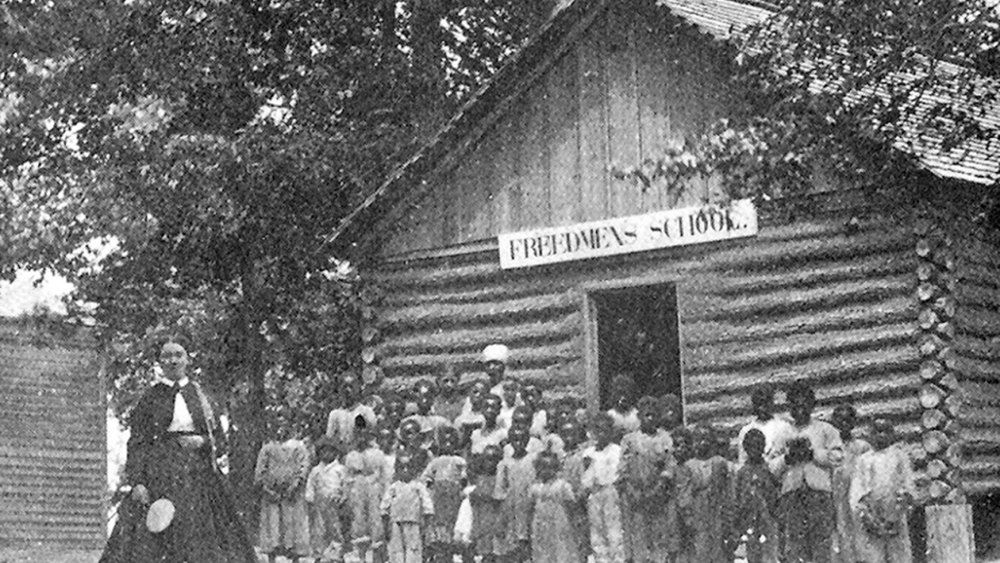
A Freedmen’s Bureau school on the James plantation, North Carolina, 1866.

Events and storylines

Named events and episodes the index follows in detail. Each has its own page.

Show all 7 events and episodes

Indexed works

Related works found in catalogs and archives across North Carolina, the most widely held first, novels aside. Each links to the institution that holds or provides it.

Widely held

To Free A Family

Nathans, Sydney · 2012 · Harvard University Press

Sydney Nathans's biography of Mary Walker, an enslaved woman from Orange County who escaped to the North in the mid nineteenth century and spent the following decades in Cambridge, Massachusetts, working to free the family she had left behind. Chapter titles trace her flight, her years among Northern friends, a rescue plot, a long silence, and the reunion that gives the book its close. Published 2012 by Harvard University Press, 330 pages with 20 pages of plates, illustrations and maps.

Why this is here: Catalog heading in the Methodist record: Women slaves.

Reviewed in Choice Reviews Online (2012), Civil War Book Review (2012).

Miss Mary's Money

Jones, H. G. · 2014 · McFarland & Co.

H. G. Jones follows the fortune of Mary Ruffin Smith (1814-1885), the unmarried heiress whose Orange and Chatham County lands passed at her death to the University of North Carolina and the Episcopal Church. Chapters profile her grandfather Francis Jones, then trace the bequest through a quarrel among Episcopalians over Price Creek, the Chapel of the Cross and the university's buildings. A December 1885 New York Times report called the gift money; Jones shows it was land. Published by McFarland in 2014, 231 pages.

Why this is here: Catalog heading in the UNC record: Plantations.

Piedmont Plantation: The Bennehan-Cameron Family and Lands in North Carolina

Anderson, Jean Bradley · 1985 · Historic Preservation Society of Durham

Jean Bradley Anderson's history of the Bennehan and Cameron families and their plantations, Stagville and Fairntosh, on lands that lay in Orange County until Durham County was formed from it in 1881. Published by the Historic Preservation Society of Durham in 1985, the book follows plantation life and ownership across several generations, with genealogical tables, a map, portraits, a bibliography and an index; 227 pages plus plates.

Why this is here: Catalog heading in the NCCU record: Plantations.

Reviewed in South Atlantic Quarterly (1987).

To Drink from the Well: The Struggle for Racial Equality at the Nation’s Oldest University

Kapur, Geeta · 2021

Geeta Kapur's history of race at the University of North Carolina at Chapel Hill, from the enslaved labor that built the campus through desegregation and the Black student protests that followed. Twelve chapters, with a foreword by William Barber II, move from the founding era and the Great Depression controversies to the state's response to integration and the turmoil of later decades; North Carolina Central University also figures. Published 2021 by Blair in Durham.

Why this is here: Catalog heading in the NCCU record: Slave labor.

The Impact of Slavery on the Education of Blacks in Orange County, North Carolina 1619-1970

Moore, Rosetta Austin · 2015

Rosetta Austin Moore's survey of Black education in Orange County from the colonial era to 1970, in a revised edition published in 2015 through Lulu in Morrisville. After chapters on slavery nationally and on schooling for enslaved people in North Carolina, the book turns to the county: its formation, the growth of its schools, the arrival of free public schooling for all, and the schools and African American educators of the twentieth century. 265 pages with maps, portraits and facsimiles.

Why this is here: Catalog heading in the UNC record: Enslaved persons.

A Mind to Stay: White Plantation, Black Homeland

Nathans, Sydney · 2017

Sydney Nathans's history of a Black community in Hale County, Alabama, whose founders were enslaved people sent there before the Civil War from the Cameron family's plantations in Orange County, North Carolina. Instead of following the Great Migration out of the South, this group stayed, moved from bondage to owning the land they had worked, and held onto it across generations. Published 2017, 342 pages with plates and maps; this is the e-book edition.

Why this is here: Catalog heading in the NC State record: Freedmen.

Reviewed in Journal of American History (2017), Journal of Social History (2017), London review of books (2017), The Journal of the Civil War Era (2018), The Journal of Southern History (2018), Environmental History (2018), ˜The œAlabama review (2019), The Oral History Review (2019), ˜The œRegister - Kentucky Historical Society/˜The œregister of the Kentucky Historical Society (2020).

Show 2 more

A Traitor and a Scoundrel: Benjamin Hedrick and the Cost of Dissent

Smith, Michael Thomas · 2003 · University of Delaware Press ; London : Associated University Presses

Michael Thomas Smith's biography of Benjamin Sherwood Hedrick, the University of North Carolina chemistry professor dismissed in 1856 after he declared support for the antislavery presidential candidate John C. Fremont. Published by University of Delaware Press in 2003, 216 pages with illustrations. Topics include abolitionists and dissenters in North Carolina, the antislavery movement in the state, and the university's biography before 1962.

Why this is here: Catalog heading in the Duke record: Abolitionists -- North Carolina -- Biography.

Reviewed in The Journal of Southern History (2005).

Slavery and the making of the University: celebrating our unsung heroes, bond and free

2005

A 38-page bibliography of sources in Wilson Library on slavery and the building of the University of North Carolina at Chapel Hill, issued by the university library in 2005 with illustrations. Its subtitle honors the unsung people, enslaved and free, behind the university's making. A finding tool for researchers rather than a narrative history.

Why this is here: Catalog heading in the UNC record: Slavery.

Recently indexed: Construction program at the University of North Carolina at Chapel Hill : construction costs, purposes, and facilities, other information (1939) · Dr. James Phillips (1882) · The life and character of Hon. David L. Swain (1878) · A pen-picture of Wilson Caldwell, colored, late the janitor of the University of North Carolina (1941) · The challenge of memorializing slavery in North Carolina : the Unsung Founders Memorial and the North Carolina Freedom Monument Project (2012) · North Carolina, Supreme Court, Raleigh : Rippy v Gant, June 1847 [printed] (1847)

Search all 293 indexed works →

Start at OCPL

Books in OCPL’s Rebecca B. Wall Local History Collection whose titles, catalog subjects, or descriptions match this theme. The Friends’ recommended starting points are labelled. Books marked Wider context cover the broader subject rather than this theme itself.

  • Foundational · NC 975.656 HISTORIC Antebellum Hillsborough, Slavery, and Enslaved and Free People of Color Who Worked at the Burwell School, 1837-1857 Historic Hillsborough Commission (Hillsborough, N.C.) · 2019

    The Historic Hillsborough Commission's account of slavery in antebellum Hillsborough and of the enslaved and free people of color who worked at the Burwell School, the female school the Burwells kept in town, between 1837 and 1857. African American history in Hillsborough and the school's own history are its two threads. Published in 2019.

  • Foundational · NC 306.3 SLA Slaves From Orange County, North Carolina: Estate Records, 1840-1865 2000

    Estate records from Orange County, 1840 to 1865, that name enslaved people: inventories, sales and divisions in which men, women and children were listed as property. Published in 2000, it is a source for the county's history of slavery and for African American genealogy.

  • Foundational · NC 973.745 NOR North Carolinians in the Era of the Civil War and Reconstruction 2008

    Paul D. Escott edits nine essays on North Carolinians from secession through Reconstruction: Piedmont disaffection, Wild's Raid and guerrilla war in the northeast, African Americans under Union occupation, soldiers and the 1864 governor's race, the war's end as seen by Chapel Hill writer Cornelia Phillips Spencer, Zebulon Vance and university president David L. Swain, women and the law, divorce at the 1868 constitutional convention, the roots of Jim Crow, and Vance's memory. UNC Press, 2008.

Show 6 more
  • Foundational · NC 342.756 BYRD Against the Peace and Dignity of the State: North Carolina Laws Regarding Slaves, Free Persons of Color, and Indians Byrd, William L. · 2007

    North Carolina's laws on enslaved people, free people of color and Native Americans, compiled by William L. Byrd III: the statutes that governed slavery and fixed the legal standing of free Black and Indian residents. Willow Bend Books first published the compilation in 2004; this 2007 Heritage Books printing runs to 479 pages with an index.

  • Foundational · 306.362 NORTH North Carolina Slave Narratives: The Lives of Moses Roper, Lunsford Lane, Moses Grandy, and Thomas H. Jones 2003

    Four narratives by men enslaved in North Carolina, reprinted in 2003: Moses Roper's of 1838, Lunsford Lane's of 1842, Moses Grandy's of 1843 and the Reverend Thomas H. Jones's of 1854. Editor William L. Andrews opens with an essay on how such books fed the abolitionist movement and began an African American literary tradition, and each text has an introduction and notes. The stories reach from Caswell County and Raleigh to Camden County and Wilmington.

  • Foundational · NC 929.375 MAL Freedmen's Marriage Records, Orange County, North Carolina, 1866-1868 Mallard, Shirley Jones · 2000

    Transcriptions by Shirley Jones Mallard of Orange County's freedmen's marriage records for 1866 to 1868, the registers in which formerly enslaved couples recorded marriages made under slavery and given legal standing after emancipation. For many African American families in the county these are the earliest records that name both partners. Compiled in 2000.

  • Foundational · NC 973.8 ZUB North Carolina During Reconstruction Zuber, Richard L. · 1969

    Published in 1969 by the State Department of Archives and History, Richard L. Zuber's short history follows North Carolina through Reconstruction after the Civil War. It runs 67 pages with illustrations, facsimiles, portraits and a bibliography, and was later reprinted by the Division of Archives and History.

  • Wider context · NC 306.362 KAY Slavery in North Carolina, 1748-1775 Kay, Marvin L. Michael · 1995

    Marvin L. Michael Kay and Lorin Lee Cary's study of slavery and enslaved people in North Carolina in the decades before the Revolution, 1748 to 1775, published by the University of North Carolina Press in 1995. The xv and 402 pages include maps, illustrations, some seventy pages of notes and sources, and an index.

  • Foundational · NC 306.363 SCARLETT Sheer Resilience : An Untold Story of A Free Community of Color in Orange County, N.C Scarlett, Beverly A. · 2024

    Beverly A. Scarlett's 2024 study of a free community of color in nineteenth-century Orange County, drawing on apprenticeship and freedmen's records among other county sources.

In the chronology

Other storylines that include this theme, earliest first. Each has its own page.

Black workers and campus labor1795–2021 · 31 events · Enslaved men built and served the university from its first buildings, Wilson Caldwell led its labor force after Reconstruction, and the janitors organized an association in 1930 that became a CIO local in 1942. The university named the laundry for Kennon Cheek and Rebecca Clark in 1998, dedicated the Unsung Founders Memorial in 2005 and published the names of 119 enslaved workers in 2018. Historic Rogers Road neighborhood1840–2021 · 25 events · The Rogers-Eubanks area grew from Black-owned farms and sawmills after emancipation, and in 1972 the county landfill was placed beside it. Residents organized through RENA and the Rogers-Eubanks Coalition from 2007, the landfill closed in 2013, and the neighborhood won a community center in 2014 and the sewer extension in 2019. Farm labor in rural Orange County1859–2022 · 16 events · Tobacco spread from Washington Duke’s turn to the crop in 1859, and after emancipation many freedpeople worked the land as tenants and sharecroppers; the 1930 census counted tenants on about a third of the county’s farms. Farm Security Administration loans reached Black farmers from 1938, tenancy fell sharply in the 1950s, and by 2022 the census counted 36 migrant workers on the county’s farms. Northside, Pine Knolls, and Tin Top1864–2023 · 43 events · Chapel Hill’s historic Black neighborhoods took shape after emancipation around the West End church and school, the Orange County Training School and its Rosenwald campus of 1924, St. Joseph CME and First Baptist, and the tin-roofed houses that named Tin Top. Lincoln High opened on Merritt Mill Road in 1951, residents resisted urban renewal in the 1970s, and as the Black population fell by about 40 percent the conservation districts, the Jackson Center and the 2015 Northside initiative worked to keep the neighborhoods in place. The university closes and reopens1868 to 1875 · 46 events · Reconstruction Republicans took control of the trustees in 1868 and dismissed the old faculty; Solomon Pool's presidency drew almost no students, and the university closed in February 1871. The legislature revived it in March 1875, Cornelia Phillips Spencer rang the bell, and it reopened in September under a rebuilt faculty.

Dated events connected with this theme: sixteen of 272, the highlights and a sample of the rest spread across the years, in date order. See all 272 dated events in the chronology →

Earliest first. Scroll sideways, or use the arrows.

16 dated events
  1. Mark Morgan is granted land in the New Hope Creek section

    Property or economic transaction · New Hope Creek

    Morgan secured land in the New Hope Creek section of eastern Orange. By 1755 he held more enslaved people than anyone else in the county.

  2. The county tax list counts 36 white polls and 82 taxable enslaved people in Hillsborough town

    Statistic or record · Orange County

    Orange County's 1790 tax list returned 2,272 polls and 406,106 acres across its eight districts, with a separate list for Hillsborough town showing 36 white polls against 82 black polls. William Hooper was charged for 22 of them, John Taylor for 10 and Francis Childs for 5.

    People: William Hooper · Walter Alves

  3. Walter Alves serves as a university trustee and board treasurer

    Chapel Hill

    Walter Alves of Orange County was a trustee of the University of North Carolina from 1795 to 1813 and treasurer of its board from 1795 to 1799.

  4. Suit by William Kirkland and others leads to the sale of Hannah and her children

    Slavery and freedom · Hillsborough, Market House

    Legal proceedings brought by William Kirkland, Catlett Campbell, Jacob Greer and Isaac Mordecai against Robert Bell placed Hannah and her children Jenny and David in the hands of the sheriff. Sheriff Samuel Turrentine sold the three at public auction at the Hillsborough Market House to Duncan Cameron for 200 pounds.

    People: Duncan Cameron · William Kirkland

  5. Frederick Nash represents Orange County in the House of Commons

    Appointment, election or service · Orange County

    Nash sat for Orange County in the House of Commons in 1814, 1816 and 1817. He was speaker of the house in 1814.

  6. St. Matthew's Church in Hillsborough is consecrated under its first rector, William Mercer Green

    Construction or physical change · Hillsborough, St. Matthew's Episcopal Church

    William Mercer Green became first rector of the reorganized St. Matthew's parish in 1825, the year work began on its brick church; state architect William Nichols and brickmaker John Berry were among the builders. Bishop John Stark Ravenscroft consecrated the church on May 21, 1826, during the diocesan convention it hosted.

    People: John Berry · John Stark Ravenscroft · William Nichols

    Subject: St. Matthew’s Episcopal Church

  7. Duncan Cameron gives his son Paul C. Cameron forty-one enslaved people

    Slavery and freedom · Orange County and Person County

    Duncan Cameron deeded his son Paul C. Cameron forty-one enslaved people, with any children the women would bear: Gabriel, Mima, Simeon and Sarah in Orange County, and families at the Mill Quarter plantation in Person County, among them Phillip and Jenny and their children Randol, Jim, Ellen, Nancy and Phill. Cameron acknowledged the deed before Justice William Gaston at Raleigh on January 1, 1835.

    People: Duncan Cameron · Paul C. Cameron · William Gaston

  8. Willie P. Mangum builds Walnut Hall at Red Mountain

    Construction or physical change · Walnut Hall, Red Mountain, Orange County (Durham County since 1881)

    Willie P. Mangum built Walnut Hall from 1842 to 1845 as an addition to his father's house of about 1800. His wife ran the 600-acre plantation, where Mangum enslaved 20 people in 1850.

  9. James Strayhorn's will names sixteen enslaved people

    Statistic or record · Blackwood Farm

    James Strayhorn’s will identifies sixteen people he enslaved.

    Subject: Blackwood Farm

  10. Alves, an enslaved man sentenced to death, is baptized at St. Matthew's

    Law, policy or court · Hillsborough

    St. Matthew's register records the baptism of Alves, "a slave under sentence of death," with James Waddell as witness.

    Subject: St. Matthew’s Episcopal Church

  11. Job Berry buys an acre on South Wake Street

    Property or economic transaction · Hillsborough

    Months after emancipation, Job Berry paid Henry N. Brown $300 for parts of lots 20 and 17 off South Wake Street, next to the Nash and Kollock School, where his wife Rebecca Nash had been enslaved.

  12. Solomon Pool's new faculty move into the old professors' houses

    Migration or settlement · East Franklin Street, Chapel Hill

    With Swain and the old faculty gone, the professors Pool brought in took over their Franklin Street homes: Fisk P. Brewer the Tom Taylor house, David Settle Patrick Swain's house, and James A. Martling the late James Phillips's house.

    People: Fisk P. (Fisk Parsons) Brewer

  13. November Caldwell, once enslaved by President Joseph Caldwell, dies

    Life event · Chapel Hill

    November Caldwell (1791-1872), held in slavery by Joseph Caldwell, brought firewood to the students, who were fond of him for his humor. A memorial in the old Chapel Hill Cemetery on the campus honors him.

    Subject: Old Chapel Hill Cemetery

  14. A Presbyterian church for Hillsborough's Black members is founded

    Founding or opening · Hillsborough

    More than a decade after emancipation, a Presbyterian church for people of color was established on land from the Brodie family at the corner of Orange and Wake streets.

  15. Commencement marks twenty-five years since the university reopened

    Naming or commemoration · Memorial Hall

    The 1900 commencement was given over to the reopening of 1875, with nineteen members of the 1875-76 student body present and addresses by Kemp Battle, George T. Winston, W. J. Peele and President Alderman.

    People: Kemp Plummer Battle · George Tayloe Winston · W. J. Peele

    Subject: Memorial Hall

  16. The Burwell School is renamed the Elizabeth Keckly Center at the Burwell School

    Naming or commemoration · Burwell School, Hillsborough

    The Burwell School Historic Site in Hillsborough took the name the Elizabeth Keckly Center at the Burwell School in late August 2026, honoring the woman the Burwells held in slavery in the house from 1835. Site director Elizabeth Hays said the aim was to hold the site's histories together.

    Subject: Burwell School

Places in this theme

Buildings, schools, churches and other sites named in the dated events on this page, the most often named first. The map shows the 38 with a known location.

Map tiles © OpenStreetMap contributors. Site locations from the N.C. State Historic Preservation Office survey, Open Orange and OpenStreetMap; town and community pins mark the middle of their mapped buildings.

Show 32 more

All places and the county map →

Research sources

Background context 8

Background from selected state and local sources

Show all 8

Places to visit 3

Maps, surveys, and the ground itself

Read contemporary evidence 10

Newspapers, photographs, and records of the time

Show all 10

Search beyond the index 8

Other catalogs, databases, and guides worth searching

Show all 8

Additional research sources

Other catalogs to search and local organizations that can help.

Background reading at OCPL

Held in OCPL’s Rebecca B. Wall Local History Collection. Selected because their titles or catalog subjects provide wider historical context for this theme; they may not discuss the Orange County theme directly.

  • Background reading · Rebecca Wall Collection My Folks Don't Want Me to Talk About Slavery: Twenty-one Oral Histories of Former North Carolina Slaves 1984

    Twenty-one narratives by formerly enslaved North Carolinians, chosen by Belinda Hurmence for their quality and published by John F. Blair of Winston-Salem in 1984; 103 pages with a bibliography. Hurmence later combined them with South Carolina accounts in 'Before Freedom: 48 Oral Histories of Former North and South Carolina Slaves' (1990).

    Subjects in the Library of Congress catalog record: Slaves -- North Carolina -- Biography; African Americans -- North Carolina -- Biography; North Carolina -- Biography OCPL call number: NC 920 MY

Search the Wall Collection for related books →

Picture: Public domain, via Wikimedia Commons. Image credits →

More to discover

Keep Reading Local

The Friends connect people with new library materials, local writers and publishers, and resources documenting Orange County.

Two mice reading back to back against a leaf, with the hand-lettered words Friends of the Orange County Public Library
Illustration by Caldecott Medalist Matthew Cordell, gifted to the Friends 2026