Skip to content

Theme

Indigenous Peoples & Archaeology

The Occaneechi, Sissipahaw, and Eno peoples, the Great Trading Path, and what archaeology has recovered along the rivers.

The Occaneechi, Sissipahaw and Eno peoples lived along the rivers and the Great Trading Path; the Occaneechi town on the Eno was occupied around 1680, the Texas community formed in the 1780s, and the Occaneechi Band of the Saponi Nation won state recognition in 2002. The records here include what archaeology has recovered.

163 indexed works are connected with this theme. 10 held at OCPL →

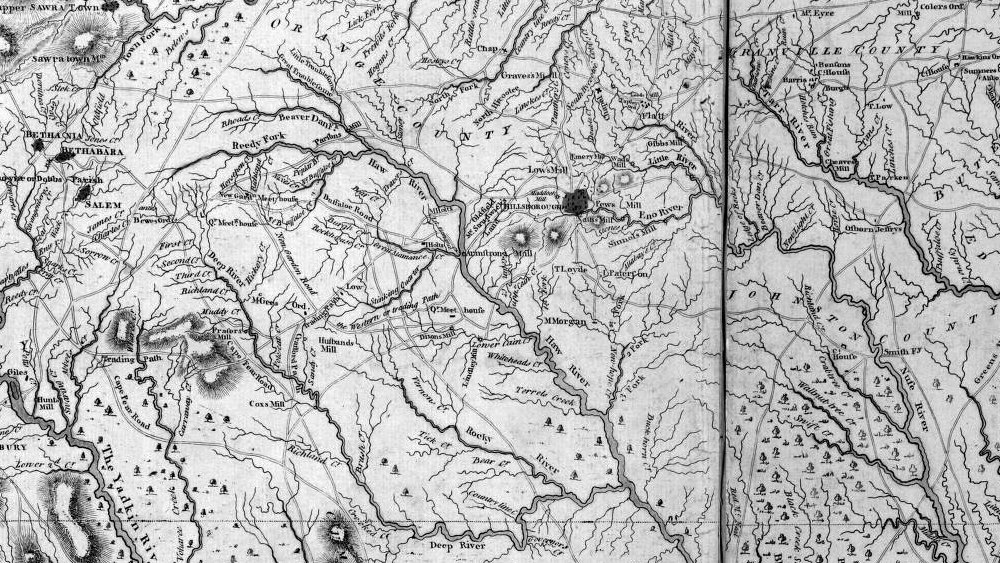
John Collet’s map of North Carolina, 1770, the Orange County sheet.

Indexed works

Related works found in catalogs and archives across North Carolina, the most widely held first, novels aside. Each links to the institution that holds or provides it.

Narrow these works. Each link opens the search already limited to this theme. Counts are indexed works, not copies on a shelf; a work can carry more than one period or place.

Widely held

Ribbons of Color Along the Eno River

2021

Collected first-hand and second-hand stories from the Eno River valley as told from the standpoint of African Americans and Native people who have lived along the river in Orange and Durham counties, from prehistory to the present day. Issued by the Eno River Association in Durham as volume 10, number 2 of the Eno Journal, 2021, 106 pages with illustrations.

American Indians in North Carolina: Geographic Interpretations

Ross, Thomas E. · 1999 · Karo Hollow Press

Thomas E. Ross's geographic study of American Indians in North Carolina. It examines Native peoples' history, cultural assimilation, and social and economic conditions across the state, with statistics. Published by Karo Hollow Press in 1999, eleven preliminary pages and 242 pages with illustrations and maps.

Eno: Reflections on Eno River State Park

McIntyre, Michael · 1993

Michael McIntyre's 23-minute documentary video on the Eno River and Eno River State Park, produced in Durham in 1993 with support from the Duke University Institute of the Arts. It covers the river's past, its geology and the effort to preserve it, including the Indigenous peoples of the Eno River region. The container credits it with the 1993 Hal Kammerer Film and Video Award at Duke. VHS videocassette, color with sound.

Beneath the ivory tower : the archaeology of academia

2010 · University Press of Florida

Collection of essays on campus archaeology in the United States, published by the University Press of Florida in 2010, xix and 341 pages with illustrations and maps. Chapters treat digs at Notre Dame, Harvard, South Carolina and other campuses. The Orange County connection is the chapter by R. P. Stephen Davis, Jr. and colleagues on excavations at the University of North Carolina in Chapel Hill.

Our People: Occaneechi Band of Saponi Nation

Knick, Stanley G. · 2008 · Native American Resource Center, UNC Pembroke

A 28-minute documentary video from the Native American Resource Center at UNC Pembroke in which members of the Occaneechi Band of the Saponi Nation speak about their history, culture and identity. Speakers include Tony Hayes, Forest Hazel, Vivette Jeffries-Logan, Sharn Jeffries, John Jeffries, Wanda Whitmore-Penner and Tammy Hayes Hill, and their words are set against photographs of the community's past and present. Produced by Stanley G. Knick and issued on DVD in 2008. Their ancestors' town stood on the Eno at present-day Hillsborough.

Completing the circle : the Hathcock Indian blood

Voncannon, Brian Everett · 1999 · Evening Storm Enterprises Publication

Brian Everett Voncannon compiled this family history of Occaneechi and Saponi descent through the Hathcock line, reaching back to Benjamin Franklin Hathcock. The 75 leaves, with illustrations, carry genealogy of the Hathcock and Vuncannon families alongside Occaneechi and Saponi history. Published in 1999 by Evening Storm Enterprises.

Show 2 more

Ghost Fields

Bradley, John · 2021

John Bradley's interview with John Blackfeather Jeffries, an elder of the Occaneechi Band of the Saponi Nation, whose tribal grounds lie in northern Orange County near Hillsborough. Occaneechi history and Native history in North Carolina and Virginia, the tribe's older homeland, are its subjects. Published in 2021.

The hidden campus : archaeological glimpses of UNC in the nineteenth century

Davis, R. P. Stephen, Jr., 1951- · 2015 · University of North Carolina at Chapel Hill

R. P. Stephen Davis Jr. delivered this talk in Wilson Library on April 14, 2015 for the Gladys Hall Coates university history lecture series, and the university published it the same year. It reports on archaeology of the nineteenth century campus at Chapel Hill, including university buildings. Forty-six unnumbered pages with illustrations, maps, facsimiles and portraits, many in color.

UNC

Recently indexed: Das Nichtwahr und das Nimmerwahr : Arbeiten über Kunst und Literatur, Sprachwissenschaft und Kulturkunde der Antike (1977) · Rutherford's expedition against the Cherokees (1888) · Sounds of globalism. [Pt. 3], North America (2010) · Voices : news from Carolina's first people (2010) · An archaeological analysis of smoking pipes from three Indian communities on the North Carolina Piedmont, AD 1400 to 1700 (1998) · An archaeological survey of the proposed expansion of the Finley Golf Course, University of North Carolina, Orange and Durham Counties, Chapel Hill, North Carolina (1992)

Search all 163 indexed works →

Start at OCPL

Books in OCPL’s Rebecca B. Wall Local History Collection whose titles, catalog subjects, or descriptions match this theme. The Friends’ recommended starting points are labelled. Books marked Wider context cover the broader subject rather than this theme itself.

  • Start here · NC 970.4 HAZEL Occaneechi-Saponi Descendants in the North Carolina Piedmont: the Texas Community Hazel, Forest · 1991

    Forest Hazel's 1991 study of the Occaneechi-Saponi descendants living in the Texas community of Orange County, near Mebane, tracing the families of that settlement. It concerns Occaneechi genealogy and Indians of North America in North Carolina. A starting point for anyone researching the county's Indigenous families.

  • Foundational · BIO JEFFRIES BRA Ghost Fields: Interview With John Blackfeather Jeffries, Elder of the Occaneechi Tribe of the Saponi Nation Bradley, John · 2021

    John Bradley's interview with John Blackfeather Jeffries, an elder of the Occaneechi Band of the Saponi Nation, whose tribal grounds lie in northern Orange County near Hillsborough. Occaneechi history and Native history in North Carolina and Virginia, the tribe's older homeland, are its subjects. Published in 2021.

  • Foundational · NC 929.209 SCARLETT The Harris Family of Orange County, North Carolina: 318 Years of Black-American Indian Culture Scarlett, Beverly A. · 2019

    Beverly A. Scarlett traces the Harris family of Orange County across what her subtitle calls 318 years of Black-American Indian culture, a family history of mixed African American and Native descent in the county. Published through Lulu in Morrisville in 2019, 95 pages with illustrations, portraits and maps. It concerns both African American and Indigenous genealogy for Orange County.

Show 6 more
  • Foundational · NC 975.656 RIBBONS Ribbons of Color Along the Eno River: The History of African Americans and People of Color Living on the Eno 2021

    Collected first-hand and second-hand stories from the Eno River valley as told from the standpoint of African Americans and Native people who have lived along the river in Orange and Durham counties, from prehistory to the present day. Issued by the Eno River Association in Durham as volume 10, number 2 of the Eno Journal, 2021, 106 pages with illustrations.

  • Foundational · NC 970.004 ROS American Indians in North Carolina: Geographical Interpretations 1999

    Thomas E. Ross's geographic study of American Indians in North Carolina. It examines Native peoples' history, cultural assimilation, and social and economic conditions across the state, with statistics. Published by Karo Hollow Press in 1999, eleven preliminary pages and 242 pages with illustrations and maps.

  • Start here · NC 975.601 WAR Indian Communities on the North Carolina Piedmont, A.D. 1000 to 1700 Ward, H. Trawick · 1993

    H. Trawick Ward and R. P. Stephen Davis, Jr. present the archaeology of Siouan-speaking communities on the North Carolina Piedmont from about A.D. 1000 to 1700, including sites along the Eno near Hillsborough, with attention to trade, social change and the spread of cultural practices. Published by the Research Laboratories of Anthropology at the University of North Carolina in 1993, 466 pages with illustrations and maps.

  • Foundational · NC PER HILLSBOR Hillsborough Historical Society Journal 1998

    Journal of the Hillsborough Historical Society, seven illustrated volumes dated 2004. Articles cover the history and antiquities of Hillsborough and Orange County, so the run is a standing source for county history. Volumes measure 23 centimeters.

  • Foundational · NC 917.56 ORANGE An Inventory Of Sites Of Cultural, Historic, Recreational, Biological, And Geological Significance In The Unincorporated Portions Of Orange County Orange County (N.C.) · 1986

    County planning department survey of significant sites in the unincorporated parts of Orange County, published in 1988, 95 pages with maps. The survey covers cemeteries, church buildings and archaeological sites on the cultural side, and plants, animals, endangered species, wildlife refuges, geology and recreation areas on the natural side. Useful for local historians, genealogists tracing burial grounds and land planners alike.

  • Wider context · NC 497.52 HARLEY Washakie: The Little Indian Boy Harley, Karen Lynch · 2024

    Karen Lynch Harley wrote and illustrated this picture book about a young Haliwa-Saponi boy who learns from his grandmother's stories while he plays on her front porch, with Tutelo-Saponi words woven into the telling. The Haliwa-Saponi, descended from Tuscarora, Nansemond, Tutelo and Saponi people, number some 4,060 citizens, most of them in Warren and Halifax counties of northeastern North Carolina. Published in Raleigh in 2024.

In the chronology

Storylines in this theme, earliest first. Each has its own page.

Dated events connected with this theme: sixteen of 61, the highlights and a sample of the rest spread across the years, in date order. See all 61 dated events in the chronology →

Earliest first. Scroll sideways, or use the arrows.

16 dated events
  1. Indigenous communities occupy the Eno River Valley

    Migration or settlement · Eno River valley

    Excavations at the Hogue and Wall sites on the Eno near Hillsborough show farming communities growing corn, beans and squash, first in small scattered settlements (Haw River phase, about 1000–1400) and then in compact palisaded villages (Hillsboro phase, about 1400–1600). The Wall site village held perhaps 100 to 150 people in the mid-1400s.

  2. The Occaneechi settle on the Eno near Hillsborough

    Migration or settlement · Hillsborough

    After leaving the Roanoke River valley in 1676, the Occaneechi built a town on the Eno River near present-day Hillsborough and lived there from about 1680 to 1710. It was a small stockaded village of ten or twelve houses and probably fewer than 75 people, and it was the town John Lawson visited in 1701. Archaeologists dug the whole village between 1983 and 1986 at a place they named the Fredricks site, and they call this period of Occaneechi life on the Eno the Fredricks phase.

  3. Virginia pays an interpreter to the Saponi and Occaneechi Indians

    Statistic or record · Williamsburg, Virginia

    Charles Kimball petitioned the Virginia House of Burgesses for his allowance as interpreter to the Saponi and Occaneechi Indians. The petition shows the Occaneechi still named separately seventeen years after they left the Eno, and enough people speaking only their own language for an interpreter to be worth paying.

  4. Indian families from Virginia settle the Texas community in northern Orange County

    Migration or settlement · Orange County

    Charles Whitmore, Jesse Whitmore and Jacob Jeffries appear on the Orange County return used for the 1790 federal census, which was compiled from a tax list of 1787. Families of the same names had moved southwest from Greensville County in Virginia, and by 1820 the settlement later called Texas, or Pleasant Grove, was intact, with the Corn and Jeffries families holding tracts of several hundred acres.

  5. Jacob Jeffries of the Texas community makes his will

    Life event · Texas community (northern Orange County)

    The will of Jacob Jeffries, one of the first heads of household on the 1787 tax list, was witnessed by David Haitcock, and one of his daughters married into the Guy family. Hazel reads such ties among the Jeffries, Haitcock, Guy and Whitmore families as the marks of a single community that married within itself.

  6. Black and Native American worshippers in Chapel Hill gather under a grape arbor and form the congregation that became St. Paul AME

    Founding or opening · Chapel Hill

    A group that included William Thompson, Charles Craig, Jerry Hargraves, Kenny Brooks, Green Merritt and Green Cordal began meeting under a grape vine arbor, with Rev. Green Cordal preaching the first service. The congregation was received into the African Methodist Episcopal connection in 1870.

    People: Green Cordal

    Subject: St. Paul AME Church

  7. The Texas community asks the Bureau of Indian Affairs for an Indian school

    Protest or organizing · Pleasant Grove Township

    Clayton Jeffries, Charles Will Jeffries and others retained a lawyer, drew up a list of Indian families, made contact with the Indian community in Person County that already had a state sponsored school, and wrote to Commissioner of Indian Affairs John Collier seeking a federal school for their children. A bureau agent visited and reported the families to be Indian, and the bureau's letters called the settlement an Indian community, but no assistance was ever given.

  8. Joffre Coe publishes an archaeological survey of the Occoneechee Hills area

    Publication, speech or performance · Occoneechee Hills, near Hillsborough

    Coe's study The Cultural Sequence of the Carolina Piedmont, in a volume edited by James B. Griffin, reported a survey and excavation near the Occoneechee Hills outside Hillsborough carried out under the Archaeological Society of North Carolina.

  9. Houses begin going up on Winnawa Walk and Saponi Drive south of the Eno

    Construction or physical change · Winnawa Walk and Saponi Drive, south of the Eno River, Hillsborough

    After Poplar Hill is moved off its old site south of the Eno in 1981, the land is divided into lots along two new streets, Winnawa Walk and Saponi Drive, and houses are built there from 1985.

  10. First annual Occaneechi powwow on the Eno planned for downtown Hillsborough

    Publication, speech or performance · Hillsborough, Eno River

    John Jeffries planned the first annual powwow on the Eno River in downtown Hillsborough. The band now holds its annual powwow and fall festival on its tribal land in Alamance County.

    People: John Blackfeather Jeffries

  11. Occoneechee Mountain becomes a State Natural Area

    Founding or opening · Hillsborough

    At the urging of the Eno River Association and The Nature Conservancy, the state began buying land on Occoneechee Mountain just south of Hillsborough, with the Conservancy purchasing 96 acres for the state. The 124-acre Occoneechee Mountain State Natural Area was dedicated on July 20, 1999, with a blessing from an Occaneechi tribal member.

    Part of Saving the Eno · 6 events

    Subject: Occoneechee Mountain State Natural Area

  12. Administrative law judge recommends state recognition of the Occaneechi Band

    Law, policy or court · Alamance and Orange counties

    After a contested case hearing that ran from February 1997 to July 1998, an administrative law judge recommended that the Commission of Indian Affairs grant the Occaneechi Band tribal recognition.

  13. North Carolina recognizes the Occaneechi Band of the Saponi Nation

    Law, policy or court · Orange and Alamance counties

    Following the 2001 appeals ruling, the Occaneechi Band of the Saponi Nation became the eighth tribe officially recognized by the State of North Carolina through the Commission of Indian Affairs.

  14. Occaneechi Band buys 25 acres for its tribal grounds

    Property or economic transaction · Little Texas community, Alamance County

    The band bought a 25-acre tract of former tobacco farmland near Dailey Store Road in northeastern Alamance County, the first land it had held as a tribe in over two centuries. The site became its ceremonial ground, open-air museum and tribal center.

  15. House bill to clarify Occaneechi recognition filed but not enacted

    Law, policy or court · Alamance and Orange counties

    House Bill 600 proposed amending G.S. 71A-7.2 to clarify the Occaneechi Band's recognition and its eligibility for federal Indian programs. Its last recorded action was referral to the Senate Committee on Rules and Operations on May 13, 2021.

  16. Kathleen DuVal wins the Pulitzer Prize for History

    Award or honor · Chapel Hill

    UNC historian Kathleen DuVal won the 2025 Pulitzer Prize in History for Native Nations: A Millennium in North America, a history of Native American nations over a thousand years. She taught early American and American Indian history at UNC-Chapel Hill.

Places in this theme

Buildings, schools, churches and other sites named in the dated events on this page, the most often named first. The map shows the 3 with a known location.

Map tiles © OpenStreetMap contributors. Site locations from the N.C. State Historic Preservation Office survey, Open Orange and OpenStreetMap; town and community pins mark the middle of their mapped buildings.

All places and the county map →

Research sources

Background context 15

Background from selected state and local sources

Show all 15

Places to visit 3

Maps, surveys, and the ground itself

Search beyond the index 7

Other catalogs, databases, and guides worth searching

Show all 7

Ask locally 4

Local organizations that preserve the story and can help you go further

Additional research sources

Other catalogs to search and local organizations that can help.

Background reading at OCPL

Held in OCPL’s Rebecca B. Wall Local History Collection. Selected because their titles or catalog subjects provide wider historical context for this theme; they may not discuss the Orange County theme directly.

  • Background reading · Rebecca Wall Collection Archaeology and the Enigma of Fort Raleigh Harrington, J. C. · 1984

    J. C. Harrington (1901 to 1998), the archaeologist best known for his work at Jamestown and often called the father of American historical archaeology, writes on the excavations at Fort Raleigh National Historic Site on Roanoke Island, which preserves the site of the English colonies of the 1580s, and on the restoration of the fort. Published in 1984 by the state's America's Four Hundredth Anniversary Committee; 36 illustrated pages with a bibliography.

    Subjects in the Library of Congress catalog record: Fort Raleigh (N.C.); Fort Raleigh National Historic Site (N.C.); Roanoke Colony OCPL call number: NC 975.617 HAR
  • Background reading · Rebecca Wall Collection The Role of Native Americans in Military Engagements: From the 17th Century to the 19th Century 2018

    Seven essays, edited by Karen L. T. Ackermann, on Native peoples at war from the 1600s to the 1800s: the Lenape against Dutch and Swedish colonists, Mohawk fighting with New France, Governor Willem Kieft's war on the Wiechquaeskeck, the 1694 destruction of Oyster River plantation, the battle at Captina Creek, Andrew Jackson's campaigns and removal, and the St. Albert Mounted Rifles. First published in 2003; reprinted in 2018, 240 pages with maps.

    Subjects in the Library of Congress catalog record: Indians of North America -- Wars -- 1600-1750; Indians of North America -- Wars -- 1750-1815; Indians of North America -- Wars -- 1815-1875 OCPL call number: NC 970.004 ROLE
  • Background reading · Rebecca Wall Collection Index to the Final Rolls of Citizens and Freedmen of the Five Civilized Tribes in Indian Territory United States · 2003

    The name index to the Dawes Commission's final rolls of the Cherokee, Chickasaw, Choctaw, Creek and Seminole nations, approved in March 1907. Roll by roll, beginning with the Choctaws by blood, names run alphabetically with the roll number and page that lead to each entry, and lists of errata and corrections come first. First printed in 1907; reprinted in 2003, 634 pages.

    Subjects in the OCPL catalog record: Indians of North America -- Indian Territory -- Indexes; Five Civilized Tribes -- Indexes; Cherokee Indians OCPL call number: NC 970.004 UNITED

Search the Wall Collection for related books →

Picture: Public domain. Image credits →

More to discover

Keep Reading Local

The Friends connect people with new library materials, local writers and publishers, and resources documenting Orange County.

Two mice reading back to back against a leaf, with the hand-lettered words Friends of the Orange County Public Library
Illustration by Caldecott Medalist Matthew Cordell, gifted to the Friends 2026