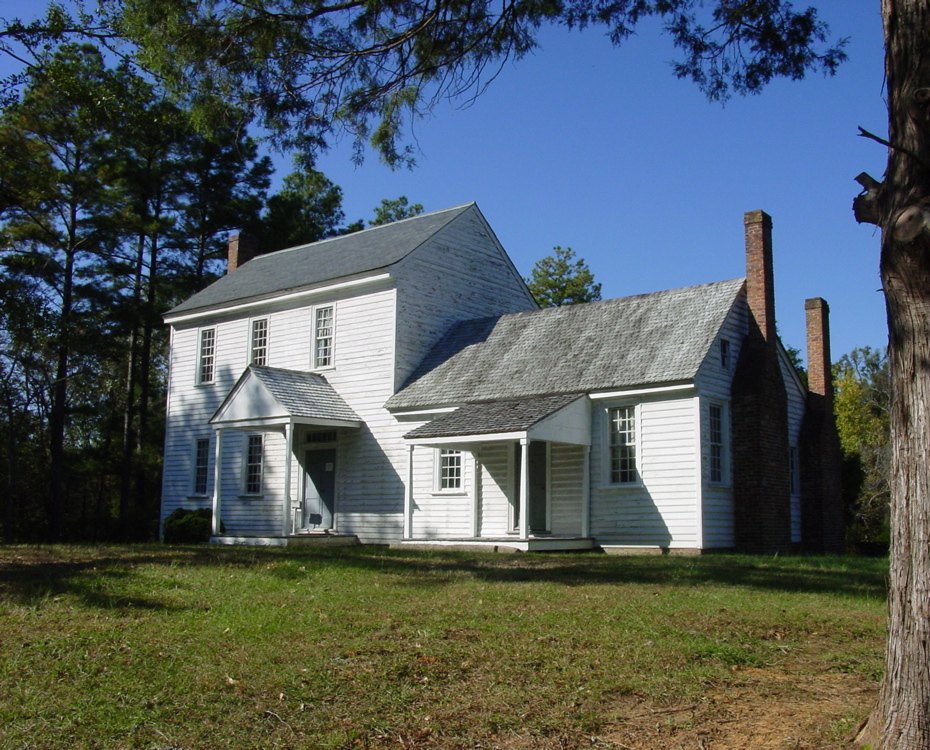
In 1799 Richard Bennehan built the house he called Stagville. By then he owned about 4,000 acres, worked by 44 or more enslaved people, and that year he joined the university's board of trustees. In November 1809 the county court gave leave to carry guns to four men: three Bennehan enslaved, Frank Kennon at the store, Humphrey at the Little River plantations and a man at the Brick House whose name the transcription gives as Donom, and to David, enslaved by Duncan Cameron at his Eno plantation; the owners gave bond and security as the law required. The same term the court ordered the patrollers Leonard Laws and George Laws, the local men named to ride their district and police enslaved people, to return six guns they had taken from men Bennehan and Cameron held in slavery.
On land beside Stagville that Bennehan had given Cameron and his wife at their 1803 marriage, Cameron began building Fairntosh in 1810, finished the main house in 1811 and added a large wing about 1818 to 1821; its dependencies included his law office, a chapel and a family burying ground. In February 1810 the court ordered a jury to turn the road from the forks at Bennehan's shop to the Eno mill so that it passed on the west side of Cameron's new house. In November 1816 it ordered the county trustee to pay Thomas Atkins, John Arnold and William Leathers the 600 dollars they had contracted for to build the bridge across the Eno at Bennehan's and Cameron's mills. On August 18, 1818 Mary Walker was born to Priscilla, whose mother, Aggy, had been one of the first enslaved children born on the Bennehan plantation, in 1781. Cameron's accounts for 1826 show close to 30,000 pounds of tobacco sold from the Bennehan-Cameron plantations, grown with the labor of enslaved people. He went on to hold more than a thousand people in slavery.
Reading on the places and people in this storyline
No indexed work is about this storyline itself yet. These are about the sites and people its dated events name, those named most often first, so they may discuss the storyline only in part. Follow a link to find a copy or view the material.
The Cameron Plantation in Central North Carolina (1776-1973) and Its Founder Richard Bennehan
Sanders, Charles Richard · 1974 · Sanders
Charles Richard Sanders's short history of the Cameron plantation in central North Carolina from 1776 to 1973 and of its founder Richard Bennehan, whose lands became Stagville and Fairntosh. It covers the Bennehan and Cameron families and their connection with the University of North Carolina at Chapel Hill. Published by the author in Durham in 1974, 79 pages with a plate and illustrations.
The Black family in slavery and freedom, 1750-1925
Gutman, Herbert G. (Herbert George), 1928-1985 · 1976 · Pantheon Books
Herbert G. Gutman's 1976 history of African American families from 1750 to 1925, published by Pantheon Books in New York, 664 pages with 38 leaves of plates. Its Orange County connection is the Bennehan and Cameron family plantations, Stagville and Fairntosh: the book discusses the people enslaved by Richard Bennehan (1743-1825) and the Camerons, and follows family ties among them under slavery and after emancipation. Subjects include African American families and enslaved persons in Orange County.
Reviewed in The Journal of Southern History (1977), The William and Mary Quarterly (1977), The American Historical Review (1977), Journal of American History (1977), The History Teacher (1977), Political Science Quarterly (1977), Journal of Black Psychology (1978), Journal of Social History (1978), Civil War history (1978), Signs (1978).
A portrait of Richard Bennehan
Bullock, Marshall · 1985
Marshall Bullock's A Portrait of Richard Bennehan, issued in Chapel Hill in 1985 together with pieces by Doris Betts, Elizabeth Sewell, Lucia A. Ciapponi, Lewis Leary and Phillip A. Snyder on southern writers and the Bible, the library as allegory, the Hanes copy of the Hypnerotomachia Poliphili in the Rare Book Collection, Parson Weems and Bernard Shaw's correspondence.
Walter Alves papers, 1771-1858, Orange County, North Carolina : also Kentucky and Tennessee.
Alves, Walter, 1768-1819 · 1993 · University Publications of America
University Publications of America issued this two reel microfilm edition in 1993, reproducing the Walter Alves papers of 1771 to 1858 with a printed reel guide. Alves, 1768 to 1819, was an Orange County landowner, and the material runs to real estate investment in North Carolina and Tennessee, Scottish American families, and letters with Richard Bennehan, William Boylan and John Wickham.
Wider background: Slavery, Emancipation & Reconstruction · the most widely held histories of the theme this storyline is filed under; they may not discuss it
To Free A Family
Nathans, Sydney · 2012 · Harvard University Press
Sydney Nathans's biography of Mary Walker, an enslaved woman from Orange County who escaped to the North in the mid nineteenth century and spent the following decades in Cambridge, Massachusetts, working to free the family she had left behind. Chapter titles trace her flight, her years among Northern friends, a rescue plot, a long silence, and the reunion that gives the book its close. Published 2012 by Harvard University Press, 330 pages with 20 pages of plates, illustrations and maps.
Reviewed in Choice Reviews Online (2012), Civil War Book Review (2012).
Miss Mary's Money
Jones, H. G. · 2014 · McFarland & Co.
H. G. Jones follows the fortune of Mary Ruffin Smith (1814-1885), the unmarried heiress whose Orange and Chatham County lands passed at her death to the University of North Carolina and the Episcopal Church. Chapters profile her grandfather Francis Jones, then trace the bequest through a quarrel among Episcopalians over Price Creek, the Chapel of the Cross and the university's buildings. A December 1885 New York Times report called the gift money; Jones shows it was land. Published by McFarland in 2014, 231 pages.
Piedmont Plantation: The Bennehan-Cameron Family and Lands in North Carolina
Anderson, Jean Bradley · 1985 · Historic Preservation Society of Durham
Jean Bradley Anderson's history of the Bennehan and Cameron families and their plantations, Stagville and Fairntosh, on lands that lay in Orange County until Durham County was formed from it in 1881. Published by the Historic Preservation Society of Durham in 1985, the book follows plantation life and ownership across several generations, with genealogical tables, a map, portraits, a bibliography and an index; 227 pages plus plates.
Reviewed in South Atlantic Quarterly (1987).
To Drink from the Well: The Struggle for Racial Equality at the Nation’s Oldest University
Kapur, Geeta · 2021
Geeta Kapur's history of race at the University of North Carolina at Chapel Hill, from the enslaved labor that built the campus through desegregation and the Black student protests that followed. Twelve chapters, with a foreword by William Barber II, move from the founding era and the Great Depression controversies to the state's response to integration and the turmoil of later decades; North Carolina Central University also figures. Published 2021 by Blair in Durham.
The Impact of Slavery on the Education of Blacks in Orange County, North Carolina 1619-1970
Moore, Rosetta Austin · 2015
Rosetta Austin Moore's survey of Black education in Orange County from the colonial era to 1970, in a revised edition published in 2015 through Lulu in Morrisville. After chapters on slavery nationally and on schooling for enslaved people in North Carolina, the book turns to the county: its formation, the growth of its schools, the arrival of free public schooling for all, and the schools and African American educators of the twentieth century. 265 pages with maps, portraits and facsimiles.
A Mind to Stay: White Plantation, Black Homeland
Nathans, Sydney · 2017
Sydney Nathans's history of a Black community in Hale County, Alabama, whose founders were enslaved people sent there before the Civil War from the Cameron family's plantations in Orange County, North Carolina. Instead of following the Great Migration out of the South, this group stayed, moved from bondage to owning the land they had worked, and held onto it across generations. Published 2017, 342 pages with plates and maps; this is the e-book edition.
Reviewed in Journal of American History (2017), Journal of Social History (2017), London review of books (2017), The Journal of the Civil War Era (2018), The Journal of Southern History (2018), Environmental History (2018), The Alabama review (2019), The Oral History Review (2019), The Register - Kentucky Historical Society/The register of the Kentucky Historical Society (2020).
Show 5 more
A Traitor and a Scoundrel: Benjamin Hedrick and the Cost of Dissent
Smith, Michael Thomas · 2003 · University of Delaware Press ; London : Associated University Presses
Michael Thomas Smith's biography of Benjamin Sherwood Hedrick, the University of North Carolina chemistry professor dismissed in 1856 after he declared support for the antislavery presidential candidate John C. Fremont. Published by University of Delaware Press in 2003, 216 pages with illustrations. Topics include abolitionists and dissenters in North Carolina, the antislavery movement in the state, and the university's biography before 1962.
Reviewed in The Journal of Southern History (2005).
Slavery and the making of the University: celebrating our unsung heroes, bond and free
2005
A 38-page bibliography of sources in Wilson Library on slavery and the building of the University of North Carolina at Chapel Hill, issued by the university library in 2005 with illustrations. Its subtitle honors the unsung people, enslaved and free, behind the university's making. A finding tool for researchers rather than a narrative history.
Wagging tongues and tittle tattle : gossip, rumor, and reputation in a small Southern town
Hoffert, Sylvia D. · 2025 · University of Georgia Press
Sylvia D. Hoffert's study of gossip, rumor and reputation in nineteenth-century Hillsborough, using the town as a case study of how talk shaped social standing and race relations in a small Southern place. Chapters take up the workings of idle chatter, people living on the edge of freedom under slavery, schooling, daily labor, and a period of fear over madness in the community. Published 2025 by the University of Georgia Press.
Mrs. Lincoln and Mrs. Keckly: The Remarkable Story of the Friendship Between a First Lady and a Former Slave
Fleischner, Jennifer · 2003 · Broadway Books
Jennifer Fleischner's double biography of Mary Todd Lincoln and Elizabeth Keckley, the dressmaker who had been enslaved, including years in Hillsborough, before buying her freedom and becoming the First Lady's confidante. Published by Broadway Books in New York in 2003, 372 pages with illustrations and a map. Topics include enslaved women in Hillsborough and the United States, dressmakers and women's friendships in the nineteenth century.
The Book of Burwell Students
Engstrom, Mary Claire · 1979 · Historic Hillsborough Commission
Mary Claire Engstrom's biographical register of the young women who attended the Burwell School in Hillsborough, subtitled lives of educated women in the antebellum South. The school was kept by Margaret Anna Burwell and her husband, and the book bears on women's education in nineteenth-century North Carolina. Published by the Historic Hillsborough Commission, 1979, 256 pages with illustrations and portraits.