Skip to content

Theme

News, Journalism & Broadcasting

Two centuries of local papers, from the Hillsborough Recorder to the Daily Tar Heel, and the broadcasters who followed.

The Hillsborough Recorder began in 1820, the Daily Tar Heel and the Chapel Hill papers followed, WUNC-TV went on the air in 1955 and WXYC made the first internet radio simulcast in 1994. The records here are the papers, their editors and the broadcasters.

526 works about News, Journalism & Broadcasting are indexed here. 8 held at OCPL →

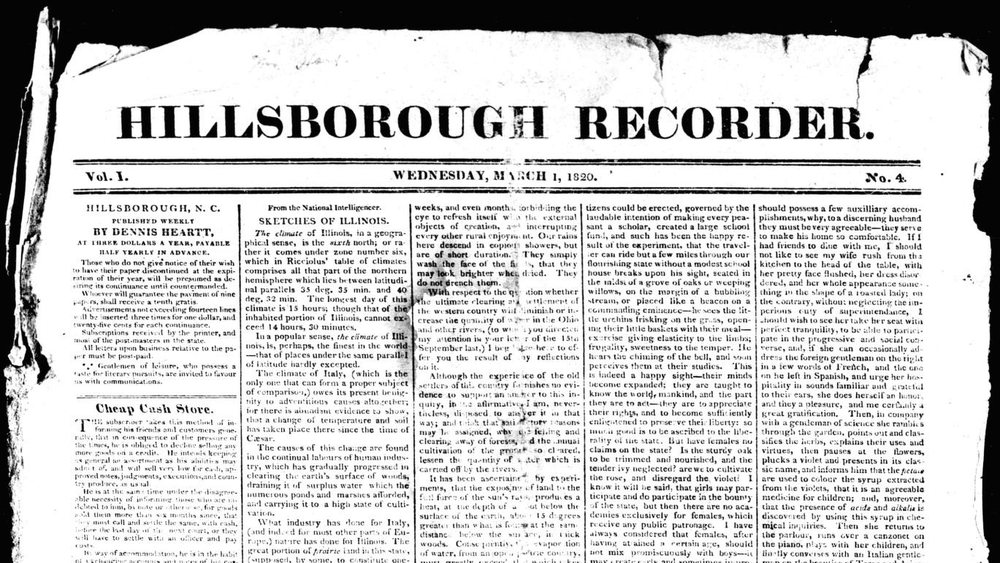
The Hillsborough Recorder of 1 March 1820.

Events and storylines

Named events and storylines the index follows in detail. Each has its own page.

More storylines

Other storylines that include this theme, in date order. Select a title to open its page or chronology entry.

Runaway apprentice notices, 1821–18671821–1867 · 19 events · From the 1820s masters placed notices in the Hillsborough Recorder and other papers when apprentices bound to them by the county court ran away. The notices gave the runaway's name and age, forbade anyone to harbor or employ them, and offered rewards, many of them five cents or a single cent, sometimes with 'no thanks' added; a few offered more, five dollars in 1837 for Ruffin Chavers, a boy of color, and ten dollars in 1862 for John Reeves, a trained tailor. Several of the runaways were youths of color, girls as well as boys, and many were nearly grown. In 1863 James M. Clark advertised an apprentice who had left while Clark was in the army, and in 1867 Thomas J. Anderson advertised for Joe Anderson, a Black bound boy of about fourteen. Each notice is the master's claim. Chapel Hill's first newspapers: the Harbinger and the Columbian Repository, 1832–18361832–1836 · Chapel Hill's first newspapers had trouble keeping going. William B. Crittenden proposed a Harbinger in 1832 but seems not to have started it. Isaac C. Patridge began his weekly Harbinger on August 27, 1833, under the supervision of the University professors, covering the sciences and arts and leaning on Elisha Mitchell and William Hooper for its contents. Its press also issued Joseph A. Hill's address attacking heavy corporal punishment. After one year Patridge said the paper would stop for some weeks while he decided whether to take a partner or retire. In 1836 Hugh McQueen started the Columbian Repository, which backed Hugh L. White for president; short of printers, it stopped that summer and returned in September with new workmen. The revenue officers' killing of Henry McMannen, 18901890 · On February 25, 1890 federal revenue officers searching for illicit stills shot Henry McMannen, a Black man, dead at his house in Little River Township. The officers said he had fired a shotgun at agent S. Kirkpatrick; others in the county said he was killed without cause, and the Rev. Sam P. Terry swore out murder warrants. Judge Armfield let the officers go after the sheriff gave them up to the U.S. marshal, and the Orange grand jury indicted five of them for murder. Federal Judge Dick freed all five by late April; the Observer wrote that the people would not be satisfied. In August the state dropped its charges against three of them. The News, Chapel Hill's weekly that became the News of Orange County, 1893–19441893–1944 · A Chapel Hill weekly founded in 1893 became Hillsborough's countywide paper. Begun as The Chapel Hill News and later renamed The News, it had a larger office and press in Chapel Hill by 1917, and in 1935 the Chapel Hill Weekly reported that it had moved to Hillsboro. In January 1944 W. B. Thompson and his wife sold its name, mailing right and good will to J. Roy Parker, an Ahoskie publisher on the university faculty. Parker renamed it The News of Orange County, remade it as a countywide weekly with journalism students as reporters. In November 1944, after ten months of printing about 150 miles away, it came off its own press in Hillsboro. The Newspaper Institute at Chapel Hill, 1916–19311916–1931 · The university and the North Carolina Press Association brought the state's editors to Chapel Hill for Newspaper Institutes, beginning in December 1916 with what the printed report called the first such institute in the state and the South. That session heard former President William Howard Taft, and the editors put out a daily, the Press Institute News, on a borrowed linotype. In January 1926 more than a hundred editors met at the Carolina Inn for a three-day institute run with the University's extension division. The seventh annual institute, in January 1931, heard Governor Gardner speak on the state's affairs in Gerrard Hall, with Mark Sullivan among the speakers. Williamsburging Franklin Street, 1940–19421940–1942 · Durham attorney J. L. Morehead urged Chapel Hill to make its Franklin Street business block as handsome as the campus, pointing to the business street of Colonial Williamsburg. Louis Graves's Chapel Hill Weekly reported the plan favorably in March 1940, and later accounts credit his paper with the campaign. In 1941 a Town Meeting committee under John M. Booker asked the aldermen for a Town Planning Commission and a consulting architect to pass on building designs. By November the commission was at work, and architect Archie Davis gave owners watercolors showing how to remodel. One building in its block followed the plan: the new Carolina Theatre, with a Colonial front from Davis's sketches, which opened on October 15, 1942.

Indexed works

Works about News, Journalism & Broadcasting from library and archive catalogs. The most widely held appear first; novels are not shown here. Follow a link to find a copy or view the material.

Widely held

Making News

Bowers, Thomas A. · 2009

Thomas A. Bowers's history of a century of journalism and mass communication teaching at the University of North Carolina, published by the School of Journalism and Mass Communication in 2009. It runs 282 pages with illustrations and portraits.

Included because: Catalog heading in the UNC record: Journalism.

A village voice : collected columns from the Chapel Hill news

Seymour, Robert E. (Robert Edward), 1925-2020 · 2003 · Chapel Hill Press

Robert E. Seymour's columns for the Chapel Hill News, gathered into a 192-page book by Chapel Hill Press in 2003. The short pieces offer anecdotes and reflections on Chapel Hill history, local manners and customs, and North Carolina life. Seymour (1925 to 2020) was the longtime pastor of Olin T. Binkley Memorial Baptist Church.

Included because: Catalog heading in the UNC record: Journalists.

The first 25 years : WCHL 1360

1978 · WCHL?

Anniversary booklet for the first twenty-five years of WCHL, the Chapel Hill radio station at 1360 on the AM dial, published in 1978. Topics include radio broadcasting and Chapel Hill history, with advertisements included. 20 unnumbered pages with illustrations and portraits.

Included because: Catalog heading in the UNC record: Radio broadcasting.

Celebrating 50 years on the air and 50 who made a difference : WCHL 1360

2003

Anniversary booklet marking fifty years of WCHL 1360, the Chapel Hill radio station, with profiles of fifty people from Chapel Hill and Carrboro. Published in 2003, 36 pages with portraits. Contributors include Roland Giduz, Jim Heavner, Jonathan Howes, Neil Offen and Rosemary Waldorf.

Included because: Catalog heading in the UNC record: Radio stations.

The origins of journalism education at UNC-Chapel Hill

Bowers, Thomas A., 1942- · 2009

Thomas A. Bowers gave this talk on the beginnings of journalism teaching at the University of North Carolina on October 15, 2009 in Wilson Library, part of the Gladys Hall Coates university history lecture series. It was printed the same year.

Included because: Catalog heading in the UNC record: Journalism.

UNC

Goodbye Howell Hall.

Simpson, Richard Hunter · 1999 · R.H. Simpson

Richard Hunter Simpson filmed this seven minute farewell to Howell Hall in 1999. The film concerns the University of North Carolina at Chapel Hill School of Journalism and Mass Communication, its buildings and its history, and the teaching of journalism in Chapel Hill. One videocassette, color with black and white sequences.

Included because: Catalog heading in the UNC record: Journalism.

UNC
Show 2 more

100th anniversary.

1993

Centennial edition of the Daily Tar Heel, the University of North Carolina student newspaper, produced at Chapel Hill in 1993 to mark one hundred years of publication. Jen Pilla is named as centennial edition editor. Topics include the paper's history along with college student newspapers and periodicals in Chapel Hill, which makes the issue a source for the paper's own record.

Included because: Catalog heading in the UNC record: Daily Tar Heel.

UNC

1360 WCHL : commemorating forty years of excellence

1993 · Village Sports, Inc.

An illustrated volume, with portraits, published by Village Sports in 1993 to mark forty years of WCHL, Chapel Hill's radio station at 1360 on the dial. Its writers were Jim Heavner, Roland Giduz, Jim Shumaker, Zora Rashkis, Dan Dunlop, George McCall, Lee Pace, Beth Tatum and Larry Stone.

Included because: Catalog heading in the UNC record: Radio stations.

UNC

Recently indexed: American health care as a business : the consequences of a profit mentality (1992) · The Blue Ridge magazine (1920) · Buck Jr (1933) · Bud (1953) · The cosmo (1949) · CPU bulletin (1969)

Search all 526 indexed works →

Start at OCPL

Books in OCPL’s Rebecca B. Wall Local History Collection whose titles, catalog subjects, or descriptions match this theme. The Friends’ recommended starting points are labelled. Books marked Wider context cover the broader subject rather than this theme itself.

Show 5 more
  • Foundational · NC 975.656 GID Who's Gonna Cover 'em Up?!: Chapel Hill Uncovered--1950-1985 : Featuring the Newsman's Notepad Giduz, Roland · 1985

    Roland Giduz, a Chapel Hill newsman, gathers anecdotes and humor about the town from 1950 to 1985 in this 1985 book, subtitled Chapel Hill uncovered and featuring the newsman's notepad. Illustrated, with an index. Part of the Rebecca B. Wall Local History Collection.

  • Foundational · NC 975.6 FOU Abstracts From Newspapers of Edenton, Fayetteville, & Hillsborough, North Carolina, 1785-1800 Fouts, Raymond Parker · 1984

    Raymond Parker Fouts abstracted the notices printed in the Edenton, Fayetteville and Hillsborough newspapers between 1785 and 1800, publishing the result through GenRec Books of Cocoa, Florida, in 1984, ii and 111 pages. The Hillsborough portion covers the Orange County seat in the first years after the Revolution.

  • Wider context · NC BIO GAMBILL GAM The Sages of Roney Street: And Other Joys, Large and Small Gambill, Jerry Gentry · 1996

    Jerry Gentry Gambill's newspaper columns, most first printed under his byline in the Durham Morning Herald and its successor, the Herald-Sun, between 1979 and 1992, gathered with other pieces and edited by John A. Gentry. Published in 1996 by University Editions of Huntington, West Virginia; 285 pages with illustrations.

  • Wider context · NC 929.375 MARRIAGE Marriage and Death Notices From Raleigh, N.C. Newspapers, 1796-1826 1977

    Two early Raleigh newspapers, the Minerva and the Star, supplied the marriage and death notices gathered here for 1796 to 1826, with a bride index for each paper's marriages. Jane Cutler Bahnsen, Elizabeth Henderson Cotten and Helen Dortch Harrison of the North Carolina Collection at the University of North Carolina prepared the indexes in the 1950s; Southern Historical Press published them in 1977, 164 pages. Some notices concern South Carolinians.

  • Wider context · NC 070.49 SPEAR Playing With Dynamite: The Story of One Newspaper Family in the South Spear, David M. · 2016

    David M. Spear tells the story of his family and The Messenger, the newspaper it published in Madison, in Rockingham County, North Carolina, during the twentieth century. The 299-page book has plates, portraits and a genealogical table on the endpapers; Gnomon Press published it for the author in 2016.

In the chronology

Dated events connected with this theme, in date order. See these 298 dated events in the chronology →

  1. A newspaper correspondent puts Orange County's taxables at four thousand Writing from Williamsburg, Virginia, in 1768 to the South Carolina and American General Gazette, a correspondent held up Orange as proof of how fast the back country was filling: twenty years earlier, he wrote, there were not twenty taxable people within the county's limits, and now there were four thousand. Connor reckoned that meant about 16,000 people, most of them Scotch-Irish with a large share of Germans.Search the index · Internet Archive: R. D. W. Connor, William K. Boyd and J. G. de Roulhac Hamilton, History of North Carolina (1919), vol. 1, p. 177
  2. Provincial Congress at Hillsborough orders its journal printed by James Davis The congress meeting at Hillsborough directed that its proceedings be delivered to James Davis, the province's printer and a delegate for the town of New Bern, who was desired to print them and send a copy to each member. It also named a committee to state and settle his account for services done as printer to the province. People: Willie Jones, Thomas PersonSearch the index · Documenting the American South: Minutes of the Provincial Congress of North Carolina, August 20 to September 10, 1775
  3. The Assembly names Thomas Davis state printer and tells him to set up his press at Hillsborough On the last day of the session Davis was appointed public printer and directed to establish his press in Hillsborough as soon as he could, to print the state's laws and legislative journals there.Search the index · Lefler and Wager, Orange County, 1752-1952 (1953), p. 63
  4. The North Carolina Gazette begins publication at Hillsborough The North Carolina Gazette of Hillsborough, apparently the county's first regular newspaper, appeared in 1785 by Lefler and Wager's account, early in 1786 by Boyd's. The only surviving copy with an imprint, dated February 16, 1786, was printed by Robert Ferguson for Thomas Davis.Search the index · Lefler and Wager, Orange County, 1752-1952 (1953), p. 124 · Also: Internet Archive
  5. William Woods Holden is born near Hillsborough William Woods Holden, later editor of the North Carolina Standard and governor, was born near Hillsborough to Thomas Holden and Priscilla Woods. His grandfather had moved to Orange County to farm, and from age six he was raised by his stepmother, Sally Nichols Holden.Search the index · NCpedia (Dictionary of North Carolina Biography): Holden, William Woods
  6. Hillsborough has 437 white residents as the Recorder begins Hillsborough was a town of 437 white people in February 1820, when Dennis Heartt, lately of Philadelphia, issued the first number of the Hillsborough Recorder. People: Dennis HearttSearch the index · Internet Archive: North Carolina Historical Review 30 (1953), p. 392
  7. The Hillsborough Recorder begins publication Dennis Heartt began publishing the weekly Hillsborough Recorder in February 1820, at three dollars a year. The paper ran until 1879, and its surviving issues are a main record of nineteenth-century Hillsborough and Orange County. People: Dennis HearttHillsborough Recorder, March 1, 1820 (Vol. 1, No. 4)
  8. The Hillsborough Recorder moves its office west of the market house The Hillsborough Recorder moved its printing office to the house opposite Dr. Smith's office, about 150 yards west of the market house. People: Dennis HearttHillsborough Recorder, November 22, 1820, p. 3
  9. The Hillsborough Recorder calls slavery a misfortune and urges colonization Editor Dennis Heartt wrote that slavery harmed the state but argued against freeing people to remain in North Carolina. He proposed sending free Black people to Africa at public expense and asked the legislature to act. People: Dennis HearttLefler and Wager, Orange County, 1752-1952 (1953), p. 103-104
  10. The Hillsborough Recorder shop prints The Discipline of Friends and A Solemn Address to Youth Besides the weekly paper, Dennis Heartt's Recorder office printed pamphlets. Two surviving titles from 1823 are The Discipline of Friends, for Quaker use, and A Solemn Address to Youth. People: Dennis HearttLefler and Wager, Orange County, 1752-1952 (1953), p. 127
  11. The court binds Ferdinand W. Burroughs to Dennis Heartt to learn printing The court bound Ferdinand W. Burroughs, 11, orphan of Smith Burroughs late of Martin County, as an apprentice to Dennis Heartt until of full age to learn the printer's trade. Heartt agreed to teach him reading, writing and the ground rules of arithmetic, to give him decent lodging and clothing, and to furnish an extra suit of clothes when his time ended. People: Dennis HearttMark Chilton, Freedom Bound: Apprenticeship, Racism & Liberation in Orange County, North Carolina 1777 to 1868 (Wandering through the NC Piedmont)
  12. William W. Holden serves as an apprentice printer at the Hillsborough Recorder At about age ten Holden was apprenticed as a printer's devil to Dennis Heartt, editor of the Hillsborough Recorder, who was responsible for his early education and political views. He struck out on his own at about sixteen, working first for the Milton Chronicle. People: Dennis HearttSearch the index · NCpedia (Dictionary of North Carolina Biography): Holden, William Woods
Show all 298 dated events
  1. The Recorder shop prints Letters on Popular Education The Hillsborough Recorder office printed Letters on Popular Education Addressed to the People of North Carolina in 1832. People: Dennis HearttLefler and Wager, Orange County, 1752-1952 (1953), p. 127
  2. William B. Crittenden proposes a newspaper called the Harbinger for Chapel Hill Crittenden, a lawyer from New York, issued proposals in March 1832 to publish the Harbinger at Chapel Hill. He seems not to have started it; the Harbinger that began in August 1833 was published by Isaac C. Patridge under the supervision of the university professors and lasted a year. People: Isaac C. PatridgeSearch the index · Internet Archive: Daniel Miles McFarland, "North Carolina Newspapers, Editors and Journalistic Politics, 1815-1835", North Carolina Historical Review 30 (1953), p. 380
  3. The Harbinger press prints Joseph A. Hill's address to the Institute of Education Isaac C. Patridge, publisher of the Harbinger, issued as a pamphlet the address Joseph A. Hill of Wilmington gave the North Carolina Institute of Education at Chapel Hill in June 1833. Papers across the state acknowledged copies and praised its attack on heavy corporal punishment and on emulation as a spur to study. People: Isaac C. PatridgeSearch the index · The Harbinger (Chapel Hill), February 20, 1834, p. 2
  4. The Harbinger suspends publication at Chapel Hill after its first year Publisher Isaac C. Patridge closed the Harbinger's first subscription year with the issue of August 27, 1834, and announced that the paper would stop for some weeks while he decided whether to take a partner or retire as publisher. He had already offered part or all of the establishment for sale and asked delinquent subscribers to pay. People: Isaac C. PatridgeSearch the index · The Harbinger (Chapel Hill), August 27, 1834, p. 3
  5. The Recorder prints a county meeting's warning to abolitionists An Orange County meeting adopted a report warning "northern fanatics" not to stir up the enslaved and predicting lasting hostility between the sections if abolitionists pressed on. Its fourteen-man committee included Frederick Nash, William A. Graham, Hugh Waddell, John U. Kirkland, Dr. Edmund Strudwick and the paper's own editor, Dennis Heartt, as a secretary. People: Frederick Nash, William A. Graham, Hugh Waddell, John U. Kirkland, Edmund Strudwick, Dennis HearttBurwell School Historic Site Task Force: Antebellum Hillsborough, Slavery, and Enslaved and Free People of Color who Worked at the Burwell School, 1837-1857 (2019), p. 49
  6. Hillsborough elects Dennis Heartt magistrate of police and seven town commissioners Hillsborough voters chose Dennis Heartt, editor of the Recorder, as magistrate of police for the coming year and elected seven town commissioners, among them Dr. Edmund Strudwick, John Scott, William H. Phillips and Stephen Moore. People: Edmund Strudwick, Stephen MooreSearch the index · Hillsborough Recorder, February 12, 1836, p. 3
  7. The Columbian Repository begins at Chapel Hill In April 1836 Hugh McQueen proposed to publish the Columbian Repository at Chapel Hill and promised to support Hugh L. White for president. The first issue appeared two months later.Search the index · Internet Archive: Daniel Miles McFarland, "North Carolina Newspapers, Editors and Journalistic Politics, 1815-1835", North Carolina Historical Review 30 (1953), p. 381 · Also: Columbian Repository (Chapel Hill), June 18, 1836, p. 2
  8. The Columbian Repository resumes publication after a suspension Short of printers since one hired hand never came and another left, the Chapel Hill paper had issued its July 28 number late, on August 2, and then stopped. It returned on September 15 with new workmen, and subscribers were not charged for the missed numbers.Search the index · Columbian Repository (Chapel Hill), September 15, 1836, p. 3
  9. The Hillsborough Recorder proposes a convention of North Carolina editors Dennis Heartt's Recorder proposed that the state's newspaper editors meet in convention at Raleigh on the first Monday in September to agree on rules for their trade; within two weeks the Raleigh editors took up the proposal and invited their brethren. People: Dennis HearttSearch the index · Hillsborough Recorder, June 9, 1837, p. 3
  10. The Hillsborough Recorder predicts North Carolina will become a rival of northern cotton mills Editor Dennis Heartt told Recorder readers that northern manufacturers would not much longer be able to count North Carolina as a market for cotton goods, and should instead expect the state to become a formidable competitor. People: Dennis HearttInternet Archive: North Carolina Historical Review 34 (1957), p. 144
  11. A memorial against dividing Orange County circulates in the Hillsborough Recorder A memorial to the General Assembly from inhabitants of Orange opposed to division, printed in the Recorder while it went round for signatures, held that a large county was harder for any family, town or company to control and would keep the tax rate low, and asked the legislature not to disturb the county's ancient relations.Search the index · Lefler and Wager, Orange County, 1752-1952 (1953), p. 18 · Also: Hillsborough Recorder, September 6, 1838, p. 3
  12. The Christian Sun is founded at Hillsborough The Christian Sun, a weekly founded at Hillsborough in 1844 as the organ of the Virginia and North Carolina Christian Conference, had Daniel Wilson Kerr, an associate of James O'Kelly, as its first editor and Dennis Heartt, publisher of the Hillsborough Recorder, as its first printer. After five years in Hillsborough the paper moved on, reaching Pittsboro, Raleigh, Suffolk and Petersburg by the end of the Civil War. People: Dennis HearttSearch the index · Internet Archive: North Carolina Historical Review 30 (1953), p. 9
  13. The Recorder begins reprinting Herman Husband's account of the Regulation Dennis Heartt began reprinting in the Recorder, from the Greensborough Patriot, Herman Husband's rare account of the Regulation in Orange so that subscribers could read and keep it, praising the Regulators' spirit of liberty. The Patriot's copy had come through the Rev. Mr. Caruthers from a Regulator's granddaughter living in Indiana. People: Dennis Heartt, Herman HusbandSearch the index · Hillsborough Recorder, February 8, 1844, p. 3
  14. The 1850 census finds Dennis Heartt's printers and apprentices living at Heartsease The 1850 census listed editor Dennis Heartt's household at Heartsease with his two daughters, his son Edwin with his wife and small daughter, two young printers, and four boys aged eleven to eighteen entered as students who were probably apprentices at the Hillsborough Recorder. People: Dennis HearttNC State Historic Preservation Office: Heartsease, National Register nomination (OR0009), p. 5
  15. Dennis Heartt takes his son Edwin A. Heartt into the Recorder With the issue that closed the paper's thirty-first volume, Dennis Heartt took his son Edwin A. Heartt into the business, and the Hillsborough Recorder was thereafter published by Dennis Heartt & Son.Search the index · Hillsborough Recorder, February 5, 1851, p. 3
  16. The Hillsborough Recorder calls for a plank road from Hillsborough to Milton An editorial regretted that no one had asked the last legislature to charter a company to build a plank road from Hillsborough to Milton by way of Roxboro or Yanceyville. It hoped a stock company would form under the general act of 1850-51 while a charter was sought.Lefler and Wager, Orange County, 1752-1952 (1953), p. 184
  17. Dennis Heartt is replaced as Hillsborough postmaster by James M. Palmer Dennis Heartt, editor of the Recorder and a Whig, was removed as postmaster at Hillsborough under the Pierce administration and succeeded by James M. Palmer, who signed the town's list of uncalled letters on October 1, 1853. Heartt marked his removal with a mock farewell in verse to the Postmaster General. People: James M. PalmerSearch the index · Hillsborough Recorder, October 5, 1853, p. 3
  18. The Hillsborough Recorder enlarges and keeps its Whig flag Dennis Heartt's Recorder came out about five columns larger at no increase in price. Announcing the change, the paper welcomed the principles of the new American or Know-Nothing party but said it would not strike the Whig flag for any new party. People: Dennis HearttSearch the index · Hillsborough Recorder, May 30, 1855, p. 2
  19. Edwin A. Heartt, the Recorder's junior partner and secretary of the town and county boards, dies Edwin A. Heartt, son and partner of Recorder editor Dennis Heartt, died in late August. The Court of Wardens, whose secretary he was, the Hillsborough town commissioners, whom he also served as secretary, and Eagle Lodge No. 71, where he was an officer, passed resolutions of mourning. People: Dennis HearttSearch the index · Hillsborough Recorder, September 12, 1855, p. 3
  20. J. M. Henderson begins publishing the Chapel Hill Weekly Gazette J. M. Henderson, lately editor and publisher of the Concord Gazette, began the Chapel Hill Weekly Gazette, a paper neutral in politics and given to literature, science, news, markets and agriculture, at two dollars a year.Search the index · Hillsborough Recorder, April 29, 1857, p. 2 · Also: The Chapel Hill Gazette, April 18, 1857, p. 2
  21. New poems by George Moses Horton appear in the Chapel Hill Gazette George Moses Horton's poem 'What Is Time' was printed in the Chapel Hill Gazette on May 9, 1857, and a courting poem he wrote for a young gentleman to send his sweetheart followed on May 16. The paper introduced him as the enslaved author of Horton's Poems, held by Hall Horton of Chatham County.Search the index · The Chapel Hill Gazette, May 9, 1857, p. 2 · Also: The Chapel Hill Gazette, May 16, 1857, p. 3
  22. The Recorder cuts the size of its sheet for lack of paper With paper scarce and much dearer, the Hillsborough Recorder came out on December 25 on a smaller sheet of poorer paper, promising to cut advertising rather than reading matter, and announced it would skip the next week's issue for the printers' holiday. People: Dennis HearttSearch the index · Hillsborough Recorder, December 25, 1861, p. 3
  23. The Recorder endorses Vance but refuses to print soldiers' charges against Holden Dennis Heartt printed resolutions from the men of Dickson's Battery backing Governor Vance but left out two: one that denounced W. W. Holden and one he read as scorning every man not in the army as a coward. He wrote that Holden sought an honorable peace and that no evidence made him a traitor, and he kept that stand when Raleigh papers objected. People: Dennis Heartt, W. W. Holden, Zebulon B. VanceHillsborough Recorder, April 20, 1864, p. 2
  24. Dennis Heartt leases the Recorder to James M. Turrentine for 1865 Dennis Heartt, in failing health, leased the Hillsborough Recorder for the coming year to James M. Turrentine, who became its editor and publisher and promised a conservative family paper, while Heartt kept his interest and its profits and stayed on to supervise.Search the index · Hillsborough Recorder, December 21, 1864, p. 2
  25. A Black newspaper editor from Baltimore canvasses Hillsborough for subscribers George T. Cook, a Black editor from Baltimore, spent a day in Hillsborough about December 1, 1866, taking subscriptions for his paper among Black residents, and on December 3 wrote from Hillsborough to the Bureau that Guilford County's courts dealt unjustly with Black people. The assistant commissioner's office, which thought him a sensationalist, asked Lt. Isaac Porter about him; Porter replied on December 18 that he had not met Cook and knew of the visit only from Black residents.Freedmen's Bureau, North Carolina Field Offices, Hillsboro: Letters and Endorsements Sent and Received, Vol. 128, transcription p. 72
  26. Dennis Heartt gives up the Hillsborough Recorder after nearly fifty years In the Recorder of January 11, 1869, Dennis Heartt announced that his connection with the paper would end with that number, thirteen months short of fifty years after its first issue. An 1899 history of the paper says he sold it to Capt. C. N. B. Evans of the Milton Chronicle.Search the index · Hillsborough Recorder, January 11, 1869, p. 2
  27. C. N. B. Evans closes the Milton Chronicle and joins the Recorder C. N. B. Evans, who had closed his Milton Chronicle, became associate editor and publisher of the Hillsborough Recorder with his son, Capt. T. C. Evans.Search the index · Hillsborough Recorder, January 26, 1870, p. 2
  28. Kirk's militia arrests Josiah Turner Jr. at Hillsborough On August 5, 1870, a detachment of Kirk's state militia seized Raleigh Sentinel editor Josiah Turner Jr. at the Hillsborough depot, took him by rail to Company Shops and then held him with Kirk's other prisoners in the Caswell County courthouse at Yanceyville. U.S. District Judge George W. Brooks ordered him discharged on August 19, 1870, on his habeas corpus petition. The impeachment article and the trial testimony name the officer as Lieutenant J. W. Hunnicutt, sent from Company Shops with about ten men by Lieutenant Colonel Burgen, and Judge Brooks ordered Kirk to pay the costs. People: William W. Holden, Josiah Turner Jr.Internet Archive: Trial of William W. Holden, Governor of North Carolina, vol. 1 (1871) · Also: Turner testimony: Report on the Alleged Outrages in the Southern States; Trial of William W. Holden; Internet Archive; Trial of William W. Holden, Governor of North Carolina (1871), vol. 1
  29. Josiah Turner Jr. of Hillsborough testifies before the Senate committee on Southern outrages Josiah Turner Jr., Conservative editor of the Raleigh Sentinel, who kept his family home at Hillsborough, testified under oath before the Senate select committee in Washington on February 24, 1871. He said he had known nothing of the White Brotherhood until the habeas corpus hearings at Raleigh in the summer of 1870, put the toll in Orange at four men hanged and one shot, besides five whipped, and called the violence a war between two secret societies, the Klan and the Union League. Asked whether he had told James E. Boyd of Graham to let the Klan ride before an election, he denied it. People: Josiah Turner Jr.U.S. Senate, Select Committee, Report on the Alleged Outrages in the Southern States (1871), p. 349
  30. John D. Cameron becomes editor and publisher of the Recorder John Donald Cameron took over the Recorder from the Evans family, who kept only their Milton Chronicle. His masthead in January 1879 read 'J. D. Cameron, Editor and Proprietor', New Series Vol. 7, Old Series Vol. 58.DigitalNC: The Durham Recorder (Durham, N.C.) Historic Issues
  31. The Plant newspaper is published at Durham The Plant, a newspaper edited by a Mr. Green, was being published at Durham, now Durham County.Search the index · Hillsborough Recorder, February 21, 1872, p. 3
  32. The Recorder moves its office to the southeast corner of the courthouse square The Hillsborough Recorder moved its office to the southeast corner of the courthouse square in Hillsborough, skipping its issue of October 20 during the move.Hillsborough Recorder, October 27, 1875, p. 3
  33. The Durham Herald begins publication A new weekly, the Herald, issued its first number at Durham by late March; by May the Recorder counted it the third paper then published in Orange County, alongside the Recorder and the Durham Tobacco Plant.Search the index · Hillsborough Recorder, March 29, 1876, p. 3
  34. Joseph A. Harris publishes the Chapel Hill Ledger Joseph A. Harris began printing the Chapel Hill Ledger in a small wooden shop on the south side of East Franklin Street. He stopped publishing it in 1880. People: Joseph A. HarrisSearch the index · Bernard Lee Bryant Jr., Occupants and Structures of Franklin Street, Chapel Hill (1998; Chapel Hill Historical Society, 1999), scan p. 135
  35. Francis D. Winston gives up his place as an editor of the Chapel Hill Ledger Francis D. Winston announced in the Ledger that his college duties obliged him to leave the paper, and the remaining editor took charge alone, promising to keep up its literary standing and to work for education, agriculture and the general welfare.Search the index · The Chapel Hill Ledger, September 7, 1878, p. 2
  36. John D. Cameron moves the Recorder from Hillsborough to Durham, ending fifty-nine years of publication in the county seat Cameron carried the paper fifteen miles east to the tobacco town, where it continued as the Durham Recorder, published every Wednesday. The last issue under the Hillsborough title in the digitized run is March 5, 1879; the first Durham issue there is July 2, 1879.DigitalNC: The Durham Recorder (Durham, N.C.) Historic Issues
  37. Cornelia Phillips Spencer edits the Chapel Hill Weekly Ledger For some months in 1879 Cornelia Phillips Spencer edited the Chapel Hill Weekly Ledger, with students R. P. Pell and Francis D. Winston as assistants. The book calls her the county's only woman editor; Charles B. Aycock took over from her. People: Charles B. Aycock, Francis D. WinstonSearch the index · Lefler and Wager, Orange County, 1752-1952 (1953), pp. 127-128 · Also: The Chapel Hill Ledger, April 26, 1879, p. 2
  38. Charles B. Aycock edits the Ledger in Chapel Hill Aycock, then a university student, took over as editor of the weekly Chapel Hill Ledger in 1879, succeeding Cornelia Phillips Spencer. The paper ran until 1880. People: Cornelia Phillips SpencerSearch the index · The Chapel Hill Ledger, November 1, 1879, p. 2 (masthead) · Also: NCpedia: Aycock, Charles Brantley; The Chapel Hill Ledger, September 13, 1879, p. 3
  39. Charles B. Aycock leaves the Ledger and Joseph A. Harris takes over as editor Joseph A. Harris, who had founded the Chapel Hill Ledger nearly two years before, announced that Charles B. Aycock had withdrawn as editor and that he would edit and publish the paper himself. People: Joseph A. HarrisSearch the index · The Chapel Hill Ledger, January 10, 1880, p. 2
  40. The Southern Mail begins publication at Hillsborough T. B. Ryan began publishing the Southern Mail, a weekly newspaper, at Hillsborough.Search the index · The Chapel Hill Ledger, January 10, 1880, p. 2
  41. The Orange County Observer begins publication at Hillsborough Joseph A. Harris started the Orange County Observer at Hillsborough in October 1880 as its publisher and one of its editors, numbering it a new series of a paper established in 1878. The paper ran until about 1917. People: Joseph A. HarrisSearch the index · Orange County Observer (Hillsborough), October 23, 1880, p. 1 (masthead: Established in 1878, New Series, Vol. I, No. 3) · Also: Lefler and Wager, Orange County, 1752-1952; Orange County Observer (Hillsborough), October 8, 1887, p. 2
  42. A new storehouse on Churton Street opens with Hayes's drug store and the Observer office A new two-story storehouse on Churton Street, north of Jones's store, was made ready for use at the start of September 1883. W. A. Hayes moved his drug store into the ground floor, and the Orange County Observer moved its office and press to the second story, where it stayed for the rest of the year. People: Joseph A. HarrisSearch the index · Orange County Observer (Hillsborough), September 1, 1883, p. 3
  43. Cornelia Phillips Spencer turns her daughter's letters from Europe into a newspaper series While June Spencer toured Europe on a family legacy in 1884, her mother used June's daily letters home as the basis for a series, "Letters from a Young Lady," printed under June's name in the North Carolina Presbyterian. The editor had sent fifty dollars before June sailed, the only pay the series brought. People: June Spencer LoveSearch the index · James Lee Love, Recollections (1920-1921), scan p. 219
  44. Hillsborough elects editor Joseph A. Harris mayor Hillsborough voters chose Joseph A. Harris, editor of the Orange County Observer, as mayor, with A. W. Graham, James Webb Jr., W. H. Newman, George C. Corbin, W. E. Steward, J. W. Hooker and D. M. Laws as commissioners. The outgoing mayor, Corbin, had declined to run again. People: James Webb Jr., George C. Corbin, Augustus Washington Graham, J. W. Hooker, Dudley M. LawsSearch the index · Orange County Observer (Hillsborough), May 9, 1885, p. 3
  45. Hillsborough elects Joseph A. Harris mayor With no opposing ticket and only about half the registered voters taking part, Hillsborough elected Joseph A. Harris, editor of the Orange County Observer, as mayor, with A. W. Graham, James A. Cheek, Henry Richards Jr., A. J. Ruffin, John Rosemond, James Webb Jr. and Jesse Hedgpeth as commissioners. The new board took office May 7 and chose Thomas D. Tinnin clerk and John Laws treasurer. People: Allen Jones Ruffin, James Webb Jr., James A. Cheek, Augustus Washington GrahamSearch the index · Orange County Observer (Hillsborough), May 7, 1887, p. 3
  46. Frederick Strudwick co-owns and edits the Hillsborough Recorder On 11 August 1887 Strudwick and C. E. Parish became co-owners and editors of the Hillsborough Recorder. Their first issue promised a firm and conservative stand on matters of public welfare and a thoroughly Democratic line in politics. Strudwick left the paper after the issue of 8 March 1888. People: Calvin E. ParishSearch the index · NCpedia: Strudwick, Frederick Nash · Also: Orange County Observer (Hillsborough), August 13, 1887, p. 2; Hillsboro Recorder, August 11, 1887, p. 2
  47. The revived Hillsboro Recorder moves Dennis Heartt's old press into its office The new Hillsboro Recorder reported that it had just moved the press and some wood type Dennis Heartt brought from Connecticut for the first Recorder of 1820 out of a Hillsborough cellar, where they had sat since 1867, and into its own office. People: Dennis Heartt, Frederick N. Strudwick, Calvin E. ParishDigitalNC: The Charlotte Democrat, October 14, 1887, p. 1 · Also: Hillsboro Recorder, October 13, 1887, p. 2; Hillsboro Recorder, October 6, 1887, p. 3
  48. F. N. Strudwick withdraws from the Hillsboro Recorder F. N. Strudwick, who had become co-owner and editor of the revived Hillsboro Recorder in 1887, withdrew from the paper.Search the index · Orange County Observer (Hillsborough), March 17, 1888, p. 3
  49. Fire destroys the Parish and Berry buildings and the Recorder printing office in Hillsborough A fire before dawn burned Postmaster Harry L. Parish's brick building, which held the post office, his store and the Hillsboro Recorder's printing office, then spread to the three-story Berry building next door. The Recorder lost its press, type and subscription books. People: Calvin E. ParishSearch the index · Orange County Observer (Hillsborough), December 1, 1888, p. 3
  50. The Orange grand jury indicts Durham editor Hackney for libeling Sheriff Hughes After the Durham Recorder printed a false report that Judge Armfield had jailed Sheriff John K. Hughes over the revenue officers' case and that the prisoners had jumped bail, the Orange County grand jury returned a true bill for libel against its editor, Hackney. People: John Knox HughesSearch the index · Orange County Observer (Hillsborough), March 22, 1890, p. 2
  51. Students start the Chapel Hillian newspaper A student paper called the Chapel Hillian appeared, edited by F. H. Argo and S. A. Ashe Jr. It gave way to two rival papers, the White and Blue of the non-fraternity men and the Tar Heel of the fraternity men, and the Tar Heel outlasted its rival.Search the index · Documenting the American South: Kemp P. Battle, History of the University of North Carolina, vol. II (1912), p. 454 · Also: The Chapel Hillian, November 4, 1890, p. 1
  52. Hillsborough re-elects Mayor Joseph A. Harris and chooses a seven-man town board Harris, the editor of the Observer, won the Monday town election as mayor. The new board was James Webb Jr., James A. Cheek, S. J. Lynch, H. N. Brown Jr., H. L. Faucette, O. D. Hooker and T. C. Hayes. People: James Webb Jr., James A. CheekSearch the index · Orange County Observer (Hillsborough), May 9, 1891, p. 3
  53. The Orange County Observer moves its office to rooms over Joseph A. Harris Jr.'s store The Orange County Observer moved its printing office in late January 1892 to new quarters over Joseph A. Harris Jr.'s store, opposite the court house.Search the index · Orange County Observer (Hillsborough), January 16, 1892, p. 3
  54. The Tar Heel publishes its first issue The first issue of The Tar Heel, volume 1, number 1, appeared on Thursday, February 23, 1893, as a weekly published under the auspices of the University Athletic Association, with Charles Baskerville as editor in chief. The student paper took the name The Daily Tar Heel in 1929. People: Charles BaskervilleIn the index: Daily Tar Heel · The Tar Heel, February 23, 1893, p. 1 (DigitalNC)
  55. The Chapel Hill News, forerunner of The News of Orange County, begins publication The weekly that became The News of Orange County began in Chapel Hill in October 1893 as The Chapel Hill News. Renamed The News, it moved to Hillsboro between 1936 and 1941 and took the title The News of Orange County in 1944. The paper still dates its founding to 1893.Search the index · DigitalNC: The Chapel Hill News (Chapel Hill, N.C.), 1893-189?, title record · Also: The Chapel Hill News, October 19, 1893, p. 2
  56. W. B. Thompson starts The Independent, a county newspaper at Chapel Hill W. B. Thompson began publishing The Independent at Chapel Hill, a weekly for Orange County that promised to be controlled by no political party, under the motto "The public good our chief study." It asked for a correspondent at every post office in Orange and Chatham.Search the index · The Independent (Chapel Hill), June 29, 1894, p. 2
  57. The Recorder's new publisher gives up the Durham Recorder and keeps the Hillsboro Recorder The Recorder's publisher announced that the Durham Recorder, bought from E. C. Hackney in July 1895, would go back to Hackney's side and be printed at the Durham Herald office, while the Hillsboro Recorder would go on alone with new type and a lower price. The paper charged that Hackney had misrepresented the accounts it bought; W. P. Ezzell had charge of the Recorder office at Hillsborough.Search the index · Hillsboro Recorder, December 12, 1895, p. 1
  58. The Alliance Weekly is published at Hillsborough for the Farmers' State Alliance The Alliance Weekly, the paper of the North Carolina Farmers' State Alliance and the National Alliance Aid, was being published at Hillsborough, where the State Alliance had moved its office from Raleigh. Its January 7, 1896 issue was volume 1, number 4.Search the index · The Alliance Weekly (Hillsborough), January 7, 1896, p. 2
  59. The Alliance Weekly resumes publication after a suspension The Alliance Weekly, the Farmers' State Alliance paper, which had stopped for some weeks in the spring of 1896, appeared again.Search the index · Hillsboro Recorder, May 7, 1896, p. 4
  60. The Alliance Weekly, published at Hillsborough, stops The Alliance Weekly, published at the Farmers' State Alliance headquarters in Hillsborough, was discontinued; its editor said it had run at a loss since the first of the year.Search the index · Orange County Observer (Hillsborough), September 10, 1896, p. 3
  61. Former Recorder owner John D. Cameron is buried at St. Matthew's Col. John D. Cameron, the newspaperman who had owned the Hillsboro Recorder, died on December 9 and was brought to Hillsborough for burial in St. Matthew's churchyard, where Bishop Joseph B. Cheshire and Rev. S. Paxson Watters read the service. People: Joseph Blount CheshireSearch the index · Orange County Observer (Hillsborough), December 16, 1897, p. 2
  62. The Yackety Yack replaces the fraternity-sponsored Hellenian as UNC's yearbook The Hellenian, the yearbook put out by the fraternities, gave way in 1901 to the Yackety Yack.Search the index · NC State Historic Preservation Office: Beta Theta Pi Fraternity House, National Register nomination (OR1744), p. 13
  63. Josiah Turner Jr. dies at his Hillsborough home Josiah Turner Jr., former Confederate congressman and editor of the Raleigh Sentinel, died at his home in Hillsborough and was buried in the churchyard of St. Matthew's Church.Search the index · NCpedia (Dictionary of North Carolina Biography): Turner, Josiah, Jr.
  64. Phillips Russell graduates from the university and helps found the Golden Fleece Russell edited the student paper the Tar Heel and was one of the founders of the honorary society Golden Fleece before graduating in 1904.Search the index · NCpedia: Russell, Charles Phillips
  65. The Durham Recorder hails "Progressive Hillsboro" and the mill town at its depot A Recorder article pointed to Hillsborough's new buildings, macadam roads and growing textile trade, and to a large mill that had raised a settlement around the depot called West Hillsboro. The authors think the mill meant was the Eno Cotton Mill, since Bellevue was not yet running.Search the index · NC State Historic Preservation Office: Bellevue Manufacturing Company, National Register nomination (OR1745), p. 14
  66. William H. Jordan publishes the Golden Rule Watchman and Messenger at Hillsboro William H. Jordan was editing and publishing the Golden Rule Watchman and Messenger at Hillsboro, a paper issued every Tuesday and Friday with a Bible verse on its masthead. The February 9, 1909 issue was volume 1, number 17, and its application for second-class mail entry at the Hillsboro post office was still pending.Search the index · The Golden Rule Watchman and Messenger (Hillsboro), February 9, 1909, p. 2
  67. The Observer publishes a special Hillsboro edition on the town's trade and officials The Orange County Observer gave its front pages to a review of Hillsboro, put at about 1,500 people with two gingham mills and a shuttle factory, and to sketches of its merchants and county officers. It reported $16,000 spent in five years on macadam streets and cement sidewalks. People: Joseph A. Harris, Frank NashSearch the index · Orange County Observer (Hillsborough), August 25, 1910, p. 1
  68. Alumni begin publishing the Alumni Review The alumni launched the Alumni Review, issued monthly during the college year, with Dean Edward Kidder Graham as an associate editor; his piece in the first issue memorialized his teacher Thomas Hume. People: Edward Kidder Graham, Thomas HumeSearch the index · Howard E. Covington Jr., Fire and Stone: The Making of the University of North Carolina under Presidents Edward Kidder Graham and Harry Woodburn Chase (2018), p. 11
  69. The Hillsboro Publishing Company takes over the Observer with John T. Johnston as editor The Orange County Observer passed from Joseph A. Harris, its publisher and owner, to the Hillsboro Publishing Company, with John T. Johnston as editor. People: Joseph A. HarrisSearch the index · Orange County Observer (Hillsborough), November 19, 1914, p. 4
  70. Branson's University News Letter publishes its first issue E. C. Branson's University News Letter, a weekly one-page sheet packed with facts about North Carolina gathered by him and his students, first appeared in mid-November 1914 with a run of four thousand copies. Its items were widely reprinted by the state's papers, and circulation grew to fifteen thousand. People: John Sprunt Hill, Eugene Cunningham BransonSearch the index · Howard E. Covington Jr., Fire and Stone: The Making of the University of North Carolina under Presidents Edward Kidder Graham and Harry Woodburn Chase (2018), p. 101
  71. Edwin Greenlaw becomes managing editor of Studies in Philology Greenlaw took over the university's journal Studies in Philology in 1915 and reorganized it as a quarterly.Search the index · NCpedia: Greenlaw, Edwin Almiron
  72. Three weekly newspapers are published in Orange County The county's weeklies in 1915 were the Orange County Observer and the Hillsboro Enterprise at Hillsborough and the Chapel Hill News.Search the index · M. C. S. Noble (University of North Carolina Bureau of Extension), The Teaching of County Geography (1915), scan p. 28
  73. The state Press Association holds a Newspaper Institute at the university The North Carolina Press Association held its midwinter session as a Newspaper Institute at the university, with addresses by former President William Howard Taft, Dean Walter Williams of Missouri, Dean Talcott Williams of Columbia and Don Seitz of the New York World. The editors put out a daily, the Press Institute News, on a borrowed linotype, and the printed report called it the first such institute in the state and the South.Search the index · The News (Chapel Hill), December 14, 1916, p. 7
  74. P. H. Elkins leases and publishes the Orange County Observer John T. Johnston, now editor and owner of the Orange County Observer, leased the paper to P. H. Elkins, who became its publisher and business manager.Search the index · Orange County Observer (Hillsborough), March 1, 1917, p. 4
  75. The News moves its office and installs a larger press The News moved its office to the building next to E. A. Brown's furniture store in Chapel Hill and set up a larger press with new type, which made the May 10 issue late.Search the index · The News (Chapel Hill), May 10, 1917, p. 5
  76. Lenoir Chambers is hired to teach journalism and run the University news service Chase recruited Chambers, a newspaperman then still in France, to teach a journalism course and manage the University's news service, arranging the job through his father while Chambers was crossing the Atlantic. People: Harry Woodburn ChaseSearch the index · Howard E. Covington Jr., Fire and Stone: The Making of the University of North Carolina under Presidents Edward Kidder Graham and Harry Woodburn Chase (2018), p. 196
  77. UNC establishes the Burdick Prize in Journalism The University's English department announced a new annual prize, the Burdick Prize in Journalism, given by Mrs. Julia Burdick of Asheville in memory of her son Edmund of the class of 1920, who died in the middle of his sophomore year.Search the index · The News (Chapel Hill), June 5, 1919, p. 5
  78. Students charter the Carolina Tar Baby Company to publish the Tar Baby The Carolina Tar Baby Company of Chapel Hill was chartered to take over publication of the Tar Baby, a university student magazine, with $510 of its small capital subscribed by students including Ernest H. Abernathy, Clarence R. Sumner, F. B. Womble and L. J. Phipps of Chapel Hill. People: Luther James PhippsSearch the index · Durham Morning Herald, February 8, 1920, p. 5
  79. Louis Graves becomes the university's first journalism professor Louis Graves came back to Chapel Hill in 1921 as the University of North Carolina's first professor of journalism. He resigned in 1924 to give his time to his newspaper.Search the index · NCpedia: Graves, Louis
  80. The Chapel Hill Weekly publishes its first issue Louis Graves published the first issue of his newspaper, the Chapel Hill Weekly, on Thursday, March 1, 1923. He owned and edited it until 1954.Search the index · NCpedia: Graves, Louis · Also: Chapel Hill Weekly, February 24, 1928, p. 1; Chapel Hill Weekly, February 25, 1927, p. 1; Chapel Hill Weekly, May 10, 1923, p. 1; Chapel Hill Weekly, March 6, 1931, p. 1; Chapel Hill Weekly, February 26, 1937, p. 1
  81. Gerald W. Johnson heads the university's newly independent journalism department After Louis Graves left in 1924, the university expanded journalism into an independent department with Johnson, an editorial writer, at its head. He left for the Baltimore Evening Sun in 1926. People: Louis GravesSearch the index · Carolina Story: Gerald W. Johnson (1890-1980)
  82. The Chapel Hill Weekly's printshop moves into its own brick building After a year and four months in the flood-prone basement of the Strowd building, the Weekly's printing plant moved into a new one-story brick building on Rosemary Lane behind the hardware store, adding equipment from a closed Burlington printing company. People: Louis GravesSearch the index · The Chapel Hill Weekly, February 25, 1927, p. 1
  83. The Orange Printshop moves into a new brick building off Rosemary Street The Orange Printshop, which printed Louis Graves's Chapel Hill Weekly, moved into a new brick building made for it on the lot behind Patterson Brothers drug store. It added new presses and machinery with the move. People: Louis GravesSearch the index · The Tar Heel, September 27, 1924, p. 4 · Also: Chapel Hill Weekly, March 12, 1925, p. 5
  84. Orange County Training School publishes a newspaper, The Orange Jewel The Orange County Training School put out a newspaper called The Orange Jewel, written by its teachers and pupils, for a large celebration Black residents planned for October 29. Its articles dealt with the educational, business and other work of Black Chapel Hill.The Chapel Hill Weekly, October 23, 1925, p. 1
  85. The North Carolina Press Association holds a Newspaper Institute in Chapel Hill More than a hundred North Carolina editors met at the Carolina Inn for a three-day Newspaper Institute run with the University's extension division. Speakers from outside the state included Douglas S. Freeman of the Richmond News-Leader, Robert Lathan of the Charleston News and Courier and Ole Buck of the Nebraska Press Association. People: Gerald W. JohnsonSearch the index · The Chapel Hill Weekly, January 15, 1926, p. 1
  86. The Orange County Training School publishes its newspaper, The Orange Jewel The fourth number of The Orange Jewel, the newspaper of the Orange County Training School, Chapel Hill's Black school, came out on January 29, 1926. The Weekly said the paper recorded the pupils' work in and out of class, with sections on athletics and student opinion, and had drawn favorable comment in educational circles.The Chapel Hill Weekly, January 29, 1926, p. 3
  87. The Reviewer magazine leaves Chapel Hill for Dallas Paul Green, editor of The Reviewer, and business manager George V. Denny announced that their efforts to raise money to keep the literary magazine going had failed. A group at Southern Methodist University in Dallas took it over to merge with the Southwest Review; the board turned down an offer from Columbia University people so that it would stay Southern. People: Paul GreenSearch the index · The Chapel Hill Weekly, April 9, 1926, p. 2
  88. The Music Supervisors Journal moves its office to Chapel Hill under editor Paul J. Weaver By mid-July 1926 the Music Supervisors Journal, whose editorship Paul J. Weaver, head of the University music department, had taken over a few weeks before, had moved its headquarters from Tulsa, Oklahoma, to Chapel Hill. Yondalin Kenady, who had assisted the previous editor for two years, came with it to an office in the New West building.Search the index · The Chapel Hill Weekly, July 16, 1926, p. 1
  89. Oscar Barker starts a new Hillsboro weekly, the Recorder A new weekly paper, the Recorder, was established in Hillsboro with Oscar Barker, a Durham newspaperman and lawyer, as editor and manager. The Weekly said it would be independent in politics, probably with Democratic leanings, and would put its heaviest emphasis on county news.Search the index · The Chapel Hill Weekly, October 8, 1926, p. 1
  90. The Student Council removes the Carolina Magazine editors over the story 'Slaves' Just as classes began, the council voted to remove the editor and assistant editor for printing a story with a hint of interracial sex. On appeal, a faculty committee Chase appointed called publication bad taste and poor judgment but not misconduct, and set the council's action aside. Durham textile executive Kemp Lewis protested; Chase defended the committee. People: Harry Woodburn ChaseSearch the index · Howard E. Covington Jr., Fire and Stone: The Making of the University of North Carolina under Presidents Edward Kidder Graham and Harry Woodburn Chase (2018), pp. 361-362 · Also: Chapel Hill Weekly, October 29, 1926, p. 1
  91. Veteran editor W. H. Thompson dies W. H. Thompson, who had edited newspapers in Reidsville and Yanceyville before coming to Chapel Hill in the 1890s to conduct the News, died after an illness of two years or more. His son W. B. Thompson was editor of the Chapel Hill News.Search the index · The Chapel Hill Weekly, March 4, 1927, p. 1
  92. A temporary radio station, WKBG, begins a week of broadcasts from the Pickwick Theatre A traveling station set up on a stage in front of the Pickwick screen to broadcast music and talks by students and townspeople for a week, opening with the village ministers on a Sunday evening. People: Luther James PhippsSearch the index · The Chapel Hill Weekly, July 1, 1927, p. 1 · Also: Chapel Hill Weekly, July 1, 1927, p. 4
  93. Hillsboro and Efland school heads start a county school newspaper A four-page county school newspaper issued its first number in the week before November 4, under the direction of G. A. Brown, superintendent of the Hillsboro school, and E. B. Goodwin, principal of the Efland school. A second issue was promised within two or three weeks. People: Grady A. BrownSearch the index · The Chapel Hill Weekly, November 4, 1927, p. 4
  94. The University extension division begins a weekly radio hour over WPTF Through WPTF in Raleigh the University extension division began a radio hour every Monday from 5 to 6, with Morgan F. Vining announcing. Robert B. House gave the first program on January 9; later programs paired faculty talks with music. People: R. B. HouseSearch the index · The Chapel Hill Weekly, January 20, 1928, p. 1
  95. The North Carolina Municipal Review begins publication in Chapel Hill Edward J. Woodhouse of the University's history and government department brought out the first issue of the North Carolina Municipal Review, a magazine on city and town government edited from Chapel Hill. The first issue carried articles on city management by Durham's city manager and the editor.Search the index · The Chapel Hill Weekly, February 10, 1928, p. 1
  96. A copy of the 1857 Chapel Hill Literary Gazette is found and given to the University By November 1928 David W. Burch, who lived beyond Orange Church north of Chapel Hill, had found among his father's papers a copy of the Chapel Hill Literary Gazette of July 18, 1857, edited by James M. Henderson, with mourning borders for Elisha Mitchell, and sent it through Charles E. Maddry to be given to the University Library. People: Charles Edward MaddrySearch the index · The Chapel Hill Weekly, November 30, 1928, p. 1
  97. UNC's radio station W4WE reports contacts in fifty countries The University's licensed radio station W4WE, a unit of the Naval Communication Reserve run by electrical engineering instructor T. B. Smiley from Phillips Hall, had exchanged messages with stations in 50 countries on every continent. Cards from places such as Chile, New Zealand, Finland and Palestine lined its wall.Search the index · The Chapel Hill Weekly, May 24, 1929, p. 1
  98. The Chapel Hill recorder's court is established Town voters approved a recorder's court 93 to 8 on May 7, 1929, the aldermen named its first recorder, C. P. Hinshaw, with a prosecuting attorney and clerk on May 13, and the court began to function on June 1, holding its first session on Monday, June 3. It heard misdemeanors from Chapel Hill Township, at first every Monday morning and by 1930 on Saturdays. The judge was elected by town voters from the municipal election of May 1931; Lefler and Wager describe the court sitting every Tuesday, with the clerk and prosecutor named by the aldermen. People: Clarence P. HinshawSearch the index · Lefler and Wager, Orange County, 1752-1952 (1953), p. 219 · Also: Chapel Hill Weekly, May 10, 1929, p. 1; Chapel Hill Weekly, June 7, 1929, p. 1; Chapel Hill Weekly, August 22, 1930, p. 1; Chapel Hill Weekly, April 17, 1931, p. 1
  99. The Tar Heel becomes the Daily Tar Heel The commencement issue of June 7, 1929, was the first published as The Daily Tar Heel, after a plan to turn the tri-weekly Tar Heel into a daily went to the Student Activities Committee. Regular daily publication began with the new volume on September 20, 1929.Search the index · The Daily Tar Heel, June 7, 1929, p. 1 · Also: Chapel Hill Weekly, June 7, 1929, p. 2; Chapel Hill Weekly, September 6, 1929, p. 1
  100. The University radio station W4WE talks with the Byrd expedition in Antarctica Operator Stanley Preston of the University's amateur station W4WE made contact with the base station of the Byrd Antarctic Expedition at Little America, whose operator reported the Chapel Hill signal readable.Search the index · The Chapel Hill Weekly, December 13, 1929, p. 5
  101. The North Carolina Press Association holds its sixth newspaper institute at Chapel Hill The state press association's sixth annual institute opened with a speech by David Lawrence, publisher of the United States Daily, in Gerrard Hall and continued with sessions at the Carolina Inn and an oyster supper at the Country Club. Morgan F. Vining and Russell M. Grumman of the University extension division ran the program with president Carey Dowd. People: Russell M. (Russell Marvin) GrummanSearch the index · The Chapel Hill Weekly, January 17, 1930, p. 1
  102. The Daily Tar Heel raises a relief fund for Orange County's poor As hard times reached the county, the student paper asked students and townspeople for gifts. Students organized the Campus Relief Fund for the Orange County Poor by late February 1930, and from January 31 through May 12 it collected $202.73. The county welfare officer counted it as part of $649.11 in emergency relief, with gifts from townspeople, a Rotary benefit show and other groups, that had aided 43 families.Search the index · Howard E. Covington Jr., Fire and Stone: The Making of the University of North Carolina under Presidents Edward Kidder Graham and Harry Woodburn Chase (2018), p. 410 · Also: Chapel Hill Weekly, February 28, 1930, p. 1; Chapel Hill Weekly, March 7, 1930, p. 5; Chapel Hill Weekly, May 16, 1930, p. 1
  103. Students vote to keep the Tar Heel a daily paper University students voted 438 to 13 to add 33 1/3 cents a quarter to their publication fee so that the Tar Heel could go on coming out six times a week after a first year as a daily published at a loss.Search the index · The Chapel Hill Weekly, May 30, 1930, p. 1
  104. Seventh Newspaper Institute meets at Chapel Hill Editors from across the state met at the Carolina Inn for the seventh annual Newspaper Institute of the University and the North Carolina Press Association. Governor Gardner spoke on the state's affairs in Gerrard Hall, and Mark Sullivan, Fred Fuller Shedd and W. W. Ball were among the speakers. People: O. Max GardnerSearch the index · The Chapel Hill Weekly, January 16, 1931, p. 1
  105. The University extension division begins Spanish lessons by radio The extension division began an eleven-week course in Spanish broadcast over WPTF in Raleigh during the University's Thursday afternoon radio hour, with N. B. Adams and three other romance-language professors teaching; the Weekly called it a new venture for the division. People: Nicholson B. (Nicholson Barney) AdamsSearch the index · The Chapel Hill Weekly, February 6, 1931, p. 1
  106. Phillips Russell returns to Chapel Hill to teach creative writing After years as a newspaperman in New York and London, Russell came back for the spring quarter of 1931 as a visiting lecturer in the English department, teaching writing, and his course was soon made a regular credit course. He taught writing at the university for twenty-five years, first in the English department and then in the School of Journalism. The Atlantic Monthly called his class, often held outdoors under the trees, one of the four best in the country.Search the index · NCpedia: Russell, Charles Phillips · Also: Chapel Hill Weekly, March 27, 1931, p. 1; Chapel Hill Weekly, April 10, 1931, p. 2
  107. Contempo and the Intimate Bookshop begin in Chapel Hill Milton Abernethy, Anthony Buttitta and three other young men distributed the first issue of Contempo, a four-page review of ideas and personalities, in Chapel Hill on April 27, 1931. They also ran the Intimate Bookshop from a dormitory room; by June it had moved above the Cavalier Cafeteria, and Contempo was later headquartered there. People: Milton AbernethyIn the index: Intimate Bookshop (Chapel Hill, N.C.) · The Daily Tar Heel, April 28, 1931, p. 1: New Literary Organ Appears on Campus
  108. The Institute of Government stages a statewide radio swearing-in of new county officers Working with Raleigh station WPTF, Coates had a five-station network carry the oath-taking of incoming sheriffs, commissioners and other county officers, with speeches by governor-elect J. C. B. Ehringhaus and his Republican opponent Clifford Frazier. People gathered in courthouses across the state to watch and listen, and Coates billed the night as the Institute's formal launch. People: Albert Coates, J. C. B. EhringhausSearch the index · Howard E. Covington Jr., The Good Government Man: Albert Coates and the Early Years of the Institute of Government (2018), p. 127
  109. Bonner Sawyer resigns as prosecutor of Chapel Hill's recorder's court At the aldermen's meeting Bonner Sawyer resigned as prosecuting attorney of the recorder's court, a post he had held since the court opened in 1929, and Roy McGinnis was chosen to succeed him. The board also chose Paul Robertson as the court's clerk in place of Jack Andrews, who had resigned. People: Paul H. RobertsonSearch the index · The Chapel Hill Weekly, September 15, 1933, p. 1 (McGinnis Succeeds Sawyer)
  110. Orange County women organize under the Reporter Plan to study New Deal agencies Under the national Reporter Plan, Mrs. W. S. Bernard, chairman for Orange County, assigned each of about two dozen Chapel Hill and Carrboro women a federal recovery agency, from the NRA and the relief administration to the TVA, to follow and report on at public gatherings.Search the index · The Chapel Hill Weekly, July 27, 1934, p. 3
  111. The Daily Tar Heel begins printing United Press wire news The student Daily Tar Heel began taking two or three columns of United Press despatches each night, wired to the Western Union office about 10 P.M., edited by the student staff and set at the Orange Printshop for early-morning delivery to dormitories and homes. The Weekly said it was the first time that spot news of the world reached the campus and village through a daily paper published in Chapel Hill.Search the index · The Chapel Hill Weekly, September 28, 1934, p. 1
  112. Popular Government becomes a monthly magazine With new gifts from Winston-Salem backers and Ceasar Cone and some subscription income, Coates moved the Institute's journal from quarterly to monthly, with advertising to help pay for it. Each monthly issue sold for ten cents and carried a courthouse or other government building on its cover. People: Albert CoatesSearch the index · Howard E. Covington Jr., The Good Government Man: Albert Coates and the Early Years of the Institute of Government (2018), p. 148
  113. Textile editor David Clark charges radicalism among UNC professors in a Gerrard Hall talk Invited by the new student branch of the American Liberty League, David Clark of the Textile Bulletin told a large crowd in Gerrard Hall that a small group of professors promoted 'atheism, socialism, and communism', naming W. T. Couch and E. E. Ericson, who were present, and Paul Green. Couch and Ericson answered in statements the next day, and the Weekly defended the University's tradition of free speech. People: William T. Couch, Paul Green, Dudley Dewitt CarrollSearch the index · The Chapel Hill Weekly, May 17, 1935, p. 1
  114. The Orange Printshop and the Chapel Hill Weekly finish a brick addition on Rosemary Lane A 60-by-32-foot brick addition with a fireproof roof, designed by H. D. Carter and built by Brodie Thompson, went up in front of the old building of the Orange Printshop and the Chapel Hill Weekly on Rosemary Lane, giving room for offices, paper stock and student editors. The shop held an open house on September 13 with its presses and linotypes running. People: H. D. Carter, Brodie Thompson, Louis GravesSearch the index · The Chapel Hill Weekly, August 23, 1935, p. 3
  115. The News, Chapel Hill's weekly since 1893, moves to Hillsboro The Weekly reported that The News, the weekly newspaper founded in Chapel Hill in 1893, had moved to Hillsboro.Search the index · The Chapel Hill Weekly, October 18, 1935, p. 5
  116. Walter Spearman joins the UNC journalism faculty Spearman, a 1929 UNC graduate and former Daily Tar Heel editor, returned to Chapel Hill after five years at the Charlotte News to teach journalism at the university, as an assistant to O. J. Coffin, head of the journalism department. The Chapel Hill Weekly reported his arrival on October 4, 1935.Search the index · Carolina Story: Walter Spearman (1908-1987) · Also: Chapel Hill Weekly, October 4, 1935, p. 1
  117. The Southern Committee for People's Rights starts its People's Rights Bulletin in Chapel Hill The Chapel Hill chapter of the Southern Committee for People's Rights issued the first number of its People's Rights Bulletin, reporting on strikes, chain gangs, lynchings and civil-liberties cases across the South. Its editorial board included Stanley Stevens, Loretto Carroll Bailey and George McKie, and Paul Green, Phillips Russell and William T. Couch were among its North Carolina sponsors. People: Loretto Carroll Bailey, George McKie, Paul GreenSearch the index · People's Rights Bulletin (Chapel Hill), January 1936, p. 1
  118. University trustees bar commercially sponsored broadcasts of games The executive committee of the University trustees unanimously adopted Irvin B. Tucker's resolution forbidding commercially sponsored broadcasts of athletic events at Chapel Hill and State College. The question had arisen when an advertising agency arranged a headache-remedy sponsorship for the Tennessee game in Kenan Stadium; a faculty committee refused the sponsor's name the day before, and the University paid for the broadcast. People: Frank Porter GrahamSearch the index · The Chapel Hill Weekly, October 23, 1936, p. 6
  119. Postmaster General Farley defends the court plan in a coast-to-coast broadcast from Memorial Hall James A. Farley, Postmaster General and Democratic party chairman, spoke in Memorial Hall at the invitation of the Carolina Political Union in support of President Roosevelt's plan to enlarge the Supreme Court and chided Democrats who opposed it. About 2,000 people filled the hall and 600 more heard him outside, and the Weekly called it the first time Chapel Hill had been at the sending end of a coast-to-coast radio hookup, carried by NBC to about thirty stations.Search the index · The Chapel Hill Weekly, March 12, 1937, p. 1
  120. The Carolina Theatre begins showing a weekly reel of Chapel Hill scenes Manager E. C. Smith had pictures of campus and village life filmed by an Eastman photographer for a 12-minute reel shown two days a week. The first, with the Carolina-Virginia game, football practice and the new gymnasium, ran in the week of December 6; Smith planned to keep the films as a pictorial history of the University and the village. People: E. Carrington SmithSearch the index · The Chapel Hill Weekly, December 10, 1937, p. 5
  121. Earl Wynn starts radio production for the Playmakers In the fall of 1939 the Playmakers began radio work under Earl Wynn, and their 'Carolina Playmakers of the Air' grew from local programs to a national network series. A campus radio studio was set up in 1940.Archibald Henderson (ed.), Pioneering a People's Theatre (1945), scan p. 18 · Also: Chapel Hill Weekly, January 19, 1940, p. 1; Chapel Hill Weekly, March 1, 1940, p. 6
  122. America's Town Meeting of the Air broadcasts from Memorial Hall as the Institute of Human Relations opens The NBC program America's Town Meeting of the Air, normally held in New York, was broadcast nationally from Memorial Hall on whether the South was the nation's number one economic problem, with Senator Josiah W. Bailey, President Frank P. Graham and cotton-picker inventor John Rust speaking and alumnus George V. Denny Jr. presiding. The evening, with Dorothy Thompson's first Weil lecture, opened the University's fifth Institute of Human Relations, which ran to April 7. People: Josiah William Bailey, Frank Porter GrahamSearch the index · The Chapel Hill Weekly, March 31, 1939, p. 1
  123. The University Press, the journalism department and the news bureau move into the rebuilt Bynum Gymnasium The University Press moved from the Alumni Building basement into the former Bynum Gymnasium, its interior completely rebuilt, taking the first and second floors, while the journalism department and the news bureau divided the third. The move cleared the Alumni Building for its interior reconstruction, which was to begin at once. People: William T. Couch, Robert W. MadrySearch the index · The Chapel Hill Weekly, April 21, 1939, p. 1
  124. The Carrboro School News, printed by a pupil on a home press, issues its first number The first issue of the Carrboro School News, four two-column pages edited and printed by a Carrboro schoolboy on a small press at his family's home, was handed out at the Carrboro school in the week ending November 3, 1939. It carried items on the school's chapel choir, rhythm band, safety patrol, Girl Scouts, reading club, a hobby show, a trip to Raleigh and school improvements.Search the index · The Chapel Hill Weekly, November 3, 1939, p. 5
  125. Ralph H. Graves is buried in Chapel Hill Ralph H. Graves, a New York editor and newspaper syndicate agent born in Chapel Hill, died at his home in Garden City, Long Island, on December 1, 1939. After a funeral there, a burial service was held at the Chapel Hill cemetery on the afternoon of Tuesday, December 5. People: Louis Graves, Ernest GravesSearch the index · The Chapel Hill Weekly, December 8, 1939, p. 2 (Ralph Henry Graves)
  126. Louis Graves sells the Orange Printshop business to W. M. Pugh Weekly editor Louis Graves sold the Orange Printshop's name, good will and stock to William M. Pugh, who had managed it for him for twelve years, and leased him the printing plant and building, keeping only the Weekly's two offices. The shop had 27 people on its payroll in mid-December 1939 and went on printing the Weekly.Search the index · The Chapel Hill Weekly, January 5, 1940, p. 1
  127. The University's new radio studio makes its first broadcast The University's radio studio on the second floor of Caldwell Hall, the former medical building, broadcast its first program, a student-written variety show with songs by the Glee Club, on the afternoon of January 14. Run by the extension division with Ralph McDonald in charge and Earl Wynn as program director, it sent non-commercial programs to seven stations in Raleigh, Durham, Greensboro, Charlotte, Salisbury and Winston-Salem. People: Russell M. (Russell Marvin) GrummanSearch the index · The Chapel Hill Weekly, January 19, 1940, p. 1
  128. Louis Graves's Weekly takes up J. L. Morehead's call to give Franklin Street a Williamsburg look Durham attorney J. L. Morehead, for years the attorney and financial adviser of the town government, urged the mayor, the aldermen and other citizens to make the Franklin Street business block as handsome as the campus and residential streets, pointing to the business street of Colonial Williamsburg as proof it could be done, and Louis Graves's Chapel Hill Weekly reported his plan favorably on March 22, 1940. Later accounts credit Graves's paper with the campaign. Joseph Hyde Pratt, John M. Booker, W. D. Carmichael Jr., Collier Cobb Jr. and George Watts Hill backed the plan, and architect Archie Davis gave the planning commission watercolors showing owners how to remodel. People: Joseph Hyde Pratt, William D. Carmichael Jr., George Watts Hill, Archie Royal Davis, John M. Booker, Collier Cobb Jr., John Lindsay MoreheadSearch the index · NC Digital Collections: M. Ruth Little, The Town and Gown Architecture of Chapel Hill, 1795-1975 (2004), p. 68 · Also: Chapel Hill Weekly, March 22, 1940, p. 1; Chapel Hill Weekly, March 22, 1940, p. 2
  129. UNC Press editor William Couch builds a brick and stone house on Laurel Hill Road William Couch, editor of the University of North Carolina Press and brother of botanist John N. Couch, built a two-story brick and stone Colonial Revival house with a two-story gallery, designed by William Sprinkle. The Weekly reported in March 1940 that his excavation was done and building about to begin on a lot he had bought from Howard Mumford Jones, and in July 1940 that the Couches had moved in. People: William Van SprinkleSearch the index · NC State Historic Preservation Office: Rocky Ridge Farm Historic District, National Register nomination (OR0303), p. 8 · Also: Chapel Hill Weekly, March 1, 1940, p. 2; Chapel Hill Weekly, July 19, 1940, p. 1; Chapel Hill Weekly, December 20, 1940, p. 6
  130. The University gives Louis Graves an honorary degree At the commencement exercises in Kenan Stadium the University conferred honorary degrees on four alumni: Louis Graves, editor of the Chapel Hill Weekly; Leslie Weil of Goldsboro, a trustee for 26 years; William A. Devin; and James A. Gray. Graves later wrote in his column of lending scissors on the platform to cut the string on the diplomas. People: James Alexander GraySearch the index · The Chapel Hill Weekly, June 13, 1941, p. 6
  131. Walter Lippmann opens the state Press Association's 18th Newspaper Institute The North Carolina Press Association's 18th annual Newspaper Institute opened in Chapel Hill on January 15 with an address by Walter Lippmann, after a welcome from President Frank P. Graham. The meeting went on the next day with a breakfast and luncheon address by Josephus Daniels and ended on the 17th. People: Josephus Daniels, Frank Porter GrahamSearch the index · The Chapel Hill Weekly, January 16, 1942, p. 1
  132. The Chapel Hill Weekly prints a special edition for the farm war campaign, sent to every rural family On May 8, 1942, the Chapel Hill Weekly put out a special edition backing the county's neighborhood-leader campaign, and a sample copy went to every rural family in Orange County. Stories in the county's papers that spring covered the leaders, edible soybeans, scrap and war bonds; the Mebane Enterprise printed the leaders' names on April 30.Search the index · U.S. Department of Agriculture Extension Service, Orange and Lee Counties, North Carolina, Demonstrate How Neighborhood Leaders Can Help in Securing Participation of Rural Families in Agriculture's Wartime Programs, Extension Service Circular 387 (1942), scan p. 13
  133. Chapel Hill aldermen elect Robert W. Madry mayor The board of aldermen unanimously elected Robert W. Madry, director of the University news bureau and an alderman, as mayor to succeed John M. Foushee, who had moved out of town after ten years as mayor. The Weekly believed no one in the University's service had headed the town government before. People: John M. FousheeSearch the index · Chapel Hill Weekly: "Madry Is Mayor; A New Alderman Is to Be Chosen" (July 10, 1942), p. 1
  134. The Pre-Flight School's weekly Cloudbuster begins publication The first issue of the Cloudbuster, the weekly paper of the Navy Pre-Flight School, appeared on September 19, 1942, put out by the school's public relations office with Ensign Leonard Eiserer as editor and Lt. (jg) Kidd Brewer as public relations officer. Its nameplate was drawn by a cadet, and from December 1942 it was printed by the Orange Printshop in Chapel Hill.Search the index · Cloudbuster (Navy Pre-Flight School, Chapel Hill), September 19, 1942, p. 4
  135. Kate Smith broadcasts her network radio hour twice from Memorial Hall The Kate Smith Hour, with Ted Collins and guest stars Jane Wyatt and George Murphy, was broadcast coast to coast from the stage of Memorial Hall, first to the Pre-Flight School's cadets and officers in the evening and again at midnight to an audience of students, faculty and townspeople. The Pre-Flight glee club sang, and the film The Navy Comes Through, starring Wyatt and Murphy, had its southern premiere at the Carolina Theatre the same day.Search the index · Cloudbuster (Navy Pre-Flight School, Chapel Hill), November 14, 1942, p. 1
  136. A March of Time crew films the Pre-Flight School's training A five-man crew from the March of Time newsreel, led by director Phillipe De Lacey and made up mostly of servicemen learning combat filming, spent a week filming the Pre-Flight program for a picture on the wartime training of American youth. A March of Time short, History of Naval Aviation, with scenes taken at the school, was shown at the Village Theatre in June.Search the index · Cloudbuster (Navy Pre-Flight School, Chapel Hill), March 13, 1943, p. 1
  137. Institute of Human Relations opens with a Town Meeting of the Air broadcast from Memorial Hall The University's Institute of Human Relations, on the theme of total victory and global peace, opened with a national broadcast of America's Town Meeting of the Air from Memorial Hall, moderated by alumnus George V. Denny, in which Senator Ball of Minnesota and John T. Flynn debated whether the United Nations should organize now. Clarence Dykstra gave the Weil lectures during the institute.Search the index · The Chapel Hill Weekly, April 9, 1943, p. 1
  138. Army Pre-Meteorology students start their own weekly, The Weathervane Students of the Army Air Forces Pre-Meteorology Unit at the University began a mimeographed weekly, The Weathervane, with news of the unit's sports, social life and other doings. Its first issue reported that about half the students came from the South.Search the index · The Chapel Hill Weekly, June 4, 1943, p. 4
  139. Reader's Digest profiles Albert Coates and the Institute of Government Roving editor J. P. McEvoy visited Chapel Hill that summer, and his article, titled 'Don't Shoot Your Sheriff: Teach Him,' ran in the October issue. It brought Coates speaking invitations from several states and an offer from founder DeWitt Wallace to pay him to tour the country, which Coates declined.Search the index · Howard E. Covington Jr., The Good Government Man: Albert Coates and the Early Years of the Institute of Government (2018), p. 197 · Also: Chapel Hill Weekly, October 15, 1943, p. 1; Chapel Hill Weekly, July 23, 1943, p. 1
  140. J. Roy Parker takes over the Chapel Hill News and renames it the News of Orange County W. B. Thompson, who had run the Chapel Hill News for some forty years (49 in the county history), and his wife, Carrie Hogan Thompson, sold the paper to J. Roy Parker, an Ahoskie publisher on the university faculty, on January 10, 1944. Parker's first issue, January 20, carried the name The News of Orange County and said he had applied on January 17 to move the office of publication from Chapel Hill to Hillsboro. In November 1944 the paper said Parker had bought it the January before, with only the name, mailing rights and good will; Thompson's obituary in the paper in 1946 put the sale in January 1943.Search the index · Lefler and Wager, Orange County, 1752-1952 (1953), p. 128 · Also: The News of Orange County (Hillsborough), November 9, 1944, p. 1; The News of Orange County (Hillsborough), August 22, 1946, p. 1; The News (Chapel Hill), January 20, 1944, p. 4; The News (Chapel Hill), February 17, 1944, p. 1
  141. The News of Orange County opens its permanent office on Churton Street in Hillsborough On Monday morning, February 21, 1944, publisher J. Roy Parker moved all business and editorial work of The News of Orange County into the C. C. Cole building on Churton Street, the former Gordon's Grocery store across from the courthouse. Parker, who had bought the paper weeks earlier, was remaking it into a countywide weekly printed for about 1,000 Orange County homes, with university journalism students as his reporters.Search the index · The News of Orange County (Hillsborough), February 24, 1944, p. 1 · Also: The News (Chapel Hill), February 17, 1944, p. 1; The News (Chapel Hill), February 17, 1944, p. 7
  142. The News of Orange County prints its first issue on its own press in Hillsboro After ten months of being printed about 150 miles away, The News came off its own press in a newly equipped plant in Hillsboro and grew from five columns to a seven-column, twenty-inch page. Publisher J. Roy Parker had bought only the paper's name, mailing right and good will the previous January and had since gathered job presses, a linotype and a newspaper press from the Elkin Tribune's printers.Search the index · The News of Orange County (Hillsborough), November 9, 1944, p. 1
  143. Newspaper describes the work of Orange County's public health nurses A News of Orange County piece described the county public health nurses' duties: school inspections, immunization against diphtheria and smallpox, well-baby clinics twice a month, a monthly maternity clinic, tuberculosis and venereal disease clinics, orthopedic referrals, and the wartime maternity and infant care program for servicemen's wives.The News of Orange County (Hillsborough), January 25, 1945, p. 2 (editorial on county public health nurses)
  144. Seven French journalists, among them Jean-Paul Sartre, visit the Pre-Flight School and its French cadets Seven journalists of the newly freed French press, on a U.S. tour run by the Office of War Information, flew into Chapel Hill on a Sunday morning, ate the noon meal with the school's French cadets in Lenoir Hall and toured Navy Hall, Graham Dormitory and Woollen Gym. They also stopped at the university's Institute for Research in Social Science and the University Press.Cloudbuster (Navy Pre-Flight School, Chapel Hill), February 9, 1945, p. 1
  145. The News of Orange County counts more than 1,200 paid subscribers Three months after it began printing in Hillsboro, The News of Orange County reported that more than 1,200 homes took the paper by mail, carrier boy, drugstore or office sale, with another 450 to 500 getting sample copies and a weekly press run of 1,800. It renewed its promise to cover every community in the county.Search the index · The News of Orange County (Hillsborough), February 15, 1945, p. 1
  146. The Saturday Evening Post profiles Coates as 'The Ugly Duckling at Chapel Hill' Warner Olivier's article cast Coates as the law school's misfit who had overcome objections to build an Institute admired around the country. It opened with a photograph of Albert and Gladys Coates in front of the Institute building. People: Gladys Hall CoatesSearch the index · Howard E. Covington Jr., The Good Government Man: Albert Coates and the Early Years of the Institute of Government (2018), p. 204
  147. Hillsboro High graduates forty-five seniors, two of them war veterans Hillsboro High School's graduation exercises on June 5 were to give diplomas to forty-five seniors, among them two overseas veterans who had left school for the service and since earned the credits they lacked: an Army private wounded overseas and an Air Forces pilot who had flown in Europe. Dr. C. Sylvester Green, editor of the Durham Morning Herald, gave the address, and Mayor Ben G. Johnston presented the diplomas.Search the index · The News of Orange County (Hillsborough), May 31, 1945, p. 1 · Also: The News of Orange County (Hillsborough), June 7, 1945, p. 4
  148. The Orange County Times opens an office on Hillsboro's main street On August 28 John A. Vaughn, circulation manager of the Orange County Times, moved into a new office in the side room of the Cole Motor Company building, three doors from The News, after working from a desk in the Coleman-Laws Hardware store. The Times was owned and printed by the Durham News-Journal shop, and the rest of its staff worked in Durham; with Times signs in the windows, The News wrote, Hillsboro now realized it had two county newspapers.Search the index · The News of Orange County (Hillsborough), August 30, 1945, p. 1
  149. Ann White Ingle becomes editor of The News of Orange County Mrs. Jack (Ann White) Ingle of Ramseur, a University of North Carolina graduate who had helped report for the paper over the summer, joined The News of Orange County full time as editor and reporter, succeeding Harry S. Large, who took over as manager.Search the index · The News of Orange County (Hillsborough), September 13, 1945, p. 1
  150. Thomas J. Wilson, longtime UNC registrar and dean of admissions, dies Dr. Thomas J. Wilson, a university figure for half a century, died at his Chapel Hill home. He had been professor, registrar, dean of admissions, secretary of the faculty, editor of the university records and its archivist.Search the index · The News of Orange County (Hillsborough), November 1, 1945, p. 1
  151. Popular Government resumes regular publication under William Cochrane After a three-year gap and a single issue in 1945, the Institute's magazine came out nine times a year from January 1946, edited by Cochrane. He also managed the Institute's daily business until he left in 1955 for Senator Kerr Scott's staff. People: Albert CoatesSearch the index · Howard E. Covington Jr., The Good Government Man: Albert Coates and the Early Years of the Institute of Government (2018), p. 206
  152. The Tar Heel returns to daily publication The UNC student paper went back to printing every day but Monday for the first time since May 1943, when wartime conditions made it a weekly; it had been a semi-weekly since January 1944. It now carried United Press wire news.Search the index · The News of Orange County (Hillsborough), February 7, 1946, p. 5
  153. Judge Whitfield orders a taxi driver and the Tar Heel editor to explain a letter criticizing his court After the solicitor read in Chapel Hill Recorder's Court a letter from taxi driver Max Weaver, printed in the Daily Tar Heel on May 4, charging the court with unfair treatment of traffic violators, Judge Henry A. Whitfield ordered Weaver and editor Bob Morrison to appear at the next session to explain it. Weaver had cited a taxi driver fined $50 for speeding while others paid far less. People: Henry A. WhitfieldSearch the index · The News of Orange County (Hillsborough), May 9, 1946, p. 1
  154. Harry D. Hollingsworth becomes editor of The News of Orange County The News of Orange County took on Harry D. Hollingsworth, a UNC journalism graduate and Army veteran who had edited the Hertford County Herald, as editor and business manager and a partner in The News, Inc. He was the second World War II veteran to join the staff that spring, after Seth L. Thomas.Search the index · The News of Orange County (Hillsborough), May 16, 1946, p. 1
  155. Newspaperman W. B. Thompson dies at Chapel Hill W. B. Thompson, 75, who had edited the Chapel Hill News for 49 years and the Hillsboro News for seven, died at his home on McCauley Street. A native of Yanceyville, he had sold his paper to J. Roy Parker, whose company published The News of Orange County.Search the index · The News of Orange County (Hillsborough), August 22, 1946, p. 1
  156. The News of Orange County wins the state press association's general excellence award At the banquet closing the Press Institute, the North Carolina Press Association gave The News of Orange County first place for general excellence among weeklies of up to ten pages for 1946, the paper's first statewide honor under the owners who took it over in January 1944. Governor R. Gregg Cherry presented the war bond and certificate to managing editor Harry D. Hollingsworth.Search the index · The News of Orange County (Hillsborough), January 30, 1947, p. 1
  157. Durham radio station WDUK opens a broadcasting studio in Chapel Hill Radio station WDUK of Durham opened a permanent studio in the Strowd Motor Company showroom, giving Chapel Hill its own broadcasts from 3 to 5 p.m. each weekday, with at least two newscasts, recorded and transcribed shows and whatever local talent could be found.Search the index · The News of Orange County (Hillsborough), March 13, 1947, p. 5
  158. Orange County's recorder's court holds its first session Under a 1947 act of the General Assembly, Orange County set up a recorder's court for the townships outside Chapel Hill. It held its first session in the Hillsboro courthouse on Monday, May 5, 1947, with L. J. Phipps of Chapel Hill as recorder and county attorney J. Dumont Eskridge as solicitor, and it sat every Monday with the clerk of superior court as its clerk. Lefler and Wager's 1953 county history dates the court to a 1949 act. People: Luther James PhippsSearch the index · The News of Orange County (Hillsborough), May 1, 1947, p. 1 · Also: Lefler and Wager, Orange County, 1752-1952; The News of Orange County (Hillsborough), May 6, 1948, p. 1
  159. Chapel Hill re-elects Mayor R. W. Madry and Recorder's Court Judge Henry Whitfield A near-record off-year turnout in Chapel Hill re-elected Mayor R. W. Madry over insurance man Paul H. Robertson, 419 to 261, and Recorder's Court Judge Henry Whitfield over John T. Manning, 385 to 304. P. L. Burch, R. J. M. Hobbs and Obie Davis won four-year seats as aldermen and E. B. Patterson a two-year seat, all unopposed. People: Paul H. Robertson, Henry A. Whitfield, Peter L. BurchSearch the index · The News of Orange County (Hillsborough), May 8, 1947, p. 1
  160. Joseph Felmet is tried in Chapel Hill Recorder's Court on the bus seating charge and sentenced to the roads Felmet's trial, put off in May while Bayard Rustin and Igal Roodenko were tried, was held in Chapel Hill Recorder's Court on June 24, 1947. He was sentenced to the county roads, appealed to Superior Court and posted a $50 bond. People: Bayard Rustin, Andrew Johnson (Journey of Reconciliation), Igal RoodenkoSearch the index · The Daily Tar Heel, December 4, 1948, p. 4
  161. The Daily Tar Heel and a run of new businesses move into Carrboro Carrboro's correspondent reported that the university's Daily Tar Heel was now housed in a new building in Carrboro, along with a new brick meat market and grocery of Wilson and Jones at the University Lake road and Highway 54, a new filling station across from it, George Poe's new garage at Lloyd and Main streets, and Clark Morris's University Cleaners, doubled in size on Lloyd Street.Search the index · The News of Orange County (Hillsborough), January 15, 1948, p. 1
  162. The News of Orange County opens a Chapel Hill office To serve Chapel Hill, Carrboro and southern Orange, The News opened an office on the second floor of the Tankersley building in Chapel Hill, shared with engineer Thomas D. Rose, and put Dorothy Dashiell Smith, a new university journalism graduate, in charge.Search the index · The News of Orange County (Hillsborough), January 29, 1948, p. 1
  163. Piedmont Electric installs a two-way radio system for its line crews The Piedmont Electric Membership Corporation installed a Motorola two-way FM radio system at its Hillsboro office and in two trucks and a car, which by the co-op's own account cut the time of service interruptions by more than half. The co-op called it the first such system installed by a power company in North Carolina; the town let it use town land for the transmitter building and the town water tank for the antenna.Search the index · The News of Orange County (Hillsborough), February 3, 1949, p. 16
  164. County commissioners name J. R. Farlow solicitor of the Orange County Recorder's Court On June 7, 1948, the commissioners appointed James R. Farlow of Chapel Hill solicitor of the county Recorder's Court to finish the term of J. Dumont Eskridge, who resigned after serving the court's first year and was thanked for his work in getting it started. Farlow was sworn in on June 14.Search the index · The News of Orange County (Hillsborough), June 10, 1948, p. 1
  165. The Jack and Jill Shop for children's clothing opens in Hillsboro The Jack and Jill Shop, selling clothing and supplies for infants and children, opened on July 1, 1948, on the second floor of the new Minnis building in Hillsboro. Its owners were Mrs. Mary J. Laws and Mrs. Mae V. Lark, the associate editor of The News of Orange County.Search the index · The News of Orange County (Hillsborough), July 1, 1948, p. 8
  166. The News of Orange County is sold to E. J. Hamlin E. J. Hamlin, a Roxboro native and Air Force veteran, bought J. Roy Parker's majority interest in The News, Inc., which published the News of Orange County and ran a printing business from Hillsboro. The transfer took effect September 1, 1948, and Hamlin took over active management later that month.Search the index · The News of Orange County (Hillsborough), September 23, 1948, p. 1 · Also: Lefler and Wager, Orange County, 1752-1952
  167. New county board reappoints Judge Phipps and names Jerry Stone recorder's court prosecutor Sworn in for a new two-year term, the county commissioners chose Collier Cobb Jr. chairman, reappointed L. J. Phipps of Chapel Hill judge of the county recorder's court for its first full term and named Jerry Stone prosecuting attorney in place of J. R. Farlow. The board also asked the State Highway Commission to use its whole county force on road upkeep after the rains and gave the capital-needs committee until February to report. People: Collier Cobb Jr.Search the index · The News of Orange County (Hillsborough), December 9, 1948, p. 1
  168. John T. Manning unseats Judge Henry A. Whitfield in the Chapel Hill recorder's court race In the town election that made Edwin S. Lanier mayor, John T. Manning, who favored keeping jury trials in the Chapel Hill court, beat Recorder's Court Judge Henry A. Whitfield 830 votes to 575. People: John Manning, Edwin Sidney LanierSearch the index · The News of Orange County (Hillsborough), May 5, 1949, p. 1
  169. Ivey's Cafe installs Carrboro's first television set A Philco television set went into Ivey's Cafe on Main Street, the first set in Carrboro and one of only three in the area, and the Iveys invited friends in for the opening programs that evening. Pictures came from a new station in Greensboro, and the cafe planned weekly showings of football highlights and the Arthur Godfrey show.Search the index · The News of Orange County (Hillsborough), September 29, 1949, p. 1
  170. UNC trustees create schools of social work and journalism In 1950 the Board of Trustees established a School of Social Work and a School of Journalism, and renamed the School of Commerce the School of Business Administration.Search the index · Lefler and Wager, Orange County, 1752-1952 (1953), p. 153
  171. The Chapel Hill recorder's court gets its first full-time clerk, succeeding Moody W. Durham Mrs. Musella W. Wagner, who had worked in the Durham County recorder's court, became the first full-time clerk of the Chapel Hill recorder's court in June 1950. She succeeded Moody W. Durham, who had held the post part time for 19 years.Search the index · The News of Orange County (Hillsborough), October 11, 1951, p. 1
  172. John Ehle teaches in UNC's radio, television and motion pictures department Ehle, an Asheville native who came to Chapel Hill after infantry service in World War II and graduated from UNC in 1949, taught in the university's Communications Center, later the Department of Radio, Television, and Motion Pictures, from 1951 to 1963. He published his first books while teaching there.Search the index · UNC Libraries: John Ehle Papers, 1918-1993 (#04555), finding aid
  173. Kay Kyser retires from show business and settles in Chapel Hill Kay Kyser left radio and television and returned with his wife Georgia to Chapel Hill, where he lived on East Franklin Street for the rest of his life.Search the index · UNC Libraries, History on the Hill: The "Ol' Professor" of the "Kollege of Musical Knowledge"
  174. Glenn Harden is elected the first woman editor of the Daily Tar Heel In a campus runoff on April 18, 1951, Glenn Harden, an independent coed candidate, beat Don Maynard about two to one for the editorship of the Daily Tar Heel for 1951-52. Pamela Dean, who puts this in 1950, notes that she was the first woman to head any of the campus publications, though a woman had been nominated to edit the Carolina Magazine in 1933.Search the index · Pamela Dean, Women on the Hill: A History of Women at the University of North Carolina (1987), scan p. 19 · Also: The Daily Tar Heel, April 19, 1951, p. 1
  175. The News of Orange prints a photograph of a Ridge Road School classroom An article on newer classroom methods in the county's Black schools ran a picture of Ridge Road pupils adding to a bulletin board, a few months before the school closed. It is the only historic photograph of the interior that has been found.Search the index · NC State Historic Preservation Office: Ridge Road School, National Register nomination (OR1104), p. 8
  176. UNC receives a construction permit for an educational FM station Approval of a construction permit for a 250-watt educational FM radio station at the University, to be run by its Department of Radio, was confirmed in Chapel Hill. Department head Earl Wynn said it would cover Chapel Hill and Durham, relay local programs to other stations and go on the air by mid-October.Search the index · The News of Orange County (Hillsborough), August 2, 1951, p. 1
  177. The News of Orange County reports its owners and a paid circulation of 2,545 In its sworn statement of ownership as of October 1, 1952, The News of Orange County named Edwin J. Hamlin of Hillsboro as its publisher, editor, managing editor and business manager, and listed The News, Inc., Hamlin, Tom Davis of Selma, and L. M. Hollander and Stuart Sechriest of Chapel Hill as owners. It reported an average of 2,545 paid copies an issue over the past twelve months and no bondholders or mortgages.Search the index · The News of Orange County (Hillsborough), October 16, 1952, p. 7
  178. WUNC, the University's student-run FM station, goes on the air WUNC, a noncommercial FM station run entirely by students for the University of North Carolina, began broadcasting on November 3, 1952, at 91.5 megacycles with 1,450 watts. It offered news, music and drama from 7 to 10 each evening, and Chancellor Robert B. House called it a big stride toward President Gray's goals for the University. People: R. B. House, Gordon GraySearch the index · The News of Orange County (Hillsborough), November 13, 1952, p. 1
  179. Kay Kyser helps raise the money to put WUNC-TV on the air Kay Kyser toured the state with William C. Friday and Billy Carmichael Jr. to raise money for UNC's educational television station, which went on the air from Chapel Hill in January 1955. People: William C. Friday, William D. Carmichael Jr.Search the index · Our State: The 1950s: UNC On The Air
  180. Robert F. Schenkkan becomes director of the university's educational television venture After the FCC granted the Consolidated University of North Carolina an educational television license, Schenkkan became director of the new venture, which went on the air as WUNC-TV from the Communication Center in Chapel Hill on January 8, 1955.Search the index · UNC Libraries: Department of Radio, Television, and Motion Pictures of the University of North Carolina at Chapel Hill Records, 1928-1980
  181. WCHL begins broadcasting WCHL, Chapel Hill's new commercial radio station, went on the air in January 1953 at 1360 on the dial with 1,000 watts, broadcasting from sunrise to sunset from a site on the Durham highway. General manager Sandy McClamroch ran it with partners Roy E. Fullen and Lonnie Dark; its first broadcast was set for January 18. People: Sandy McClamrochSearch the index · Chapel Hill Weekly (January 16, 1953): WCHL's First Broadcast · Also: The News of Orange County (Hillsborough), January 8, 1953, p. 1; The News of Orange County (Hillsborough), January 15, 1953, p. 8; Chapel Hill Weekly, January 23, 1953, p. 4; Chapel Hill Weekly, January 30, 1953, p. 7
  182. The News of Orange prints the first picture of the Cedar Grove Negro School A front-page photograph presented the new school as a major piece of the county's three-year building program. The story listed seven classrooms, a library, an office, a heating plant, two toilets and a multipurpose room used from the start as four classrooms.NC State Historic Preservation Office: Cedar Grove School, National Register nomination (OR3044), p. 20
  183. Vermont Royster wins the Pulitzer Prize for Editorial Writing Vermont C. Royster, a UNC graduate, won the Pulitzer Prize for editorial writing for his regular editorials in The Wall Street Journal.Search the index · Daily Tar Heel (DigitalNC): Pulitzer Prize Given To Two Ex-UNC Men (May 6, 1953)
  184. The Consolidated University applies for an educational television channel at Chapel Hill The university filed an application with the Federal Communications Commission for channel 4 at Chapel Hill, with studios planned at Chapel Hill, State College and Woman's College. University attorney Seymour Krieger said gifts and pledges would cover the estimated $1,100,000 to build the station and $240,000 for its first year. People: Gordon GraySearch the index · The News of Orange County (Hillsborough), June 4, 1953, p. 1
  185. The FCC grants the University a permit to build an educational television station on Channel 4 University officials learned that the Federal Communications Commission had granted the Consolidated University a construction permit for a non-commercial educational station on Channel 4, which the News called the first educational television station in North Carolina. Slightly more than a million dollars in private funds had been raised for equipment, studios at Chapel Hill, State College and Woman's College, and two years of telecasting, and President Gordon Gray named Robert F. Schenkkan director of television and Alan MacIntyre chief engineer. People: Gordon GraySearch the index · The News of Orange County (Hillsborough), October 1, 1953, p. 1
  186. Louis Graves sells the Chapel Hill Weekly After 31 years as its editor and owner, Louis Graves sold the Chapel Hill Weekly in 1954 to the Chapel Hill Publishing Company. He stayed on as contributing editor through 1960.Search the index · UNC Libraries: Louis and Mildred Graves Papers, 1814; 1876-1992
  187. Hillsboro's Ground Observer post stands a 24-hour watch in Operation Alert During the nationwide civil defense test, fourteen volunteers manned the post in the fire tower southwest of Hillsboro from 10 a.m. Monday to 10 a.m. Tuesday in two-person shifts and phoned nine aircraft sightings to the Durham filter center. The post asked for more volunteers.Search the index · The News of Orange County (Hillsborough), June 17, 1954, p. 1
  188. High Rock and Harmony families hold their second Farm and Home Tour Visitors met at the High Rock Service Station and toured some twenty farms and homes in the High Rock and Harmony neighborhoods to see the improvements made, and the judges ranked the families in three groups. Lewis Austin, editor of the Carolina Times, came as an out-of-county guest, and the tour closed with a picnic dinner.Search the index · The News of Orange County (Hillsborough), July 1, 1954, p. 1
  189. Clarence P. Hinshaw, former Chapel Hill recorder's court judge and town attorney, dies Clarence Preston Hinshaw, once judge and solicitor of the Chapel Hill Recorder's Court and for many years the town attorney, died of a heart attack at his home on Eastwood Lake. His funeral was held in the University Methodist Church. People: Clarence P. HinshawSearch the index · The News of Orange County (Hillsborough), August 12, 1954, p. 8
  190. Ed Yoder and Louis Kraar edit the Daily Tar Heel UNC students Ed Yoder and Louis Kraar were listed together as editors of the Daily Tar Heel in the spring and fall of 1955.Search the index · The Daily Tar Heel, October 4, 1955, p. 2
  191. WUNC-TV begins broadcasting WUNC-TV began broadcasting from Chapel Hill on January 8, 1955.Search the index · PBS North Carolina
  192. The sheriff's two-way radio system goes into operation at the courthouse Transmitting equipment for the Orange County sheriff's radio system went into operation at the courthouse in Hillsborough, linking the office with the Chapel Hill police and all five county patrol cars. Until then the cars could call only the Chapel Hill police station; night calls still went through Chapel Hill.Search the index · The News of Orange County (Hillsborough), January 13, 1955, p. 1
  193. Hillsboro's Ground Observer post goes on a 72-hour round-the-clock alert The Hillsboro Ground Observer Corps post began a 72-hour round-the-clock watch, reporting every aircraft it saw to the filter center in Durham. For the alert the post moved from the fire tower on Eno Mountain, where it had been for several years, to the former Highway Patrol office on Court Square, and 18 volunteers worked four-hour shifts, with high school students taking daytime hours. Supervisor J. L. Brown Jr. had asked the county commissioners for money to build an observation building.Search the index · The News of Orange County (Hillsborough), March 24, 1955, p. 1
  194. Robert W. Madry, former Chapel Hill mayor and longtime head of the University News Bureau, dies Robert W. "Bob" Madry, 57, former mayor of Chapel Hill and for more than 30 years director of the University News Bureau, died at Memorial Hospital after ten weeks' illness from a kidney ailment. Hundreds attended his funeral the next day at the Chapel Hill Baptist Church, among them newspaper editors and reporters from across the state, and he was buried in the Chapel Hill Cemetery.Search the index · The News of Orange County (Hillsborough), April 14, 1955, p. 6
  195. UNC's Faculty Council approves credit for courses taught by television On motions presented by Law School Dean Brandis for the UNC Television Council, the Faculty Council approved in principle giving credit for television courses in the summer and early fall of 1955 and transfer credit for Woman's College courses given by television. Both were to be experiments only, with any permanent plan needing the council's further approval.Search the index · The News of Orange County (Hillsborough), June 9, 1955, p. 8
  196. Robert F. Schenkkan resigns as head of UNC's educational television Robert F. Schenkkan, who had organized the university's new educational television station, resigned to take the same post at the University of Texas and planned to leave Chapel Hill in August. Station staff said the move was not tied to the legislature's halving of the television appropriation, though the paper reported disagreement higher up over whether the station should lean to education or entertainment.Search the index · The News of Orange County (Hillsborough), June 9, 1955, p. 8
  197. Hilliard Caldwell writes the Negro Community news column for the Chapel Hill News Leader Caldwell was named as correspondent at the head of the column, which carried news of Black Chapel Hill and asked Lincoln High School graduates to send in their college addresses for the next week's issue.Search the index · DigitalNC, Chapel Hill News Leader, September 1, 1955, page 6
  198. O. J. "Skipper" Coffin, longtime UNC journalism dean, dies Oscar J. Coffin, 69, who headed the University's journalism school for 27 years and kept teaching until June 1956, died after moving to Raleigh; his funeral was held at University Methodist Church in Chapel Hill on October 31, with burial in the Chapel Hill Cemetery. The News wrote that he was generally credited with swinging the committee that first sent Carl Durham to Congress in 1938.Search the index · The News of Orange County (Hillsborough), November 1, 1956, p. 6
  199. Representative John W. Umstead Jr. reports on the legislature in a weekly newspaper column During the 1957 General Assembly The News of Orange County ran a column by Representative John W. Umstead Jr., "John Umstead Says," on the bills before the legislature, from teacher pay and highway safety to the University's budget.Search the index · The News of Orange County (Hillsborough), March 14, 1957, p. 1
  200. The News of Orange County wins honorable mention for its Reverie strike story At the North Carolina Press Institute's midwinter meeting in Chapel Hill, the News of Orange County won honorable mention in the Piedmont Industries award for excellence in business writing for editor Edwin Hamlin's story on the Reverie Lingerie strike, the only weekly recognized among 55 entries. The judge, Vermont Royster of the Wall Street Journal, praised its clear account of the issues for the community. People: Vermont RoysterSearch the index · The News of Orange County (Hillsborough), January 30, 1958, p. 1
  201. WUNC-TV's Chapel Hill studio moves back into Swain Hall after its January fire WUNC-TV's Chapel Hill staff returned to their regular quarters in Swain Hall after a January 3 fire that destroyed the station's offices and did about $60,000 in smoke and water damage had sent them to basement offices and a temporary studio. Chapel Hill programs had been off the air little more than an hour during the fire.Search the index · The News of Orange County (Hillsborough), April 17, 1958, p. 3
  202. A Superior Court jury rules for two stockholders in the fight over the Chapel Hill News Leader In a suit by stockholders L. M. Hollander and Phillips Russell against fellow stockholders Roland Giduz and Edwin J. Hamlin, The News, Inc., and the News Leader Company, a jury under Judge Hoyle Sink found that the parties had agreed to form the company with four stockholders, that the defendants had wrongfully taken control by issuing stock to The News, Inc., and that the company was insolvent. The defendants appealed to the state Supreme Court; the News of Orange County, itself owned by The News, Inc., reported the verdict. People: Phillips Russell, Roland GiduzSearch the index · The News of Orange County (Hillsborough), January 22, 1959, p. 1
  203. The Chapel Hill News Leader suspends publication The semiweekly Chapel Hill News Leader announced in its January 29, 1959 issue that it was stopping publication. The paper had gone into receivership.Search the index · The Chapel Hill Weekly, February 2, 1959, p. 1 · Also: Chapel Hill Weekly, April 27, 1959, p. 3
  204. Bonner D. Sawyer buys the Hillsborough building that houses the News of Orange County Hillsborough attorney Bonner D. Sawyer bought from Gilbert Ray of Fayetteville the building occupied by Citizens Insurance, Ray's Electric and the News of Orange County, and began modernizing its second floor for his law office. He said he needed more room because an associate attorney would join his firm about August 1.Search the index · The News of Orange County (Hillsborough), June 18, 1959, p. 4 (To Move Office)
  205. The News of Orange County turns tabloid and names Roland Giduz editor Publisher Edwin J. Hamlin, 11 years at the head of the weekly, changed it to tabloid size with more pages, made Chapel Hill alderman Roland Giduz editor and Lawrence Brogan advertising manager, and began free Thursday-morning carrier delivery to every household in Chapel Hill and Carrboro, which the paper called the area's first 'controlled' circulation. Rural Orange kept mail delivery, and printing stayed at 311 East Main Street, Carrboro.Search the index · The News of Orange County (Hillsborough), September 17, 1959, p. 1
  206. The journal Computing Reviews begins publication with a UNC editor Computing Reviews, a new journal reporting work in electronic digital computation, began publication with John W. Carr III, director of UNC's Research Computation Center, as editor. The News tied it to the work being done on the University's Univac 1105.Search the index · The News of Orange County (Hillsborough), May 5, 1960, p. 22
  207. Sandy McClamroch is elected mayor of Chapel Hill without opposition McClamroch, an alderman, ran unopposed for mayor in the town election of May 2, 1961 and received 1,030 votes, succeeding the retiring mayor, O. K. Cornwell. Before the vote he took questions from residents at a public meeting at the Negro Community Center sponsored by the Chapel Hill Fellowship for School Integration and the Civic Club, and on a WUNC radio panel, saying he wanted to improve the town's public relations and would discuss merging Chapel Hill and Carrboro.Search the index · The Chapel Hill Weekly, April 20, 1961, p. 1 (McClamroch In As Mayor; Seven Running For Board) · Also: The News of Orange County (Hillsborough), May 4, 1961, p. 3
  208. McClamroch is sworn in as mayor and Joe Page is named to his aldermen seat McClamroch and three re-elected aldermen, Adelaide Walters, Paul Wager and Hubert Robinson, were sworn in at the Monday night meeting of the Board of Aldermen by Recorder's Court Judge William Stewart. The board named businessman Joe Page to the unexpired two year aldermen's term McClamroch left on becoming mayor, and elected Mrs. Walters mayor pro tem. People: Paul W. Wager, Hubert Robinson, Adelaide WaltersSearch the index · The Chapel Hill Weekly, May 11, 1961, p. 1 (Joe Page Gets Appointment To Board Of Aldermen)
  209. Hyconeechee Regional Library director David Flick writes a books column for the News of Orange County By January 1962 the News of Orange County was running "Between the Covers," a column of news and comment on books in the public library by the director of the Hyconeechee Regional Library. The North Carolina Library Association's 1962 directory lists David Flick as the region's director, at Yanceyville.The News of Orange County (Hillsborough), January 11, 1962, p. 12: Between the Covers
  210. WCHL radio moves into new quarters Chapel Hill radio station WCHL moved to new quarters with only one day off the air allowed by the Federal Communications Commission; Mack Preslar and his technicians worked from Sunday night until 5:45 a.m. Tuesday, 15 minutes before sign-on, to finish the move.Search the index · The News of Orange County (Hillsborough), March 29, 1962, p. 1
  211. The Orange Printshop closes after 39 years The Orange Printshop, founded by Louis Graves in 1923 with the Chapel Hill Weekly, stopped work at the close of business on August 15, 1962. W. M. Pugh had run it as lessee since the 1940s, and the building had just been sold to the Bank of Chapel Hill. People: Louis GravesSearch the index · The News of Orange County (Hillsborough), August 23, 1962, p. 5 · Also: Chapel Hill Weekly, October 31, 1962, p. 14
  212. The Chapel Hill Weekly moves into the old Harris-Connors Chevrolet agency on West Franklin The town's weekly paper took over the space the Chevrolet dealer had left. Renamed the Chapel Hill Newspaper, it moved a few doors west in late 1973.Search the index · Bernard Lee Bryant Jr., Occupants and Structures of Franklin Street, Chapel Hill (1998; Chapel Hill Historical Society, 1999), scan p. 313
  213. Recorder's Court convicts most of the Merchants Bureau sit-in demonstrators Judge Stewart of the Chapel Hill Recorder's Court found most of the demonstrators arrested at the July 19 Merchants Bureau sit-in guilty and fined them, after solicitor Roy Cole refused to honor the truce agreement to drop the charges. According to the Conscience, the police chief and the Merchants Bureau director had said they would not press charges, and the court broke with its usual practice of not convicting when the injured party withdrew.The Chapel Hill Conscience, August 24, 1963, p. 3
  214. Chapel Hill Recorder's Court fines the man who struck a student at the post office fast Judge William S. Stewart fined Milford Cordell Hill $50 and costs for striking Louis S. Calhoun Jr. at the scene of the fast on March 28, on complaints sworn out by the police officers who saw it.The Daily Tar Heel, April 10, 1964, p. 1
  215. Chapel Hill Weekly founder Louis Graves is buried in the Old Chapel Hill Cemetery Louis Graves (1883-1965), founder, publisher and editor of the Chapel Hill Weekly, was buried in the cemetery.Search the index · NC State Historic Preservation Office: Old Chapel Hill Cemetery, National Register nomination (OR0496), p. 23
  216. John E. Greenbacker Jr. leads the Dialectic and Philanthropic literary society The federal court's findings in Dickson v. Sitterson list Greenbacker as president of the Dialectic and Philanthropic Literary Society, one of the recognized student organizations whose officers brought the Speaker Ban suit. The Daily Tar Heel likewise named him as Di-Phi president among the ten student leaders who wrote to Chancellor Sitterson on March 1, 1966. People: J. Carlyle SittersonSearch the index · Justia: Dickson v. Sitterson, 280 F. Supp. 486 (M.D.N.C. 1968)
  217. John E. Greenbacker Jr. serves as associate editor of the Daily Tar Heel The masthead of the December 7, 1966 Daily Tar Heel lists Greenbacker as associate editor under editor Fred Thomas. He wrote signed opinion pieces, and a letter in the same issue takes issue with his Sunday column profiling the SDS leader Gary Waller. People: Gary WallerSearch the index · The Daily Tar Heel, December 7, 1966, p. 2
  218. Charles Kuralt wins a Peabody Award for On the Road Kuralt received a personal Peabody Award for On the Road, his segment of Americana on the CBS Evening News with Walter Cronkite. He was then a CBS News correspondent based in New York.Search the index · Peabody Awards: Personal Award: Charles Kuralt for “On the Road”
  219. Jeff MacNelly draws editorial cartoons for the Chapel Hill Weekly UNC student Jeff MacNelly began drawing editorial cartoons for the Chapel Hill Weekly under editor Jim Shumaker, then left school to work for the paper full time. He modeled the editor in his later comic strip Shoe on Shumaker.Search the index · Cigar Aficionado: Quick On The Draw
  220. The Black Student Movement starts its newspaper, Black Ink The Black Student Movement at UNC put out the first number of Black Ink, which it called a journal of Black ideas for Black students and the Black community. The first issue said a weekly paper was beyond the staff for now.Black Ink (Black Student Movement, UNC), November 1969, p. 1
  221. WCHL declines to publicize the Walk Against Hunger during the Community Chest drive General manager Jim Heavner, that year's chairman of the local Community Chest, said WCHL would not give public service time to the Walk Against Hunger because the station gave all its spots to the Community Chest during its campaign.Search the index · The Daily Tar Heel, November 21, 1969, p. 1 (WCHL Won't Publicize Walk)
  222. Woody Durham calls Carolina football and basketball on the radio Durham, a 1963 UNC graduate, was the radio play-by-play voice of Tar Heel football and men's basketball for 40 years, calling more than 1,800 broadcasts.Search the index · UNC-Chapel Hill: Woody Durham passes away at the age of 76
  223. UNC announces Vermont Royster will join its faculty as Kenan professor of journalism and public affairs The university announced that Vermont C. Royster, retiring as editor of The Wall Street Journal, would join the UNC faculty the next September as Kenan professor of journalism and public affairs. He taught journalism and political science in Chapel Hill until 1981.Search the index · Daily Tar Heel (DigitalNC): Vermont C. Royster to join UNC faculty (January 7, 1971)
  224. Jeff MacNelly wins the Pulitzer Prize for Editorial Cartooning Jeff MacNelly, a former Chapel Hill Weekly cartoonist then drawing for The Richmond News Leader, won the Pulitzer Prize for editorial cartooning at the age of 24.Search the index · Cigar Aficionado: Quick On The Draw
  225. The BSM wins a late-night slot for Black Sounds on WCAR After the campus station WCAR's board of directors vetoed the Black-oriented program Black Sounds, the Black Student Movement circulated a petition and some twenty members confronted the board. BSM chairman Warren Carson told the board that Black students did not listen to WCAR, and the board voted 8 to 1 to air the show from midnight to 3 a.m., Sunday through Thursday.Search the index · Black Ink (Black Student Movement, UNC), February 1973, p. 3
  226. The Daily Tar Heel gets its first Black editorial staff member A Black student serving as night editor became the first Black member of the Daily Tar Heel's editorial staff, according to Black Ink's history of the BSM.Search the index · Black Ink (Black Student Movement, UNC), March 23, 1978, p. 2
  227. Bishetta Merritt becomes the first Black faculty member in Radio, Television and Motion Pictures Dr. Bishetta Merritt, a new Ohio State Ph.D. in media, joined the Department of Radio, Television and Motion Pictures as its first Black faculty member, choosing UNC over offers from Black colleges short of funds.Search the index · Black Ink (Black Student Movement, UNC), October 1974, p. 3
  228. Charles Kuralt wins a second Peabody Award, for On the Road to '76 Kuralt received his second personal Peabody Award for On the Road to '76, a weekly CBS News series begun July 4, 1975, visiting places and events in each of the fifty states for the Bicentennial.Search the index · Peabody Awards: Personal Award: Charles Kuralt for “On the Road to ’76”
  229. Black journalism students organize the North Carolina Association of Journalists Black students in the School of Journalism organized the association to promote the Black press, on an idea of Afro-American Studies director Sonja Stone; Winston-Salem Chronicle publishers Ernest Pitt and Ndubisi Egemonye spoke at its first meeting. People: Sonja Haynes StoneSearch the index · Black Ink (Black Student Movement, UNC), February 1976, p. 3
  230. WUNC-FM returns to the air as an NPR affiliate UNC's radio station WUNC, which had begun FM broadcasting in 1952 and had been silenced by equipment problems in the early 1970s, returned to the air from Chapel Hill on April 3, 1976, as a National Public Radio affiliate.Search the index · UNC University Archives: WUNC Records, 1929-2021, historical note
  231. Afro-American Studies teaches its first course on the history of the Black press Sonja Haynes Stone, with a graduate assistant, taught Afro-American Studies 65, the History of the Black Press, in the first summer session of 1976, and that spring she had helped students form the North Carolina Association of Journalists to support the Black press. In 1976-77 Bernadine Moses taught the first Black press course offered in the regular session. People: Sonja Haynes StoneSearch the index · Black Ink (Black Student Movement, UNC), August 18, 1976, p. 13
  232. The Carolina Gay Association begins publishing its newsletter, Lambda The Carolina Gay Association published the first issue of Lambda, a special orientation edition marked Volume I, Number 1, mailed from Box 39 in the Student Union. The newsletter stayed the association's paper under each of its later names.Search the index · Lambda (Carolina Gay and Lesbian Association, UNC), August 1976, p. 1
  233. The School of Journalism holds a workshop on the Black press The UNC School of Journalism invited Black newspaper editors, publishers, television journalists and students to a two-day workshop on the Black press, with Armistead Pride as keynote speaker. Black Ink charged that the dean's welcome, given seated and about the floor-waxing under way, offended the guests, many of whom did not return for the second day.Search the index · Black Ink (Black Student Movement, UNC), November 9, 1976, p. 8
  234. Afro-American Studies wins a Rockefeller grant for a Black press institute The African and Afro-American Studies Curriculum received a Rockefeller Foundation grant for a Southeastern Regional Black Press Institute, a 1977 series of conferences, workshops and seminars to train future leaders of Black newspapers. Sonja Haynes Stone and Bernadine Moses directed it, and the curriculum proposed a center of Black press archives at the university. People: Sonja Haynes StoneSearch the index · Black Ink (Black Student Movement, UNC), February 22, 1977, p. 3
  235. Black Ink wins its first journalism award Black Ink, the Black Student Movement's newspaper, won third place for best college magazine in the Society of Professional Journalists' Southern Region, its first journalism award.Search the index · Black Ink (Black Student Movement, UNC), October 27, 1989, p. 6
  236. Walter Spearman receives the Thomas Jefferson Award Spearman received the Thomas Jefferson Award in 1978, near the end of a teaching career in which students admired his defense of freedom of speech and of the press.Search the index · Carolina Story: Walter Spearman (1908-1987)
  237. A Daily Tar Heel poll finds most students oppose funding the Carolina Gay Association A Daily Tar Heel survey reported that almost 58 percent of 398 UNC students polled wanted the Campus Governing Council to give the Carolina Gay Association no money, as student budget hearings neared and letters for and against the group ran in the paper.Search the index · Lambda (Carolina Gay and Lesbian Association, UNC), March 1978, p. 1
  238. Jeff MacNelly wins a second Pulitzer Prize for Editorial Cartooning Jeff MacNelly, a former Daily Tar Heel sports editor and Chapel Hill Weekly cartoonist, won his second Pulitzer Prize for editorial cartooning while at The Richmond News Leader.Search the index · Daily Tar Heel (DigitalNC): Cartoonist MacNelly wins second Pulitzer (April 19, 1978)
  239. The Southeastern Black Press Institute holds its first summer journalism seminar The Southeastern Black Press Institute, a demonstration project of UNC's Afro-American Studies Curriculum headed by Sonja H. Stone, brought 11 high school students from the Southeast to Chapel Hill for four weeks of classes in news writing, the Black press and photography. The first seminar cost about $9,000 and held a gospel festival on July 30 saluting the Black press and the Black church. People: Sonja Haynes StoneSearch the index · Black Ink (Black Student Movement, UNC), August 18, 1978, p. 10
  240. Black journalism students demand Black faculty and a Black press course in the journalism school The Journalism Organization for Black Students published demands that the UNC School of Journalism hire Black faculty, add a course on the Black press in America, publicize minority scholarships and job openings, and improve advising. The school then had no Black faculty, and its search for a photojournalism teacher that spring had drawn no Black applicants.Search the index · Black Ink (Black Student Movement, UNC), August 18, 1978, p. 5
  241. The BSM announces its radio program Ebony Spotlight on WXYC The BSM announced Ebony Spotlight, a ten-minute public affairs program for the student station WXYC to air Mondays and Wednesdays, with campus news, profiles of Black students, a calendar of BSM events and spots for student talent.Search the index · Black Ink (Black Student Movement, UNC), September 29, 1978, p. 1
  242. A legal aid lawyer challenges WUNC-FM over its lack of Black staff Benjamin A. Currence, a staff attorney with the North Central Legal Assistance Program, said WUNC radio's license renewal papers showed no Black full-time employees and proposed an advisory committee including faculty and BSM officers. He said that without a negotiated agreement he would ask the FCC to deny the station's license renewal before the November 1 deadline.Search the index · Black Ink (Black Student Movement, UNC), October 27, 1978, p. 2
  243. CGA on the Radio begins on WXYC The Carolina Gay Association's 'CGA On the Radio' began on student station WXYC, 89.3 FM, as a weekly five-minute news and feature program.Search the index · Lambda (Carolina Gay and Lesbian Association, UNC), November 1978, p. 7
  244. Edwin M. Yoder Jr. wins the Pulitzer Prize for Editorial Writing Yoder won the 1979 Pulitzer Prize for Editorial Writing while editorial page editor of the Washington Star, where he worked from 1975 to 1981.Search the index · UNC Libraries: Edwin M. Yoder Papers, 1930s-1990s
  245. Sandy McClamroch helps found the Carol Woods retirement community McClamroch, by then a former mayor and the founder of WCHL, was instrumental in founding the Carol Woods retirement community in Chapel Hill in 1979.Search the index · Orange County Veterans Memorial: Roland (Sandy) McClamroch
  246. The journalism school hires Harry Amana and adds a course on the Black press After the Journalism Organization of Black Students pressed the faculty in 1978 for Black instructors, the School of Journalism hired Harry Amana, a Temple University teacher and former Philadelphia Tribune reporter, as a lecturer. Afro-American Studies 68, the Black Press, was cross-listed as Journalism 68.Search the index · Black Ink (Black Student Movement, UNC), February 5, 1979, p. 1
  247. Harry Amana directs the Black Press Institute's second summer journalism seminar UNC journalism professor Harry Amana directed the Southeastern Black Press Institute's 1979 summer seminar for 11 high school students from five Southern states, which ended with five-day internships at newspapers in Greensboro and Winston-Salem and a graduation in Upendo Lounge on August 7.Search the index · Black Ink (Black Student Movement, UNC), August 20, 1979, p. 3
  248. Philip Meyer returns to UNC as a Kenan Professor of journalism After running market research for Knight Ridder Newspapers from 1978, Meyer came back to Chapel Hill in 1981 with a Kenan Professorship at UNC. He later became the journalism school's first Knight Chair and taught until 2008.Search the index · UNC Hussman School of Journalism and Media: Phil Meyer: 1930-2023
  249. Vermont Royster is among the first inductees of UNC's North Carolina Journalism Hall of Fame The UNC School of Journalism began its Journalism Hall of Fame in 1981, inducting Vermont Royster, former editor of The Wall Street Journal, with Pete McKnight and Charles Kuralt. People: Charles KuraltSearch the index · Daily Tar Heel (DigitalNC): Journalism Days article (April 10, 1987)
  250. The Phoenix, a new campus newspaper, begins publishing The Phoenix, started by former Daily Tar Heel staff members, said its first editorial called for more minority recruitment and that greater Black enrollment was the main issue on campus.Search the index · Black Ink (Black Student Movement, UNC), March 31, 1981, p. 1
  251. Regina Sherard becomes the first Black woman on UNC's journalism faculty Regina Sherard, a Fisk University graduate who had coordinated the Black Cultural Center at the University of Missouri, joined the School of Journalism in Howell Hall as its first Black woman faculty member. By March 1985 she had taught there about a year and a half.Search the index · Black Ink (Black Student Movement, UNC), March 28, 1985, p. 3
  252. Shanklin's Press prints Irene Oliver Pender's History of Orange County Schools Shanklin's Press of Hillsborough, the Black-owned print shop run by the family of Thomas Shanklin, published Irene Oliver Pender's A History of Orange County Schools: 1752-1983. The shop began in the family home in the 1960s and later moved to Cornelius Street.Search the index · North Carolina State Historic Preservation Office: Hillsborough Historic District Additional Documentation (National Register documentation, about 2013)
  253. Regina Sherard joins the UNC journalism faculty Regina Sherard, a Fisk graduate and former coordinator of the Black Culture Center at the University of Missouri, joined the School of Journalism as an instructor in fall 1983 at the invitation of Dean Richard Cole.Search the index · Black Ink (Black Student Movement, UNC), November 10, 1983, p. 4
  254. The Landmark attacks student-fee funding of the Carolina Gay Association Bob Windsor's Chapel Hill biweekly The Landmark ran columns faulting Jim Hunt's Senate campaign for taking gay donors' money and urging readers to press legislators and trustees to end student-fee support for the Carolina Gay Association, and gay readers threatened to call its advertisers. Lambda answered that the association's office was public and that its 1983-84 allocation of $778 was 0.3 percent of student fees given to organizations.Search the index · Lambda (Carolina Gay and Lesbian Association, UNC), March 1984, p. 7
  255. Vermont Royster wins the Pulitzer Prize for Commentary Vermont Royster, Kenan professor emeritus in the UNC School of Journalism, won the Pulitzer Prize for distinguished commentary for his weekly Wall Street Journal column "Thinking Things Over." It was his second Pulitzer, thirty years after the first.Search the index · Daily Tar Heel (DigitalNC): UNC graduate Royster wins second Pulitzer (April 17, 1984)
  256. Jim Heavner urges limits on sales at the UNC Student Stores In a Village Advocate column, Heavner, president of the Village Companies, asked the university to take a hard look at the Student Stores under the Umstead Act, calling them Orange County's largest retail store. Student body president Paul Parker and university officials defended the stores, which funded financial aid.Search the index · The Daily Tar Heel, December 4, 1984, p. 1 (Heavner item on the Student Stores)
  257. Charles Kuralt gives the UNC spring commencement address Kuralt, who had edited the Daily Tar Heel as a student, returned to Chapel Hill to deliver the University's spring commencement address in 1985. He told the graduates that the influence of the University of North Carolina at Chapel Hill moves outward to the farthest corners of the state.Search the index · UNC-Chapel Hill: 225 years of Tar Heels, Charles Kuralt
  258. Jeff MacNelly wins a third Pulitzer Prize for Editorial Cartooning Jeff MacNelly, by then the editorial cartoonist of the Chicago Tribune, won his third Pulitzer Prize for editorial cartooning.Search the index · Cigar Aficionado: Quick On The Draw
  259. Jeff MacNelly is named to the North Carolina Journalism Hall of Fame UNC's School of Journalism announced that Jeff MacNelly, then a two-time Pulitzer winner, and five other journalists would be inducted into the North Carolina Journalism Hall of Fame at a banquet at the Carolina Inn on Sunday, April 14.Search the index · Daily Tar Heel (DigitalNC): Hall of Fame to honor journalists (April 9, 1985)
  260. Doug Marlette wins the Pulitzer Prize for Editorial Cartooning Doug Marlette won the 1988 Pulitzer Prize for Editorial Cartooning for work he did at The Charlotte Observer and The Atlanta Constitution. By then he was working for the Constitution in Atlanta.Search the index · Poynter: Today in Media History: Who won the 1988 Pulitzer Prizes?
  261. The School of Journalism establishes a minority scholarship named for publisher Vivian Austin Edmonds The UNC School of Journalism established a scholarship for minority sophomores majoring in journalism in the name of Vivian Austin Edmonds, publisher of the Durham weekly The Carolina Times, and planned to honor her that spring.Search the index · Black Ink (Black Student Movement, UNC), April 20, 1988, p. 2
  262. Black Ink begins publishing weekly Black Ink, the Black Student Movement's paper, brought out its first weekly issue after printing every two weeks earlier in the fall, with plans to stay weekly through May and to raise advertising to pay for it.Search the index · Black Ink (Black Student Movement, UNC), November 12, 1990, p. 2
  263. Chuck Stone joins the UNC journalism faculty Stone came to UNC-Chapel Hill in 1991 and taught journalism there until he retired in 2005, holding the Walter Spearman professorship.Search the index · WUNC: Chuck Stone, UNC Professor And Pioneering Journalist, Dies
  264. Black Ink publishes a record 19th issue in one school year With its March 25 issue, its 19th of the 1990-91 year after it became a weekly that fall, Black Ink broke a record of 18 issues in a year that had stood since 1974. The editors credited assistant dean Sibby Anderson-Thompkins with helping find the money for the final issue.Search the index · Black Ink (Black Student Movement, UNC), March 25, 1991, p. 2
  265. Jeff MacNelly pledges $25,000 toward a UNC journalism professorship honoring Jim Shumaker Jeff MacNelly pledged $25,000 to the UNC School of Journalism and Mass Communication toward the James H. Shumaker Term Professorship. Shumaker had edited the Chapel Hill Weekly when MacNelly drew for it as a student.Search the index · Daily Tar Heel (DigitalNC): Cartoonist plans to give money for endowment (January 9, 1992)
  266. Former trustee John W. Pope runs a newspaper ad against the Black Cultural Center After the trustees approved a freestanding center, former UNC trustee John W. Pope took out a full-page ad in The Chapel Hill News calling on residents, parents and students to oppose the project as a monument to racial separatism.Black Ink (Black Student Movement, UNC), November 22, 1993, p. 6
  267. WXYC makes the first internet radio simulcast WXYC streamed its radio broadcast over the internet on November 7, 1994. People: Paul JonesUNC
  268. Charles Kuralt receives the Charles Frankel Prize The National Endowment for the Humanities gave Charles Kuralt the Charles Frankel Prize, the award now called the National Humanities Medal, for chronicling American life for CBS News, above all in his On the Road reports.Search the index · National Endowment for the Humanities: Charles Frankel Prize
  269. Perry Deane Young writes a column for the Chapel Hill Herald Young, a Vietnam War correspondent and author, wrote a column for the Chapel Hill Herald from 1996 to 2003.Search the index · UNC Libraries: Perry Deane Young Papers, 1954-2004 (finding aid)
  270. The Village Companies sells WCHL to Curtis Media Group The Village Companies sold WCHL, then the smallest of its dozen or so media outlets, to Curtis Media Group, which paired it with Durham's WDNC and moved it out of Chapel Hill.Search the index · The Daily Tar Heel, September 10, 2002, p. 9 (WCHL to Reconnect With Chapel Hill)
  271. The News and Observer runs a series on the end of the Hogan family dairy near Carrboro Sally Hicks's four-part series followed the Hogan family as they gave up their 450-acre dairy near Carrboro, long in the family, and turned it into a housing subdivision.Search the index · NC Historic Preservation Office: Richard L. Mattson, History and Architecture of Orange County (1996), p. 65
  272. Lambda resumes publication after about three years B-GLAD revived its paper, Lambda, after a gap of three to four years and handed out the new issue in the Pit on National Coming Out Day. The November issue moved to newsprint with a press run of 3,000 copies, up from 500.Search the index · Lambda (Carolina Gay and Lesbian Association, UNC), November 1997, p. 2
  273. Paul Jones becomes director of ibiblio.org at UNC After directing MetaLab from 1997, Paul Jones became director of ibiblio.org, the university's public digital library, in 1999. The same year he became a clinical associate professor in UNC's schools of journalism and of information and library science.Search the index · ibiblio.org: Paul Jones, Curriculum Vitae
  274. Doug Marlette teaches at UNC as a Distinguished Visiting Professor of journalism Hillsborough cartoonist Doug Marlette served as a Distinguished Visiting Professor in UNC's School of Journalism and Mass Communication, teaching courses on the editorial cartoon and on humor writing.Search the index · The Carrboro Citizen: Doug Marlette dies in crash (July 12, 2007)
  275. Shannon Ravenel leaves Algonquin's editorial directorship for her own imprint Ravenel stepped down as editorial director of Algonquin Books of Chapel Hill to choose books for Shannon Ravenel Books, an imprint within Algonquin, by then a division of Workman Publishing.Search the index · South Carolina Encyclopedia: Ravenel, Shannon
  276. Doug Marlette is inducted into the UNC Journalism Hall of Fame UNC's journalism school inducted Doug Marlette, then living in Hillsborough, into its Journalism Hall of Fame.Search the index · The Carrboro Citizen: Doug Marlette dies in crash (July 12, 2007)
  277. VilCom takes over WCHL's operations and brings the station back to Chapel Hill Curtis Media kept ownership, but Heavner's VilCom took charge of the station's operations, planned a move to VilCom Circle in Chapel Hill by November 1 and an all-news and talk format, and aimed to make WCHL again the reference point for news of Chapel Hill and Carrboro.Search the index · The Daily Tar Heel, September 10, 2002, p. 9 (WCHL to Reconnect With Chapel Hill)
  278. A radio host leads a Heterosexual Pride Parade on Franklin Street, and students march in parody G105 morning host Bob Dumas led a Heterosexual Pride Parade down Franklin Street at the start of the fall semester; about 50 people, counting protesters, marched for some 25 minutes. Members of the GLBT-SA's Committee for a Queerer Carolina joined with parody signs such as "Let Straight People Adopt, Too!"Search the index · Lambda (Carolina Gay and Lesbian Association, UNC), October 2004, p. 17
  279. WCOM community radio begins broadcasting WCOM, a 100-watt low-power FM community station run by the nonprofit Public Gallery of Carrboro, first went on the air at 103.5 FM from Carrboro at 11:27 p.m. on September 29, 2004. Its founders included Jacques Menache and Ruffin Slater, and it first broadcast from a building at Weaver and Greensboro streets.Search the index · WCOM 103.5 FM: History of WCOM
  280. UNC holds the first Chuck Stone workshop for high school students The journalism school's Chuck Stone Program for Diversity in Education and Media held its first workshop for rising high school seniors in 2007, honoring the professor who had retired two years earlier.Search the index · UNC: Chuck Stone Program (home page)
  281. David Zucchino discusses Wilmington's Lie in UNC's Nelson Benton Lecture David Zucchino, a UNC journalism alumnus and former lecturer at the school, spoke about his book Wilmington's Lie, on the 1898 Wilmington coup, in the Carroll Hall auditorium.Search the index · UNC Hussman School of Journalism and Media: Nelson Benton Lecture Series: David Zucchino '73 on Wilmington's Lie
  282. UNC names its athletics media center for Woody Durham UNC Athletics and the Rams Club named the media and communications center beside the Dean E. Smith Center the Woody Durham Media and Communications Center, with trustee approval, and recognized his family at halftime of the February 16 men's basketball game against Pittsburgh. People: Bubba CunninghamSearch the index · University of North Carolina Athletics: UNC Names Athletics Media Center To Honor Woody Durham
  283. Walter R. Mears dies in Chapel Hill Walter R. Mears, the Pulitzer Prize-winning Associated Press political reporter, died at his Chapel Hill apartment on March 3, 2022. He had made his home in Chapel Hill after retiring in 2001 and had taught journalism at UNC for a time. A memorial service was held in Chapel Hill on March 24.Search the index · WSLS (Associated Press): Pulitzer winner Walter Mears dies, AP's 'Boy on the Bus'
  284. David Zucchino teaches International Reporting at UNC as an adjunct instructor Two-time Pulitzer winner David Zucchino returned to UNC as an adjunct instructor to teach a course in international reporting, run as a working newsroom.Search the index · UNC Hussman School of Journalism and Media: Pulitzer-winning correspondent David Zucchino '73 preps students for international reporting
  285. The News of Orange merges with the Mebane Enterprise Womack Publishing announced on January 3, 2024, that its weeklies The News of Orange County and the Mebane Enterprise would merge at the end of January. The combined paper, with a section for Mebane, covers Mebane, Hillsborough and Efland from the News of Orange office in Hillsborough, and the Mebane office closed.Search the index · The Daily Tar Heel: News of Orange County and Mebane Enterprise to merge at end of January (January 15, 2024)
  286. Chuck Stone receives a posthumous Pulitzer Prize special citation The Pulitzer Prize Board gave Stone, the former Walter Spearman Professor of journalism at UNC, a special citation for his civil rights reporting, his work as the first Black columnist at the Philadelphia Daily News and his part in founding the National Association of Black Journalists.Search the index · UNC Hussman School of Journalism and Media: Chuck Stone awarded Pulitzer Prize citation

Places in this theme

Buildings, schools, churches and other sites named in the dated events on this page, the most often named first. The map shows the 35 with a known location.

Map tiles © OpenStreetMap contributors. Site locations from the N.C. State Historic Preservation Office survey, Open Orange, Orange County GIS, OpenStreetMap and a few other published sources named on each site’s page; town and community pins show approximate locations.

Show 40 more

All places and the county map →

Research sources

Sources and research tools for this subject. Research guide: How to research with Orange County Indexed.

Background 9

Show all 9

Records of the time 8

Show all 8

Collections and databases 11

Show all 11

Local help

Picture: Public domain. Image credits →

More to discover

Keep Reading Local

The Friends connect people with new library materials, local writers and publishers, and resources documenting Orange County.

Two mice reading back to back against a leaf, with the hand-lettered words Friends of the Orange County Public Library
Illustration by Caldecott Medalist Matthew Cordell, gifted to the Friends 2026