Indexed works
Works about or by George Moses Horton. Each links to the institution that holds or provides it. Background reading appears below.
By George Moses Horton
The Black Bard of North Carolina
Horton, George Moses · 1997 · University of North Carolina Press
Selected poems of George Moses Horton (1798?-about 1880), the enslaved North Carolina poet who sold his verses to students at the university in Chapel Hill, in an edition published in 1997 in the Chapel Hill Books series. The volume gathers uncollected poems with selections from his three books, 'The Hope of Liberty', 'The Poetical Works' and 'Naked Genius', and opens with an introduction and a bibliography of his writings. 192 pages.
Reviewed in Choice Reviews Online (1997), The Journal of Southern History (1998), African American Review (1999).
Naked Genius
Horton, George Moses · 1865
George Moses Horton's 1865 poetry collection, the last book by the enslaved poet who sold verses to students at Chapel Hill for decades before gaining his freedom at the end of the Civil War. Revised and compiled by Will H. S. Banks and first published in Raleigh; this later reprint from the Chapel Hill Historical Society runs 160 pages. Topics include nineteenth-century African American poetry.
Poems by a Slave
Horton, George Moses · 1837
George Moses Horton's Poems by a Slave, the 1837 second edition of the collection first issued as The Hope of Liberty, 23 pages, here as an online reproduction of the Oberlin College Library copy. Horton was enslaved in Chatham County, as the preface states, and composed verse for students at the University of North Carolina in Chapel Hill. The poems include reflections on slavery.
The Hope of Liberty: Containing a Number of Poetical Pieces
Horton, George Moses · 1829
George Moses Horton's first collection of poems, printed in 1829 while he was still enslaved in North Carolina. Horton composed verse for sale to students at the university in Chapel Hill, and the collection includes poems on slavery and liberty.
George Moses Horton poem, 1856
Horton, George Moses, 1798?-approximately 1880 · 1856
A poem by George Moses Horton, born about 1798 and dead by about 1880, dated 1856 and accompanied by a second item. Part of the Southern Historical Collection at UNC, collection 4799-Vault. Horton was an African American poet writing while enslaved in North Carolina. Subjects include Henry A. Dixon, Martha Sugg Dixon, slavery and social life in Chapel Hill.
About George Moses Horton
Poet: The Remarkable Story of George Moses Horton
Tate, Don · 2015 · Peachtree Publishers
Don Tate's picture-book biography of George Moses Horton (1798?-about 1880), the enslaved North Carolina poet who learned to read on his own, then to write, and saw his poems published while still held in bondage. For years Horton sold love poems to students at the University of North Carolina in Chapel Hill, and his freedom came only with the Civil War. First edition, 2015, 36 unnumbered pages with color illustrations by the author, for young readers.
Included because: Catalog heading in the NC State record: Horton, George Moses, 1798?-approximately 1880.
The Black Poet: Being the Remarkable Story of George Moses Horton, a North Carolina Slave
Walser, Richard Gaither · 1966 · Philosophical Library
Richard Walser's biography of George Moses Horton, the enslaved poet who sold verses to students at the University of North Carolina in Chapel Hill and published while still enslaved. The subtitle notes the story is partly told by Horton himself. Published by the Philosophical Library in 1966, 120 pages with illustrations; this copy is inscribed by the author.
Included because: Catalog heading in the NC Cardinal record: Horton, George Moses, 1798?-approximately 1880.
The poetical works of George M. Horton : the colored bard of North-Carolina : to which is prefixed The life of the author
1845
The 1845 Hillsborough edition of George Moses Horton's poems, printed under the title 'the colored bard of North-Carolina' and prefaced by his own account of his life, about eighteen pages of autobiography. Horton, who lived from about 1798 to about 1880, was enslaved in North Carolina. His poems include reflections on slavery and the lives of enslaved people.
Included because: Catalog heading in the UNC record: Horton, George Moses, 1798?-approximately 1880.
George Moses Horton : poem
Harris, Trudier · 2007
Trudier Harris wrote this poem for the dedication of George Moses Horton Residence Hall at the University of North Carolina on 12 February 2007, preserved as a typescript. Horton (1798?-approximately 1880) was an enslaved poet in Chapel Hill.
Included because: Catalog heading in the UNC record: Horton, George Moses, 1798?-approximately 1880.
University of North Carolina at Chapel Hill, Wilson Library, North Carolina Collection
North Carolina ECHO (Project) · 2002
A book of verse by George Moses Horton, billed on its title page as the colored bard of North Carolina and printed in Hillsborough, shown from the North Carolina Collection. Horton was an enslaved poet who sold verses to UNC students in Chapel Hill. NC ECHO photograph, 6 May 2002.
Included because: Their name appears in the record.
NC Digital Collections record courtesy of the North Carolina Department of Natural and Cultural Resources.
Simpson and Biddle Family Papers
Unknown · 1721
Papers of John Simpson (1728 to 1788) and Samuel Simpson (1765 to 1836), merchants, planters and legislators of Pitt and Craven counties, and of the Rev. William P. and Mary Simpson Biddle, their son Samuel Simpson Biddle and his children and Carraway in-laws, 1721 to 1928 with a 1944 item. Shipping, cotton, Baptist affairs and the university at Chapel Hill are among the topics. State Archives of North Carolina, PC.1533.
Included because: Catalog heading in the State Archives of NC record: Horton, George Moses.
Show 1 more about George Moses Horton
Horton, George Moses (Chapel Hill Historical Society vertical file)
George Moses Horton, the enslaved poet who wrote verse for University of North Carolina students and published 'The Hope of Liberty' in 1829, is covered in clippings, copied articles and published pieces, promotional materials and notes. Undated folder, box 5 of the Individuals and Families series of the Chapel Hill Historical Society's vertical files.
Included because: Its title names this person.
Research sources
Sources and research tools for this person. For ready-made searches of other catalogs, see Search further. Research guide: Trace a family through historical records.
Historic sites, markers, and maps
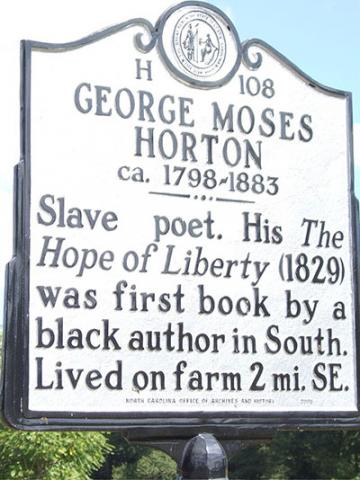
- NC DNCR: George Moses Horton (H-108)NC Dept. of Natural and Cultural Resources Marker text on Horton as an antebellum Black poet and the first African American to publish a book in the South.
Collections and databases