Skip to content

Theme

Carolina Sports

Pep rallies, rivalries, and championships: the games and athletes that made Chapel Hill a sports town.

Chapel Hill became a sports town through the university: the 1957 and 1982 basketball championships, the women’s soccer dynasty from 1981, the 1994 women’s basketball title, and the rivalries and pep rallies around them. Hillsborough had its own arena in the Occoneechee Speedway, a stock-car track from 1947 to 1968.

1,024 works about Carolina Sports are indexed here. 16 held at OCPL →

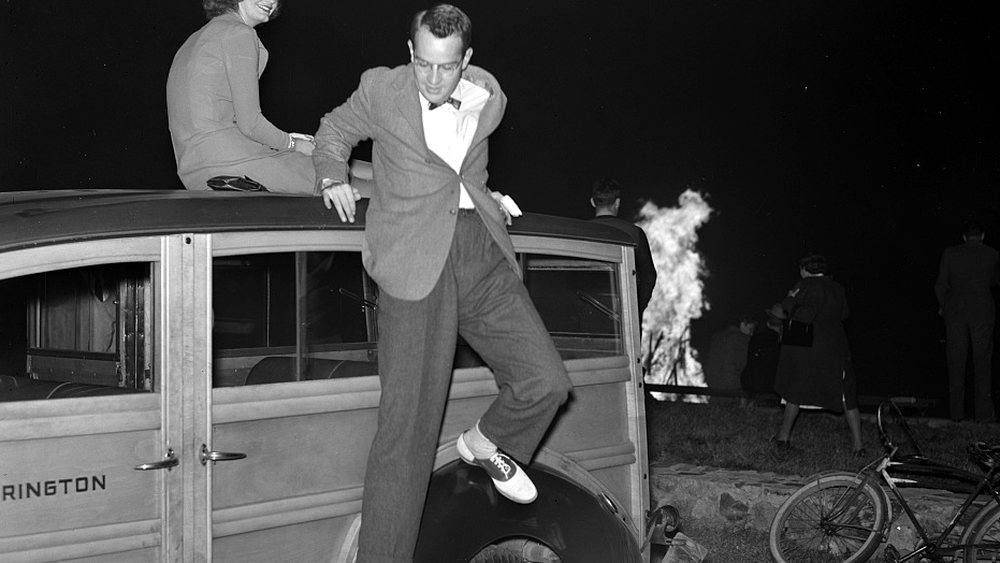
A pep-rally bonfire, Chapel Hill, 1939.

Events and storylines

Named events and storylines the index follows in detail. Each has its own page.

Occoneechee Speedway, HillsboroughNASCAR’s early dirt track on the Eno, 1949–1968; not the Orange County Speedway in Rougemont UNC women’s soccer national dynastyTwenty-three national championships won in Chapel Hill, from the 1981 AIAW title under Anson Dorrance to the 2024 NCAA title under Damon Nahas UNC national championships beyond women’s soccerThe national titles won by Carolina teams other than women’s soccer, from the 1924 basketball team’s later Helms recognition and the 1957 NCAA title to the field hockey, lacrosse, men’s soccer and tennis championships The fight over Sunday racing, 1956–1958How ministers and their allies set out to stop Sunday stock car races at Orange Speedway and a new jalopy track, the county commissioners’ changing stand, the 1957 act of the legislature and the courts that first upheld it and then struck it down Kenan Memorial Stadium, 1926–1988How Kenan Memorial Stadium was built: William R. Kenan Jr.’s gift, the trustees’ choice of the ravine site, the town’s complaints about blasting, the concrete stands, Kenan’s added $28,000, and the opening game and Thanksgiving Day dedication of 1927 Woollen Gymnasium, the Bowman Gray Pool and the first women’s dormitories, 1935–1941How the University built its new gymnasium, the Bowman Gray pool and its first dormitory for women with a PWA grant: the 1936 grant, the work begun in 1937, the presentation of the gymnasium, the pool’s opening and the naming for Charles T. Woollen
Show all 12 events and storylines
The University’s new athletic field, 1933–1936The University’s new athletic field on the Raleigh road, graded by Civil Works crews in the winter of 1933-34, finished with relief labor in 1935 after a halt in Emergency Relief work, and dedicated as Fetzer Field in May 1936 The Graham Plan dispute, 1936The 1936 dispute over President Frank P. Graham’s Southern Conference eligibility rules: the trustees’ referral to the faculties, the Chapel Hill faculty’s 80 to 40 vote to approve them, and Carl Snavely’s departure for Cornell that spring The 1939 law ending University merchandisingHow a 1939 state law forbidding the University to sell merchandise in competition with citizens moved its coal and appliance trade to Bennett and Blocksidge, with their new Carrboro coal yard, and the Carolina Sports Shop John Kenfield opened that fall A football player’s death and the reform of UNC athletics, 1971–1972How a varsity football player’s death from heat stroke in 1971 led to changes in UNC athletics: the faculty inquiry and the former players’ challenge to it, Chancellor Sitterson’s order for physicians at practices, the Faculty Council’s athletics report and the Sports Medicine Program of 1972 Building and opening the Dean E. Smith Center, 1978–1989How UNC built its Student Activities Center between 1978 and 1984: the arena plan for the Baity land, the 1980 approvals by the trustees and the Town Council, the gift and loan that paid for it, the 1982 student seating fight, and the reviews of its steel and cracked beams in 1983 and 1984 UNC and the state budget cuts, 1989–1991How the state’s budget cuts reached UNC between 1989 and 1991: the 1989 deficit and Student Congress’s loan offer, the 1990 cuts and hiring freeze, the protests and Save UNC Day, Hardin’s decision against layoffs, the 1991 section cuts and graduate students’ demands, the Carolina Inn decision and the budget flexibility the campus won

More storylines

Other storylines that include this theme, in date order. Each has its own page.

StorylineCarolina athletics from the ban to the undefeated 1898 team, 1888–19021888–1902 · 13 events · Carolina athletics began with a fight over whether to play at all: organized football started at the university in 1888, and by 1890 the trustees had forbidden intercollegiate contests altogether. A student petition won repeal by January 1891, and that April the football and baseball associations united as the Athletic Association. The 1892 team lost only to Virginia and then beat Virginia in a rematch at Atlanta. In 1895 the association hired Princeton's Thomas G. Trenchard, whose team won seven games before losing to Virginia. After a disorderly fall term the faculty in 1896 barred students on probation from the teams and made players pledge not to drink or gamble on trips. The 1898 team was undefeated and untied. StorylineThe University builds under Venable, 1900–19091900–1909 · 19 events · Under Francis P. Venable, elected president in 1900, the University spent a decade building. Julian S. Carr paid for the Carr Building, a dormitory, and in 1900-01 the University finished its water works, sewer system and heating plant and completed the Alumni Building and the Mary Ann Smith Dormitory. After Professor Charles Baskerville described the crowded chemistry laboratories, the legislature in 1905 gave $50,000 for a chemical laboratory, finished in 1906. Judge William Preston Bynum gave a gymnasium, and the trustees agreed to buy the University Inn for dormitories. A new president's house, an infirmary and the YMCA building followed in 1907, Davie Hall opened in 1908, and in 1909 Gerrard Hall was refitted so that daily chapel could resume. StorylineWomen students at the University, 1914–19211914–1921 · 8 events · Women were registered in every department and professional school of the University by the fall of 1916, and by 1921 they had two houses of their own. Cora Zeta Corpening enrolled in 1914 as what Covington's history calls the first woman candidate for a medical degree, and Margaret Berry of Hillsborough graduated from the law school in 1915, the first woman to do so according to the guide to her papers. In 1916 the News called the women's registration in all departments a first, and they organized a co-ed club. In 1921, after years of pleas from adviser Inez Stacy, the university gave women two houses, room for about forty-five of the sixty-five enrolled. StorylineThe Sorrell building theatre: Carolina, Village and Varsity, 1927–19801927–1980 · 10 events · W. B. Sorrell's building on the north side of Franklin Street opened in 1927 with the Carolina Theatre between his optometry shop and Jeff's Campus Confectionery. The theatre became the Village in 1942, when a new Carolina opened across the street, and the Varsity in 1951. After pickets in 1961 it agreed to admit Black University students. Fire gutted it in November 1966, and it reopened in September 1967. StorylineThe Navy Pre-Flight School at Chapel Hill, 1942–1945May 1942–October 1945 · 92 events · Commissioned at UNC in May 1942, the U.S. Navy Pre-Flight School trained 18,700 cadets before it was decommissioned on October 15, 1945. Cadets ate in Lenoir Hall and drilled in a Navy-built armory that opened in 1943. George H. W. Bush trained there as a cadet, Gerald Ford taught there, and Ted Williams played on its baseball team. StorylineAthletics reform and drug testing at UNC, 1989–19901989–1990 · 6 events · In December 1989 a Faculty Council committee chaired by Doris Betts called for sweeping changes in UNC athletics, and the council took up its 32 recommendations early in 1990, passing the last 11 in February in a package Chancellor Paul Hardin called historic. That June the trustees declined to make drug testing of athletes mandatory, but the Board of Governors refused to exempt the campus, and UNC began mandatory testing in November 1990.

Indexed works

Works about Carolina Sports from library and archive catalogs. The most widely held appear first; novels are not shown here. Follow a link to find a copy or view the material.

Widely held

Carolina Basketball: A Century of Excellence

Lucas, Adam · 2010 · University of North Carolina Press

Adam Lucas marks one hundred years of basketball at the University of North Carolina in this illustrated history, published by UNC Press in 2010 in association with the athletics department. Chapters follow the program from the game's arrival on campus and the 'White Phantoms' of the Southern Conference through the founding of the ACC, the 1957 season, Dean Smith's changes to the game and the title seasons of 1982, 1993, 2005 and 2009, closing with a century of statistics. 289 pages.

Included because: Catalog heading in the UNC record: Basketball.

The Blue Divide: Duke, North Carolina, and the Battle on Tobacco Road

Moore, Johnny; Chansky, Art · 2014 · Triumph Books

The Duke and North Carolina basketball rivalry written together by Johnny Moore and Art Chansky, the latter a sports reporter who has followed it since his student days at UNC. The book opens with the 2014 season and moves through recruiting battles old and new, 'Black and Blue Sunday', 'Blood and Roses', and chapters on the rivalry's heroes, leaders and teachers, with a foreword by Jay Bilas and a photo gallery. Published by Triumph Books in 2014, 289 pages.

Included because: Catalog heading in the UNC record: Basketball.

Game Changers

Chansky, Art · 2016

Art Chansky's 2016 account of Dean Smith, Charlie Scott and the years that changed Chapel Hill as a Southern college town. Scott was the first Black scholarship player in the Carolina basketball program. Topics include civil rights, racism in sports and the university's twentieth-century history.

Included because: Catalog heading in the UNC record: Basketball.

What it means to be a Tar Heel: Roy Williams and North Carolina's greatest players

Fowler, Scott · 2010 · Triumph Books

Scott Fowler gathers recollections from Carolina basketball players, decade by decade from the 1950s to the 2000s, organized around Roy Williams and the question in the title. Contributors include Lennie Rosenbluth, Larry Brown, Billy Cunningham, Charlie Scott, Phil Ford, James Worthy, Brad Daugherty, Eric Montross, Vince Carter, Antawn Jamison, Raymond Felton and Sean May, each entry giving position and playing years. Published 2010 by Triumph Books of Chicago, 270 pages, here as an e-book.

Included because: Catalog heading in the UNC record: Basketball.

To Hate Like This Is to Be Happy Forever

Blythe, Will · 2006 · Harper Collins

Will Blythe's account of the Duke and North Carolina basketball rivalry, described in its subtitle as thoroughly obsessive, intermittently uplifting and occasionally unbiased. Blythe writes as a Chapel Hill partisan, and the book treats sports rivalries, basketball fans and the social side of the game in North Carolina. Published by HarperCollins in New York in 2006, first edition, 357 pages.

Included because: Catalog heading in the UNC record: Basketball.

Light Blue Reign

Chansky, Art · 2009

Art Chansky's 2009 history of the Carolina basketball dynasty that three coaches, Frank McGuire and Dean Smith among them, built at the University of North Carolina. Smith wrote the foreword and Rick Brewer the introduction. Chapters cover Final Fours, the Larry Brown bond, recruiting and the program's records.

Included because: Catalog heading in the UNC record: Basketball.

Show 2 more

Blue Blood II

Chansky, Art · 2018 · St. Martin's Press

A sequel to Art Chansky's 2005 Blue Blood, continuing the story of the Duke and North Carolina basketball rivalry through the years since that book appeared. Published by St. Martin's Press in 2018. First edition, 296 pages with color illustrations.

Included because: Catalog heading in the UNC record: Basketball.

The Legends Club

Feinstein, John · 2016

John Feinstein's account of the three coaches who defined Triangle college basketball in the 1980s: Dean Smith (1931-2015) at North Carolina, Mike Krzyzewski at Duke and Jim Valvano (1946-1993) at N.C. State, all working within a few miles of one another. Feinstein follows the recruiting contests, the rivalry among the three programs and the personal competition among the three men, which was not always friendly, and the pressure that came with national attention. Published by Doubleday in 2016, 404 pages with plates.

Included because: Catalog heading in the Duke record: Basketball.

Recently indexed: 1956-57 Tar Heel basketball : national champions (1957) · 39th annual national collegiate basketball championship : the Omni/Atlanta, Georgia : March 26 and 28, 1977 (1977) · Big Four Tournament : State, Carolina, Duke, Wake Forest, Dec 18-19, 1970, Greensboro Coliseum (1970) · Carolina athletes in war and peace (1919) · Carolina fever (1981) · The Chapel Hill Athletic Club welcomes the 1960 Tar Heels (1960)

Search all 1,024 indexed works →

Start at OCPL

Books in OCPL’s Rebecca B. Wall Local History Collection whose titles, catalog subjects, or descriptions match this theme. The Friends’ recommended starting points are labelled. Books marked Wider context cover the broader subject rather than this theme itself.

  • Start here · 796.323 CHANSKY Game Changers: Dean Smith, Charlie Scott, and the Era That Transformed A Southern College Town Chansky, Art · 2016

    Art Chansky's 2016 account of Dean Smith, Charlie Scott and the years that changed Chapel Hill as a Southern college town. Scott was the first Black scholarship player in the Carolina basketball program. Topics include civil rights, racism in sports and the university's twentieth-century history.

  • Foundational · NC 796.357 JACOBS Across the Line: Tales of the First Black Basketball Players in the ACC and SEC Jacobs, Barry · 2023

    Barry Jacobs profiles the Black players who first crossed the color line in men's basketball at eighteen schools of the Atlantic Coast and Southeastern conferences, among them Billy Jones at Maryland, Perry Wallace at Vanderbilt, C. B. Claiborne at Duke, Charles Scott at North Carolina, Al Heartley at N.C. State and Norwood Todmann at Wake Forest. This revised and updated edition appeared in 2023.

  • Wider context · NC 796.095 SUM A History of Sports in North Carolina Sumner, James · 1990

    Jim L. Sumner's overview of sports in North Carolina, with sketches of athletes, published by the state's Division of Archives and History in 1990; 119 pages, illustrated, with a bibliography and index.

Show 5 more
  • Foundational · NC BIO SMITH MUM Dean Smith: A Biography Mumau, Thad · 1990

    Biography of Dean Smith, the University of North Carolina basketball coach, by Thad Mumau, published by J. F. Blair in Winston-Salem in 1990. A revised edition of the author's 'The Dean Smith Story' from 1980, 287 pages with illustrations.

  • Rebecca Wall Collection · 796.323 JAC Three Paths to Glory: A Season on the Hardwood With Duke, N.C. State, and North Carolina Jacobs, Barry · 1993

    Barry Jacobs follows one college basketball season inside three Atlantic Coast Conference programs, Duke, N.C. State and North Carolina, the Triangle rivals whose campuses sit a short drive apart. Published by Macmillan in 1993, 397 pages with illustrations.

  • Wider context · NC 796.043 JACOBS Golden Glory: The First 50 Years of the ACC Jacobs, Barry · 2002

    An illustrated history of the Atlantic Coast Conference from its founding in 1953 to its fiftieth year, by Barry Jacobs. Across six sections it sets the league's story beside features on the Yow sisters, Duke women's tennis, Maryland women's lacrosse, North Carolina women's soccer, Georgia Tech track, Virginia men's soccer, Wake Forest golf and Chesley's ACC basketball broadcasts. Published in Greensboro by Mann Media in 2002.

  • Wider context · NC 796.357 SUM Separating the Men From the Boys: The First Half-century of the Carolina League Sumner, James · 1994

    The Carolina League, the minor baseball league founded in 1945, traced through its first fifty seasons by Jim L. Sumner, curator of sport at the North Carolina Museum of History. John F. Blair of Winston-Salem published the history in 1994: 260 pages with illustrations, a bibliography and an index.

  • Foundational · NC 796.72 SAN Occoneechee-Orange Speedway: Hillsboro, N.C Sanseverino, Edward P. · 1995

    Edward P. Sanseverino's 1995 account of the Occoneechee-Orange Speedway, the stock car track outside Hillsborough that ran in the middle decades of the twentieth century. Topics include automobile racing and racetracks in North Carolina and Hillsborough in the twentieth century.

In the chronology

A selection of 12 events from the 477 chronology entries for this theme, including highlights and examples from different years. See all 477 dated events in the chronology →

  1. James W. Jeffreys starts a four-horse mail coach line between Hillsborough and Oxford Mail contractor James W. Jeffreys began running a line of four-horse post coaches three times a week between Hillsborough and Oxford. His notice of October 7 said the coaches left Hillsborough on Tuesday, Thursday and Sunday mornings and connected with lines from Greensborough and to Blakely, the Roanoke end of the Petersburg railroad. Place: Hillsborough to Oxford · Also named: James W. JeffreysSearch the index · The Harbinger (Chapel Hill), September 24, 1833, p. 3
  2. Carolina plays Virginia in Chapel Hill for the first time The Thanksgiving Day game with Virginia, the high point of the season, was held in Chapel Hill for the first time. Covington puts the crowd on Emerson Field at more than 8,000; the News estimated 12,000 to 15,000 people, with 3,000 to 4,000 automobiles and several special trains, and called it perhaps the largest crowd that had ever watched a football game in the state. Place: Emerson Field, UNC, Chapel HillSearch the index · Howard E. Covington Jr., Fire and Stone: The Making of the University of North Carolina under Presidents Edward Kidder Graham and Harry Woodburn Chase (2018), p. 212 · Also: The News (Chapel Hill), December 6, 1919, p. 1; The News (Chapel Hill), December 6, 1919, p. 5
  3. Ted Williams, Johnny Pesky and Johnny Sain report to the Pre-Flight School as aviation cadets Five major league players reported to the Navy Pre-Flight School as cadets of the 25th Battalion: Ted Williams and Johnny Pesky of the Boston Red Sox, Johnny Sain and Louis Gremp of the Boston Braves, and Joe Coleman of the Philadelphia Athletics. Besides the regular cadet course they played for the Cloudbusters baseball team, which by late June had won sixteen of its last eighteen games. People: Ted Williams Place: Navy Pre-Flight School, University, Chapel Hill · Also named: Johnny Pesky, Johnny Sain, Louis Gremp, Joe ColemanCloudbuster (Navy Pre-Flight School, Chapel Hill), May 8, 1943, p. 1
  4. Rameses VI, the Carolina mascot, dies at the Hogan farm Rameses VI, the University's ram mascot, died on September 10 at the Hogan farm where the mascots were kept, and his 18-month-old son, Rameses VII, was to be christened before the Oklahoma game on September 24. Place: Hogan farm, Route 2, Chapel HillSearch the index · The News of Orange County (Hillsborough), September 22, 1955, p. 4
  5. UNC men’s basketball wins the 1957 NCAA national championship UNC defeated Kansas, 54–53 in triple overtime, to win the national title. People: Frank McGuire Place: Chapel HillSearch the index · NCAA championship history: Division I men’s basketball
  6. UNC head football coach Bill Dooley buys the Wood house on Fern Lane Dooley bought the 1957 Ranch built for radiologist Ernest Wood and lived there until 1994. People: Bill Dooley Place: Wood House, 110 Fern Lane, Laurel Hill, Chapel Hill · Also named: Ernest WoodSearch the index · NC State Historic Preservation Office: Rocky Ridge Farm Historic District Boundary Increase and Additional Documentation, National Register nomination (OR1748), p. 10
  7. The UNC Board of Governors asks to plan a $21 million basketball arena and athletic complex The Board of Governors voted to ask the General Assembly for authority to plan a $21 million athletic complex near Manning Drive, with an 18,000-seat basketball arena, an indoor pool, a practice court and offices, to be paid for without state money from private gifts, gate receipts or student fees. It also asked $5.9 million for an art building beside the Ackland, authority to spend $2.3 million enlarging the Carolina Union, and $720,000 in parking funds for a 600-space lot south of Manning Drive. Place: Manning Drive, University, Chapel Hill · Also mentions: Carolina UnionSearch the index · The Daily Tar Heel, October 18, 1978, p. 1
  8. UNC, NC State and Duke club hockey teams play their home games at the Daniel Boone ice rinks The club ice hockey teams of UNC, North Carolina State and Duke played their home games at the Daniel Boone ice rinks in Hillsborough, the rinks sold the schools ice and the teams kept the admissions, manager Maxine Freeland said. As the only rinks nearby, they drew skaters mainly from Raleigh, Durham and Chapel Hill. Place: Daniel Boone ice rinks, Hillsborough · Also named: Maxine FreelandSearch the index · The Daily Tar Heel, February 7, 1986, p. 4
  9. UNC dedicates the renovated Irwin Belk Track around Fetzer Field UNC dedicated the renovated track around Fetzer Field as the Irwin Belk Track, with athletic director John Swofford presenting a plaque to Irwin Belk, a 1945 graduate and former track and cross-country letterman, before a dedication meet in which the Tar Heels defeated four teams including Virginia and N.C. State. People: John Swofford Place: Fetzer Field, UNC, Chapel Hill · Also named: Irwin BelkSearch the index · The Daily Tar Heel, April 8, 1991, p. 3
  10. UNC women’s basketball wins the 1994 NCAA national championship Charlotte Smith’s last-second three-pointer gave UNC a 60–59 victory over Louisiana Tech. People: Sylvia Hatchell Place: Chapel Hill · Also named: Charlotte SmithSearch the index · NCAA championship history: Division I women’s basketball · Also: The Daily Tar Heel, April 4, 1994, p. 1; The Daily Tar Heel, April 27, 1994, p. 3
  11. UNC women’s soccer wins the 2003 NCAA national championship UNC defeated Connecticut, 6–0, in the national final. People: Anson Dorrance Place: Chapel HillSearch the index · NCAA championship history: Division I women’s soccer
  12. UNC extends Bubba Cunningham's contract and names his successor as athletics director The university gave Cunningham a two-year extension through July 2029 and announced he would leave the athletics director's post in the summer of 2026 to become senior adviser to the chancellor and athletics director. Racing executive Steve Newmark was hired as executive associate athletic director to succeed him. People: Bubba Cunningham Place: Chapel Hill · Also named: Steve NewmarkSearch the index · UNC-Chapel Hill: Carolina extends Bubba Cunningham's contract, names athletics director successor

See all 477 dated events in the chronology →

Places in this theme

Buildings, schools, churches and other sites named in the dated events on this page, the most often named first. The map shows the 42 with a known location.

Map tiles © OpenStreetMap contributors. Site locations from the N.C. State Historic Preservation Office survey, Open Orange, Orange County GIS, OpenStreetMap and a few other published sources named on each site’s page; town and community pins show approximate locations.

Show 37 more

All places and the county map →

Research sources

Sources and research tools for this subject. Research guide: How to research with Orange County Indexed.

Background 14

Show all 14

National Register files

Historic sites, markers, and maps

Records of the time 19

Show all 19

Collections and databases 7

Show all 7

Local help

Picture: Farm Security Administration photographs, Library of Congress; public domain. Image credits →

More to discover

Keep Reading Local

The Friends connect people with new library materials, local writers and publishers, and resources documenting Orange County.

Two mice reading back to back against a leaf, with the hand-lettered words Friends of the Orange County Public Library
Illustration by Caldecott Medalist Matthew Cordell, gifted to the Friends 2026