Skip to content

Theme

Community & Civic Organizations

Clubs, lodges, mutual aid, and civic life.

Clubs, lodges, mutual-aid societies and civic groups did much of the county’s public work: the campaign for the Negro Public Library, the saving of the Eno, the freedom movement of the 1960s and the response to Hurricane Fran all ran through them. The records here are their histories and papers.

152 works about Community & Civic Organizations are indexed here. 1 held at OCPL →

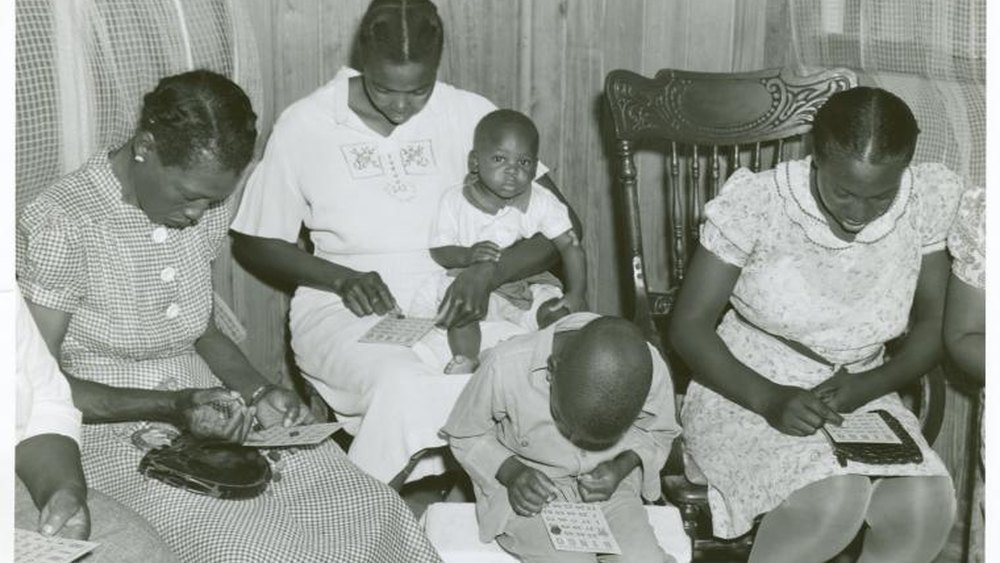
A home demonstration club meeting, 1940.

Events and storylines

Named events and storylines the index follows in detail. Each has its own page.

Show all 18 events and storylines
Fire protection for the countryside, 1951–1964How rural Orange got fire trucks when the town departments stopped answering calls outside their limits: the Orange Fire Protective Association, Carrboro’s contracts, and the Greater Chapel Hill fire district Recreation in Chapel Hill and Carrboro, 1955–1964The two-year campaign for a recreation tax district around Chapel Hill and Carrboro: the Jaycees’ petition, Carrboro’s wish to stay out, the hearing where integration came up, the 1957 vote that turned it down and the private plans that followed The Hillsboro Exchange Club’s community park, 1954–1958The recreation park a Hillsborough service club built south of town: the land it leased and bought, the minstrel shows and notes its members signed to pay for it, and the miniature golf course that opened it in 1956 The Chapel Hill Red Cross chapter, 1917–1919The Chapel Hill Red Cross chapter from its founding in May 1917 to its report of April 1919: its officers and workrooms, the dressings, comfort bags and Christmas packages it shipped, the War Fund drive, the conservation committee and the influenza work The women’s legislative program, 1927The women’s legislative program of 1927 as Chapel Hill followed it: the League of Women Voters’ convention at the Carolina Inn, the Community Club’s bills and its letters to Orange County’s legislators, the child labor bill, and the $2,000 for the Efland home The Orange County Civic Association, 1928The Orange County Civic Association in its first months of 1928: its founding at Hillsboro as a nonpartisan group to gather facts about county government, with E. C. Branson and Paul W. Wager, and its meetings on school bus costs and the county’s roads Chapel Hill’s first airports, 1928–1934Charlie Lee Martindale’s airfield north of Chapel Hill from 1928 to 1931: the first passenger flights, the North State Aircraft Company’s hangar and lessons, the Legion’s roof marker, the longer runways, Southern Airways, and the field’s place on the federal air maps Relief in Orange County as the Depression deepens, 1929–1933How Orange County met the needs of its poor as hard times arrived in 1929 and 1930: George H. Lawrence’s warnings, the commissioners’ matching health fund, the county home study, the Kiwanis and King’s Daughters relief and the Daily Tar Heel’s fund Chapel Hill’s Dogwood Festival, 1933–1935Chapel Hill’s Dogwood Festival from its first year in 1933 to its third in 1935: the folk music, dancing and crafts, the 1934 charter and second festival, the Cherokee ball game on Emerson Field, and the state Scout Jubilee held with it Selective service in Orange County, 1940–1946How the draft worked in Orange County from 1940 to the end of the war: the draft board and its first registration, the first volunteers sent to Fort Bragg, the later registrations, the Chapel Hill examining board, the farm deferments and the final count of men drafted Carrboro and the Chapel Hill buses, 1971–1986How Carrboro came to be served by Chapel Hill’s buses: the town’s refusals and referendum defeats from 1971 to 1976, the 1977 route past its apartment complexes paid for with the University, the 1978 deadlock and cost formula, and the F route and year-round service of 1979 The Inter-Faith Council shelter and the old municipal building, 1985–1991How the Inter-Faith Council’s homeless shelter and Community Kitchen settled in Chapel Hill’s old municipal building between 1985 and 1989: the temporary shelter in the basement, the kitchen’s move to Merritt Mill Road, the search for a permanent site, the 1987 lease, the 1988 task force and the 1989 renovation

More storylines

Other storylines that include this theme, in date order. Each has its own page.

StorylineEagle Lodge and the Hillsborough Masonic Hall, 1788–18231788–1823 · 10 events · Eagle Lodge, silent since 1799, was revived at Hillsborough in 1819 and paid for its Masonic Hall with a lottery. Under a new number, 71, the lodge voted money toward a male academy in 1820, and from 1821 it ran a lottery, held over eleven years, to pay for a hall. In July 1823 commissioners advertised for proposals to build a brick hall, and the cornerstone was laid on November 23, 1823 at what is now 142 West King Street. The Greek Revival hall was designed by the state architect William Nichols and is believed built by John Berry and Samuel Hancock. The Grand Lodge restored the lodge's original number, 19, in 1932. StorylineTemperance and the liquor question in Orange County, 1825–18591825–1859 · 14 events · Treating voters with liquor, and the liquor trade itself, drew organized opposition in Orange County from 1825 to 1859. In 1825 a court house meeting declared treating injurious to morality, and about 1827 the university trustees won a law against distilling or selling liquor at or near Chapel Hill. Temperance societies spread from 1829; by 1834 the Hawfields and Cross Roads society counted 437 members, and at least nine or ten distilleries had stopped. In 1841 Hillsborough men formed a Washington Temperance Society. In 1854 the county voted against the liquor 'Reform' question, but the 1855 Revised Code barred liquor sales within two miles of Chapel Hill, and in 1859 the village banned traveling liquor sellers. StorylineThe Grange in Orange County, 1873–19481873–1948 · 6 events · The Patrons of Husbandry, or Grange, took root in Orange County twice. James Means of Concord organized the Eno Grange at Cedar Grove in December 1873, and in October 1874 delegates of seven Granges organized a county council with John K. Hughes as master. A state Grange revival from 1929 to 1931 produced five Orange chapters, among them Schley Grange No. 710. Schley and Fairfield made their halls out of abandoned schoolhouses, and the chapters met every two weeks with women and children as members. A Grange was organized at New Hope in 1946, and in 1948 W. Kerr Scott, the Democratic nominee for governor and a former State Grange master, spoke to the county's Granges. StorylineChapel Hill's volunteer fire company, 1898–19311898–1931 · 22 events · From about 1898 a volunteer company fought Chapel Hill's fires, at first with two hand reels and hose lent by the University, and more than once a building burned where no hydrant was near. In 1921 the town built a brick municipal building and fire house and received an American La France motor truck. In June 1922, with the nearest hydrant almost half a mile away, fire destroyed the Orange County Training School, the county's school for Black students. In 1923 the company hosted the state's firemen at a barbecue, and the state association elected Chief John L. Foister its president. After officers missed an alarm, the aldermen put a full-time fireman on duty in 1928. In 1931 the bricklayer John Johnson became, by the Weekly's account, the only Black member of a white fire company in North Carolina. StorylineThe Anderson Chapter, UDC, and the Confederate graves at Hillsborough, 1899–19121899–1912 · 6 events · Fourteen Hillsborough women organized a chapter of the United Daughters of the Confederacy in October 1899 and spent its first years marking and honoring the county's Confederate dead. Named for Gen. George Burgwyn Anderson, a Hillsborough native who died of a wound received at Sharpsburg, the chapter under Mrs. Robina Webb held Memorial Day in 1901 with flags and flowers on soldiers' graves. It helped feed veterans at an Efland picnic in 1902 and raised money in 1906 to mark graves. By June 1908 it had marked the graves it could identify and published the names. In July 1912 it appealed to the men of Orange for a monument to the county's Confederate soldiers. StorylineUniversity students' night schools and social work, 1910–19161910–1916 · 4 events · About 1911, asked for help by the young Black workers who cut firewood and carried water in the dormitories, students began teaching them reading and arithmetic in what were called moonlight schools. Under Frank Porter Graham at the campus YMCA those classes grew to take in history, English, debating, home sanitation and the Bible. The YMCA had already organized Sunday schools enrolling 321 pupils. On November 1, 1915 it opened night moonlight schools in six schoolhouses within four miles of Chapel Hill, with 54 student teachers and about 300 pupils, and students also ran a night school at Carrboro and two for Black pupils. Fifteen students carried the night schools on in the fall of 1916.
Show all 19 storylines
StorylineBattle Park and the Battle Park Association, 1914–19331914–1933 · 6 events · Kemp Battle's paths through Battle Park were restored from 1931 by volunteers who were then put in charge of the land around University Lake as well. Students cleaned the park's trails during Community Service Week in 1914, and by 1917 an open-air theatre stood on a hillside there. In 1931 a meeting at Colonel Joseph Hyde Pratt's home launched the Battle Park Association, and citizens working without pay under Pratt cleared paths and built bridges, opening about three miles of trail that year. In 1933 the association was incorporated, and the University trustees put it in charge of both Battle Park and the land around the new University Lake, where it ran motorboat rides to pay for more improvements. StorylineThe Chapel Hill Country Club and its golf links, 1920–19291920–1929 · 6 events · Fire destroyed the Chapel Hill Country Club's first clubhouse on April 3, 1920, and the club rebuilt on land given by William C. Coker. After a time in the Gorgon's Head lodge, members opened a new clubhouse on Coker's grounds south of the campus on May 17, 1923. The club had broken ground for a golf course that March, and by August it had cleared the first fairway and graded four greens. In January 1929 the club gave up 6 acres and received 29 from Coker, enough to extend the course to nine holes, and in February Coker gave the six-acre hill back so the club could stay open. The land later passed to the university, and the Laurel Hill subdivision was laid out along the course. StorylineScouting in Chapel Hill and Carrboro, 1925–19351925–1935 · 4 events · Chapel Hill hosted what the Weekly called the national council's first patrol leaders' training camp in 1925, when about 125 picked North Carolina Scouts camped on Emerson Field. By 1932 thirty-six men had set up a Chapel Hill district committee under Joseph Hyde Pratt to equip and house the troops of Chapel Hill and Carrboro. In 1933 it reported that the Carrboro troop had grown and had a three-room house, that the Chapel Hill troop had 47 members, and that plans were under way for a troop for Black boys. In December 1935 a new district council sought student leaders for the Carrboro troop and heard a report on the Black troop. StorylineThe Movie Guild and Sunday movies in Chapel Hill, 1931–19371931–1937 · 4 events · Sunday movies in Chapel Hill ran for years as charity benefits under an informal understanding before the aldermen legalized them in 1937. By January 1931 a Movie Guild with Paul Green as president was showing educational and artistic films to members on Sunday afternoons at the Carolina Theatre for local charities. In 1935 its directors gave one Sunday show's proceeds toward the American Legion post's log hut and added a Sunday night picture after church services, and they reported money spent on relief, school lunches and other needs. The 1937 rules allowed Sunday shows outside the evening church hour and required the Guild to report its receipts and spending each year. StorylineThe American Legion's hut, 1934–19441934–1944 · 5 events · The Chapel Hill post of the American Legion first planned to make the old Methodist church into its memorial hut, then built a log hut on Rosemary Lane. In December 1934 the post announced a bargain to buy the church for $3,750, but by March 1935 it had given up the plan, finding the work would cost more than it could raise. It then planned a log hut on a Rosemary Lane lot from trees given by country members. Legionnaires did much of the building, and a crew of Black masons filled the cracks between the logs. The first meeting in the hut came on March 19, 1937, and in 1944 the post burned the mortgage. StorylineChapel Hill women's peace organizing, 1935–19391935–1939 · 3 events · In September 1939, with war in Europe, Chapel Hill women organized to keep the United States out of it. The Chapel Hill branch of the Women's International League for Peace and Freedom, founded in 1935 by Charlotte Adams, sent Congressman Carl Durham a letter urging him to keep the arms embargo, put basic war materials on a cash-and-carry basis and hold war trade to peacetime levels, answering his statement that most people he had talked with favored repeal. That month other Chapel Hill women formed Mothers for Peace, with no dues, political aims or affiliations, and called on women across the country to write the President and their members of Congress and to fight war propaganda. StorylineChapel Hill's most valuable citizen award, 1935–19421935–1942 · 5 events · From 1935 the Carolina Theatre gave an annual trophy to Chapel Hill's most valuable citizen, chosen by a committee. The first winner, Mrs. R. B. Lawson, was cited for years of aid to the poor through the King's Daughters and volunteer relief work. Automobile dealer Bruce Strowd won in 1937 for his work for the town's schoolchildren, and on unemployment and the county welfare board. Harry F. Comer of the University YMCA won for 1938, and R. M. Grumman of the University extension division and Mrs. Grumman, until recently a librarian and teacher at the Carrboro school, in 1939. In January 1942 the trophy, then given by the Carolina and Pick theatres, went to Mrs. Robert H. Wettach. StorylineOrange County’s home front in the Second World War1940–1946 · 151 events · From 1940 to 1945 Orange County was drawn into the Second World War. Red Cross women sewed garments for Britain and later made surgical dressings, a record 2,507 of them in Hillsborough on D-Day. The draft board sent men into the Army from 1940, and by late October 1945 it counted 3,110 drafted. Farm families, schools and civic clubs pledged or sold war bonds and gathered scrap, and the county more than doubled its quota in the Seventh War Loan. Carrboro's munitions plant loaded shells for the Navy, and German prisoners of war worked Orange farms in 1945. The county marked V-E Day quietly, while Chapel Hill celebrated the end of the war with Japan on Franklin Street. StorylineBlack Chapel Hill on the home front, 1942–19441942–1944 · 9 events · From 1942 to 1944 Chapel Hill's Black residents carried on their own home-front work, from civil defense and scrap collection to bond sales and gardens. By 1943 twelve Black men trained for fire protection had civil defense arm bands, and the Orange County Training School had collected 22,075 pounds of scrap; its Jeep campaign sold more in stamps and bonds than the $900 cost of an Army jeep. Black residents began a Victory Garden campaign and formed a Citizens Service Corps. In 1944 Black veterans of both world wars formed an American Legion post, and a federally funded day nursery for children of Black working mothers opened at the Training School. StorylineThe Hillsboro Health Club and its community center, 1945–19471945–1947 · 6 events · Meeting with county health department leaders in May 1945, Black parents and teachers in Hillsboro organized to improve health conditions, with Roosevelt Warner as chairman. University of Virginia researchers came that July to study the Health Club for a book, and by November it was restoring the old Odd Fellows Hall as a community center, where it gave a banquet for returning Black veterans in March 1946. The county library for Black readers moved into the center that April, and in 1947 Agnes Johnson Whitted taught a kindergarten there. StorylineThe Rural Progress Program and its successors, 1951–19591951–1959 · 21 events · Orange County joined the state Rural Progress campaign in September 1951, aiming to add $1,000 to each farm family's income and to improve every home and community. County workers enlisted more than 100 white neighborhood leaders and Black captains to survey farm families, and Lincoln High's agriculture department began the program among Black families around Chapel Hill. Separate prize nights for white and Black farm families followed each year. Orange was named the state's County of the Year in December 1953 and won the division for Black families in February 1954. Successor programs followed in 1955 and 1957, and Cedar Grove won the silver loving cup for Black families in 1957 and 1958. StorylineChapel Hill protests over U.S. policy in Central America, 1981–19891981–1989 · 20 events · From 1981 Chapel Hill groups protested U.S. military aid to El Salvador with leafleting, vigils at the Franklin Street post office and a march across campus, and marked the anniversaries of Archbishop Oscar Romero's killing. In 1983 a sanctuary group sought a church for refugees and a statewide coalition met in Murphey Hall; a 1984 teach-in debated the Kissinger report, and a vigil opposed intervention in Nicaragua. From 1985 the protests turned to aid for the Contras, with a march on Rep. Bill Cobey's office, an unofficial referendum outside the polls, a silent protest at a Contra leader's speech and roadside crosses; in 1988 about 200 people marched against troops sent to Honduras. StorylineHabitat for Humanity of Orange County, 1984–19961984–1996 · 15 events · Habitat for Humanity of Orange County grew from an ecumenical effort begun at Binkley Baptist Church in 1982 and was incorporated in 1984. Its first house went up at Chestnut Oaks, on land given by Access Inc., and in 1987 it finished a home for a Carrboro family the Daily Tar Heel called the first in the county to receive its help. Visiting Soviet students helped raise a house in 1989. In 1991 Habitat raised its 18th house, hired its first paid coordinator and began a Street of Hope at Chestnut Oaks with state and county money, and in 1992 a campus drive began for a house for a UNC staff member. In 1994 it dedicated its 30th house and broke ground for one built entirely by women, and in 1996 two authors signed books to fund another.

Indexed works

Works about Community & Civic Organizations from library and archive catalogs. The most widely held appear first; novels are not shown here. Follow a link to find a copy or view the material.

Widely held

African Americans of Durham and Orange counties : an oral history

Bolduc, Jean · 2016 · The History Press

Jean Bolduc's collection of oral history interviews with Black residents of Durham and Orange counties, published by The History Press in 2016, 125 pages with photographs and portraits. The narrators are the poet Jaki Shelton Green, civil rights lawyer Floyd McKissick, Walter Jackson, Nate Davis, Brenda Stephens, Diane Wright, Jackie Wagstaff and Michelle Johnson, and a closing chapter deals with the Ku Klux Klan. The interviews document Black life and race relations in the two counties across the twentieth century.

Included because: Catalog heading in the UNC record: Davis, Nate, 1951?-.

African Americans of Durham & Orange Counties

Bolduc, Jean · 2016

Jean Bolduc's 2016 collection of interviews with African American residents of Durham and Orange counties, presented as short biographies. The subjects are Floyd McKissick (1922-1991), the first African American admitted to UNC's law school, Walter Jackson, Brenda Stephens, Nate Davis, poet Jaki Shelton Green, Jackie Wagstaff, Diane Wright and Michelle Johnson, with a closing chapter on the Ku Klux Klan. 125 pages with illustrations.

Included because: The record names this subject alongside a heading for the county or its towns.

"Whites only" : a pastor's retrospective on signs of the new South

Seymour, Robert E. (Robert Edward), 1925-2020 · 2011 · Chapel Hill Press

Robert E. Seymour, a Baptist pastor in Chapel Hill associated with Olin T. Binkley Memorial Baptist Church, looks back on segregation and race relations in the South from the pulpit. A clergyman's memoir covering church history in the town, Baptists in North Carolina and the segregation of African Americans. Published by Chapel Hill Press in 2011, 204 pages.

Included because: The record names this subject alongside a heading for the county or its towns.

A history of Epsilon Beta Chapter of Chi Omega at the University of North Carolina at Chapel Hill, North Carolina, 1923-1999.

Clark, Blanche (Blanche R.) · 1999 · Epsilon Beta of Chi Omega House Corp.?

Chapter history of Epsilon Beta of Chi Omega at the University of North Carolina, covering 1923 to 1999 and written by Blanche Clark with Ann Thornburgh. Twenty nine unnumbered leaves with illustrations and a portrait, issued in Chapel Hill in 1999. Guion Griffis Johnson is among the people discussed.

Included because: The record names this subject alongside a heading for the county or its towns.

UNC

House Joint Resolutions, April 17 - May 2

North Carolina. General Assembly · 1782

Joint resolutions of the House of Commons from April 17 to May 2, 1782, with messages, petitions and depositions. Among them are thanks to Thomas Burke, the Hillsborough lawyer who had been governor, a land dispute involving James Taylor and Edmund Pendleton of Virginia, and a poll tax exemption for Francis Falkner. 87 images.

Included because: The record names this subject alongside a heading for the county or its towns.

NC Digital Collections record courtesy of the North Carolina Department of Natural and Cultural Resources.

Joint Select Committees: Reports and Papers, May 8 - May 18

North Carolina. General Assembly · 1782

From the 1782 session of the General Assembly, joint select committee reports and papers of 8 to 18 May, in 134 images. Captain James Reed, James Houston of Rowan County and George Meek are among those whose cases came before the committees. Other matters include State Legion officers, disabled veterans, price regulation, Cherokee affairs, Thomas Burke, and Hillsborough and Orange County.

Included because: The record names this subject alongside a heading for the county or its towns.

NC Digital Collections record courtesy of the North Carolina Department of Natural and Cultural Resources.

Show 2 more

Senate Joint Resolutions, May 16 - May 18

North Carolina. General Assembly · 1782

Resolutions of the North Carolina Senate from 16 to 18 May 1782: naming Thomas Davis public printer, favoring Joseph Pitman of Edgecombe County, obtaining clothing for Continental officers and soldiers, and answering a memorial of John Huske. Nathanael Greene, Jethro Sumner and the Battle of Eutaw Springs are among the names. 51 images, with Hillsborough tied to the session.

Included because: The record names this subject alongside a heading for the county or its towns.

NC Digital Collections record courtesy of the North Carolina Department of Natural and Cultural Resources.

August-September, 1780: Joint Select Committees (Reports of and messages concerning)

North Carolina. General Assembly · 1780

Reports and messages of joint select committees from August and September 1780, when the General Assembly met at Hillsborough after the defeat at Camden. Committees worked on supplies and provisions for the army and the adjustment of public claims. Horatio Gates, Richard Caswell, Abner Nash, William Hooper, hospitals, surgeons, cavalry and wagons all appear. 88 pages.

Included because: The record names this subject alongside a heading for the county or its towns.

NC Digital Collections record courtesy of the North Carolina Department of Natural and Cultural Resources.

Recently indexed: New generation newsletter · Newsletter for the new generation (1984) · School of Social Work, UNC, Community Action Training Unit (1970) · [Chapel Hill comprehensive plan revision mailings] (1999) · League lines (1985) · Minutes of the Chapel Hill Community Council meeting on November 14, 1950 (1950)

Search all 152 indexed works →

Start at OCPL

Books in OCPL’s Rebecca B. Wall Local History Collection whose titles, catalog subjects, or descriptions match this theme. The Friends’ recommended starting points are labelled. Books marked Wider context cover the broader subject rather than this theme itself.

  • Foundational · NC PER HILLSBOR Hillsborough Historical Society Journal 1998

    Journal of the Hillsborough Historical Society, seven illustrated volumes dated 2004. Articles cover the history and antiquities of Hillsborough and Orange County, so the run is a standing source for county history. Volumes measure 23 centimeters.

  • Foundational · NC 975.656 BOLDUC African Americans of Durham & Orange Counties: An Oral History Bolduc, Jean · 2016

    Jean Bolduc's 2016 collection of interviews with African American residents of Durham and Orange counties, presented as short biographies. The subjects are Floyd McKissick (1922-1991), the first African American admitted to UNC's law school, Walter Jackson, Brenda Stephens, Nate Davis, poet Jaki Shelton Green, Jackie Wagstaff, Diane Wright and Michelle Johnson, with a closing chapter on the Ku Klux Klan. 125 pages with illustrations.

  • Rebecca Wall Collection · NC 330.975 EKI Poor Carolina: Politics and Society in Colonial North Carolina, 1729-1776 Ekirch, A. Roger · 1981

    A. Roger Ekirch's study of politics and society in colonial North Carolina between 1729, when the Crown bought the colony from the Lords Proprietors, and 1776. Published by the University of North Carolina Press in 1981, 305 pages with maps, it treats economic conditions, social structure and government in the decades when Orange County was created and Hillsborough became its seat.

Show 5 more
  • Foundational · NC 398 DUK The Frank C. Brown Collection of North Carolina Folklore: The Folklore of North Carolina, Collected by Dr. Frank C. Brown During the Years 1912 to 1943, in Collaboration With the North Carolina Folklore Society Frank C. Brown Collection of North Carolina Folklore · 1952

    Frank C. Brown of Duke University and the North Carolina Folklore Society, which he founded in 1913, gathered this folklore from 1912 to 1943 through his classes and trips into the mountains. Duke University Press published it from 1952 to 1964 in seven volumes under general editor Newman Ivey White, with wood engravings by Clare Leighton: games, customs, riddles, proverbs, speech and tales; ballads and folk songs with their music; and popular beliefs and superstitions.

  • Wider context · NC 975.604 BRO A Lasting Gift of Heritage: A History of the North Carolina Society for the Preservation of Antiquities, 1939-1974 Brook, David Louis Sterrett · 1997

    Founded in 1939 chiefly to see Tryon Palace rebuilt at New Bern, the North Carolina Society for the Preservation of Antiquities went on after the war to fight for old buildings across the state. David Louis Sterrett Brook, a former head of the State Historic Preservation Office, tells its story through 1974. Published in 1997 by the Division of Archives and History with Preservation North Carolina, 205 pages.

  • Wider context · NC 369.13 DAV Revolution's Godchild: The Birth, Death, and Regeneration of the Society of the Cincinnati in North Carolina Davis, Curtis Carroll · 1976

    Curtis Carroll Davis traces the North Carolina Society of the Cincinnati, the state branch of the hereditary order formed by Continental Army officers in 1783, from its founding through its collapse and eventual revival. The University of North Carolina Press published it for the Society in 1976 in a numbered edition of 1,000 copies; 301 pages with illustrations, a bibliography and an index.

  • Wider context The North Carolina Genealogical Society Journal 1975

    The quarterly journal of the North Carolina Genealogical Society, published in Raleigh since 1975, with articles on North Carolina family research and transcriptions of original records. William D. Bennett compiled a consolidated index to its first ten years, 1975 to 1984, published in 1997, and Heritage Books has reprinted early volumes.

  • Wider context · NC 309.175 MAT Society in Revolutionary North Carolina Mathews, Alice Elaine · 1976

    Alice Elaine Mathews looks at North Carolina society during the Revolutionary War in this short study, number 8 in the bicentennial pamphlet series that the state Division of Archives and History published in 1976. Its 91 pages carry illustrations, a map and a bibliography.

In the chronology

A selection of 12 events from the 732 chronology entries for this theme, including highlights and examples from different years. See all 732 dated events in the chronology →

  1. Continental officers organize the North Carolina Society of the Cincinnati at James Hogg's cabin Former officers of the North Carolina Continental line gathered near Hillsborough in a cabin owned by the merchant James Hogg and founded the state's Society of the Cincinnati. They elected Jethro Sumner president, Thomas Clark vice president and Adam Boyd secretary. Sixty-six of the roughly six hundred commissioned officers the state sent to the war joined by contributing a month's pay. People: Jethro Sumner, James Hogg, Adam Boyd Place: near Hillsborough · Also named: Thomas ClarkSearch the index · North Carolina Society of the Cincinnati: History
  2. Hillsboro citizens form a Law and Order League A Law and Order League was organized at Hillsboro on a Thursday night meeting. Charles H. Robertson of the Eno Cotton Mills explained its purpose, Dr. W. N. Mebane took the chair, and officers were elected to give the town officers public support in enforcing the law. People: Charles H. Robertson Place: Hillsborough · Also named: W. N. Mebane · Also mentions: Eno Cotton MillsSearch the index · Orange County Observer (Hillsborough), October 5, 1911, p. 5
  3. Citizens organize the Orange County Civic Association Citizens from around the county formed the Orange County Civic Association, a nonpartisan group to gather and publish facts about county government, at a meeting in the Hillsboro school auditorium. E. C. Branson was chairman and Paul W. Wager secretary; commissioners' chairman John McCauley attended. People: Eugene Cunningham Branson, Paul W. Wager Place: Hillsboro school auditorium, Hillsborough · Also named: John McCauleySearch the index · The Chapel Hill Weekly, February 17, 1928, p. 3
  4. The United Daughters of the Confederacy hold their state convention in Chapel Hill The North Carolina Division of the United Daughters of the Confederacy held its 38th annual convention in Chapel Hill from October 9 to 11, 1934, with about 300 delegates expected. Three fraternities gave up their houses to lodge them, President Graham welcomed them in Memorial Hall, the Playmakers revived Jane Toy Coolidge's play "Agatha," set in ante-bellum Hillsboro, and on October 11 the delegates elected Mrs. William S. Bernard of Chapel Hill president of the division. People: Frank Porter Graham Place: Memorial Hall and Carolina Inn, Chapel Hill · Also named: Mrs. William S. BernardSearch the index · The Chapel Hill Weekly, October 12, 1934, p. 1
  5. Volunteers man an aircraft observation post at the American Legion Hut Chapel Hill set up an aircraft observation post at the American Legion Hut on Rosemary Lane under chief observer L. J. Phipps, who with his assistants spotted 13 planes in trial watches on November 12. Volunteers were to watch daily from 5 A.M. to 6 P.M. from November 15 through 29, telephoning each sighting as an 'Army flash' to the Army information center in Raleigh, and Phipps said the main purpose was to train civilians for such posts if war came. People: Luther James Phipps, Paul H. Robertson Place: American Legion Hut, Rosemary Lane, Chapel Hill · Also mentions: American Legion Hut, Rosemary LaneThe Chapel Hill Weekly, November 14, 1941, p. 1
  6. Orange County farmers sign war production plans well above the county's goals Signed war production plans showed Orange County farmers intending to beat the goals set for the county, among them 27,562 bushels of corn against 16,000, 701 sows against 450, and 2,382,720 dozen eggs against 1,237,000. County agent Don Matheson credited the neighborhood committees set up the year before. People: Don S. Matheson Place: Orange CountyThe Chapel Hill Weekly, March 19, 1943, p. 1
  7. The Carrboro Athletic Club dedicates its lighted ball field at the Carrboro school More than 500 people came as the Carrboro Athletic Club dedicated the reconditioned ball ground at the Carrboro school, which the club had fitted with lights for night games at a cost of $2,300 raised from members and donors. Mayor I. A. West spoke, and the club team beat the Carrboro Firemen 5 to 4 in the opening softball game. Place: Carrboro school ball field, Carrboro · Also named: I. A. WestSearch the index · The News of Orange County (Hillsborough), May 8, 1947, p. 3
  8. The Hillsboro Exchange Club buys a site for a community recreation park on the Chapel Hill road Meeting at the Colonial Inn, the Hillsboro Exchange Club approved buying about seven acres a mile south of town on the west side of the Chapel Hill road (Highway 86), with a stream along one side, for a community recreation park. Two senior students at the State College School of Design, guided by Lewis Clarke, had surveyed possible sites and recommended this one, and the club's park committee had approved preliminary plans. Proceeds of the club's minstrel show went to the park. Place: West side of Chapel Hill Road (NC 86), one mile south of Hillsborough · Also named: Lewis Clarke · Also mentions: Colonial InnSearch the index · The News of Orange County (Hillsborough), May 5, 1955, p. 1
  9. Chapel Hill church women ask the county for a welfare office in Chapel Hill A group from the Chapel Hill Council of United Church Women, including Mildred Ringwalt, asked the Orange County commissioners for a branch welfare office in the Chapel Hill area with a caseworker at least two days a week, and offered volunteers. The acting welfare superintendent replied that lay volunteers could not do casework. People: Mildred Ringwalt Place: Orange CountySearch the index · The News of Orange County (Hillsborough), June 8, 1961, p. 4
  10. The University and the towns open the INFO telephone referral service INFO, a telephone information and referral line for students and townspeople, began service as a joint project of the University's Office of Student Affairs and the towns of Chapel Hill and Carrboro, also sponsored by the campus YM-YWCA, N.C. Memorial Hospital and Student Government. University and town volunteers answered its calls from 9 a.m. to 9 p.m. Place: Chapel Hill · Also mentions: N.C. Memorial HospitalSearch the index · The Daily Tar Heel, August 26, 1974, p. 18
  11. Alpha Phi Omega's Campus Chest auction raises about $7,400 for local charities The Campus Chest drive of the Alpha Phi Omega service fraternity raised about $7,400 with an auction in Great Hall for twelve charities, among them the Inter-Faith Council, Orange County Special Olympics, the Orange Senior Center, the Carrboro Meet Your Neighbor Club and Planned Parenthood of Orange County. Place: Great Hall, Carolina Union, University, Chapel Hill · Also mentions: Inter-Faith CouncilSearch the index · The Daily Tar Heel, April 4, 1986, p. 4
  12. Hilliard Caldwell dies at 88 Caldwell, who advised the Lincoln High School students who held Chapel Hill's first sit-in in 1960 and later served on the Carrboro Board of Aldermen, died on September 6, 2025. The town issued a statement remembering his service and courage. People: Hilliard Caldwell, Barbara Foushee Place: Carrboro · Also mentions: Lincoln High SchoolSearch the index · The Daily Tar Heel: Civil rights activist and former Carrboro Alderman Hilliard Caldwell dies at 88 years old

See all 732 dated events in the chronology →

Places in this theme

Buildings, schools, churches and other sites named in the dated events on this page, the most often named first. The map shows the 67 with a known location.

Map tiles © OpenStreetMap contributors. Site locations from the N.C. State Historic Preservation Office survey, Open Orange, Orange County GIS, OpenStreetMap and a few other published sources named on each site’s page; town and community pins show approximate locations.

Show 82 more

All places and the county map →

Research sources

Sources and research tools for this subject. Research guide: How to research with Orange County Indexed.

Background

National Register files

Collections and databases 6

Show all 6

Local help

Picture: Farm Security Administration photograph by Marion Post Wolcott, Library of Congress; public domain. Image credits →

More to discover

Keep Reading Local

The Friends connect people with new library materials, local writers and publishers, and resources documenting Orange County.

Two mice reading back to back against a leaf, with the hand-lettered words Friends of the Orange County Public Library
Illustration by Caldecott Medalist Matthew Cordell, gifted to the Friends 2026