From the Trading Path to the railroad depots, highways, and buses that tied the county's towns together.
In briefThe Great Trading Path, the North Carolina Railroad of 1849, the depots that turned West End into Carrboro, and the highways and buses that followed tied the county’s towns together. The storylines follow the railroad town and the Occoneechee Speedway.
460 indexed works are connected with this theme. 8 held at OCPL →
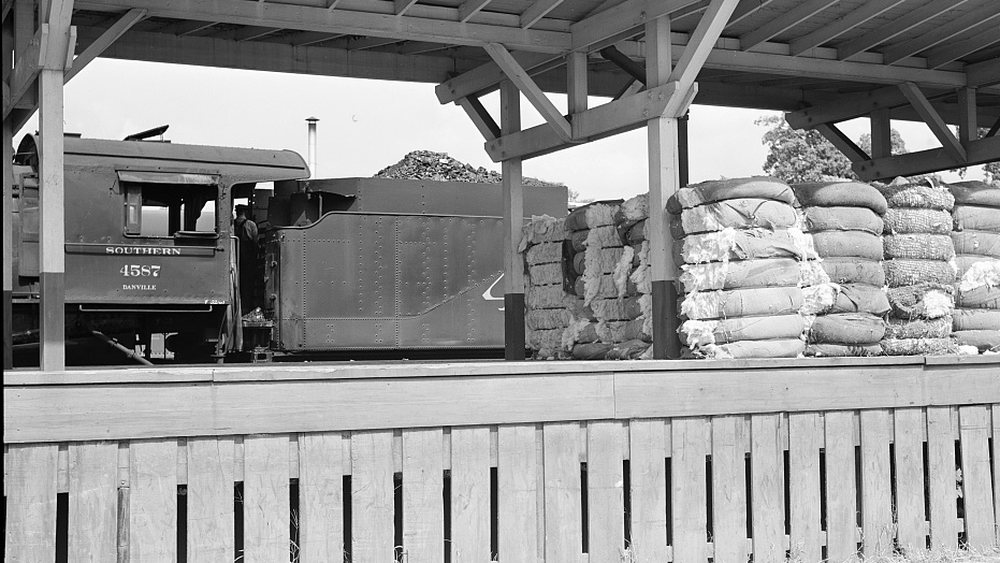
A Southern Railway locomotive and cotton bales at a depot.
Indexed works
Related works found in catalogs and archives across North Carolina, the most widely held first, novels aside. Each links to the institution that holds or provides it.
Narrow these works. Each link opens the search already limited to this theme. Counts are indexed works, not copies on a shelf; a work can carry more than one period or place.
Stewart E. Dunaway's compilation of Orange County road and bridge papers concerning county bridges between 1787 and 1865. It reproduces documents in facsimile, with maps and partial transcriptions, and provides names useful for genealogical research. First compiled in two volumes in 2008, then combined and updated, this 2013 edition has 253 pages, 28 cm.
Farewell forever, old road to Durham : lessons from the history of transportation planning in the North Carolina Piedmont
Chilton, Mark · 2012 · Hand Made Books
Mark Chilton's short history of transportation planning in the North Carolina Piedmont, drawing lessons from earlier projects. Subjects include the Cape Fear Navigation Company and river navigation, and the railroads of Chapel Hill and Carrboro, including the State University Railroad Company whose spur brought trains to the two towns. Chilton was mayor of Carrboro when the book appeared. Published by Hand Made Books, Carrboro, 2012, 92 pages with illustrations, maps and portraits.
Three volumes of historic Orange County road records compiled by Stewart E. Dunaway and self-published through Lulu.com in 2008, with maps. The documents, reproduced as facsimiles and sometimes transcribed, include petitions for new roads, requests for road upkeep, bridge records and papers explaining why roads were rerouted. Road petitions name the householders along a route. The third volume also gathers records connected with Cyrus Guy's lynching in Orange County in 1869.
Three volumes of Orange County road records assembled by Stewart E. Dunaway from the original petitions, orders and maps at the North Carolina State Archives, reproduced in facsimile with partial transcriptions. Volume 1 covers 1786 to 1820, volume 2 1820 to 1849 and volume 3 1850 to 1883. The papers document the laying out and upkeep of county roads and name the residents involved. June 2009 update, distributed through Lulu, 28 cm.
Orange County, North Carolina Lost Deeds Records (1752-1769,1793)
Dunaway, Stewart E. · 2013
Stewart E. Dunaway's 2013 compilation of Orange County deed records outside the regular deed books, covering 1752 to 1769 and 1793. The loose papers include road petitions and cartway orders, providing material for county history, genealogy and the history of roads.
Orange County, N.C., road records. Volume I, 1786-1820
Dunaway, Stewart E. · 2010 · S.E. Dunaway
Stewart E. Dunaway's first volume of Orange County road records, reproducing documents and maps from the North Carolina State Archives for the years 1786 to 1820, with partial transcriptions, an index and a list of overseers. Road papers name the landowners along each route. Self-published in 2010, 348 pages.
Freedom riders : 1961 and the struggle for racial justice
Arsenault, Raymond · 2006 · Oxford University Press
Raymond Arsenault's history of the 1961 Freedom Rides and the campaign against segregated interstate travel in the South. Published by Oxford University Press in 2006. Its North Carolina material reaches Chapel Hill, Durham, Greensboro and Charlotte, which is where the Orange County connection lies, and the wider subject is African American civil rights work, segregation in transportation and race relations through the twentieth century.
Community cookbook from Cross Roads Baptist Church in Hillsborough, printed by Morris Press Cookbooks in 2005 in a three-ring binder. Recipes are credited to their contributors. The book includes Southern cooking, church history and material on the Family House of Chapel Hill. 124 pages of recipes plus front and back matter, with color illustrations.
Books in OCPL’s Rebecca B. Wall Local History Collection whose titles, catalog subjects, or descriptions match this theme. The Friends’ recommended starting points are labelled. Books marked Wider context cover the broader subject rather than this theme itself.
Three volumes of historic Orange County road records compiled by Stewart E. Dunaway and self-published through Lulu.com in 2008, with maps. The documents, reproduced as facsimiles and sometimes transcribed, include petitions for new roads, requests for road upkeep, bridge records and papers explaining why roads were rerouted. Road petitions name the householders along a route. The third volume also gathers records connected with Cyrus Guy's lynching in Orange County in 1869.
In 1849 the legislature chartered the North Carolina Railroad, finished in 1856 from Goldsboro through Raleigh, Greensboro and Salisbury to Charlotte. Allen W. Trelease follows the company to 1871, when it leased its line to the Richmond and Danville, and weighs what the railroad meant for the state's development; the line spurred the growth of Durham, Company Shops (later Burlington) and High Point. UNC Press, 1991; 486 pages with illustrations and maps.
Stewart E. Dunaway's compilation of Orange County road and bridge papers concerning county bridges between 1787 and 1865. It reproduces documents in facsimile, with maps and partial transcriptions, and provides names useful for genealogical research. First compiled in two volumes in 2008, then combined and updated, this 2013 edition has 253 pages, 28 cm.
Railroads of the Sandhills region of North and South Carolina, in essays by S. David Carriker on the lines and how they were run. Heritage Publishing Company of Matthews issued the first volume, on the nineteenth century from 1825 to 1900, in 1985 and the second, on 1900 to 1985, in 1987. Both are illustrated, partly in color, and indexed, and Carriker later wrote and edited further volumes.
Orange County road records gathered by Stewart E. Dunaway in three volumes, covering 1786 to 1820, 1820 to 1849 and 1850 to 1883, and issued in an updated edition in 2009 with illustrations, maps and an index. Dunaway has published many other compilations on Hillsborough and Orange County, among them histories of local mills, town lots and land grants.
Burlington began as Company Shops, the town the North Carolina Railroad built around its maintenance shops in the 1850s, incorporated in 1866 and renamed in 1887, and Durward T. Stokes tells its history. The town lies in Alamance County, formed from Orange in 1849. John F. Blair published the 169 pages, with illustrations, a bibliography and an index, in 1981.
Marshall L. Smith's brief life of William Churton, 1710 to 1767, the surveyor who laid out Hillsborough in the 1750s, with notes on the Churton family. Self-published in Hillsborough in 1998, 22 unnumbered pages with illustrations and maps.
Stewart E. Dunaway's compilation of Guilford County road and bridge records in three volumes, covering 1799 to 1839, 1840 to 1854 and 1855 to 1890, with maps and an index. Issued in 2008 with no publisher named. Guilford was formed in 1771 from parts of Rowan and Orange counties.
County documents on roads and bridges in Person County from 1797 to 1888, compiled by Stewart E. Dunaway and issued in 2008: 263 pages with illustrations, maps and an index. Person County, cut from Caswell in 1791, lies just north of Orange.
In the chronology
Storylines in this theme, earliest first. Each has its own page.
Dated events connected with this theme: sixteen of 175, the highlights and a sample of the rest spread across the years, in date order. See all 175 dated events in the chronology →
Earliest first. Scroll sideways, or use the arrows.
William Churton laid out a town and common on a 400-acre tract on the north side of the Eno that was granted to him in 1754, where the trading path crossed the river. Known as Corbinton by 1755, it was incorporated as Childsburg by an act of the 1759–60 session and renamed Hillsborough in 1766.
The North Carolina Railroad is chartered and built
Founding or opening · Hillsborough
The General Assembly chartered the North Carolina Railroad in 1849, after Senate speaker Calvin Graves cast the deciding vote. The state built the 223-mile line from Goldsboro to Charlotte between 1851 and 1856, running it through Hillsborough, and the first train ran its full length in January 1856.
Orange County residents put up $100,000 for the North Carolina Railroad
Property or economic transaction · Orange County
Orange County people pledged $100,000 in 1850 toward building the North Carolina Railroad, planned to cross the state from Goldsboro through Hillsborough to Charlotte. Its first rails went down at Greensboro in 1851.
As the act restoring the land-scrip fund required, trustees B. F. Moore, David M. Carter and Kemp P. Battle burned 160 special tax bonds of $1,000 each issued for the Western North Carolina Railroad, with Seaton Gales as witness. In return the state had given the university its bond for the $125,000 fund, paying $7,500 a year.
Lloyd built the Alberta Cotton Mill beside the railroad in West End in 1898 and 1899, the brick mill that later became Durham Hosiery Mill No. 4 and then Carr Mill Mall.
At about age eleven, growing up near the railroad tracks in the settlement that became Carrboro, Elizabeth Cotten wrote "Freight Train." She played a right-handed guitar upside down, and the song became a folk standard after Folkways released her recording in 1958.
Construction or physical change · Toney Strayhorn House, 109 Jones Ferry Road, Carrboro
Toney Strayhorn, born enslaved in Orange County, became a farmer and brick mason and in the late 1800s built a one-room log cabin on his tract. He and later his son William enlarged it until, by about 1910, it stood two stories high with a rear ell and big brick end chimneys that show the family's skill.
A freight wreck at the Occoneechee Farm siding sets a gasoline tank car burning
Disaster or outbreak · Occoneechee Farm siding, Southern Railway, east of Hillsborough
Three cars of a Southern freight train, one a gasoline tank car, left the track at the Occoneechee Farm siding east of Hillsboro. The tank car caught fire and burned through the night, a flour car and a lumber car burned, and passengers were transferred around the torn-up track until repairs the next afternoon.
Chapel Hill rededicates its Daniel Boone Trail marker opposite the post office
Naming or commemoration · Franklin Street opposite the post office, Chapel Hill
At a town ceremony Ella Boone Dixon, a Boone descendant, placed a flag over the Boone Trail plaque and J. Hampton Rich explained its legend. Mayor John M. Foushee led the program.
Interracial riders testing segregation on interstate buses reached Chapel Hill on April 12, 1947. The next day police arrested four of them at the bus station and a white cab driver struck rider James Peck. Convicted in Orange County, Bayard Rustin, Igal Roodenko and Joe Felmet surrendered at the Hillsborough courthouse on March 21, 1949 to serve chain-gang sentences.
The three county library systems incorporated as one region to enlarge book collections, run a shared bookmobile and provide trained supervision. The regional board held its second meeting on September 13, 1948 at the Confederate Memorial Library in Hillsboro, with Sydney Green of Orange County as president and Mrs. Douglas Davis as regional librarian.
Carr Store Road, the east-west road through the Cedar Grove crossroads, was paved in 1958, about a decade after the north-south Efland-Cedar Grove Road. Until then farmers in the area could find farm-to-market roads impassable for months of the year.
Braxton Foushee was elected to the Carrboro Board of Aldermen in 1969, the first Black member of the town's governing board, and served until 1981. He pressed for paved roads and sidewalks in Black neighborhoods and counted bringing bus service to Carrboro as his proudest achievement.
Founding or opening · Daniel Boone Village, South Churton Street, Hillsborough
By 1972 the Daniel Boone Recreation Park had a roller rink, an ice rink, a ski lift, a refrigerated toboggan slide, an antique car and wax museum, a fort, an amphitheater and a campground, circled by a small railroad on which costumed performers staged holdups. With relocated log cabins and false-front shops it looked like a frontier town, and Freeland was dubbed the "Walt Disney of Hillsborough."
The Town Council unanimously approved an agreement to study converting the 11-mile rail corridor, which still carries coal to UNC's cogeneration plant, into a multi-use trail once the plant stops using coal.
Chantal dropped up to 10 inches of rain on Orange County on the night of July 6, 2025. Chapel Hill crews made more than 50 water rescues around Camelot Village and Eastgate Crossing, Carrboro's Weatherhill Pointe flooded, and the Eno at Hillsborough set a record crest on July 7. The county declared an emergency that day.
Places in this theme
Buildings, schools, churches and other sites named in the dated events on this page, the most often named first. The map shows the 25 with a known location.
NC LIVE: prepared search for Roads, Rail & TransportationNC LIVE
An advanced search of the state’s shared databases already scoped to Orange County’s places and this subject; edit it freely, and sign in through your North Carolina library to read
Additional research sources
Other catalogs to search and local organizations that can help.
Places to visit:NC DNCR: North Carolina Railroad (F-12)NC Dept. of Natural and Cultural Resources
Related to the chronology entry “The North Carolina Railroad Is Chartered and Built” (1849–1856).
Ask locally:Local History Help Hours and request formOCPL Local History Liaison
The library’s Local History Liaison helps in person most Mondays, 12 to 3, at the Main Library, or by the online request form