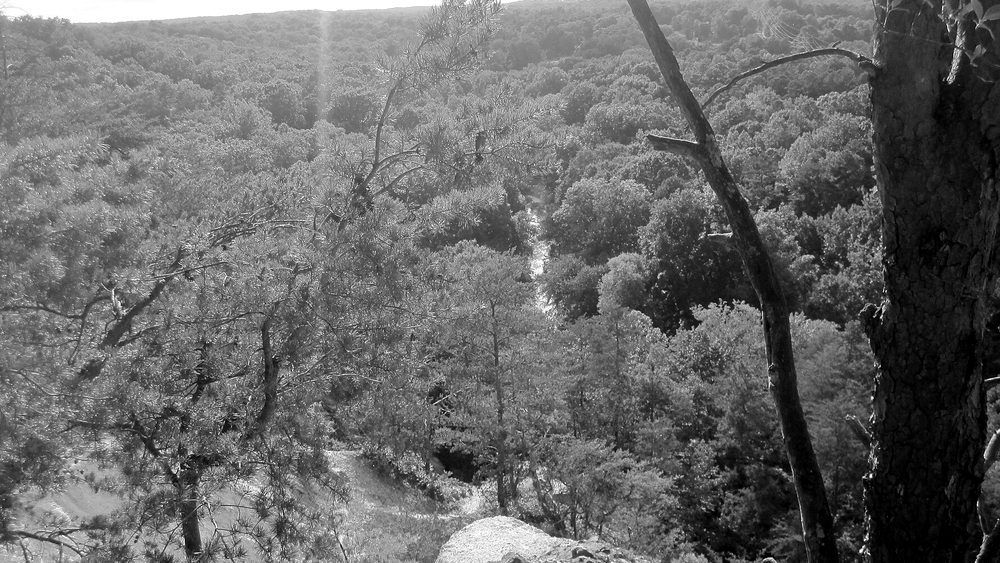
The river and the land around it, from mill sites to state parks.
In briefThe Eno powered local mills and later became a focus of conservation efforts: the Association for the Preservation of the Eno River Valley formed in 1966, the state park followed in 1973, and the fights over University Lake, Cane Creek, the Rogers Road landfill and the 1976 drought shaped how the county uses land and water. Hurricane Fran in 1996 belongs here too.
Related works found in catalogs and archives across North Carolina, the most widely held first, novels aside. Each links to the institution that holds or provides it.
Narrow these works. Each link opens the search already limited to this theme. Counts are indexed works, not copies on a shelf; a work can carry more than one period or place.
McVaugh, Rogers; McVaugh, Michael R.; Ayers, Mary · 1996
Elisha Mitchell, the University of North Carolina professor for whom Mount Mitchell is named, as botanist and as observer of early Chapel Hill, in a study by Rogers McVaugh, Michael R. McVaugh and Mary Ayers. It covers Mitchell's botanical knowledge, the plants of Chapel Hill and the town's historical geography. Published by the Botanical Garden Foundation in Chapel Hill in 1996, 122 pages with illustrations and maps.
Architectural and historical inventory of Carrboro by Claudia Roberts Brown, published in 1983 by the Carrboro Appearance Commission and the town. The 48-page survey, with illustrations and maps, documents the town's historic buildings and their conservation.
Collected first-hand and second-hand stories from the Eno River valley as told from the standpoint of African Americans and Native people who have lived along the river in Orange and Durham counties, from prehistory to the present day. Issued by the Eno River Association in Durham as volume 10, number 2 of the Eno Journal, 2021, 106 pages with illustrations.
Emily Eidenier Pearce's history of Rogers Road, the historically African American neighborhood on the edge of Chapel Hill and Carrboro, and of what happened to it after Orange County opened its landfill next door in 1972. Drawing on interviews with residents, the book records the neighborhood's origins, family life, churches and customs, and then the environmental and social burdens of decades beside the landfill. Privately issued in 2009, 298 pages with illustrations, maps and portraits.
David Cook collects the grim side of the Eno River's past in Orange and Durham counties: ghost stories, crimes, train wrecks and accidents, including the hanging of rebels near the river in 1771, a sawmill accident said to have started a run of hauntings, and a dance one Valentine's Day that ended badly. Published by The History Press in 2025, 141 pages with illustrations.
Johnston and Robson Mill History, New Hope Creek (Orange Co., N.C.)
Dunaway, Stewart E. · 2010
Stewart E. Dunaway's history of the two mills George Johnston built on New Hope Creek in Orange County, the first in 1793 and the second in 1820, the earlier of which he sold to the Englishman William Robson. Self-published in 2010, 256 pages with illustrations, maps and facsimiles. Topics include gristmills in Orange County and the Blackwood, Johnston, Robinson and Robson families, so the volume serves both mill history and genealogy.
An Historical Address Delivered in Saint Matthew's Church, Hillsboro, N.C., on Sunday, August 24, 1924
Cheshire, Joseph Blount · 1925
Address by Bishop Joseph Blount Cheshire at St. Matthew's Church in Hillsborough on 24 August 1924, marking the parish's hundredth anniversary. Printed in Durham in 1925 at the vestry's order, with a foreword by the rector. Cheshire discusses George Micklejohn, William Mercer Green and Moses Ashley Curtis.
History of Patterson Mill, New Hope Creek, Orange County, NC
Dunaway, Stewart E. · 2010
Stewart E. Dunaway's 2010 study of Patterson Mill, a gristmill site on New Hope Creek where Orange County meets Chatham County. The book pairs a short genealogy of the Patterson family with a close survey of what remains of the mill on land now inside Duke Forest, supported by maps, facsimile documents and illustrations across 176 pages. Self-published in a second issue dated October 10, 2010.
Books in OCPL’s Rebecca B. Wall Local History Collection whose titles, catalog subjects, or descriptions match this theme. The Friends’ recommended starting points are labelled. Books marked Wider context cover the broader subject rather than this theme itself.
Collected first-hand and second-hand stories from the Eno River valley as told from the standpoint of African Americans and Native people who have lived along the river in Orange and Durham counties, from prehistory to the present day. Issued by the Eno River Association in Durham as volume 10, number 2 of the Eno Journal, 2021, 106 pages with illustrations.
Mary Claire Engstrom's history of the Quaker settlers of the Eno River valley from about 1750 to 1847, in the country that is now Orange and Durham counties. Published by the Association for the Preservation of the Eno River Valley in Durham in 1989, 73 pages with illustrations, maps and portraits.
The North Carolina Division of Parks and Recreation's master plan for Eno River State Park, dated June 1979, for the park that follows the river through Orange and Durham counties. Plans and maps, some in color, lay out the proposed development. Published by the Division in Raleigh, 64 pages in an oblong format.
Hugh Conway Browning's 1973 history of the Eno River valley, subtitled some of its lands, some of its people, some of its mills, treating the tracts, families and water mills along the river in Orange and Durham counties. Among the people it covers is William Andrew Browning, 1835 to 1916.
Nancy Learned Haines tells the story of the Quaker families who left Pennsylvania around 1750 for the Eno River valley near Hillsborough, where they farmed, traded and built a school, and asks how a community committed to peace fared through the unrest of the colonial years. Published by Pleasant Green Books in 2026, 122 pages with bibliography and index. Subjects include Quakers in North Carolina and the history of Hillsborough, Orange County and the Eno River valley.
Hillsborough seen by twenty-seven writers in essays, fiction and poems collected by Eno Publishers in 2010. Allan Gurganus writes on renovating old houses, David Payne and Beverly A. Scarlett on the Eno, Brooks Graebner on the courthouse and the churches, Nancy Goodwin keeps a gardener's journal, and Lee Smith offers scenes from 'On Agate Hill'; Randall Kenan, Michael Malone, Hal Crowther, Jill McCorkle, Craig Nova and Jaki Shelton Green also appear. 210 pages.
An inventory of the natural areas and wildlife habitats of Orange County, prepared by Dawson Sather for Triangle Land Conservancy in 2004. A reference for land planners and conservation groups identifying the county's significant tracts and habitats.
The guide to the birds of North and South Carolina by Eloise F. Potter, James F. Parnell and Robert P. Teulings, first published in 1980 and revised for this second edition of 2006 from the University of North Carolina Press. It has 399 pages with color illustrations, a map, a bibliography and an index.
A pocket field guide by Stan Tekiela to the birds of North and South Carolina, 342 pages with color illustrations, a bibliography and an index. Published by Adventure Publications of Cambridge, Minnesota, in 2001; a second edition followed in 2004.
In the chronology
Dated events connected with this theme: sixteen of 94, the highlights and a sample of the rest spread across the years, in date order. See all 94 dated events in the chronology →
Earliest first. Scroll sideways, or use the arrows.
Excavations at the Hogue and Wall sites on the Eno near Hillsborough show farming communities growing corn, beans and squash, first in small scattered settlements (Haw River phase, about 1000–1400) and then in compact palisaded villages (Hillsboro phase, about 1400–1600). The Wall site village held perhaps 100 to 150 people in the mid-1400s.
After leaving the Roanoke River valley in 1676, the Occaneechi built a town on the Eno River near present-day Hillsborough and lived there from about 1680 to 1710. It was a small stockaded village of ten or twelve houses and probably fewer than 75 people, and it was the town John Lawson visited in 1701. Archaeologists dug the whole village between 1983 and 1986 at a place they named the Fredricks site, and they call this period of Occaneechi life on the Eno the Fredricks phase.
At daybreak about 45 North Carolina cavalry under Captain Joseph Graham and mounted riflemen under Captain Richard Simmons, sent out by General Andrew Pickens, surprised the British guard of about 26 regulars and two Loyalists that was keeping Thomas Hart's mill on the Eno grinding for Cornwallis's army. Graham's accounts report the whole guard killed, wounded or captured with no Patriot dead, and the party reached Pickens's camp with its prisoners ahead of pursuing British cavalry.
Founding or opening · Davie Hall, University of North Carolina, Chapel Hill
By 1908 William C. Coker, who had come to the university as an associate professor in 1902, was a full professor and chair of the newly established Botany Department, housed in Davie Hall.
Residents who had begun organizing in 1965 against plans to dam the Eno for a water-supply reservoir formed the Association for the Preservation of the Eno River Valley on October 14, 1966. Led by Margaret and Holger Nygard, it began the campaign that preserved the river corridor in Durham and Orange counties.
Governor Robert W. Scott named a Utilities Study Commission to weigh whether the University of North Carolina should keep, sell or otherwise dispose of the water and sewer systems it operated for Chapel Hill and Carrboro. On May 28, 1976 the commission concluded that divesting most of the university's utility holdings was the best course.
After years of citizen opposition to damming the Eno for a reservoir, Governor James Holshouser accepted the first tracts for Eno River State Park in June 1973, including 90 acres donated by Dr. and Mrs. Frederick Bernheim. The first 1,000 acres opened to the public in 1975 along the river in Orange and Durham counties.
A drought from August 1976 to January 1977 forced Chapel Hill and UNC to buy more water from Durham, ban unnecessary water use and cut campus services. By August 1977 University Lake was lower still, and the new Orange Water and Sewer Authority kept conservation rules and used federal drought aid to buy Durham water.
On appeal by the Cane Creek Conservation Authority, several landowners and Teer Farms, the N.C. Court of Appeals vacated the commission's certificate, which Wake County Superior Court had upheld on March 5, 1980. It held that the decision needed an environmental impact statement under the state Environmental Policy Act and a review of the whole record, and sent the case back to the commission.
Orange County adopted the Orange County-Chapel Hill-Carrboro Joint Planning Area Land Use Plan and map on August 19, 1986, designating a low-density Rural Buffer. The three governments signed the Joint Planning Agreement on November 2, 1987, and the county dates the buffer to 1988.
Hurricane Fran came ashore on the night of September 5, 1996 and crossed to the Triangle overnight. In Chapel Hill winds topped 70 mph, falling trees caused about 29,000 power outages and UNC cancelled classes, and the Eno at Hillsborough hit a record flow. No one in Orange County was killed.
Fran brought down several roughly 200-year-old trees around New West Hall and left North Campus and Cameron Avenue covered in fallen trees, while the Davie Poplar survived. University power came back within hours, and Sitterson Hall opened as a place for people to recharge batteries, get ice and water and shower.
At the urging of the Eno River Association and The Nature Conservancy, the state began buying land on Occoneechee Mountain just south of Hillsborough, with the Conservancy purchasing 96 acres for the state. The 124-acre Occoneechee Mountain State Natural Area was dedicated on July 20, 1999, with a blessing from an Occaneechi tribal member.
The 44-acre Occoneechee Speedway site near Hillsborough, acquired by preservationists from the France and Staley families in 1997, was listed in the National Register of Historic Places on May 2, 2002. It is the only surviving dirt track from NASCAR's inaugural 1949 season.
Chantal dropped up to 10 inches of rain on Orange County on the night of July 6, 2025. Chapel Hill crews made more than 50 water rescues around Camelot Village and Eastgate Crossing, Carrboro's Weatherhill Pointe flooded, and the Eno at Hillsborough set a record crest on July 7. The county declared an emergency that day.
Ending twenty years on the town's governing board, Haven-O'Donnell said she was encouraging new voices and would turn to organizing and advocacy on reproductive rights, tenants' rights, stormwater, water quality and PFAS pollution. Chapelboro noted that during her service the council approved the South Green development, a community safety task force and greenway projects.
Places in this theme
Buildings, schools, churches and other sites named in the dated events on this page, the most often named first. The map shows the 13 with a known location.
NC LIVE: prepared search for Eno & EnvironmentNC LIVE
An advanced search of the state’s shared databases already scoped to Orange County’s places and this subject; edit it freely, and sign in through your North Carolina library to read
Ask locally 6
Local organizations that preserve the story and can help you go further
Orange County Natural & Cultural ResourcesOrange County Natural & Cultural Resources
The county department for land, water, farmland, historic, and archaeological conservation
Eno River AssociationEno River Association
The association that saved the river: history, conservation, and the Festival for the Eno
Local History Help Hours and request formOCPL Local History Liaison
The library’s Local History Liaison helps in person most Mondays, 12 to 3, at the Main Library, or by the online request form
Background reading at OCPL
Held in OCPL’s Rebecca B. Wall Local History Collection. Selected because their titles or catalog subjects provide wider historical context for this theme; they may not discuss the Orange County theme directly.
Driving tours of the state's natural areas, 38 in all, written by naturalists from across the state and edited by Dirk Frankenberg, a marine sciences professor at UNC Chapel Hill. Grouped by the coast, the coastal plain, the Piedmont and the mountains, each tour follows a route of thirty to seventy miles linking parks, preserves, hiking and nature trails and scenic overlooks. UNC Press, 2000, 412 pages with 42 maps.
Subjects in the Library of Congress catalog record: Natural areas -- North Carolina -- Guidebooks; Natural history -- North Carolina -- Guidebooks; Ecotourism -- North Carolina OCPL call number: 508.756 EXP
Anne Melyn Cassebaum follows the Haw River from its seeps in Forsyth and Guilford counties past the cotton mills of Alamance and the whitewater and Jordan Lake of Chatham, then down the Cape Fear to the sea. Her history draws on interviews with mill owners and hands, archaeologists, farmers, environmentalists and water-treatment managers, and closes with a list of citizen groups working for the river. McFarland, 2011; 229 pages with maps and portraits.
Subjects in the Library of Congress catalog record: Haw River Valley (N.C.) -- History; Human ecology -- North Carolina -- Haw River Valley; Stream ecology -- North Carolina -- Haw River (River) OCPL call number: NC 975.658 CASSEBAU