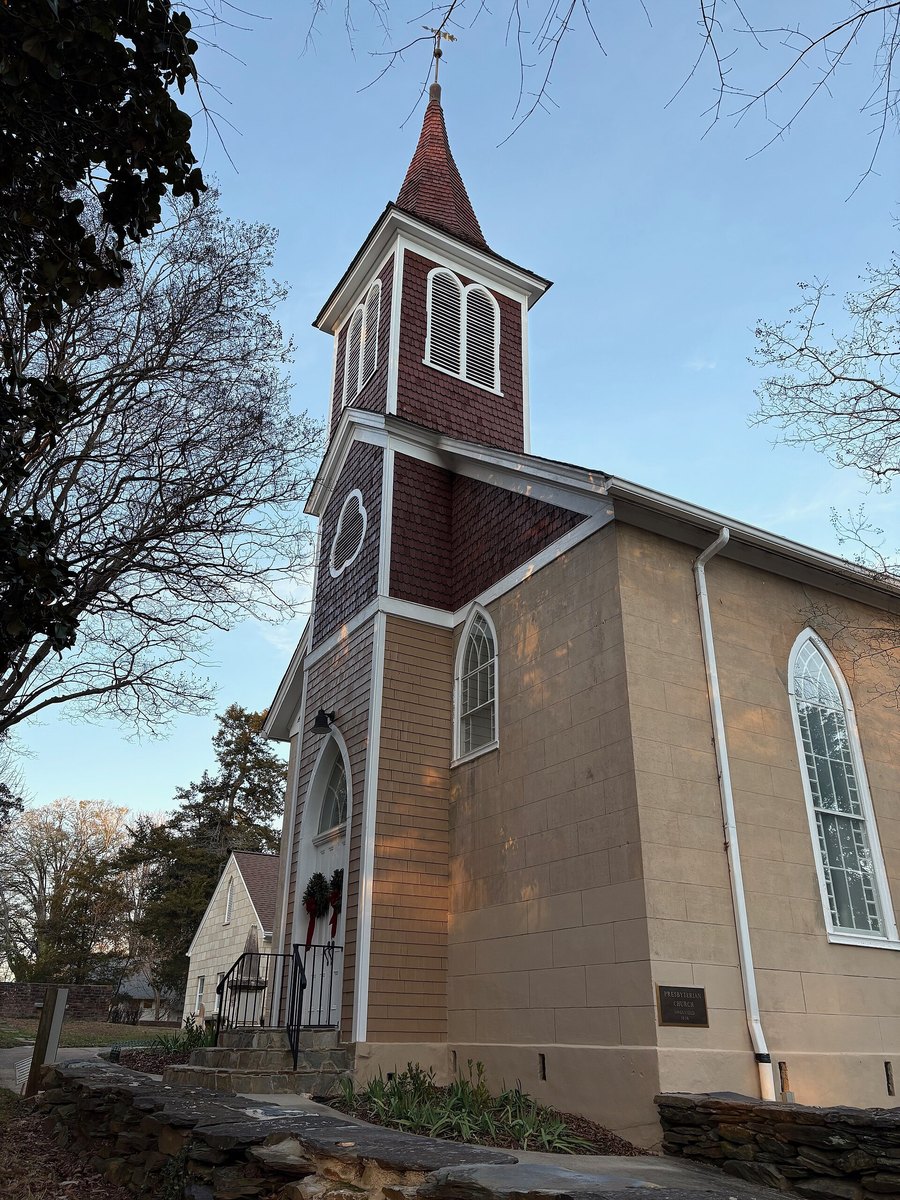
Hillsborough's brick Presbyterian church on West Tryon Street was built near the site of the colonial St. Matthew's church with money from a lottery the state authorized, and the brickmasons John Berry and Samuel Hancock are credited with the work. In September 1816 Mary W. Burke, eight other people and the Rev. John Knox Witherspoon organized the Hillsborough Presbyterian Church. On November 17, 1821 Hancock joined the church he had helped build. On June 21, 1823 the session charged William Adams and John Wall with trading in enslaved people and admonished both men without punishing them. On August 23, 1833 Witherspoon ended seventeen years as pastor; his advocacy of religious education, Sunday schools and preaching for enslaved people had strained relations with his congregation. On May 10, 1834 the Rev. S. J. Price baptized six enslaved women held by the Nash, Watters, Scott and Waddell households. John Wall Norwood became treasurer in 1834, ruling elder in 1835 and, from 1836, clerk of session for 48 years. In 1835 Robert Burwell began a thirteen-year pastorate, and in January 1836 the trustees bought a house as his manse. In 1835 Dr. James Webb built a frame Sessions House for the Sunday school, and in August 1837 the Presbyterian Female Benevolent Society held a fair in the Masonic Hall.
Reading on the places and people in this storyline
No indexed work is about this storyline itself yet. These are about the sites and people its dated events name, those named most often first, so they may discuss the storyline only in part. Follow a link to find a copy or view the material.
One hundred and fifty years of service, 1816-1966
1966 · Hillsborough Presbyterian Church
Anniversary history of Hillsborough Presbyterian Church marking its hundred and fiftieth year, from the congregation's founding in 1816 to 1966, published by the church in Hillsborough. 28 pages with illustrations, portraits and a facsimile. It includes Presbyterian experience of the Civil War.
Pipe Organ
Derrick and Felgemaker Pipe Organ Company · 1831
Pipe organ and bench by Derrick and Felgemaker of Erie, Pennsylvania, dated 1831, with the makers' name imprinted above the keys. The pewter pipes stand in three rows, and those on view are decorated with gold leaf and flowers. The organ served the Presbyterian church in Hillsborough.
Hillsborough Presbyterian Church, Churton & West Tryon Streets, Hillsborough, Orange County, NC
Historic American Buildings Survey · 1933
Historic American Buildings Survey documentation, compiled after 1933, of the brick Hillsborough Presbyterian Church at Churton and West Tryon Streets: three photographs, four data pages and a caption page. Names tied to the church's story include William Hooper, Archibald Murphy, William A. Graham, Frederick Nash, William J. Bingham and Edmund Strudwick, and its history touches on the Revolutionary War and slavery.
Hillsboro, N.C. Presbyterian Church, Built about 1810
1810 · Paul C. Koeber Co., New York, N.Y
About 1810, the date in this card's title, belongs to the Hillsborough Presbyterian church building; the postcard carries no date of its own. The Paul C. Koeber Company of New York published it.
Hillsborough Historical Society
North Carolina ECHO (Project) · 2002
Plaque on the wall in front of the Old Town Cemetery in Hillsborough, just behind the Hillsborough Historical Society's building, photographed for the North Carolina ECHO project on 6 March 2002.
NC Digital Collections record courtesy of the North Carolina Department of Natural and Cultural Resources.
Hillsborough Historical Society
North Carolina ECHO (Project) · 2002
Old Town Cemetery in Hillsborough, which lies just behind the Hillsborough Historical Society's building, in a North Carolina ECHO project photograph taken 6 March 2002.
NC Digital Collections record courtesy of the North Carolina Department of Natural and Cultural Resources.
The Old Town Cemetery (1757), Hillsborough, North Carolina
Engstrom, Mary Claire · 1966 · Historic Hillsborough Commission
Mary Claire Engstrom compiled this single folded typescript sheet for the Historic Hillsborough Commission in 1966, recording the Old Town Cemetery of 1757 in Hillsborough. A note places the ground on lots 98 and part of 97 at the northwest corner of Churton and West Tryon streets. Topics include epitaphs, cemetery recording and Orange County genealogy. Part of UNC's North Carolina Collection.
The Book of Burwell Students
Engstrom, Mary Claire · 1979 · Historic Hillsborough Commission
Mary Claire Engstrom's biographical register of the young women who attended the Burwell School in Hillsborough, subtitled lives of educated women in the antebellum South. The school was kept by Margaret Anna Burwell and her husband, and the book bears on women's education in nineteenth-century North Carolina. Published by the Historic Hillsborough Commission, 1979, 256 pages with illustrations and portraits.
Anna Burwell and the business of being a Presbyterian minister's wife in North Carolina, 1835-1857
Hoffert, Sylvia D. · 2019 · Historical Research Office, Office of Archives and History
Sylvia D. Hoffert's article on Margaret Anna Burwell, 1810 to 1871, and the work of being a Presbyterian minister's wife in North Carolina from 1835 to 1857, the years of the female school she and her husband kept in Hillsborough. Pages 245 to 275 with illustrations, facsimiles and portraits, issued by the Office of Archives and History in Raleigh in 2019.
Antebellum Hillsborough, Slavery, and Enslaved and Free People of Color Who Worked at the Burwell School, 1837-1857
Historic Hillsborough Commission (Hillsborough, N.C.) · 2019
The Historic Hillsborough Commission's account of slavery in antebellum Hillsborough and of the enslaved and free people of color who worked at the Burwell School, the female school the Burwells kept in town, between 1837 and 1857. African American history in Hillsborough and the school's own history are its two threads. Published in 2019.
Antebellum Hillsborough, Slavery, and Enslaved and Free Peoples of Color Who Worked at the Burwell School -1837-1857: A Study of the Research Committee of the Burwell School Historic Site, Janie Morris and Betty Eldenier, Co-chairs
2019
Research by a committee at the Burwell School Historic Site, co-chaired by Janie Morris and Betty Eldenier, into the enslaved people and free people of color who worked at the Burwell School in Hillsborough between 1837 and 1857, the years it ran as a female school. Published in 2019, it covers slavery and education in nineteenth century Hillsborough.
Burwell School
North Carolina ECHO (Project) · 2002
Photograph from the Burwell School in Hillsborough, taken 6 April 2002 for the North Carolina ECHO project. Its caption recalls the school's founder, the Reverend Robert Burwell, who arrived in 1835 as the town's Presbyterian pastor.
NC Digital Collections record courtesy of the North Carolina Department of Natural and Cultural Resources.
Margaret Anna Robertson Burwell Diary [1866-1871]
Burwell, Margaret Anna Robertson, 1810-1871 · 1866
Diary of Margaret Anna Robertson Burwell covering 7 January 1866 to 27 January 1871, ending in the year of her death. Born in Virginia in 1810, she and her husband, Robert Armistead Burwell, had earlier run a girls' school in Hillsborough, where she served as principal.
Margaret Anna Robertson Burwell Diary [1855]
Burwell, Margaret Anna Robertson, 1810-1871 · 1855
Anna Burwell's diary for 1855, from 1 January to 17 December, written while she lived in Hillsborough and served as principal of Mr. and Mrs. Burwell's Female School, which she ran with her husband, Robert Armistead Burwell.
The Circular [1848-1851]
1848
Circular for Mr. and Mrs. Burwell's Female School in Hillsborough, 1848 to 1851, the only complete one known. It gives the course of study, tuition, patrons and a roll of students. Robert and Margaret Anna Burwell ran the school for young white women from 1837 to 1857.
Wider background: Churches & Faith · the most widely held histories of the theme this storyline is filed under; they may not discuss it
Miss Mary's Money
Jones, H. G. · 2014 · McFarland & Co.
H. G. Jones follows the fortune of Mary Ruffin Smith (1814-1885), the unmarried heiress whose Orange and Chatham County lands passed at her death to the University of North Carolina and the Episcopal Church. Chapters profile her grandfather Francis Jones, then trace the bequest through a quarrel among Episcopalians over Price Creek, the Chapel of the Cross and the university's buildings. A December 1885 New York Times report called the gift money; Jones shows it was land. Published by McFarland in 2014, 231 pages.
Church in the Old Fields: Hawfields Presbyterian Church and Community in North Carolina
Turner, Herbert Snipes · 1962
Herbert Snipes Turner's history of Hawfields Presbyterian Church and its community from 1738 to 1960. Hawfields lies in what is now Alamance County, land that was part of Orange County until 1849, and the book gives a place to Henry Pattillo, the congregation's eighteenth-century minister. Published by the University of North Carolina Press in 1962, 297 pages with illustrations.
Reviewed in The Journal of Southern History (1963).
A Historical Sketch of New Hope Church, in Orange County, N.C
Craig, D. I. · 1891
Rev. D. I. Craig's history of New Hope Church, a Presbyterian congregation in Chapel Hill Township, Orange County, printed at Reidsville in 1891. A closing family history section covers the Strayhorn, Craig, Blackwood and Kirkland families.
Jane Crow: The Life of Pauli Murray
Rosenberg, Rosalind · 2017
Rosalind Rosenberg's 2017 biography of Pauli Murray (1910-1985), lawyer, poet and Episcopal priest, raised in Durham. Its six parts follow a Southern childhood, the move to New York, the 1938 application to the University of North Carolina that was refused because Murray was Black (the chapter is titled 'Members of your race are not admitted'), law school and the coining of the phrase Jane Crow, the Cold War years, the push toward 'an NAACP for women', and a late-life ordination. 494 pages with portraits.
Reviewed in The Journal of Southern History (2018).
Journey to New Hope
Murphy, Barbara A. · 2006
A congregational history of New Hope Presbyterian Church in Orange County, written by Barbara A. Murphy and published in 2006 by Chapel Hill Press. Chapters take up the five successive church buildings, the land itself, the ministers who served, the cemeteries, members who went to war, the church's organization, its music, gifts and memorials, and its outreach to the surrounding community. It also covers Presbyterian experience of the Civil War. 126 pages with illustrations and portraits.
Facing Tomorrow, Understanding Yesterday
1992
A history of Orange United Methodist Church in Chapel Hill since 1832, prepared by the congregation's History Committee and edited by Margaret A. Blanchard with Julia Blackwood, Mildred Stout, Wiley Williams, Kay Creech, Andrea Stark and Shirley Mallard. Published by Taylor Publishing of Dallas in 1992, 161 pages with illustrations, some in color, a facsimile, maps and portraits.
Show 6 more
Binkley: A Congregational History
Gardner, Andrew · 2023 · The University of Tennessee Press
Andrew Gardner's history of Binkley Memorial Baptist Church in Chapel Hill, named for Olin T. Binkley, covering the years between the late 1950s and the 2010s and tracing how a congregation with Southern Baptist roots came to be known for liberal Christianity. Published by the University of Tennessee Press in 2023, 213 pages with illustrations.
Centennial Monograph
Habel, Samuel Tilden · 1954 · The Baptist Church
Samuel Tilden Habel's centennial monograph on the Baptist Church at Chapel Hill, covering its first hundred years from 1854 to 1954. It pairs a narrative of the congregation with membership lists. Published by the church in Chapel Hill in 1954, 58 pages plus sixteen pages of plates with illustrations, portraits and facsimiles.
A History of the Chapel Hill Baptist Church, 1854-1924
Howell, Almonte Charles · 1945
A. C. Howell's history of the Baptist church in Chapel Hill from 1854 to 1924, published in 1945. Thirty-two pages with one plate; the story touches the Baptist State Convention of North Carolina as well as the congregation itself.
The Church of the Atonement and the Chapel of the Cross at Chapel Hill
Henderson, Archibald · 1938
Archibald Henderson's history of the Episcopal congregation in Chapel Hill, the Church of the Atonement and the Chapel of the Cross, as the title names them. A short work of Chapel Hill church history and of the Episcopal Church in North Carolina, published in Hartford, Connecticut, by the Church Missions Publishing Company in 1938, 57 pages with illustrations and portraits. One copy carries the author's presentation inscription to the North Carolina State Library.
An Historical Address Delivered in Saint Matthew's Church, Hillsboro, N.C., on Sunday, August 24, 1924
Cheshire, Joseph Blount · 1925
Address by Bishop Joseph Blount Cheshire at St. Matthew's Church in Hillsborough on 24 August 1924, marking the parish's hundredth anniversary. Printed in Durham in 1925 at the vestry's order, with a foreword by the rector. Cheshire discusses George Micklejohn, William Mercer Green and Moses Ashley Curtis.
The first parish register of the Chapel of the Cross (1842-1881)
2024 · Chapel Hill Historical Society
Transcription of the first register kept by Chapel of the Cross, the Episcopal parish on Franklin Street in Chapel Hill, with its entries from 1842 to 1881. Published by the Chapel Hill Historical Society in 2024 with an introduction and a bibliography, 142 pages with illustrations and portraits.