Carolina athletics from the ban to the undefeated 1898 team, 1888–1902
Carolina athletics began with a fight over whether to play at all: organized football started at the university in 1888, and by 1890 the trustees had forbidden intercollegiate contests altogether. A student petition won repeal by January 1891, and that April the football and baseball associations united as the Athletic Association. The 1892 team lost only to Virginia and then beat Virginia in a rematch at Atlanta. In 1895 the association hired Princeton's Thomas G. Trenchard, whose team won seven games before losing to Virginia. After a disorderly fall term the faculty in 1896 barred students on probation from the teams and made players pledge not to drink or gamble on trips. The 1898 team was undefeated and untied.
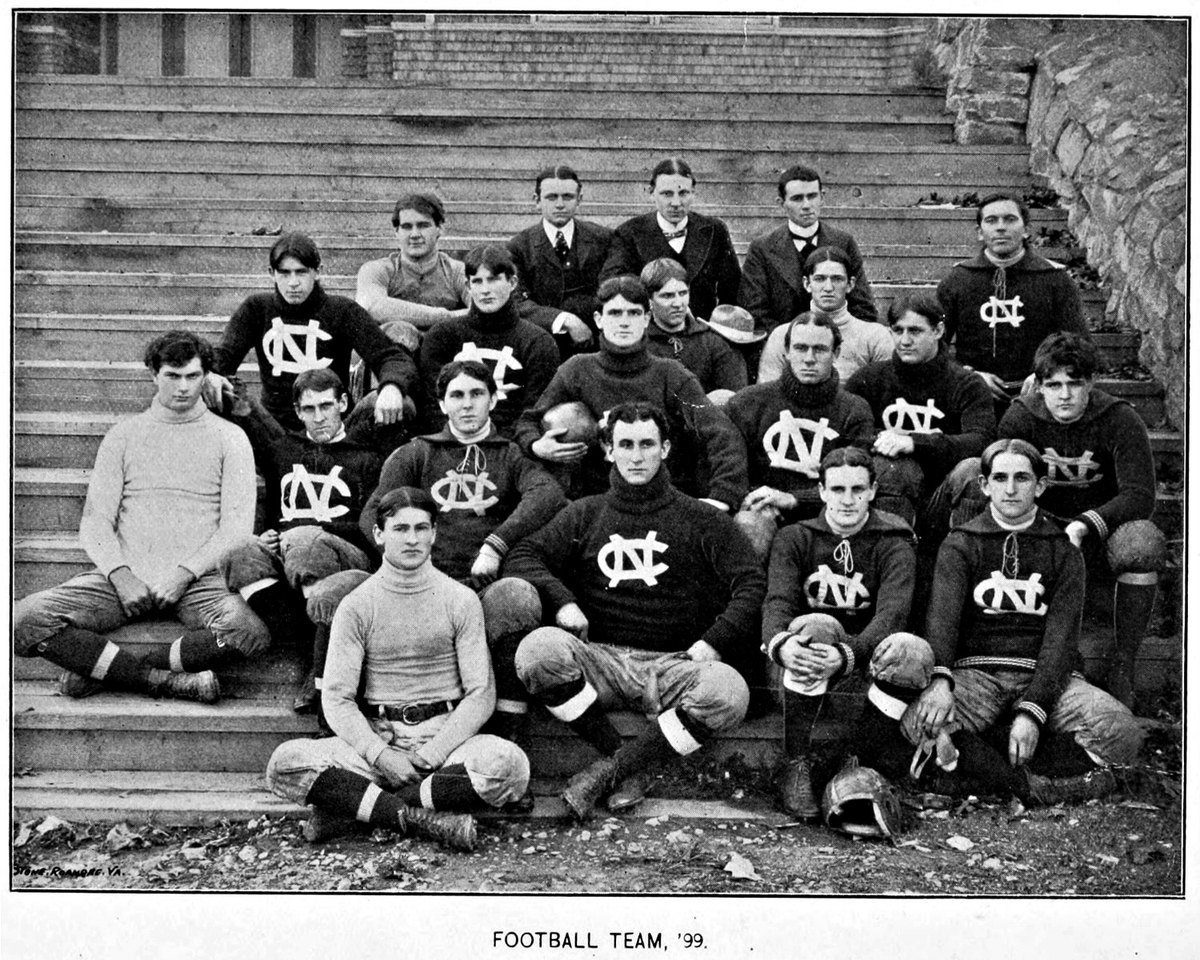
University of North Carolina football team identified as 1899, published in The Hellenian, 1900Photograph published 1900; via Wikimedia Commons · Public domain · Source
Organized football began at the university in 1888. After disputes with other colleges the faculty in 1889 limited games to college grounds, and in 1890 the trustees forbade intercollegiate contests altogether. A student petition won repeal, and by January 12, 1891 the trustees' executive committee had consented to athletic games again. On April 11 the football and baseball associations united as the Athletic Association of the University of North Carolina. When the nine beat Trinity 8 to 3 that month, the college and town bells rang. In June the faculty chose Charles S. Mangum, student director of the gymnasium, as a paid instructor in gymnastics, boxing and fencing. Under captain Michael Hoke, with Charles Baskerville at fullback, the 1892 team lost only to Virginia in October and beat Virginia in a rematch at Atlanta on November 26. In 1893 the university joined the Intercollegiate Tennis Association as its only Southern member. In 1895 the Athletic Association hired Princeton's Thomas G. Trenchard, whose team won seven games and tied one before losing to Virginia. In February 1896, after a disorderly fall term, the faculty barred students neglecting their studies or on probation from the teams and made players pledge not to drink or gamble on trips. Ernest Graves played fullback on the undefeated, untied team of 1898, and by early 1902 the university had laid off a new athletic field with a stand.
Reading on the places and people in this storyline
No indexed work is about this storyline itself yet. These are about the sites and people its dated events name, those named most often first, so they may discuss the storyline only in part. Follow a link to find a copy or view the material.
North Carolina. Department of Insurance · 1935 · Insurance Commissioners' Office
An inspection report from the North Carolina Department of Insurance, issued at Raleigh in 1935, on two buildings at the University of North Carolina at Chapel Hill. The report condemns Gerrard Hall for structural damage and directs that the gymnasium known as the Tin Can be cleared of equipment unrelated to athletics and used only for the purposes its original plans set out.
Gerrard Hall: photographs (Chapel Hill Historical Society)
1890
Eight photographs of Gerrard Hall on the UNC campus, dated 1890. Views include three men near the hall, one with a tennis racket, students around the building, a delivery truck at its side, and a view toward South Building and the YMCA. From the UNC Campus binder, Prints and Photographs Collection (CHHS.002).
Broadside for a baseball game pitting University of North Carolina faculty against the graduating seniors on Saturday, 23 May 1896. The officials named for the game were University President George Tayloe Winston and his predecessor, Kemp Plummer Battle.
Argo, Fordyce Hubbard · 1891 · Dialectic and Philanthropic Societies
A biographical sketch of George Tayloe Winston on his election as president of the University of North Carolina, written by Fordyce Hubbard Argo and printed at Chapel Hill in 1891 by the Dialectic and Philanthropic Societies. It was detached from the North Carolina University magazine. Winston followed Kemp P. Battle in the presidency, and this introduced him to readers on campus.
Papers of Locke Craig, Asheville lawyer who served in the North Carolina legislature from 1898 to 1903 and as governor from 1913 to 1917. The 126 items, beginning in 1880, include personal letters, political and religious speeches, an address on Freemasonry, and a chemistry notebook he kept as a University of North Carolina student. Kemp P. Battle, Henry G. Connor and Woodrow Wilson are among the names that appear.
Papers of George Tayloe Winston (1852 to 1932), a member of the University of North Carolina faculty in the nineteenth century. The papers span 1862 to 1969. The subjects reach well beyond Chapel Hill: naval service and sea life, officers' diaries, ship drawings, travel in Paris, Madeira and Panama, and Venezuelan foreign relations. Part of the Southern Historical Collection at UNC, collection 797.
Selection of correspondence to Benjamin W. Kilgore, assistant chemist, N. C. Agricultural Experiment Station.
Battle, H. B. (Herbert Bemerton), 1862-1929 · 1892
Letters and data sheets from H. B. Battle and others, sent from 1892 to 1894 to Benjamin W. Kilgore, then assistant chemist at the North Carolina Agricultural Experiment Station. They deal with the station's chemical work, trials of phosphoric acid, castor pomace and cottonseed meal as fertilizers, and various inquiries. Charles Baskerville and Charles E. Brewer are among the names connected with the letters. 56 images.
NC Digital Collections record courtesy of the North Carolina Department of Natural and Cultural Resources.
Wider background: Carolina Sports· the most widely held histories of the theme this storyline is filed under; they may not discuss it
Carolina Basketball: A Century of Excellence
Lucas, Adam · 2010 · University of North Carolina Press
Adam Lucas marks one hundred years of basketball at the University of North Carolina in this illustrated history, published by UNC Press in 2010 in association with the athletics department. Chapters follow the program from the game's arrival on campus and the 'White Phantoms' of the Southern Conference through the founding of the ACC, the 1957 season, Dean Smith's changes to the game and the title seasons of 1982, 1993, 2005 and 2009, closing with a century of statistics. 289 pages.
The Blue Divide: Duke, North Carolina, and the Battle on Tobacco Road
Moore, Johnny; Chansky, Art · 2014 · Triumph Books
The Duke and North Carolina basketball rivalry written together by Johnny Moore and Art Chansky, the latter a sports reporter who has followed it since his student days at UNC. The book opens with the 2014 season and moves through recruiting battles old and new, 'Black and Blue Sunday', 'Blood and Roses', and chapters on the rivalry's heroes, leaders and teachers, with a foreword by Jay Bilas and a photo gallery. Published by Triumph Books in 2014, 289 pages.
Art Chansky's 2016 account of Dean Smith, Charlie Scott and the years that changed Chapel Hill as a Southern college town. Scott was the first Black scholarship player in the Carolina basketball program. Topics include civil rights, racism in sports and the university's twentieth-century history.
What it means to be a Tar Heel: Roy Williams and North Carolina's greatest players
Fowler, Scott · 2010 · Triumph Books
Scott Fowler gathers recollections from Carolina basketball players, decade by decade from the 1950s to the 2000s, organized around Roy Williams and the question in the title. Contributors include Lennie Rosenbluth, Larry Brown, Billy Cunningham, Charlie Scott, Phil Ford, James Worthy, Brad Daugherty, Eric Montross, Vince Carter, Antawn Jamison, Raymond Felton and Sean May, each entry giving position and playing years. Published 2010 by Triumph Books of Chicago, 270 pages, here as an e-book.
Will Blythe's account of the Duke and North Carolina basketball rivalry, described in its subtitle as thoroughly obsessive, intermittently uplifting and occasionally unbiased. Blythe writes as a Chapel Hill partisan, and the book treats sports rivalries, basketball fans and the social side of the game in North Carolina. Published by HarperCollins in New York in 2006, first edition, 357 pages.
Art Chansky's 2009 history of the Carolina basketball dynasty that three coaches, Frank McGuire and Dean Smith among them, built at the University of North Carolina. Smith wrote the foreword and Rick Brewer the introduction. Chapters cover Final Fours, the Larry Brown bond, recruiting and the program's records.
A sequel to Art Chansky's 2005 Blue Blood, continuing the story of the Duke and North Carolina basketball rivalry through the years since that book appeared. Published by St. Martin's Press in 2018. First edition, 296 pages with color illustrations.
John Feinstein's account of the three coaches who defined Triangle college basketball in the 1980s: Dean Smith (1931-2015) at North Carolina, Mike Krzyzewski at Duke and Jim Valvano (1946-1993) at N.C. State, all working within a few miles of one another. Feinstein follows the recruiting contests, the rivalry among the three programs and the personal competition among the three men, which was not always friendly, and the pressure that came with national attention. Published by Doubleday in 2016, 404 pages with plates.
Chansky, Art · 2005 · T. Dunne Books : ST. Martin's Press
Fifty years of the Duke and North Carolina basketball rivalry, as told by Art Chansky and published by Thomas Dunne Books in 2005. Chapters run from the 'Legend of Tobacco Road' through 'Dominate, then integrate', 'Blue blood bitterness' and 'Fall of an empire' to a postscript on the twenty-first century, with attention to the brawls and controversies that fed the feud. 373 pages with sixteen pages of plates.
Anne R. Keene's history of the Cloudbusters, the baseball team of the Navy Pre-Flight School at the University of North Carolina in Chapel Hill during the Second World War, on which Ted Williams played in 1943. The chapters move from a batboy's trunk of keepsakes through the pre-flight training program to the players' lives after the war, and Keene's own family is part of the story. Published by Sports Publishing in New York in 2018, 340 pages with sixteen pages of plates.
Durham, Woody; Lucas, Adam · 2012 · John F. Blair, Publisher
Memoir of Woody Durham, who called University of North Carolina football and basketball on the radio from 1971 until he retired in 2011, written with Adam Lucas. Four decades of Tar Heel games as heard from the broadcast booth. Subjects include radio broadcasters and sportscasters, North Carolina, biography.
Art Chansky's celebration of Tar Heel basketball and Dean Smith, published in 1996 as Smith neared the end of his coaching career at the University of North Carolina. The Tar Heels and the university's basketball history are its subjects. Published by Warner Books in New York, 152 pages with illustrations, some in color, in a large format.
Each dated event above names its source, the place to start. For finding more on an event across newspapers, records and histories, see the research guide Follow an event across several accounts. Ask at the North Carolina Room of the Orange County Public Library for help with local sources.
Cite or share
Friends of the Orange County Public Library. “Carolina athletics from the ban to the undefeated 1898 team, 1888–1902.” Orange County Indexed, https://focplnc.org/orange-county-books/storylines/carolina-athletics-storyline-1888/. Accessed October 22, 2026.