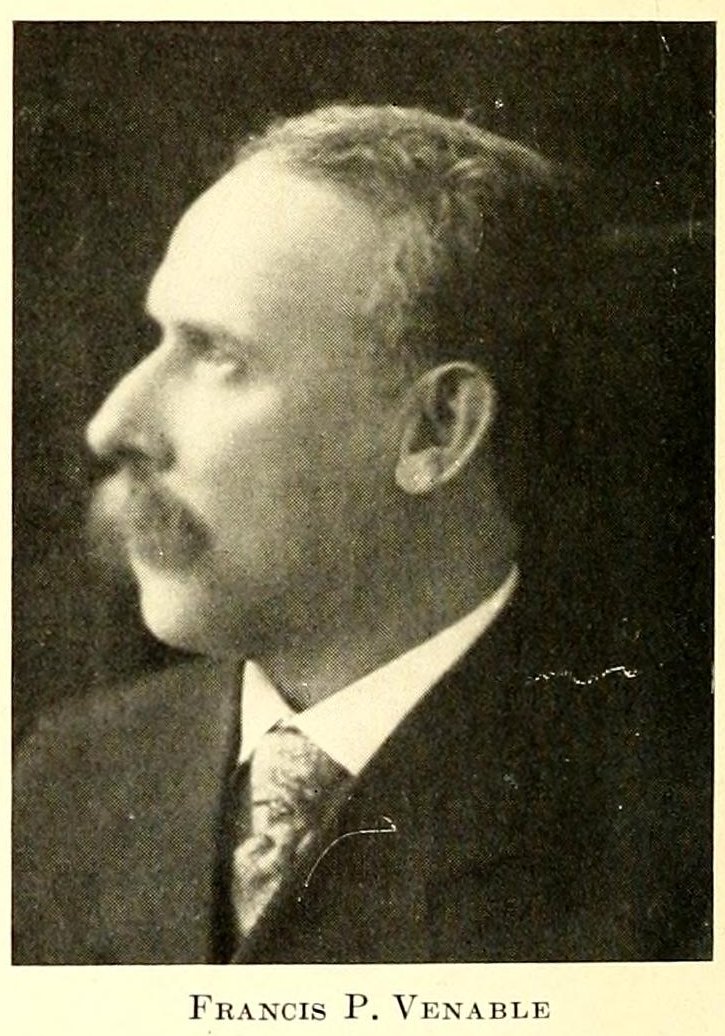
Francis P. Venable was elected president of the university in 1900, and at that year's commencement the trustees accepted the Carr Building, a dormitory for seventy-four students that Julian S. Carr paid for at $18,000. In 1900-01 the university finished its water works, sewer system and a hot-water heating plant, renovated Gerrard Hall and pulled down its decaying south porch, and completed the Alumni Building and the Mary Ann Smith Dormitory. In 1905, after Professor Charles Baskerville described the crowded chemistry laboratories, the legislature raised the yearly appropriation to $45,000 and gave $50,000 for a chemical laboratory, sited on the east side of the campus. That May Judge William Preston Bynum gave a gymnasium in memory of his grandson. The chemistry building, finished in 1906, held three times as many students as the old one, and Person Hall was refitted for the Medical Department. In June 1906 the trustees agreed to buy the old hotel, then the University Inn, for $19,700 for dormitories, and their visiting committee urged an infirmary. In 1907 a new president's house, an infirmary for about twenty patients and the YMCA building, dedicated June 2, were completed, and work began on a biological building that opened as Davie Hall for the fall 1908 session. By University Day 1908 there was a new athletic field, and in the fall of 1909 Gerrard Hall was refitted so that daily chapel could resume for every undergraduate.
Reading on the places and people in this storyline
No indexed work is about this storyline itself yet. These are about the sites and people its dated events name, those named most often first, so they may discuss the storyline only in part. Follow a link to find a copy or view the material.
About Gerrard Hall · named in 2 of this story’s entries
Inspection of "Gerrard Hall," "Gymnasium"
North Carolina. Department of Insurance · 1935 · Insurance Commissioners' Office
An inspection report from the North Carolina Department of Insurance, issued at Raleigh in 1935, on two buildings at the University of North Carolina at Chapel Hill. The report condemns Gerrard Hall for structural damage and directs that the gymnasium known as the Tin Can be cleared of equipment unrelated to athletics and used only for the purposes its original plans set out.
Gerrard Hall, University of North Carolina. Chapel Hill, N.C.
1915 · Albertype Co., Brooklyn, N.Y
Gerrard Hall, an ivy-covered building on the University of North Carolina campus in Chapel Hill, on a 1915 Albertype Co. postcard.
Gerrard Hall: photographs (Chapel Hill Historical Society)
1890
Eight photographs of Gerrard Hall on the UNC campus, dated 1890. Views include three men near the hall, one with a tennis racket, students around the building, a delivery truck at its side, and a view toward South Building and the YMCA. From the UNC Campus binder, Prints and Photographs Collection (CHHS.002).
About Davie Hall · named in 2 of this story’s entries
Davie Hall, University of N.C., Chapel Hill, N.C.
1932 · Sutton & Alderman, Druggists, Chapel Hill, N.C
Davie Hall at the University of North Carolina on a 1932 postcard published by Sutton & Alderman, Druggists, of Chapel Hill. Writing to his mother, the sender identifies it as Dr. Coker's botany hall, with a pergola belonging to the wisteria arbor, and mentions catching up on his reading.
"Davie Hall" -- U.N.C. Chapel Hill, N.C.
1909 · Holliday Studio
Postcard of Davie Hall on the UNC campus in Chapel Hill, published by the Holliday Studio in 1909. The sender's note on the front describes a lively commencement, with three girls up from Raleigh staying nearly a week.
Davie Hall, University of North Carolina, Chapel Hill, N.C.
R. W. Foister, Chapel Hill, N.C
Undated postcard published by R. W. Foister of Chapel Hill showing Davie Hall, the University of North Carolina's biological laboratory of 1908. The building honors William R. Davie, called the Father of the University.
Davie Hall: photographs (Chapel Hill Historical Society)
Davie Hall at the University of North Carolina in two undated views, one with New East to the left and one of the north side. From the UNC Campus binder, Prints and Photographs Collection (CHHS.002).
Carr Building: photographs (Chapel Hill Historical Society)
1910
Front of the Carr Building at the University of North Carolina in 1910, with an automobile parked outside. A single photograph from the UNC Campus binder, Prints and Photographs Collection (CHHS.002).
Chapel Hill, N.C., U.N.C. Campus looking East showing Carr Building and Bynum Gymnasium
1908 · Piedmont Supply Co
Looking east across the University of North Carolina campus in Chapel Hill toward the Carr Building and Bynum Gymnasium, on a 1908 postcard from Piedmont Supply Co., made in Germany. The sender writes of a busy year and reports with pride that John passed the State Board and is at a medical meeting in Winston.
Carr Building, University of North Carolina, Chapel Hill, N.C.
1905 · Albertype Co., Brooklyn, N.Y
Albertype Co. postcard of the Carr Building on the University of North Carolina campus in Chapel Hill, from about 1905 to 1915. A sign on the building carries its name.
Carr Building, U.N.C., Chapel Hill, N.C.
R. W. Foister, Chapel Hill, N.C
A view of the Carr Building at the University of North Carolina, published in Chapel Hill by R. W. Foister. Subjects include educational facilities, universities and colleges and North Carolina postcards, and the place terms are Chapel Hill and Orange County. No photographer is named.
Francis Preston Venable of the University of North Carolina
Bursey, Maurice M. · 1989 · Chapel Hill Historical Society
Maurice M. Bursey's biography of Francis Preston Venable (1856 to 1934), chemist and president of the University of North Carolina, published by the Chapel Hill Historical Society in 1989. It also covers the history of the university's chemistry department. Illustrated, 111 pages, with bibliographies.
Reviewed in Isis (1992).
The University of North Carolina, 1900-1930 : the making of a modern university
Wilson, Louis Round, 1876-1979 · 1957 · University of North Carolina Press
Louis Round Wilson's history of the University of North Carolina between 1900 and 1930, published by the University of North Carolina Press in 1957 with illustrated endpapers. Wilson, long the university librarian, follows the presidencies of Francis Preston Venable, Edward Kidder Graham and Harry Woodburn Chase.
Venable Hall, University of North Carolina, Chapel Hill, North Carolina
Graycraft Card Co. (Danville, Va.) · 1915 · Danville, Va.: Graycraft Card Co
Venable Hall at the University of North Carolina, dedicated in 1925 and named for chemistry professor and university president Francis Preston Venable, on a black and white Graycraft Card Co. postcard with a white border. Undated, from the Ellen Payne Odom Genealogy Library Postcard Collection.
Venable, Alderman, Graham, Battle at Graham's Inauguration
1915
Four University of North Carolina presidents, Francis P. Venable, Edwin A. Alderman, Edward Kidder Graham and Kemp Plummer Battle, pose together at Graham's inauguration in this real photo postcard of 1915. Mailed to R. H. Lewis in Raleigh, it bears a short greeting from K.P.B. and an April 1915 postmark.
Wider background: UNC & Campus Life · the most widely held histories of the theme this storyline is filed under; they may not discuss it
Carolina Basketball: A Century of Excellence
Lucas, Adam · 2010 · University of North Carolina Press
Adam Lucas marks one hundred years of basketball at the University of North Carolina in this illustrated history, published by UNC Press in 2010 in association with the athletics department. Chapters follow the program from the game's arrival on campus and the 'White Phantoms' of the Southern Conference through the founding of the ACC, the 1957 season, Dean Smith's changes to the game and the title seasons of 1982, 1993, 2005 and 2009, closing with a century of statistics. 289 pages.
Chapel Hill Murder and Mayhem
Jackson, Rick · 2023
Rick Jackson's true crime history of Chapel Hill, published by The History Press in 2023, in 28 short chapters. Cases include the Efland bank robbery, the execution of John Henry Breeze, the unsolved murder of Suellen Evans, the killing at the Internationalist Bookstore and the death of Eve Carson.
The Blue Divide: Duke, North Carolina, and the Battle on Tobacco Road
Moore, Johnny; Chansky, Art · 2014 · Triumph Books
The Duke and North Carolina basketball rivalry written together by Johnny Moore and Art Chansky, the latter a sports reporter who has followed it since his student days at UNC. The book opens with the 2014 season and moves through recruiting battles old and new, 'Black and Blue Sunday', 'Blood and Roses', and chapters on the rivalry's heroes, leaders and teachers, with a foreword by Jay Bilas and a photo gallery. Published by Triumph Books in 2014, 289 pages.
Miss Mary's Money
Jones, H. G. · 2014 · McFarland & Co.
H. G. Jones follows the fortune of Mary Ruffin Smith (1814-1885), the unmarried heiress whose Orange and Chatham County lands passed at her death to the University of North Carolina and the Episcopal Church. Chapters profile her grandfather Francis Jones, then trace the bequest through a quarrel among Episcopalians over Price Creek, the Chapel of the Cross and the university's buildings. A December 1885 New York Times report called the gift money; Jones shows it was land. Published by McFarland in 2014, 231 pages.
The Chronicles of the Bicentennial Observance of the University of North Carolina at Chapel Hill
Tepper, Steven J. · 1998
Steven J. Tepper's chronicle of how the University of North Carolina marked its bicentennial in 1993 and 1994. An appendix reprints the University Day speeches of October 12, 1993, given by Paul Hardin, James B. Hunt Jr., C.D. Spangler, William C. Friday, Charles Kuralt and President Bill Clinton, plus bicentennial addresses by Li Lu, Francis S. Collins and Richard J. Richardson. Published by the university in Chapel Hill, 1998; 284 pages.
Game Changers
Chansky, Art · 2016
Art Chansky's 2016 account of Dean Smith, Charlie Scott and the years that changed Chapel Hill as a Southern college town. Scott was the first Black scholarship player in the Carolina basketball program. Topics include civil rights, racism in sports and the university's twentieth-century history.
Show 6 more
William Friday
Link, William A. · 1995
Biography of William C. Friday, president of the University of North Carolina system, by historian William A. Link, published by UNC Press in 1995 with the subtitle power, purpose, and American higher education. It covers Friday's career and the history of the university at Chapel Hill and statewide. Part of the Rebecca B. Wall Local History Collection.
Light on the Hill
Snider, William D. · 1992
William D. Snider's history of the University of North Carolina at Chapel Hill, published by the University of North Carolina Press in 1992. It runs 370 pages with illustrations, a bibliography and an index.
Reviewed in History of Education Quarterly (1993), The Journal of Southern History (1993).
Chapel Hill in Plain Sight
Athas, Daphne · 2010 · Eno Publishers
Twelve essays by novelist Daphne Athas (1923-2020) on the Chapel Hill she knew across the twentieth century. Subjects include Carrboro as 'the Paris of the Piedmont', philosopher Horace Williams, Betty Smith writing in Chapel Hill, Junius Scales, Ab Abernethy and the Intimate Bookshop, Richard Wright's visit, and a set of Chapel Hill murders. Published 2010, 243 pages with illustrations.
What it means to be a Tar Heel: Roy Williams and North Carolina's greatest players
Fowler, Scott · 2010 · Triumph Books
Scott Fowler gathers recollections from Carolina basketball players, decade by decade from the 1950s to the 2000s, organized around Roy Williams and the question in the title. Contributors include Lennie Rosenbluth, Larry Brown, Billy Cunningham, Charlie Scott, Phil Ford, James Worthy, Brad Daugherty, Eric Montross, Vince Carter, Antawn Jamison, Raymond Felton and Sean May, each entry giving position and playing years. Published 2010 by Triumph Books of Chicago, 270 pages, here as an e-book.
The Campus of the First State University
Henderson, Archibald · 1949
Archibald Henderson's history of the campus of the University of North Carolina at Chapel Hill, its buildings and grounds from the founding in the 1790s onward. Henderson, a professor of mathematics and a prolific historian of the university, wrote it in the years around the university's sesquicentennial. Published by the University of North Carolina Press in 1949, 412 pages with illustrations and bibliographical footnotes.
Reviewed in The Journal of Southern History (1949), South Atlantic Quarterly (1950).
The Woman Who Rang the Bell: The Story of Cornelia Spencer Phillips
Russell, Charles Phillips · 1949
Charles Phillips Russell's biography of Cornelia Phillips Spencer (1825-1908), the Chapel Hill writer remembered for ringing the bell of South Building when the university reopened in 1875 after its closure during Reconstruction. It doubles as a history of Chapel Hill and the university. Published by the University of North Carolina Press in 1949, 293 pages with illustrations.
Reviewed in Journal of American History (1949).