Skip to content

Local figure

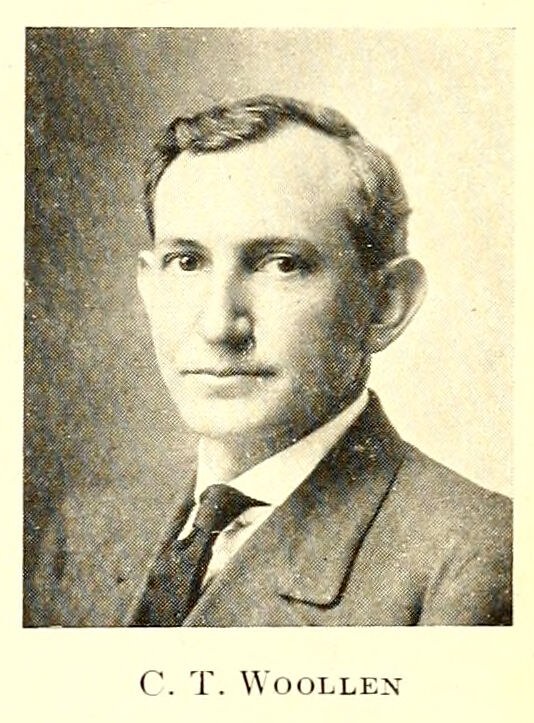
Charles T. Woollen

Charles Thomas Woollen (1878–1938) served the university for decades as registrar, purchasing agent, proctor, business manager and comptroller, and was the first director of the university band from 1903 to 1919. In 1937 the university named its new gymnasium for him.

Source: The Carolina Story: Charles Thomas Woollen (1878-1938) and Woollen Gymnasium

2 works about Charles T. Woollen are indexed here.

Charles T. Woollen, portrait plate, 1905

Life and Orange County connections

Storylines this person is part of, in date order. Each has its own page.

Dated events connected with this person, in date order. See these 20 dated events in the chronology →

  1. Charles T. Woollen becomes the first director of the university band Charles T. Woollen, a university administrator, became the first director of the university band in 1903 and led it until 1919. The band first performed at a university baseball game in 1904 and was giving concerts on the Alumni Building steps by 1906. Place: Chapel Hill · Also mentions: Alumni BuildingSearch the index · The Carolina Story: Charles Thomas Woollen (1878-1938) and Woollen Gymnasium
  2. University janitors organize with the Industrial Workers of the World Black janitors at the university formed an affiliate of the IWW and weighed a strike for higher wages as the spring term closed. Business manager Charles T. Woollen answered that he would hire a new crew from Durham, and the effort faded. That fall all the campus help lost their jobs when the SATC took over the buildings. People: Charles T. Woollen Place: UNC, Chapel HillHoward E. Covington Jr., Fire and Stone: The Making of the University of North Carolina under Presidents Edward Kidder Graham and Harry Woodburn Chase (2018), pp. 359-360
  3. The Students' Army Training Corps takes over the campus Registration, put off to September 24 and 25, opened a year run by the army: dormitories became Barracks 1 through 8, Swain Hall the Mess Hall, and the year was cut into twelve-week quarters with classes grouped by age. About seven hundred enrolled, nearly all of them required to take a course on the issues of the war, and the commander worked from the Sigma Chi house. People: Edward Kidder Graham, Charles T. Woollen Place: UNC, Chapel Hill · Also mentions: Swain HallSearch the index · Howard E. Covington Jr., Fire and Stone: The Making of the University of North Carolina under Presidents Edward Kidder Graham and Harry Woodburn Chase (2018), p. 170
  4. UNC trustees turn the campus's growth southward and call for a landscape plan Planning for 1,500 students the next year, the trustees combined their committees on buying land and on buildings, authorized them to hire a landscape engineer to draft a development plan, and decided that new building should move toward the south end of the campus rather than into four dormitories proposed for the north end. They also voted a monument over the graves of President and Mrs. Graham. People: Harry Woodburn Chase, Charles T. Woollen, John Sprunt Hill, J. Bryan (John Bryan) Grimes, James Alexander Gray Place: UNC, Chapel HillSearch the index · The News (Chapel Hill), June 26, 1919, p. 1
  5. Trustees order a building plan for 3,000 students At commencement Chase told the trustees the University had hit its limit, with laboratories running three shifts and 500 teachers turned away from summer school, and the visiting committee called the dormitories unsafe and unsanitary. The board told Chase to list what an enrollment of 3,000 would need. People: Harry Woodburn Chase, Charles T. Woollen Place: UNC, Chapel HillSearch the index · Howard E. Covington Jr., Fire and Stone: The Making of the University of North Carolina under Presidents Edward Kidder Graham and Harry Woodburn Chase (2018), pp. 217-218
  6. L. B. Rogerson joins the University and sets up its accounting and budget systems L. B. Rogerson came to the University in 1921 and installed its accounting and budget systems under the direction of Charles T. Woollen, the University's business manager. He was later the University's auditor and then its assistant controller and business manager at Chapel Hill. People: L. B. Rogerson, Charles T. Woollen Place: Chapel HillSearch the index · The Chapel Hill Weekly, September 3, 1943, p. 1
  7. The University completes the South Road behind the campus Business manager Charles T. Woollen's new map of the University grounds showed the South road behind the campus, connecting the Pittsboro-Pinehurst and Raleigh roads, completed and in use, with a stretch behind the cemetery from the new athletic building to the Country Club road still to be built. People: Charles T. Woollen Place: Behind the campus, between the Pittsboro and Raleigh roads, Chapel Hill · Also mentions: Country ClubSearch the index · The Chapel Hill Weekly, January 31, 1924, p. 1
  8. The Carolina Power and Light Company finds gas service for Chapel Hill too costly for now After a canvass of the town and campus, the Carolina Power and Light Company's Durham manager reported that extending gas mains from Durham to Chapel Hill would cost about $122,000 and that the expected revenue would not justify it, though the company had not finally turned the idea down. People: Charles T. Woollen, James Munsie Bell Place: Chapel HillSearch the index · The Chapel Hill Weekly, October 2, 1924, p. 1
  9. The University faculty approves an Athletic Council to run college sports In the week before the 1926 commencement the University faculty approved a plan putting all athletics under a new Athletic Council of three faculty members, three alumni and three students, with the director of athletics and the graduate manager as members ex officio. Because the Southern Conference required faculty control, the faculty members, with the president, held a veto over the council's acts; the council held its first full meeting in October 1926 with A. W. Hobbs as chairman. People: Robert A. Fetzer, Charles T. Woollen Place: University of North Carolina, Chapel Hill · Also named: A. W. HobbsSearch the index · The Chapel Hill Weekly, June 4, 1926, p. 1
  10. Concrete pouring begins on the Kenan Stadium stands With the excavation slowed some six weeks by unexpected rock, the contractors began pouring the concrete seats of the east stand, and by mid-June were laying 500 seats a day toward a total of 24,000. The athletic authorities set October 15 for finishing the whole job, in time for the Thanksgiving game with Virginia. People: Charles T. Woollen Place: Kenan Stadium, Chapel HillSearch the index · The Chapel Hill Weekly, June 3, 1927, p. 1
  11. William R. Kenan Jr. sees the stadium and adds $28,000 to his gift William Rand Kenan Jr. came to Chapel Hill on September 24 and saw for the first time the stadium he gave the University in memory of his parents. Before leaving he added $28,000 to his original $275,000 to pay for the field house at the south end and other features not in the first plan, bringing the gift to $303,000. People: William Rand Kenan Jr., Charles T. Woollen, Arthur Cleveland Nash Place: Kenan Memorial Stadium, Chapel HillSearch the index · The Chapel Hill Weekly, September 30, 1927, p. 1
  12. The Summer School board lets students wear pajama suits about the campus On July 31, 1929, about twenty summer-school students who had begun wearing pajama-style suits on campus and in the village paraded before the Summer School's administrative board in the South Building, which saw no objection so long as nothing offended decency. The fashion followed editor Louis Graves's long campaign for cooler men's summer clothes and W. O. Saunders's pajama walk in Elizabeth City. People: Louis Graves, R. B. House, Charles T. Woollen, Addison Hibbard Place: South Building, UNC, Chapel HillSearch the index · The Chapel Hill Weekly, August 2, 1929, p. 1
Show all 20 dated events
  1. Water begins to back up behind the University's new Morgan Creek dam With the dam at full height except for one section, water was rising about a foot a day and spreading out of the creek bed toward what would be a lake of some 200 acres. The University was buying a light motor launch and two rowboats to patrol it and expected the dam done by the end of June. People: Charles T. Woollen Place: Morgan Creek, west of Chapel HillThe Chapel Hill Weekly, June 3, 1932, p. 1
  2. Charles T. Woollen is chosen comptroller of the consolidated University The executive committee of the trustees, meeting in Raleigh, elected Charles T. Woollen comptroller, the chief financial officer of the new consolidated University of North Carolina. He had served the University since 1901 as registrar, secretary to President Venable, purchasing agent, proctor, business manager and graduate manager of athletics. Place: University of North Carolina (meeting in Raleigh)Search the index · The Chapel Hill Weekly, April 14, 1933, p. 1
  3. The University Janitors' Association reports the University's pledge that no Black workers will be dismissed When a rumor spreading from Durham said the University would dismiss its janitors and other Black employees, the officers of the University Janitors' Association wrote to the Weekly that President Frank Graham and business manager Charles T. Woollen had assured them no janitors had been or would be discharged, which the association said had been the policy throughout the Depression. People: Frank Porter Graham, Charles T. Woollen Place: University of North Carolina, Chapel Hill · Also named: Frank GrahamThe Chapel Hill Weekly, August 11, 1933, p. 1
  4. South Building's first floor is rebuilt into offices for the consolidated University Following consolidation, the partitions on the first floor of South Building were rearranged to give new offices to the registrar, the comptroller, the dean of administration, the assistant comptroller, the purchasing supervisor and the student loan fund; the President's office was left as it was. People: R. B. House, Charles T. Woollen, L. B. Rogerson Place: South Building, UNC, Chapel HillSearch the index · The Chapel Hill Weekly, August 10, 1934, p. 1
  5. The University's service plants cut Chapel Hill electric rates A lower schedule of electric rates from the University Consolidated Service Plants took effect on October 1, 1934, after a summer study by J. S. Bennett ordered by comptroller C. T. Woollen. The combination rate for households cooking with electricity gave way to one domestic schedule; a family's first 10 kilowatt hours fell from $1 to 75 cents and 100 kilowatt hours from $7.75 to $3.98. People: Charles T. Woollen, John S. Bennett Place: Chapel HillSearch the index · The Chapel Hill Weekly, September 21, 1934, p. 1
  6. Ground clearing begins for the University's new gymnasium Clearing began on the site between the Tin Can and Fetzer Field, facing the Raleigh road, for a gymnasium with a 250 by 150 foot main floor seating more than 5,500 for games and a wing holding a 165 by 55 foot swimming pool. Arthur C. Nash was supervising architect, working with Atwood and Weeks of Durham, and the building was expected to be finished by the middle of January 1938. People: Arthur Cleveland Nash, Charles T. Woollen, Oliver K. Cornwell Place: Raleigh Road, south edge of UNC campus, Chapel Hill · Also mentions: Fetzer Field, Tin CanSearch the index · The Chapel Hill Weekly, April 9, 1937, p. 1
  7. The university names its new gymnasium for Charles T. Woollen The university trustees named the new gymnasium, opened in the spring of 1938, for Charles T. Woollen, its longtime registrar, business manager and comptroller, who had advocated for the building and helped oversee its construction. The Chapel Hill Weekly treated the trustees' choice as fresh news on June 3, 1938, and wrote later that the building was formally named at a gathering in his honor that June, the alumni luncheon of June 7. He died on September 21, 1938. Place: Woollen Gymnasium, UNC, Chapel HillSearch the index · The Carolina Story: Charles Thomas Woollen (1878-1938) and Woollen Gymnasium · Also: Chapel Hill Weekly, June 3, 1938, p. 2; Chapel Hill Weekly, June 10, 1938, p. 4; Chapel Hill Weekly, September 23, 1938, p. 1
  8. University controller Charles T. Woollen dies Charles Thomas Woollen, controller of the University, died of a heart attack at his Chapel Hill home at 59. He had served the University for 37 years, from a freshman clerk in the registrar's office in 1901 to business manager in 1914 and controller of the consolidated University, and the new gymnasium bore his name. Place: Chapel HillSearch the index · The Chapel Hill Weekly, September 23, 1938, p. 1

People named in the same events

People named in the same dated entries as Charles T. Woollen, those sharing the most entries first. Each line links one of the shared entries in the chronology, where its source is cited. A shared entry shows these people in the same event, not how well they knew each other.

Show 4 more

Indexed works

Works about or by Charles T. Woollen. Each links to the institution that holds or provides it. Background reading appears below.

Charles T. Woollen Gymnasium, U. of N.C., Chapel Hill, North Carolina

Graycraft Card Co., Danville, Va

The Charles T. Woollen Gymnasium at Chapel Hill, published by the Graycraft Card Company of Danville, Virginia, and undated. Chapel Hill and Orange County are the place terms attached.

Included because: Its title names this person.

Woollen Gymnasium, University of North Carolina, Chapel Hill, N.C.

North Carolina News Company, Durham, N.C

Woollen Gymnasium at the University of North Carolina, on a North Carolina News Company postcard. The caption says the building cost $650,000, was dedicated in 1938 and bears the name of Charles T. Woollen, the university's controller for many years. Undated.

Included because: Their name appears in the record.

Places in this person’s story

Buildings, schools, churches and other sites named in the dated events on this page, the most often named first. The map shows the 3 with a known location.

Map tiles © OpenStreetMap contributors. Site locations from the N.C. State Historic Preservation Office survey, Open Orange, Orange County GIS, OpenStreetMap and a few other published sources named on each site’s page; town and community pins show approximate locations.

All places and the county map →

Research sources

Sources and research tools for this person. For ready-made searches of other catalogs, see Search further. Research guide: Trace a family through historical records.

Background

Records of the time

Collections and databases

  • NC LIVE: prepared search for Charles T. Woollen Library card Search NC LIVE for this subject and Orange County. You can change the search terms. Sign in through your North Carolina library to access the materials.
  • Ancestry Library Edition In the libraryOrange County Public Library Census, birth, death and marriage records, and more, free on the public computers at OCPL libraries

Local help

Search further

Search other catalogs and collections for this name. Results may include other people with the same name and have not been reviewed by the Friends.

Books about Charles T. Woollen

Find copies at other libraries

Photographs, papers, and newspapers

Historical records and collections

These searches use Charles T. Woollen’s name without birth or death dates, so results may include namesakes. Links open in a new tab.

Found a book OCPL doesn’t own? You can often borrow it through interlibrary loan at OCPL.

Picture: Charles T. Woollen, portrait plate, 1905. Public domain. Kemp P. Battle, History of the University of North Carolina, vol. 2 (1912); via the Internet Archive

More to discover

Keep Reading Local

The Friends connect people with new library materials, local writers and publishers, and resources documenting Orange County.

Two mice reading back to back against a leaf, with the hand-lettered words Friends of the Orange County Public Library
Illustration by Caldecott Medalist Matthew Cordell, gifted to the Friends 2026
