The Sorrell building theatre: Carolina, Village and Varsity, 1927–1980
W. B. Sorrell's building on the north side of Franklin Street opened in 1927 with the Carolina Theatre between his optometry shop and Jeff's Campus Confectionery. The theatre became the Village in 1942, when a new Carolina opened across the street, and the Varsity in 1951. After pickets in 1961 it agreed to admit Black University students. Fire gutted it in November 1966, and it reopened in September 1967.
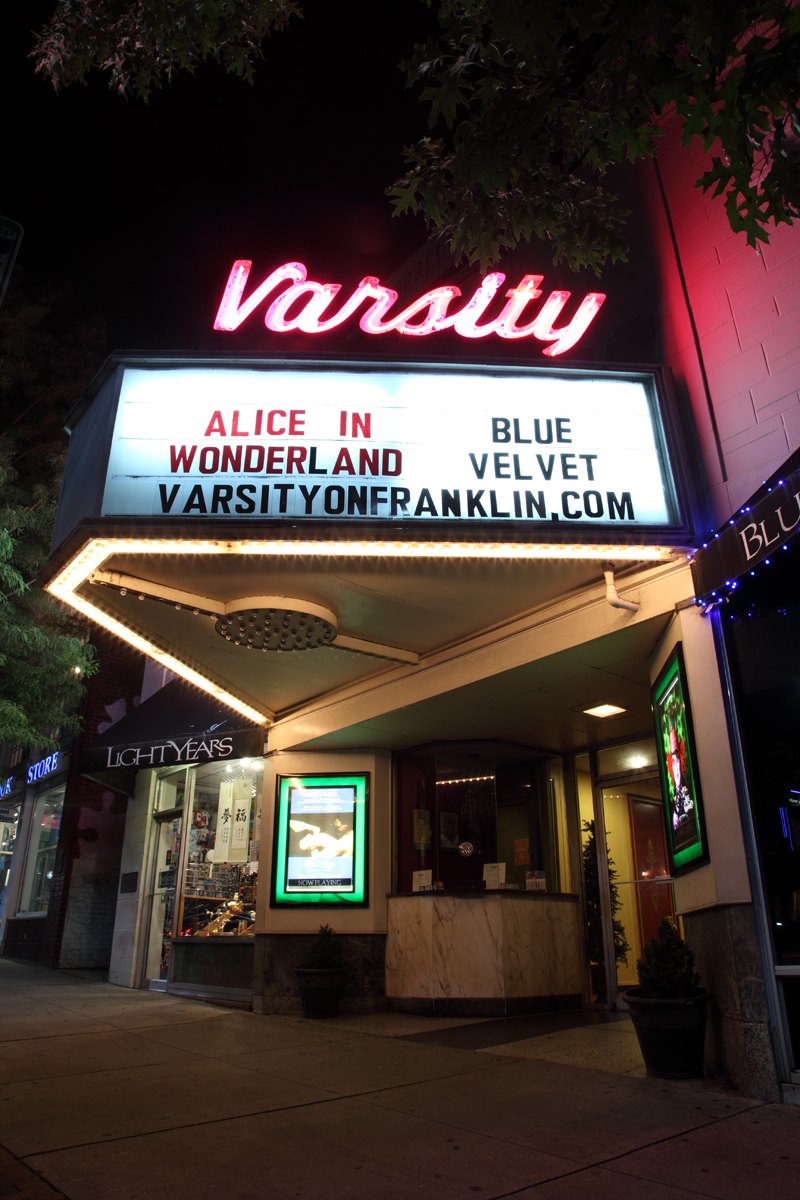
Varsity Theatre in the Sorrell building, Chapel Hill, June 2, 2010Photograph by Wgreaves; via Wikimedia Commons · CC BY-SA 3.0 · Source
In April 1927 contractor Charles Martindale began preparing the ground for W. B. Sorrell's moving-picture theatre on the north side of Franklin Street, next to Berman's store; it was leased to Publix-Saenger Theatres. When the building was finished its first tenants were Sorrell's optometry shop, the Carolina Theatre and Jeff's Campus Confectionery. When a new Carolina Theatre opened across the street on October 15, 1942, the older house took the name The Village and showed the Navy Pre-Flight School's free movies for cadets. In May 1951 Varsity Theatres, Inc., of High Point took it over, renamed it the Varsity and made it a first-run house. In 1961 church and student groups picketed the Varsity after Black patrons were refused entry, and that November it agreed to admit Black University students. Fire gutted the 500-seat theatre early on November 16, 1966, in what the Daily Tar Heel called the worst fire in Chapel Hill since 1946. Workmen were renovating it the next spring, and it reopened in September 1967 as "the all new Varsity Theatre." In February 1980 gay men from Chapel Hill handed out leaflets answering the film Cruising during its run at the Varsity.
Buildings, schools, churches and other sites named in the dated events on this page, the most often named first. The map shows the 1 with a known location.
Reading on the places and people in this storyline
No indexed work is about this storyline itself yet. These are about the sites and people its dated events name, those named most often first, so they may discuss the storyline only in part. Follow a link to find a copy or view the material.
Black-and-white exterior view of the Varsity Theatre on East Franklin Street in Chapel Hill, dated between 1957 and 1983. Neighbors in the frame include Village Opticians, Jeff's Campus Confectionery and Schoolkids Records, which also traded as Record Bar.
Views of the Carolina Theatre, a movie house on East Franklin Street in Chapel Hill, from about 1941 to 1945 and from 1977. The earlier pictures are in black and white.
Varisty Theatre: photographs (Chapel Hill Historical Society)
1994
Front of the Varsity Theatre in Chapel Hill during a parade in 1994, with cars in view. One photograph in the Chapel Hill Historical Society's Prints and Photographs Collection.
Varsity Theatre, Record Bar, Sharyn Lynn Shoppe, Revco: photographs (Chapel Hill Historical Society)
1983
Negatives from 1983 of several Chapel Hill storefronts, among them the Varsity Theatre, Record Bar, the Sharyn Lynn Shoppe and Revco. From the Chapel Hill Historical Society's Prints and Photographs Collection.
Anne R. Keene's history of the Cloudbusters, the baseball team of the Navy Pre-Flight School at the University of North Carolina in Chapel Hill during the Second World War, on which Ted Williams played in 1943. The chapters move from a batboy's trunk of keepsakes through the pre-flight training program to the players' lives after the war, and Keene's own family is part of the story. Published by Sports Publishing in New York in 2018, 340 pages with sixteen pages of plates.
Alex Albright's history of the B-1 band, the group of Black musicians drawn largely from students and graduates of North Carolina A&T who became the first Black sailors of the modern Navy to serve above the rank of messman, and the first of more than a hundred Black Navy bands in wartime. The band was posted to the Navy Pre-Flight School at Chapel Hill, the book's Orange County link. Published by R.A. Fountain in 2013, 194 pages with illustrations and portraits.
Programs like this one came from the athletic associations of the five Navy pre-flight schools. This issue covers Camp Davis against North Carolina Pre-Flight at Kenan Stadium in Chapel Hill on October 16, 1943. Fifty-two pages carry portraits of commanders, coaching notes, line-ups and statistics, along with sections on the Georgia, Del Monte, Iowa and St. Mary's schools.
Football program for the game between the cadets of Camp Lejeune and those of the Navy Pre-Flight School at Chapel Hill, set for November 13, 1943, at Kenan Stadium. Sixty-three pages with portraits of commanders, notes on the two coaching staffs, line-ups and statistics, plus pages on the Georgia, Del Monte, Iowa and St. Mary's pre-flight schools.
Edward G. Danziger's memoir of love and cooking, published by J. F. Blair in 1967. Danziger (1893 to 1972) ran Danziger's Old World Restaurant in Chapel Hill, and the book tells his life as a restaurateur in the town.
The Research Triangle: From Tobacco Road to Global Prominence
Rohe, William M. · 2011 · University of Pennsylvania Press
William M. Rohe's history of Research Triangle Park and the region around it, published by the University of Pennsylvania Press in 2011. Topics include regional planning and the economic and social conditions of the Research Triangle Park region, one corner of which is Chapel Hill and the university. 298 pages with illustrations and maps.
The Black family in slavery and freedom, 1750-1925
Gutman, Herbert G. (Herbert George), 1928-1985 · 1976 · Pantheon Books
Herbert G. Gutman's 1976 history of African American families from 1750 to 1925, published by Pantheon Books in New York, 664 pages with 38 leaves of plates. Its Orange County connection is the Bennehan and Cameron family plantations, Stagville and Fairntosh: the book discusses the people enslaved by Richard Bennehan (1743-1825) and the Camerons, and follows family ties among them under slavery and after emancipation. Subjects include African American families and enslaved persons in Orange County.
Orvin Lee Shiflett's biography of William Terry Couch, 1901 to 1988, the editor who built up UNC Press at Chapel Hill over four decades in publishing, with a subtitle that calls his career a lightning rod for controversy. Chapters treat culture in the South, a case history in book publishing, objectivity and social science and 'The Sainted Book Burners'. It bears on scholarly publishing and university presses in the twentieth century. McFarland, 2015, 268 pages with illustrations.
A Generosity of Spirit: The Early History of the Research Triangle Park
Link, Albert N. · 1995 · Research Triangle Foundation of North Carolina
Albert N. Link's early history of Research Triangle Park, published in 1995 by the Research Triangle Foundation of North Carolina. Topics include research parks, research institutes and industrial research in the state, with the park's own history at the center. 149 pages with illustrations and maps.
Annette Marie Council's book about her family and Mama Dip's Country Kitchen, the Chapel Hill restaurant, published by NP Press in 2005. Subjects include African Americans in Chapel Hill, the restaurant's history and family biography. Fourteen introductory pages and 223 pages of text with illustrations, part local history and part family account.
Link, Albert N. · 2002 · Research Triangle Foundation of North Carolina
Albert N. Link's history of the Research Triangle Park, the research park founded to draw on the universities at Chapel Hill, Durham and Raleigh, published in 2002 by the Research Triangle Foundation of North Carolina in 278 pages with illustrations. Topics include research parks, research institutes and industrial research in North Carolina and the history of the park itself.
Many Missions: Research Triangle Institute's First 31 Years
Larrabee, Charles X. · 1991
Charles X. Larrabee's history of the Research Triangle Institute over its first thirty one years, published in 1991. Topics include research institutes and research parks in North Carolina and the history of Research Triangle Park, the research district that lies between Chapel Hill, Durham and Raleigh.
Alex Sayf Cummings's 2020 book on the knowledge economy of the Research Triangle, technology research and the history of Research Triangle Park. Chapel Hill and its university form one corner of the Triangle.
Bright leaf culture and Thomas Day : Orange and Caswell counties
Vernacular Architecture Forum (U.S.). Conference (2016 : Durham, N.C.) · 2016 · Vernacular Architecture Forum
A tour guidebook prepared for the 2016 Vernacular Architecture Forum conference in Durham, leading visitors through buildings in Orange and Caswell counties. It takes in the architecture of the bright leaf tobacco economy and the work of Thomas Day, the free Black cabinetmaker of Caswell County who worked in the middle of the nineteenth century.
I raised my hand to volunteer : students protest in 1960s Chapel Hill.
2007 · University of North Carolina at Chapel Hill
Account of student protest in 1960s Chapel Hill, published by the University of North Carolina at Chapel Hill in 2007 with illustrations. It draws together the civil rights movement and segregation in the town, discrimination in restaurants, academic freedom and university autonomy, protest against the Vietnam War, Students for a Democratic Society and the Black Student Movement on campus.
Each dated event above names its source, the place to start. For finding more on an event across newspapers, records and histories, see the research guide Follow an event across several accounts. Ask at the North Carolina Room of the Orange County Public Library for help with local sources.
Cite or share
Friends of the Orange County Public Library. “The Sorrell building theatre: Carolina, Village and Varsity, 1927–1980.” Orange County Indexed, https://focplnc.org/orange-county-books/storylines/sorrell-building-theatre-storyline-1927/. Accessed October 22, 2026.