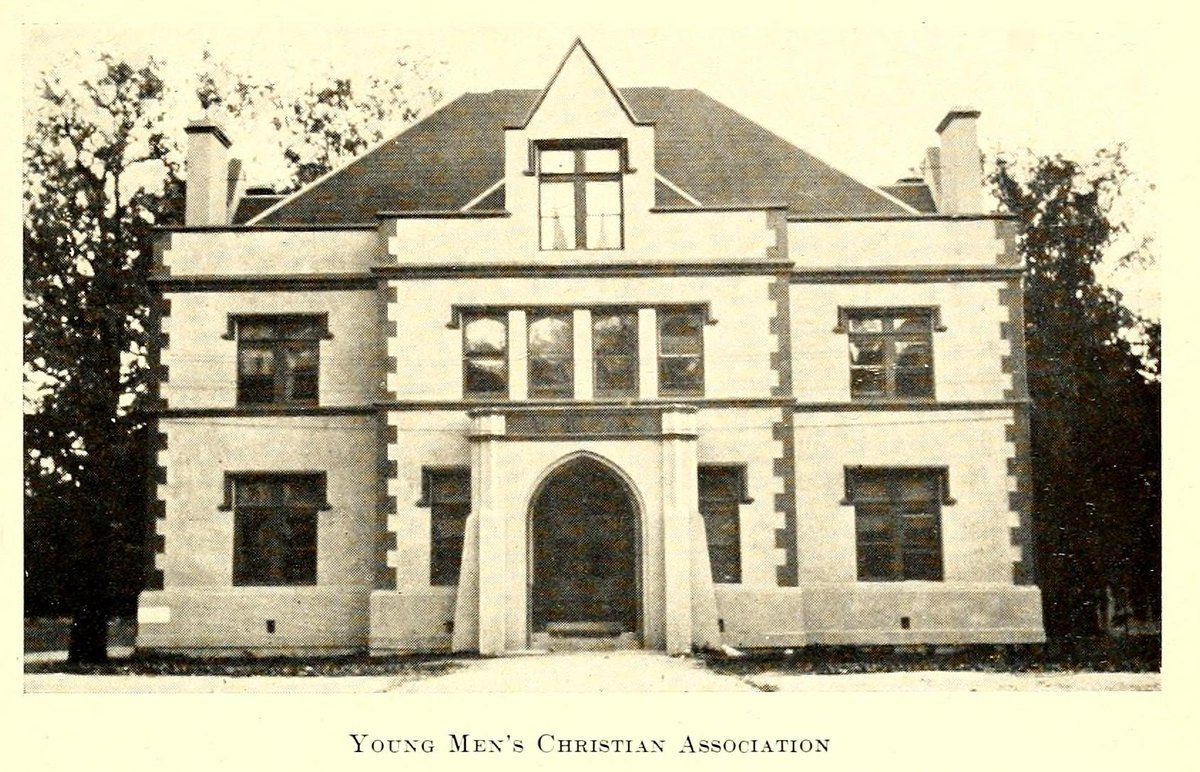
In 1910-11 the university YMCA organized Sunday schools at Calvander, Clark's Chapel, Williams' Chapel, Ephesus, Mount Carmel, Orange Church, Rankin's Chapel and Smith's Level, enrolling 321 pupils. About 1911, asked for help by the young Black workers who cut firewood and carried water in the dormitories, students began teaching them reading and arithmetic in what were called moonlight schools. Under Frank Porter Graham at the campus YMCA those classes grew to take in history, English, writing, debating, home sanitation and the Bible. On November 1, 1915 the University YMCA opened night moonlight schools in six schoolhouses within four miles of Chapel Hill, with 54 student teachers and 40 to 75 adults at each, about 300 in all. Courses ran from reading and writing to arithmetic, history and civil government. Students also ran a night school at Carrboro and two night schools for Black pupils. In the fall of 1916 fifteen students carried on the night schools begun the year before, with an average of 60 at the Carrboro schools and 35 at the schools in the Black settlement. They also organized a Boys' High School Club in Chapel Hill and, for younger boys, the Knights of King Arthur, along Boy Scout lines.
Reading on the places and people in this storyline
No indexed work is about this storyline itself yet. These are about the sites and people its dated events name, those named most often first, so they may discuss the storyline only in part. Follow a link to find a copy or view the material.
Oral history interview with Anne Queen, April 30, 1976 interview G-0049-1, Southern Oral History Program Collection (#4007).
Queen, Anne · 2007 · University Library, UNC-Chapel Hill
Anne Queen (1911-2005), director of the Campus Y at UNC, interviewed by Joseph Herzenberg on April 30, 1976 for the Southern Oral History Program. Queen grew up in Canton, North Carolina, in a working family, finished school in 1930 and spent ten years with Champion Paper and Fibre, where she came to identify with the New Deal Democrats and took an interest in labor. She also discusses Berea College, Yale Divinity School, and student political activity and civil rights work at Chapel Hill. Two hours thirty-eight minutes.
Oral history interview with Anne Queen, November 22, 1976: interview G-0049-2, Southern Oral History Program Collection (#4007)
Queen, Anne · 2007 · University Library, UNC-Chapel Hill
Second of two Southern Oral History Program interviews with Anne Queen (1911-2005), who came to Chapel Hill after years as an industrial worker and went on to direct the Campus YWCA-YMCA, a center of student activism. Recorded November 22, 1976, by Joseph Herzenberg, this hour-long conversation covers how Queen saw politics in the South and the nation change through the mid-twentieth century, and student political activity at UNC. Published online in 2007 by the UNC-Chapel Hill Library in Documenting the American South.
Oral history interview with Daniel H. Pollitt, November 19, 1990: interview L-0048, Southern Oral History Program Collection (#4007)
Pollitt, Daniel H. · 2007 · University Library, UNC-Chapel Hill
Law professor Daniel H. Pollitt remembers Anne Queen (1911-2005), director of UNC's Campus Y, in a Southern Oral History Program interview recorded November 19, 1990, by Cindy Cheatham. Queen's commitment to social justice matched Pollitt's own work for racial equality and support of student activists, and he describes her Campus Y as the place where students concerned with civil rights in segregated Chapel Hill gathered and learned to organize. Published online in 2007 by the UNC-Chapel Hill Library in Documenting the American South.
Oral history interview with William C. Friday, December 18, 1990: interview L-0049, Southern Oral History Program Collection (#4007)
Friday, William C. · 2007 · University Library, UNC-Chapel Hill
William C. Friday, UNC system president from 1957 until 1986, was interviewed by Cindy Cheatham in December 1990 about Anne Queen (1911-2005). Queen came to the campus YWCA as associate director in 1956 and led the merged YMCA-YWCA from 1964 to 1975. Friday recalls working with her through the years of student political activity in Chapel Hill and reflects on the place of the Y in university life. About forty minutes; electronic edition from the UNC library, 2007, through Documenting the American South.
Wider background: Schools & Education · the most widely held histories of the theme this storyline is filed under; they may not discuss it
William Friday
Link, William A. · 1995
Biography of William C. Friday, president of the University of North Carolina system, by historian William A. Link, published by UNC Press in 1995 with the subtitle power, purpose, and American higher education. It covers Friday's career and the history of the university at Chapel Hill and statewide. Part of the Rebecca B. Wall Local History Collection.
The Woman Who Rang the Bell: The Story of Cornelia Spencer Phillips
Russell, Charles Phillips · 1949
Charles Phillips Russell's biography of Cornelia Phillips Spencer (1825-1908), the Chapel Hill writer remembered for ringing the bell of South Building when the university reopened in 1875 after its closure during Reconstruction. It doubles as a history of Chapel Hill and the university. Published by the University of North Carolina Press in 1949, 293 pages with illustrations.
Reviewed in Journal of American History (1949).
Hark the Sound of Tar Heel Voices
Barefoot, Daniel W. · 2008
Daniel W. Barefoot arranges first-hand recollections of the University of North Carolina by decade, from the 'infant university' of the 1790s through the Civil War years when promise turned to despair, the rebuilding of the 1870s, the 'frosh' life of the 1880s, wartime fame in the 1940s, the controversies of the 1960s and the bicentennial of the 1990s. Thomas Wolfe's student years appear among the voices. Published by John F. Blair of Winston-Salem in 2008, 257 pages.
The Story of the Institute of Government, The University of North Carolina at Chapel Hill
Coates, Albert McKinley · 1981
Albert Coates's own account of the Institute of Government at the University of North Carolina, which he founded, subtitled 'out of a classroom in Chapel Hill' and published in 1981. The 303 pages trace the institute's history and its role in educating North Carolina's public officials.
Blood on the Old Well
Emery, Sarah Watson · 1963
Sarah Watson Emery's 1963 book on the University of North Carolina, concerned with communism on the Chapel Hill campus and with academic freedom in 1960 and 1961. Published by Prospect House in Dallas, 240 pages with illustrations.
Horace Williams
Winston, Sr., Robert Watson · 1942 · The University of North Carolina press
Robert Watson Winston's biography of Henry Horace Williams (1858-1940), who taught philosophy at the University of North Carolina for half a century, subtitled gadfly of Chapel Hill. Published by the University of North Carolina Press in 1942, 309 pages with frontispiece and portraits; this copy is autographed. Topics include educators in Chapel Hill and the university's history.
Reviewed in Social Forces (1943).
Show 6 more
To Drink from the Well: The Struggle for Racial Equality at the Nation’s Oldest University
Kapur, Geeta · 2021
Geeta Kapur's history of race at the University of North Carolina at Chapel Hill, from the enslaved labor that built the campus through desegregation and the Black student protests that followed. Twelve chapters, with a foreword by William Barber II, move from the founding era and the Great Depression controversies to the state's response to integration and the turmoil of later decades; North Carolina Central University also figures. Published 2021 by Blair in Durham.
Communists on Campus
Billingsley, William J. · 1999 · University of Georgia Press
William J. Billingsley's history of the Speaker Ban Law, the 1963 North Carolina statute that barred known Communists from speaking on state campuses, and the fight over it at the University of North Carolina in Chapel Hill. The subtitle sets the scope: race, politics and the public university in sixties North Carolina. It treats academic freedom, anti-communist movements and free speech in the state. University of Georgia Press, 1999, 308 pages with eight pages of plates.
Reviewed in Academe (2000), The American Historical Review (2001), The Journal of Southern History (2001), Journal of American History (2001), The Journal of Politics (2001).
Frank Porter Graham and the 1950 Senate Race in North Carolina
Pleasants, Julian M.; Burns, Augustus M., III · 1990 · UNC Press
Julian M. Pleasants and Augustus M. Burns III on the 1950 Democratic Senate primary in North Carolina, in which Frank Porter Graham, the former president of the University of North Carolina, lost to Willis Smith after a campaign marked by race-baiting. Primaries, elections and race relations in the state are its subjects. Published by UNC Press in 1990, 356 pages with illustrations.
Reviewed in Choice Reviews Online (1991), The American Historical Review (1991), Journal of American History (1991), The Journal of Southern History (1992).
Francis Preston Venable of the University of North Carolina
Bursey, Maurice M. · 1989 · Chapel Hill Historical Society
Maurice M. Bursey's biography of Francis Preston Venable (1856 to 1934), chemist and president of the University of North Carolina, published by the Chapel Hill Historical Society in 1989. It also covers the history of the university's chemistry department. Illustrated, 111 pages, with bibliographies.
Reviewed in Isis (1992).
Old Days in Chapel Hill
Chamberlain, G. Hope Summerell · 1926
Hope Summerell Chamberlain's life and letters of Cornelia Phillips Spencer (1825 to 1908), published in 1926, which doubles as a picture of Chapel Hill and the university in the nineteenth century. It runs 325 pages with illustrations and portraits.
Fire and Stone: The Making of the University of North Carolina under Presidents Edward Kidder Graham and Harry Woodburn Chase
Covington, Jr., Howard E. · 2018
Howard E. Covington Jr.'s history of how the University of North Carolina took shape under Presidents Edward Kidder Graham (1876 to 1918) and Harry Woodburn Chase (1883 to 1955), published by the University Library in 2018. The 528-page account covers campus history in the early twentieth century and includes portraits.
Reviewed in The Journal of Southern History (2020).
NC Digital Collections record courtesy of the North Carolina Department of Natural and Cultural Resources.