Skip to content

Storyline

The Regulator crisis, 1766–1771

Orange County’s backcountry uprising against courthouse corruption, from Maddock’s Mill to the Hillsborough riot and the 1771 executions.

Orange County farmers organized in 1766 against high fees, taxes and dishonest county officers, calling a meeting at Maddock's Mill that October. Protest turned violent at the Hillsborough court in September 1770 and ended with the Regulators' defeat at Alamance on May 16, 1771 and the hanging of six at Hillsborough on June 19.

Read the 137 eventsAll storylines

226 works about The Regulator crisis, 1766–1771 are indexed here. 5 held at OCPL →

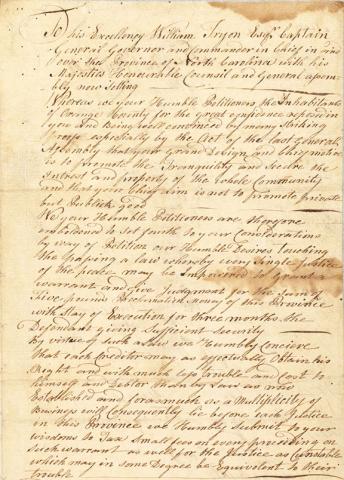
Petition of Orange County to Governor Tryon, 1768

In the chronology

Episodes in this history, in date order. Each has its own page.

Other events in this storyline, in date order. See these 137 dated events in the chronology →

  1. Edmund Fanning settles in Hillsborough Fanning, a New York-born Yale graduate, came to Hillsborough and soon became register of deeds for Orange County, the office whose fees made him the Regulators' chief target. People: Edmund Fanning Place: HillsboroughM. C. S. Noble (University of North Carolina Bureau of Extension), The Teaching of County Geography (1915), scan p. 35 · Also: Internet Archive
  2. Thomas Hart is appointed sheriff of Orange County Governor Arthur Dobbs appointed Thomas Hart sheriff of Orange County in 1763, and he served two years. His father-in-law, John Gray, had held the office before him. As collector of taxes Hart became unpopular with the Regulators, though Stokes found no charge that he abused any of them in collecting. People: Thomas Hart, Arthur Dobbs, John Gray Place: Orange CountyInternet Archive: Durward T. Stokes, "Thomas Hart in North Carolina", North Carolina Historical Review 41 (1964), p. 326
  3. Edmund Fanning qualifies as register of Orange County Fanning, a lawyer who came to the county town in 1762, qualified as register in March 1763. He went on to buy several town lots and build a large house on the later site of the Masonic Lodge. People: Edmund Fanning Place: HillsboroughNash, Hillsboro, Colonial and Revolutionary (1903), p. 6
  4. The Assembly passes a bill excusing Thomas Hart and others from paying taxes On November 20, 1764, the Assembly passed a bill excusing Thomas Hart, then sheriff of Orange, and others from paying taxes, which the Regulators did not forget. Eli Caruthers later recorded the Regulators' story that Edmund Fanning, who owed his seat to Hart, carried a bill giving Hart a thousand pounds for losses as sheriff that he never suffered. People: Thomas Hart, Edmund Fanning Place: Orange CountyInternet Archive: Durward T. Stokes, "Thomas Hart in North Carolina", North Carolina Historical Review 41 (1964), p. 327
  5. A deputy sheriff takes John McVay's deer skins for one levy John McVay of Orange County swore in May 1768 that in 1765 a sub-sheriff, Charles Appa Crumby, came to his house and carried off eight prime deer skins worth four to five pounds for a single levy of ten or twelve shillings, and would not let him redeem them the next day though he brought the money and the distress fee. Place: Orange County · Also named: John McVay, Charles Appa CrumbyInternet Archive: Hermon Husband, A Continuation of the Impartial Relation (1770), ed. Archibald Henderson, North Carolina Historical Review 18 (1941), p. 77
  6. Edmund Fanning drags John Pyle from his horse in a Hillsborough street According to Philip Jackson, as John Pyle swore in 1770, after Fanning's militiamen had been in town under arms over the Stamp Act, Fanning received a letter advising him to lay down his commission or keep his men from opposing the King's laws. Judging Pyle the author, Fanning stopped him in the street, seized his bridle and pulled him head first off his horse, and Pyle afterward paid some costs in the affair. People: Edmund Fanning Place: Hillsborough · Also named: John Pyle, Philip JacksonInternet Archive: Hermon Husband, A Continuation of the Impartial Relation (1770), ed. Archibald Henderson, North Carolina Historical Review 18 (1941), p. 70
  7. The Granville District land office is closed The office that granted land across Orange County for the Granville proprietary stayed shut from about 1765. Governor Tryon wrote in 1770 that it had been closed for more than five years and that newcomers to Rowan and Orange, finding no land to buy, settled on vacant land, which fed their discontent. Place: Orange CountySearch the index · Colonial and State Records of North Carolina, vol. 8, p. 195: Letter from William Tryon to the Earl of Hillsborough, April 12, 1770 · Also: Lefler and Wager, Orange County, 1752-1952
  8. The Assembly finds Sheriff Thomas Hart's tax account short and orders the omitted poll tax collected Hart had not collected the poll tax, and on May 10, 1765, the Assembly at Wilmington found his account short through error. On May 15 it passed a bill requiring the omitted poll tax to be collected. Hart settled with the colony, and in 1770 a petition of 174 Orange inhabitants to Chief Justice Martin Howard against fees called him the only sheriff that ever settled. People: Thomas Hart, Martin Howard Place: Orange CountyInternet Archive: Durward T. Stokes, "Thomas Hart in North Carolina", North Carolina Historical Review 41 (1964), p. 327
  9. A Deep River meeting drafts Regulator Advertisement Number Two Meeting in Herman Husband's neighborhood, settlers wrote a second paper and chose William Cox and William Masset to attend the Maddock's Mill meeting on October 10. It asked the county's assemblymen, vestrymen and officers to come and answer their questions. People: Herman Husband Place: Deep River · Also named: William Cox, William MassetLefler and Wager, Orange County, 1752-1952 (1953), p. 30
  10. The Regulator movement organizes in Orange County Orange County farmers first organized in 1766 to question county officers about taxes and fees, a Sandy Creek effort that Herman Husband led and that lapsed in 1767. In early 1768 a new association, soon called the Regulation, pledged to pay no taxes or fees beyond what the law allowed. People: Herman Husband, Edmund Fanning, William Tryon Place: Countywide · Also mentions: Sandy CreekColonial and State Records of North Carolina, vol. 7, pp. 671-672: Regulators' Advertisement No. 4
  11. Orange County's first Regulator paper invokes the Stamp Act resistance An Orange County notice of August 1766, later called Regulators' Advertisement No. 1, praised the Sons of Liberty for resisting the Stamp Act and asked each neighborhood to send men to a meeting at Maddock's Mill to question local officers. Place: HillsboroughSearch the index · Colonial and State Records of North Carolina, vol. 7, pp. 249-250: Regulators' Advertisement No. 1
  12. Farmers met at Maddock’s Mill to press the county’s officers to account for fees and taxes Delegates from Orange County neighborhoods met at Maddock's Mill to ask their assemblymen and vestrymen how public money was spent. The officers refused to attend, and the meeting resolved that such conferences between voters and their representatives should be held every year. Place: CountywideColonial and State Records of North Carolina, vol. 7, pp. 251-252: Regulators' Advertisement No. 3
Show all 137 dated events
  1. James Watson brings Edmund Fanning's answer to the Regulators' meeting at Maddock's Mill When none of the county's officers came to the meeting, Watson arrived alone late in the day with word from Fanning that he considered it an insurrection. The delegates drew up Regulator Advertisement Number Three in his presence; Watson called it just and reasonable and promised to give copies to the county officials. People: James Watson, Edmund Fanning Place: Orange CountySearch the index · Lefler and Wager, Orange County, 1752-1952 (1953), pp. 30-31 · Also: Colonial and State Records of North Carolina 7:251-252, Regulators' Advertisement No. 3, minutes of the meeting of October 10, 1766
  2. Edmund Fanning tells the November court he has answered the farmers' complaints Speaking for the county officers, Fanning rejected the protest and reported that he had written its organizers a reply he expected to end the matter. People: Edmund Fanning Place: HillsboroughLefler and Wager, Orange County, 1752-1952 (1953), p. 31
  3. Sandy Creek men challenge the register's deed fees in the Orange County court Using a copy of the province's revised laws bought jointly by two men, one of them a county justice, two Sandy Creek men copied the lawful fees for registering deeds and objected in court to what they were charged. Threatened with arrest for contempt, they gave up, and the justice who half owned the book was soon put out of his commission. Place: Hillsborough · Also mentions: Sandy CreekInternet Archive: Bassett, The Regulators of North Carolina (1765-1771) (1896), p. 163
  4. Clerk Francis Nash is cleared of charging illegal fees In the first Regulator complaints against Orange County officials in 1768, the clerk Francis Nash was accused of taking illegal fees. He was exonerated. People: Francis Nash Place: HillsboroughSearch the index · NCpedia: Nash, Francis
  5. Deputy attorney general John Williams signs the order jailing Herman Husband and William Butler Appointed deputy attorney general for the Hillsborough district in 1768, Williams signed the order that sent the Regulator leaders Husband and Butler to jail after the April disturbance in Hillsborough. NCpedia suggests this is why the rioters beat him in 1770. People: John Williams, Herman Husband, William Butler (Regulator) Place: HillsboroughSearch the index · NCpedia: Williams, John (Marion M. Edmonds, 1996)
  6. George Micklejohn carries messages between the Regulators and the authorities During the 1768 unrest the Hillsborough rector acted several times as a courier between the Regulators and the authorities, seeking a peaceful settlement. The Regulators called him "our Rector." People: George Micklejohn Place: HillsboroughSearch the index · NCpedia: Micklejohn, George (Dictionary of North Carolina Biography)
  7. Orange farmers swear scores of depositions against county officers They accused Sheriff William Nunn and his deputies of seizing deer skins, livestock, a gun and cloth, and one man swore he had paid clerk Francis Nash for letters of administration he never received. People: Francis Nash, William Nunn Place: Orange CountyLefler and Wager, Orange County, 1752-1952 (1953), p. 33
  8. Regulator William Butler serves as an Orange County tax collector and deputy sheriff William Butler, a farmer living near Sandy Creek, was appointed a county tax collector in Orange County in 1768 and a deputy sheriff in 1770, in the same years he emerged as a principal leader of the Regulators. People: William Butler (Regulator) Place: Orange County · Also mentions: Sandy CreekSearch the index · NCpedia: Butler, William
  9. The governor's Council thanks Edmund Fanning and his men for their conduct against the Regulators After Tryon read the Council his cold reply to the Regulators' petition, which forbade further meetings and told them to let the taxes be collected, Fanning was called into the room and formally thanked with his men for their behavior in the recent troubles. People: Edmund Fanning, William Tryon Place: New Bern or Brunswick (Council)Internet Archive: Bassett, The Regulators of North Carolina (1765-1771) (1896), p. 171
  10. Sheriff Tyree Harris advertises his tax collection and a charge on late payers Under a new act requiring sheriffs to sit at five places in each county between January 1 and March 1 to receive taxes, Orange sheriff Tyree Harris posted notice that anyone who did not pay at those times and places would owe him two shillings eightpence extra, even if the money was ready when his deputy called. Husband called the notice insulting and said it helped stir up the "Mob" that became the Regulators. People: Tyree Harris Place: Orange CountyInternet Archive: Hermon Husband, An Impartial Relation (1770), ed. William K. Boyd, North Carolina Historical Review 3 (1926), p. 234
  11. Settlers west of the Haw River call Orange County's representatives and vestry to a settlement at the courthouse Inhabitants on the west side of the Haw River addressed Orange County's Assembly men and vestrymen, asking them to fix a day before the next court to meet at the courthouse and settle accounts of taxes and officers' fees, and declaring they would pay no more taxes until they had a full settlement. Place: Orange CountyDocumenting the American South, Colonial and State Records: Regulators' Advertisement No. 5, address from inhabitants near Haw River to the Orange County Vestry and General Assembly representatives, March 22, 1768
  12. Orange farmers draw up Regulator Advertisement Number Four At their second meeting, on April 4, 1768, the Regulators adopted the paper known as Advertisement Number Four, setting out the members' pledges on taxes and officers' fees, attendance at meetings, shared costs and majority rule. The first meeting's paper, Number Five in Husband's numbering, is dated March 22, 1768. Place: Orange CountyLefler and Wager, Orange County, 1752-1952 (1953), p. 31 · Also: Internet Archive: Hermon Husband, An Impartial Relation
  13. Regulators ask Orange County's late sheriff and a vestryman to bring the tax accounts Meeting again, the Regulators asked the former sheriff and a vestryman to meet their committee with lists of taxables, insolvents and public spending, and asked the county's assemblymen to come and show the law for the fees charged on deeds. Two men were chosen to carry the request, but the seizure of a Regulator's mare days later overtook it. Place: Orange CountyInternet Archive: Bassett, The Regulators of North Carolina (1765-1771) (1896), p. 166
  14. Regulators rescue a seized horse at Hillsborough After the sheriff seized a Regulator's horse for an unpaid levy, Regulators rode into Hillsborough, took the horse back and fired shots into the roof of Edmund Fanning's house; John Gray's letter to Fanning put them at about 100, Husband's Impartial Relation at sixty or seventy. Officials sought the arrest of William Butler, Peter Craven and Ninian Bell Hamilton as ringleaders. People: Herman Husband, Edmund Fanning, Peter Craven, William Butler (Regulator) Place: Hillsborough · Also named: John Gray, Ninian Bell HamiltonColonial and State Records of North Carolina, vol. 7, pp. 705-706: Letter from John Gray to Edmund Fanning, April 9, 1768 · Also: Internet Archive: Hermon Husband, An Impartial Relation
  15. Tenants on Samuel Strudwick's Haw Fields land meet to keep possession by force Francis Nash reported to Edmund Fanning that Strudwick's tenants had formed an association to hold his lands against him and had met in the Haw Fields the day before he wrote. People: Francis Nash, Edmund Fanning, Samuel Strudwick Place: Haw Old Fields (Hawfields)Nash, Hillsboro, Colonial and Revolutionary (1903), p. 96
  16. Thomas Hart and Francis Nash tell Fanning they cannot raise the troops he ordered Edmund Fanning, away at Halifax, had ordered Captain Thomas Hart to raise 500 men for the defense of the county. On April 17, 1768, Hart and Francis Nash wrote back that they could not raise them, that feeling against Fanning ran high, and that Strudwick's tenants were meeting in revolt at the Haw Fields. Fanning passed their report to Governor Tryon on April 23, and it was read in council at Wilmington four days later. People: Thomas Hart, Francis Nash, Edmund Fanning, William Tryon Place: HillsboroughInternet Archive: Durward T. Stokes, "Thomas Hart in North Carolina", North Carolina Historical Review 41 (1964), p. 328
  17. Edmund Fanning writes Governor Tryon that Orange is in revolt Two weeks after Regulators rescued a seized horse at Hillsborough, Fanning reported people across the county binding themselves by oath to refuse taxes, and said he and other officers expected an attack. People: Edmund Fanning, William Tryon, Thomas Lloyd (died 1792), Thomas Hart, Francis Nash, James Thackston, John Gray Place: HillsboroughLefler and Wager, Orange County, 1752-1952 (1953), p. 31
  18. Tryon orders the Regulators home and puts seven counties' militia on alert Answering Fanning, the governor issued one proclamation to the people and another to militia officers in Bute, Halifax, Granville, Rowan, Mecklenburg, Cumberland and Johnston counties to stand ready to march to his aid. People: William Tryon, Edmund Fanning Place: Orange CountyLefler and Wager, Orange County, 1752-1952 (1953), p. 32
  19. A general Regulator meeting agrees to send twelve men to meet county officials at Thomas Lindley's The meeting agreed to send twelve men and then named thirteen, among them Herman Husband, James Hunter and Rednap Howell, to gather at Lindley's on May 11 in hope of meeting representatives of the officers. The arrests of Husband and William Butler broke up the plan. People: Herman Husband, William Butler (Regulator), Rednap Howell, James Hunter Place: Thomas Lindley's · Also named: Thomas LindleyColonial and State Records of North Carolina, vol. 7, pp. 731-732: Regulators' Advertisement No. 8, minutes of the meeting of April 30, 1768 · Also: Lefler and Wager, Orange County, 1752-1952
  20. More than 400 Orange County inhabitants sign a petition to the governor and council At the April 30 meeting the Regulators drew up a petition to the governor and council in the name of the inhabitants of Orange County, to be held back unless the officers failed to settle. Herman Husband, not yet a Regulator, was among more than 400 signers. People: Herman Husband Place: Orange CountyInternet Archive: Bassett, The Regulators of North Carolina (1765-1771) (1896), p. 169
  21. The governor's secretary posts Tryon's proclamation at Hillsborough On the day the Regulators met to choose their delegates, Governor Tryon's secretary Edwards reached Hillsborough and put up the governor's proclamation against the disturbances. Fanning set out for Sandy Creek with an armed party the next day. People: Edmund Fanning, Isaac Edwards Place: Hillsborough · Also mentions: Sandy CreekInternet Archive: Bassett, The Regulators of North Carolina (1765-1771) (1896), p. 169
  22. Orange militia is called out against the Regulators, and only 120 armed men appear With Edmund Fanning away at the Halifax court, Lieutenant Colonel Gray reported the Hillsborough horse rescue and was ordered to raise seven militia companies. Only 120 men came with arms, and the officers judged that no more than 150 men in the county could be relied on, so they agreed to a truce and named three men to meet the Regulator leaders on April 20. People: Edmund Fanning Place: Hillsborough · Also named: Lieutenant Colonel GrayInternet Archive: Bassett, The Regulators of North Carolina (1765-1771) (1896), p. 166
  23. Regulators confront officials at Hillsborough Edmund Fanning and 27 armed men arrested Herman Husband and William Butler at Sandy Creek on May 2, 1768. The next day hundreds of Regulators and neighbors marched on Hillsborough; officials released the prisoners, and the governor's secretary read a proclamation promising to hear their grievances, after which the crowd dispersed. People: Herman Husband, William Butler (Regulator), Edmund Fanning Place: Hillsborough · Also mentions: Sandy CreekColonial and State Records of North Carolina, vol. 7, pp. 759-766: Regulators' Advertisement No. 11
  24. Regulators at George Sally's resolve to settle their disputes by arbitration According to Husband, the meeting at George Sally's resolved that if the governor would not help them, they would stay out of the courts altogether and leave their differences to arbitration rather than riot, and passed round a subscription paper for it. Rednap Howell carried the paper to Brunswick, where Tryon read it, grew angry and ordered him to burn it. People: Rednap Howell, William Tryon, Herman Husband Place: George Sally's, Orange County; BrunswickInternet Archive: Hermon Husband, An Impartial Relation (1770), ed. William K. Boyd, North Carolina Historical Review 3 (1926), p. 304
  25. Regulators meeting at George Sally's appoint a committee of eight to petition Governor Tryon Having agreed after the May confrontation to submit their case to the governor, the Regulators met at George Sally's in Orange County, declared their loyalty to King George and named William Moffitt, William Cox, Harmon Cox, John Low, John Marshall, James Hunter, Rednap Howell and George Hendry to gather the complaints into a petition and to implore the governor's pardon in the most submissive manner. People: James Hunter, Rednap Howell Place: Orange County · Also named: William Moffitt, William Cox, Harmon Cox, John Low, John Marshall, George HendryDocumenting the American South, Colonial and State Records: Regulators' Advertisement No. 10, minutes of a meeting of the Regulators, May 21, 1768
  26. Orange Regulators send their papers to the Regulators of Anson County Asked by the Anson County Regulators how to organize, the Orange Regulators sent them a copy of their May 21 proceedings, to keep them from running into errors, and promised more papers. Bassett thinks this advice helped turn the Anson movement toward petitioning that August. Place: Orange CountyInternet Archive: Bassett, The Regulators of North Carolina (1765-1771) (1896), p. 173
  27. Ralph McNair presses Herman Husband to adopt a petition written by the officers After the May confrontation at Hillsborough, the county officers sent Husband, through Ralph McNair, a petition of their own drafting in which the Regulators would call their conduct illegal and withdraw their charges. McNair warned that Fanning would report the case to Tryon as treason if it was refused, and the Regulators instead named their own committee to lay their papers before the governor. People: Herman Husband, Edmund Fanning, Ralph McNair Place: Orange CountyInternet Archive: Bassett, The Regulators of North Carolina (1765-1771) (1896), p. 170
  28. James Hunter and Rednap Howell present the Regulators' petition to Tryon at Brunswick The petition, Advertisement Number Nine, carried 474 names, 31 of them written in German. Tryon told the Regulators to give up their name and pay their taxes, but he also warned officers against excess fees and had the lawful fees published. People: James Hunter, William Tryon, Rednap Howell Place: BrunswickLefler and Wager, Orange County, 1752-1952 (1953), p. 34
  29. Governor Tryon arrives at Hillsborough and stays into August Tryon came to Hillsborough in early July 1768 and stayed until mid-August, hoping the county would submit, while the Regulators went on refusing their taxes. He left for Salisbury on August 17. People: William Tryon Place: HillsboroughInternet Archive: Bassett, The Regulators of North Carolina (1765-1771) (1896), p. 174
  30. Regulators hear the governor's letter from the sheriff and resolve to petition the Assembly At a Regulator meeting called to answer Tryon's reply, the Orange sheriff read a letter and proclamation telling them to submit to tax collection. The sheriff and his deputy swore the crowd refused and threatened them; Husband said the people only told the sheriff they would take the matter to the Assembly, and the meeting sent Tryon an answer saying so. People: Herman Husband Place: Orange CountyInternet Archive: Bassett, The Regulators of North Carolina (1765-1771) (1896), p. 174 · Also: Internet Archive: Hermon Husband, An Impartial Relation
  31. Justice James Thackston reports William Butler vowing not to pay the palace tax Thackston told former sheriff Tyree Harris that Butler said the Regulators would pay nothing toward the governor's house at New Bern for three years, and that some two hundred Regulators had threatened anyone who seized their goods. People: William Butler (Regulator), James Thackston, Tyree Harris Place: Orange CountyLefler and Wager, Orange County, 1752-1952 (1953), p. 29
  32. James Hunter and John Low deliver a Regulator letter to Governor Tryon at Hillsborough Hunter and John Low waited on Governor Tryon at Hillsborough with a letter from the Regulators. Tryon told them he would answer it on August 17, after consulting his Council. People: James Hunter, William Tryon Place: Hillsborough · Also named: John LowSearch the index · Documenting the American South: Colonial and State Records of North Carolina, Journal of William Tryon's journey to Hillsborough (Jun 20 to Oct 2, 1768)
  33. Eight Regulator leaders meet Governor Tryon at Hillsborough and are refused a committee to examine the county's taxes A week after their letter was delivered, eight principal Regulators met Tryon in Hillsborough and asked that their grievances be settled by a committee reviewing the county's tax accounts. Tryon refused, telling them the law was the only channel for redress, and the next day sent a letter to the inhabitants south of the Haw. People: William Tryon Place: HillsboroughDocumenting the American South, Colonial and State Records: Journal of William Tryon's journey to Hillsborough, including orders to the militia, June 20 to October 2, 1768
  34. Sheriff John Lea brings the Regulators Tryon's demand for a 1,000 pound bond On the day set for settling accounts, the former sheriff stayed away and the new sheriff, John Lea, brought a severe letter from Tryon, endorsed by three councillors at Hillsborough. It demanded that twelve leading Regulators meet him at Salisbury by August 25 and give a 1,000 pound bond that no one would try to rescue Butler and Husband at the September court; Tryon left for Salisbury the same day. People: William Tryon, William Butler (Regulator), Herman Husband Place: Orange County · Also named: John LeaInternet Archive: Bassett, The Regulators of North Carolina (1765-1771) (1896), p. 175
  35. An Orange militia neighborhood resolves not to march against the Regulators Warned out to go against the Regulators as enemies, men of one Orange County neighborhood met and put in writing that they took the Regulators for loyal subjects acting for the good of the country, would not go against them until they were proved enemies, and would oppose any fine for not appearing and appeal to the governor. Place: Orange CountyInternet Archive: Hermon Husband, An Impartial Relation (1770), ed. William K. Boyd, North Carolina Historical Review 3 (1926), p. 253
  36. Regulators refuse to give Tryon the bond he demanded Two days after Lea delivered the demand, the Regulators answered that their peaceable leaders could restrain the rest only if they stayed free of such a bond, and that they had never meant to rescue the prisoners, only to ask the governor to dissolve the Assembly. Place: Orange CountyInternet Archive: Bassett, The Regulators of North Carolina (1765-1771) (1896), p. 175
  37. Presbyterian ministers, among them Henry Pattillo of Orange, write against the Regulation While Tryon toured Rowan and Mecklenburg to raise troops, Presbyterian ministers Hugh McAden, James Creswell, Henry Pattillo and David Caldwell sent him a letter of loyalty condemning the Regulators, and the pastors also wrote to the colony's Presbyterians telling them to keep out of the movement. The letter was read to the Rowan militia and helped raise volunteers for the march on Hillsborough. People: Henry Pattillo, David Caldwell, William Tryon, Hugh McAden Place: Rowan and Mecklenburg counties · Also named: James CreswellInternet Archive: Bassett, The Regulators of North Carolina (1765-1771) (1896), p. 176
  38. Tryon musters about 400 militia at Hillsborough and swears them to allegiance When the town was thought to be in danger, Tryon called out the militia but could gather only about 400 men, to whom he gave an oath of allegiance to the King and the provincial government before sending them home. People: William Tryon Place: HillsboroughInternet Archive: Bassett, The Regulators of North Carolina (1765-1771) (1896), p. 175
  39. Tryon's army gathers at Hillsborough to guard the superior court Tryon reached Hillsborough on September 19 with 195 Rowan and 310 Mecklenburg volunteers, and two days later 699 Orange and 120 Granville militia joined them. With gentlemen volunteers, artillery and officers the force came to 1,461 men, a quarter of the Assembly among its officers. People: William Tryon, Edmund Fanning, Thomas Lloyd (died 1792), Thomas Hart Place: HillsboroughInternet Archive: Bassett, The Regulators of North Carolina (1765-1771) (1896), p. 177
  40. At the Hillsborough camp, Robert Palmer is named one of six lieutenants general Palmer, whom Governor Tryon had made adjutant general of the militia marching on Hillsborough, was named a lieutenant general of the army in orders issued at the Hillsborough camp on September 20, 1768. The same orders posted a town guard of a hundred men, with the court house and market house as guard rooms. People: Robert Palmer, William Tryon, John Rutherford, John Sampson, Benjamin Heron, Samuel Strudwick, John Ashe Place: HillsboroughSearch the index · Documenting the American South, Colonial and State Records: Journal of William Tryon's journey to Hillsborough, including orders to the militia, June 20 to October 2, 1768
  41. Chief Justice Martin Howard and two associate justices hold the Hillsborough superior court term Martin Howard, Maurice Moore and Richard Henderson sat at the Hillsborough District Superior Court term in which Edmund Fanning was found guilty and Regulators including William Butler were tried. People: Martin Howard, Maurice Moore, Richard Henderson, Edmund Fanning, William Butler (Regulator), Herman Husband Place: HillsboroughSearch the index · Documenting the American South, Colonial and State Records: Minutes of the Hillsborough District Superior Court, September 22 to October 1, 1768
  42. Regulators gather within a mile of Hillsborough, face Tryon's militia and disperse With the superior court sitting under guard of more than a thousand militia, armed Regulators appeared within a mile of Hillsborough on September 22: upwards of eight hundred by Tryon's journal, about 3,700 by Husband's Impartial Relation. A council of war set terms: surrender nine leaders, lay down arms and promise to pay taxes. The Regulators asked for the night to answer and by the next morning had dispersed, about thirty coming in to give up their arms. People: William Tryon, Griffith Rutherford Place: HillsboroughDocumenting the American South, Colonial and State Records: Journal of William Tryon's journey to Hillsborough, including orders to the militia, June 20 to October 2, 1768 · Also: Internet Archive: Hermon Husband, An Impartial Relation
  43. Tryon sends troops out to arrest the Regulator leaders The day after the Regulators dispersed, Tryon sent a body of troops to seize the men he most wanted. Some gave themselves up and others resisted, but all who were taken were soon let go because no true bill could be found against them. People: William Tryon Place: Orange CountyInternet Archive: Bassett, The Regulators of North Carolina (1765-1771) (1896), p. 179
  44. Tryon hands John Rutherford command of the army at Hillsborough Made a lieutenant general on September 20 to lead the right wing, the Orange Brigade, Rutherford took command of the whole army at the Hillsborough camp when Tryon's illness worsened, and ordered the next day's sermons to the troops. People: John Rutherford, William Tryon Place: HillsboroughSearch the index · Colonial and State Records of North Carolina, vol. 7, pp. 831-834: Journal of William Tryon's journey to Hillsborough, June 20 to October 2, 1768
  45. George Micklejohn preaches to Tryon's militia at Hillsborough Before Governor Tryon and the troops raised against the Regulators, Micklejohn preached on the important duty of subjection to the civil powers. Tryon had the sermon printed and distributed, and it cost Micklejohn favour with opponents of royal authority. People: George Micklejohn, William Tryon Place: HillsboroughSearch the index · NCpedia: Micklejohn, George (Dictionary of North Carolina Biography)
  46. A Hillsborough jury finds Edmund Fanning guilty on an indictment In the same superior court term that tried the Regulator leaders, the King's indictment against Edmund Fanning went to a jury on September 27, which found him guilty. The day before, Herman Husband had surrendered William Butler to the court, and both men entered 500 pound bonds to abide its sentence. People: Edmund Fanning, Herman Husband, William Butler (Regulator), Richard Henderson, Maurice Moore, Martin Howard Place: HillsboroughDocumenting the American South, Colonial and State Records: Minutes of the Hillsborough District Superior Court, September 22 to October 1, 1768
  47. The last of Tryon's militia leave Hillsborough The troops stayed in town through the court term, began to be discharged on September 28, and the last detachment marched away on October 2. The expedition cost the province 4,844 pounds. People: William Tryon Place: HillsboroughInternet Archive: Bassett, The Regulators of North Carolina (1765-1771) (1896), p. 179
  48. Grand jury indictments for rout against James Hunter are quashed at the Hillsborough superior court The grand jury returned three indictments for rout naming James Hunter with William Butler, Ninian Hamilton and other Regulators. The court quashed all three for an irregular return and ordered the attorney general to prepare new bills. People: James Hunter, William Butler (Regulator), Richard Henderson, Maurice Moore, Martin Howard, Peter Craven Place: Hillsborough · Also named: Ninian HamiltonSearch the index · Documenting the American South: Colonial and State Records of North Carolina, Minutes of the Hillsborough District Superior Court (Sep 22 to Oct 1, 1768)
  49. Edmund Fanning orders John Pyle out of Hillsborough before the superior court A few days before the September 1768 court, John Pyle came to town to hire a lawyer for Herman Husband. By his sworn account he was surrounded in the street by soldiers, then accused by Fanning of planning to burn the town, and ordered out; he left without paying his reckoning. John Wilcox, the Cross Creek storekeeper who had persuaded Husband to stand trial, wrote on September 23 that he too had been ordered out of town. People: Edmund Fanning, Herman Husband Place: Hillsborough · Also named: John Pyle, John WilcoxInternet Archive: Hermon Husband, A Continuation of the Impartial Relation (1770), ed. Archibald Henderson, North Carolina Historical Review 18 (1941), p. 70
  50. Edmund Fanning resigns as register of Orange County after his conviction Found guilty at the September court on five counts of taking excess fees for registering deeds, and fined a penny on each, Fanning at once gave up the office of register. People: Edmund Fanning Place: HillsboroughInternet Archive: Bassett, The Regulators of North Carolina (1765-1771) (1896), p. 181
  51. Henry Pattillo preaches to Tryon's troops at Hillsborough While the militia were quartered in Hillsborough, the Presbyterian minister Henry Pattillo preached to them and was publicly thanked. The German minister Suther was ordered to preach to the German troops as well. People: Henry Pattillo Place: Hillsborough · Also named: SutherSearch the index · Internet Archive: Bassett, The Regulators of North Carolina (1765-1771) (1896), p. 180
  52. Herman Husband is jailed in Hillsborough's new stockaded prison during the superior court By Husband's account, soldiers in town for the court harried him with bayonets and once stood him on a tavern table to jeer at him until Colonel John Ashe pulled them off. When the court sat on the Monday, Fanning charged him with new crimes touching his life and he was committed to a newly built, higher prison fortified all round, crowded with nine or ten prisoners, most of them Regulators, under a gallows-like beam. He and William Butler were bailed that night. People: Herman Husband, William Butler (Regulator), Edmund Fanning, John Ashe Place: Hillsborough jailInternet Archive: Hermon Husband, An Impartial Relation (1770), ed. William K. Boyd, North Carolina Historical Review 3 (1926), p. 261
  53. Samuel Devinney and John Philip Hartzo are convicted over the horse rescue Each was fined 25 pounds and given three months in jail, but Tryon soon freed the prisoners and put off collecting their fines for three months. People: William Tryon, Samuel Devinney Place: Hillsborough · Also named: John Phillip HartzoLefler and Wager, Orange County, 1752-1952 (1953), p. 35
  54. William Butler is convicted of riot at the Hillsborough superior court With Governor Tryon's militia in Hillsborough for the September 1768 term, the superior court tried the Regulator cases. Herman Husband was acquitted; William Butler was found guilty on two counts and sentenced to a fine of 50 pounds and six months in prison, but Tryon released him and suspended the fines. People: William Butler (Regulator), Herman Husband, William Tryon, Samuel Devinney Place: HillsboroughSearch the index · Documenting the American South: John Spencer Bassett, The Regulators of North Carolina (1765-1771)
  55. William Few and John Butler stand surety for the Regulator William Butler At the September 1768 court in Hillsborough, William Few, who sympathized with the reforms but took no part in the agitation, and John Butler, who opposed the Regulation, went on the bond of John's brother William Butler, one of the most active Regulators. People: William Few, John Butler, William Butler (Regulator) Place: HillsboroughInternet Archive: Archibald Henderson, ed., "Hermon Husband's Continuation of the Impartial Relation", North Carolina Historical Review 18 (1941), p. 78
  56. Tryon pardons the 1768 protesters except thirteen named leaders His proclamation left out men including James Hunter, Herman Husband, Ninian Bell Hamilton and William Payne. People: James Hunter, Herman Husband, Peter Craven Place: Hillsborough · Also named: Ninian Hamilton, Matthew Hamilton, William Payne, Ninian Bell HamiltonLefler and Wager, Orange County, 1752-1952 (1953), p. 35 · Also: Nash, Hillsboro, Colonial and Revolutionary
  57. Tyree Harris reports the Regulators ready to pay their taxes Writing to Tryon, Tyree Harris said that on recent visits to the Regulators in their homes he had found them willing to pay their taxes. People: William Tryon, Tyree Harris Place: Orange CountyInternet Archive: Bassett, The Regulators of North Carolina (1765-1771) (1896), p. 179
  58. The Assembly issues 20,000 pounds in paper money to pay the troops raised at Hillsborough The Assembly that met in November 1768 first proposed 30,000 pounds in paper to pay the militia gathered at Hillsborough and other debts; after the governor and upper house objected it passed a 20,000 pound issue that was not legal tender. Tryon said he signed it because the militia would not turn out again unpaid. People: William Tryon Place: New Bern (Assembly)Internet Archive: Bassett, The Regulators of North Carolina (1765-1771) (1896), p. 185
  59. The Assembly lets reform bills sought from Orange die A bill for trying debts under 5 pounds before one justice, asked for in an Orange petition and brought in by Fanning, failed when the two houses split over a rider on riot trials. Bills to form new counties out of Orange and Johnston and out of Orange and Rowan were also rejected, though many people had to travel as far as 60 miles to court. People: Edmund Fanning Place: New Bern (Assembly)Internet Archive: Bassett, The Regulators of North Carolina (1765-1771) (1896), p. 184
  60. The Assembly pays for printing Micklejohn's sermon to the troops The Assembly voted to repay the Orange parish minister George Micklejohn for printing the sermon he had preached to the troops at Hillsborough. Bassett, citing Foote's Sketches, reports that the sermon said at least twenty Regulators ought to have been hanged. People: George Micklejohn Place: New Bern (Assembly)Internet Archive: Bassett, The Regulators of North Carolina (1765-1771) (1896), p. 186
  61. An unsigned address urges Orange County voters to change their assemblymen When Tryon dissolved the Assembly and called a new election in 1769, an address appeared in Orange, perhaps by Husband, that set out the people's wrongs and told voters the remedy was in their own hands. Orange went on to replace its whole delegation, electing Husband and John Pryor. People: Herman Husband, John Pryor Place: Orange CountySearch the index · Internet Archive: Bassett, The Regulators of North Carolina (1765-1771) (1896), p. 183
  62. Orange and Rowan Regulators petition the Assembly for reforms Regulators of Orange and Rowan joined in a petition asking that lawyers and court clerks be barred from the Assembly, that officers be paid salaries, that taxes rest on property, that small debts be tried before one magistrate and a jury of six, and that the county be divided. It also asked that ministers of every denomination be allowed to marry couples and that Assembly votes be recorded. Place: Orange CountyInternet Archive: Bassett, The Regulators of North Carolina (1765-1771) (1896), p. 187
  63. Regulators whip Orange County sheriff John Lea The one serious disturbance Nash records in the county between October 1768 and the 1770 riot was the whipping of Sheriff John Lea in 1769. Place: Orange County · Also named: John LeaNash, Hillsboro, Colonial and Revolutionary (1903), p. 21
  64. The March 1769 superior court at Hillsborough hears the Regulators' cases against the officers With no troops in town, many Regulators came to the March 1769 court to prosecute the officers, with little success. James Hunter's case was continued, and Fanning was tried again on the old fee charge and formally convicted. Herman Husband had already been acquitted at the September 1768 term. People: Herman Husband, James Hunter, Edmund Fanning Place: HillsboroughInternet Archive: Bassett, The Regulators of North Carolina (1765-1771) (1896), p. 182 · Also: Internet Archive: Hermon Husband, An Impartial Relation
  65. Orange voters elect Regulators Herman Husband and John Pryor to the Assembly In the elections set for July 18, 1769, Orange returned the Regulators Herman Husband and John Pryor to the Assembly over Edmund Fanning. People: Herman Husband, Edmund Fanning, John Pryor Place: Orange CountyColonial and State Records of North Carolina, vol. 8, pp. 302-303: members returned to the Assembly begun at New Bern October 23, 1769 (list printed at the head of the December 1770 minutes) · Also: Lefler and Wager, Orange County, 1752-1952; Colonial and State Records of North Carolina, vol. 8, pp. 53-54: Letter from William Tryon to the Earl of Hillsborough, July 3, 1769
  66. Tryon issues a general pardon for the 1768 disturbances The proclamation extended to fines and forfeitures for everyone involved in the Orange County troubles of the year before. People: William Tryon Place: Orange CountyLefler and Wager, Orange County, 1752-1952 (1953), p. 35 · Also: Nash, Hillsboro, Colonial and Revolutionary
  67. Regulators' complaints against Orange officers are thrown out at the Hillsborough superior court According to a Regulator petition that Husband printed, neither the chief justice nor the attorney general came to the September 1769 term. The deputy attorney and both associate judges lodged with the man the Regulators blamed for their troubles, the grand jury was hand-picked, and no petty jury trials of officers were held. A bill against the clerk of the county court for taking 3 pounds 4 shillings 6 pence on a common attachment was returned ignoramus with the others, and the deputy refused to hear William Butler. People: William Butler (Regulator) Place: HillsboroughInternet Archive: Hermon Husband, An Impartial Relation (1770), ed. William K. Boyd, North Carolina Historical Review 3 (1926), p. 280
  68. Herman Husband publishes An Impartial Relation His account of the Regulation traced the first disturbances to Orange County while granting that Granville and Halifax had been in the same dispute years earlier. People: Herman Husband Place: Orange CountyLefler and Wager, Orange County, 1752-1952 (1953), p. 25
  69. Hillsborough officials and merchants pledge to defend one another after the riot Just after the September 1770 riot, Francis Nash, Edmund Fanning, Alexander Martin, Thomas Henderson, Jesse Benton, William Johnston, Adlai Osborne and others formed an association for mutual aid and protection. Many members lived too far apart to help one another in a sudden emergency. People: Francis Nash, Edmund Fanning, Alexander Martin, Jesse Benton, William Johnston, Adlai Osborne Place: Hillsborough · Also named: Thomas HendersonNash, Hillsboro, Colonial and Revolutionary (1903), p. 19
  70. Orange justices with cases pending pick the jury for the Hillsborough superior court According to the Regulators' Continuation, after their complaint to the Assembly brought a fairer jury to one court, the county justices who had suits pending met early on the first day of the inferior court and chose the whole jury for the next superior court, mostly officers like themselves. The other justices quarreled with them the next day but could not undo it. People: Herman Husband Place: Orange County court, HillsboroughInternet Archive: Hermon Husband, A Continuation of the Impartial Relation (1770), ed. Archibald Henderson, North Carolina Historical Review 18 (1941), p. 75
  71. Orange County reelects Herman Husband and John Pryor to the Assembly In the new election called after Tryon dissolved the Assembly in November 1769, Orange again returned the Regulator candidates Husband and Pryor. Fanning, who had lost, came back through the new borough of Hillsborough. People: Herman Husband, Edmund Fanning, John Pryor Place: Orange CountySearch the index · Internet Archive: Bassett, The Regulators of North Carolina (1765-1771) (1896), p. 189
  72. Orange justices take sworn statements for Herman Husband's defense Before justices Jacob Brooks, Joab Brooks and John Low, all sympathetic to the Regulators, John Pyle, William McFarson, William Butler, and Stephen and Aquilla Jones swore to what they knew of Husband's arrest and the September 1768 court. Butler swore Husband had always refused to join the Regulation. McFarson swore Edmund Fanning told him Husband must surely die. The Joneses swore they fled Hillsborough on the first night of that court in fear for their lives. People: William Butler (Regulator), Herman Husband, Edmund Fanning Place: Orange County · Also named: John Pyle, William McFarson, Stephen Jones, Aquilla Jones, Jacob Brooks, Joab Brooks, John LowInternet Archive: Hermon Husband, A Continuation of the Impartial Relation (1770), ed. Archibald Henderson, North Carolina Historical Review 18 (1941), p. 66
  73. James Hunter presents a Regulator petition to Judge Henderson on the first day of the Hillsborough court On Saturday, the first day of the September 1770 Hillsborough superior court, James Hunter presented Judge Richard Henderson with a petition signed by many Regulators. Henderson put off his answer until Monday, the day the Regulators crowded the courtroom and broke up the court. People: James Hunter, Richard Henderson Place: HillsboroughSearch the index · Documenting the American South: Colonial and State Records of North Carolina, Letter from Richard Henderson to William Tryon (Sep 29, 1770)
  74. Ralph McNair's house is attacked on the night of the Hillsborough court riot On the night after the Regulators broke up the superior court, parties of them patrolled Hillsborough's streets, and McNair's house was attacked and its windows broken along with those of several other houses. McNair gave a sworn account on October 9, 1770. People: Ralph McNair Place: HillsboroughSearch the index · Documenting the American South, Colonial and State Records: Deposition of Ralph McNair concerning the regulators at the Hillsborough District Superior Court, October 9, 1770
  75. Regulators disrupt the Hillsborough Superior Court About 150 Regulators crowded the Hillsborough Superior Court, beat the lawyer John Williams, Edmund Fanning and others, and forced Judge Richard Henderson to adjourn; he fled that night. The next day the crowd tore down Fanning's house and wrote mocking judgments on the court docket. People: Herman Husband, Edmund Fanning, Richard Henderson, Alexander Martin, Thomas Hart, John Williams Place: HillsboroughColonial and State Records of North Carolina, vol. 8, pp. 241-244: Letter from Richard Henderson to William Tryon, September 29, 1770
  76. Regulators stone Johnston and Thackston's store, where Edmund Fanning took refuge During the riot at the Hillsborough superior court, Edmund Fanning broke loose from the crowd dragging him from the courtroom and fled into the store of William Johnston and James Thackston. The Regulators attacked the building with stones and brickbats and broke everything they could reach. People: James Thackston, William Johnston, Edmund Fanning Place: HillsboroughSearch the index · Nash, Hillsboro, Colonial and Revolutionary (1903), p. 16
  77. Regulators whip Thomas Hart in the Hillsborough court riot During the riot that broke up the Hillsborough superior court, the Regulators whipped Thomas Hart, the merchant and mill owner who had served as commissary to Tryon's army in 1768. People: Thomas Hart Place: HillsboroughInternet Archive: Archibald Henderson, ed., "Hermon Husband's Continuation of the Impartial Relation", North Carolina Historical Review 18 (1941), p. 75
  78. Regulators pull down and plunder Edmund Fanning's house in Hillsborough The morning after the court broke up and Judge Henderson slipped out of town, the Regulators went to Fanning's house, smashed the furniture, emptied the cellar, carried his papers into the street and left the house almost demolished. Witnesses also heard them drink damnation to King George and success to the Pretender. People: Edmund Fanning, Richard Henderson, Ralph McNair Place: HillsboroughDocumenting the American South, Colonial and State Records: Deposition of Ralph McNair concerning the regulators at the Hillsborough District Superior Court, October 9, 1770
  79. Hillsborough's leading men write to Governor Tryon for protection after the riot James Watson, Francis Nash, Thomas Hart, Robert Lytle, William Johnston, James Thackston and James Monro wrote from Hillsborough describing the Regulators' insolence at the superior court, said they stood hourly in danger of their lives and estates, and asked Tryon to adopt whatever measures he judged proper. People: Francis Nash, Thomas Hart, William Johnston, James Thackston, James Watson Place: Hillsborough · Also named: Robert Lytle, James MonroDocumenting the American South, Colonial and State Records: Letter from James Watson, Francis Nash, et al. to William Tryon, September 30, 1770
  80. Tryon's Council orders a proclamation against the Hillsborough rioters and defers the Assembly Meeting at New Bern on the Hillsborough dispatches, the Council heard the Attorney General's opinion that pulling down Fanning's house and the assaults amounted to a riot, and ordered a proclamation requiring every justice of the peace to pursue the persons who assembled at Hillsborough on September 24 and 25. It advised putting off the Assembly to November 30. People: William Tryon, Edmund Fanning Place: New Bern (Council Chamber)Documenting the American South, Colonial and State Records: Minutes of the North Carolina Governor's Council, October 16 and 18, 1770
  81. Regulators name the Orange County sheriff one of two officials charging fair fees John Butler of the Hawfields was sheriff of Orange County in 1770, at the height of the Regulator crisis, and testified to the General Assembly that the Regulators had obstructed him in carrying out his duties. A Regulator petition of October 1770 nonetheless named him as one of only two public officials charging fair fees for their services. People: John Butler Place: Orange CountySearch the index · NCpedia: Butler, John
  82. The Assembly expels Orange County's member Herman Husband and the Council orders his arrest The House of Assembly resolved that Husband, a principal promoter of the late riots in Orange County and publisher of a seditious letter printed over James Hunter's name, be expelled. The same day the Council unanimously advised his arrest and the Chief Justice issued a warrant; he lay in the New Bern jail until a grand jury found no bill on February 8, 1771. People: Herman Husband, James Hunter, William Tryon, Martin Howard Place: New BernDocumenting the American South, Colonial and State Records: Minutes of the North Carolina Governor's Council, December 20, 1770
  83. Barnaby Cabe hauls supplies and prisoners for Governor Tryon's army An expense account shows Cabe served as a wagoner for Tryon's militia in 1771, carrying supplies, hauling prisoners to New Bern and appearing as a witness against the Regulators after Alamance. People: Barnaby Cabe Place: Orange CountyNC State Historic Preservation Office: Cabe-Pratt-Harris House, National Register nomination (OR0656), p. 9
  84. Governor Tryon's army buys supplies at Ralph McNair's Hillsborough store On his expedition against the Regulators, Governor William Tryon bought supplies at McNair's Hillsborough store, including Delft bowls and gilt tin cups. People: Ralph McNair, William Tryon Place: HillsboroughSearch the index · NCpedia: MacNair, Ralph (Claiborne T. Smith Jr., Dictionary of North Carolina Biography, 1991)
  85. James Hunter's family takes refuge at Gilbert Strayhorn's house John A. Freeland, grandson of Alexander Strain, told D. I. Craig that after James Hunter's house was burned and he was outlawed, the Hunter family took refuge at Gilbert Strayhorn's house near New Hope, and that Strayhorn's nephew Alexander Strain met and married Hunter's daughter there. Craig gives no date; the year assumes this was the Regulator James Hunter, outlawed in 1771. People: Gilbert Strayhorn, James Hunter Place: New Hope · Also named: Alexander StrainSearch the index · NC Digital Collections: D. I. Craig, Historical Sketch of New Hope Church in Orange County, N.C. (1891), p. 10
  86. Orange County elects Francis Nash to a seat left by Herman Husband's expulsion With John Pryor dead and Herman Husband expelled from the Assembly, Orange County filled the two vacant seats in 1771 with Ralph McNair and Francis Nash, both strong opponents of the Regulators. Nash had fought against the Regulators at Alamance that year as a militia captain. People: Francis Nash, Herman Husband, Ralph McNair, John Pryor Place: Orange CountySearch the index · Documenting the American South: John Spencer Bassett, The Regulators of North Carolina (1765-1771)
  87. Outlawed Regulator leaders petition Governor Martin for pardon From hiding, some in South Carolina, Jeremiah Field, Ninian Bell Hamilton, Matthew Hamilton, James Hunter, Thomas Welborn, William Butler and John Fruit asked the new governor, Josiah Martin, for pardon. The Assembly asked mercy for all but Husband, Butler and Howell, but Martin waited because Tryon had left the matter to the Crown. People: Josiah Martin, James Hunter, William Butler (Regulator) Place: Orange County · Also named: Jeremiah Field, Ninian Bell Hamilton, Matthew Hamilton, Thomas Welborn, John FruitInternet Archive: Bassett, The Regulators of North Carolina (1765-1771) (1896), p. 207
  88. Regulator leader Thomas Person is held in irons at Hillsborough After the Battle of Alamance, Governor Tryon had Thomas Person seized and held in irons in Hillsborough for three weeks, during which he was marched to the gallows and back. He was released without trial. People: Thomas Person, William Tryon Place: HillsboroughSearch the index · NCpedia: Person, Thomas
  89. William Few moves his family from Orange County to Georgia Pressed by lawsuits after he had gone surety for several people, William Few sold much of his property and moved his family to Georgia, leaving his son William to settle his affairs. The same year his son James was executed after Alamance and Tryon's army ruined the family's crops; the colonial assembly later compensated Few for the loss. People: William Few, James Few Place: Orange County · Also named: William Few Jr.Internet Archive: Archibald Henderson, ed., "Hermon Husband's Continuation of the Impartial Relation", North Carolina Historical Review 18 (1941), p. 78
  90. The Assembly passes the Johnston Riot Act against the Regulators Named for its author Samuel Johnston, the law let riot cases be tried in any county, outlawed anyone who resisted or evaded arrest, and allowed the governor to use troops against the Regulators. The Crown later condemned parts of it. People: Samuel Johnston Place: New BernLefler and Wager, Orange County, 1752-1952 (1953), p. 37
  91. Guilford County is formed from Orange and Rowan Governor Tryon assented to the act creating Guilford County from parts of Rowan and Orange, a bill Edmund Fanning had brought in. Tryon told the Earl of Hillsborough the new county was meant to divide the Regulator districts. People: William Tryon, Edmund Fanning Place: western Orange CountyColonial and State Records of North Carolina, vol. 8, pp. 385-479: Minutes of the Lower House of the General Assembly, January 1771 · Also: Lefler and Wager, Orange County, 1752-1952
  92. A mounted troop of Regulators rides through Hillsborough firing pistols A troop of mounted Regulators, turned back from its march on New Bern, came down on Hillsborough, drove residents indoors, took liquor at the tavern and galloped through the streets firing pistols before riding off. Nash says they did no great damage. Place: HillsboroughNash, Hillsboro, Colonial and Revolutionary (1903), p. 19
  93. Regulators marching on New Bern turn back at Haw River Regulators from Rowan, Orange and Granville gathered under James Hunter to march on New Bern, where Herman Husband was jailed. They broke up at Haw River on hearing that a grand jury had declined to indict him and he had been released on February 8. People: James Hunter, Herman Husband, Rednap Howell Place: Haw RiverNash, Hillsboro, Colonial and Revolutionary (1903), p. 21
  94. A special court at New Bern presents and indicts Husband, Hunter, Butler and Howell for the Hillsborough riot Sitting under Chief Justice Martin Howard with Maurice Moore and Richard Henderson, the special court of oyer and terminer at New Bern received a grand jury presentment against the Regulators who in September last 'broke up that Court' at Hillsborough, and returned indictments for riot against Herman Husband, James Hunter, William Butler and Rednap Howell among others. People: Richard Henderson, Herman Husband, James Hunter, William Butler (Regulator), Maurice Moore, Martin Howard, Rednap Howell Place: New BernDocumenting the American South, Colonial and State Records: Minutes of the New Bern District Court of Oyer and Terminer, including court docket, March 11 to 16, 1771
  95. Regulator threats keep the Hillsborough superior court from sitting At the March 1771 term the Hillsborough District superior court recorded that the Regulators led by Herman Husband, James Hunter, Rednap Howell, William Butler and Samuel Devinney, who had broken up the September court, were still threatening judges, lawyers and officers, so none attended. The court was continued to September 1771. People: William Butler (Regulator), James Hunter, Herman Husband, Rednap Howell, Samuel Devinney Place: Hillsborough · Also mentions: Hillsborough DistrictSearch the index · Documenting the American South: Colonial and State Records, Minutes of the Hillsborough District Superior Court, March 1771
  96. Four Orange County militia companies march with Tryon against the Regulators When Tryon's eastern column gathered on the march from New Bern, Orange and Dobbs each supplied four companies, the largest contingents in a force of 917 rank and file and 151 officers. Two Orange companies were later left to guard Hillsborough when the army moved on to Alamance. People: William Tryon Place: Johnston Court House and HillsboroughInternet Archive: Bassett, The Regulators of North Carolina (1765-1771) (1896), p. 201
  97. Thomas Hart contracts to supply provisions for Tryon's campaign against the Regulators Hart accepted Governor Tryon's offer to victual the militia raised to suppress the Regulators, on the terms on which he had supplied the troops at Hillsborough in 1768. His department covered nearly a thousand men from eleven counties including Orange. People: Thomas Hart, William Tryon Place: Orange CountySearch the index · Documenting the American South: Colonial and State Records of North Carolina, Letter from William Tryon to Thomas Hart (Apr 13, 1771)
  98. James Thackston raises a company of Orange County militia against the Regulators Thackston enlisted sixty-two Orange County men into a militia company for the 1771 campaign against the Regulators. People: James Thackston Place: Orange CountySearch the index · NCpedia: Thackston, James (Arthur C. Menius III, 1996)
  99. Robert Howe serves as quartermaster general of Tryon's army against the Regulators Governor Tryon's order book for the 1771 campaign against the Regulators, which took his army through Hillsborough to the Battle of Alamance and back to the Hillsborough camp, names Colonel Robert Howe quartermaster general. People: Robert Howe, William Tryon Place: Orange CountySearch the index · Documenting the American South, Colonial and State Records: Order Book for William Tryon's regiment in the military campaign against the Regulators, May 1 to June 20, 1771 (vol. 8, pp. 659-676)
  100. Tryon's army camps on the south bank of the Eno opposite Hillsborough Marching west from New Bern, Tryon's army entered Orange by an old road past Patterson's and camped across the Eno from the town on May 9. A hospital and a supply depot were set up at Hillsborough, and on May 11 the army marched through town and west along the later Graham road. People: William Tryon, Edmund Fanning, John Ashe Place: Eno River opposite HillsboroughNash, Hillsboro, Colonial and Revolutionary (1903), p. 23
  101. Tryon's army halts at Colonel Mebane's for Sunday worship on the march to Alamance Leaving Hillsborough on May 11, Tryon stopped on Sunday at Colonel Mebane's for divine service, then marched to the Haw River, where 23 mounted men under Captain Bullock joined as his only cavalry. He ordered his troops not to take property and reached Alamance Creek on May 14. People: William Tryon Place: Colonel Mebane's, Haw River and Alamance Creek (then Orange County) · Also named: Colonel Mebane, Captain BullockInternet Archive: Bassett, The Regulators of North Carolina (1765-1771) (1896), p. 202
  102. David Caldwell goes between Tryon's camp and the Regulators before the Battle of Alamance At the request of his parishioners, some of them Regulators, Caldwell visited Governor Tryon's camp on May 15 with Alexander Martin to urge mild measures. On the morning of the battle he was riding along the Regulator lines urging the men to go home when the order to fire was given. People: David Caldwell, William Tryon, Alexander Martin Place: Alamance battlefield (then Orange County)Search the index · Documenting the American South: William Henry Foote, Sketches of North Carolina (1846)
  103. Regulators seize Colonel John Ashe and Captain Walker and whip them On the morning before the battle, some of the Regulators caught Colonel John Ashe and Captain Walker while they were out scouting, whipped them severely and held them prisoner. Many Regulators condemned the act, and some threatened to leave the cause if it happened again. People: John Ashe Place: near Alamance Creek (then Orange County) · Also named: Captain WalkerInternet Archive: Bassett, The Regulators of North Carolina (1765-1771) (1896), p. 203
  104. Willie Jones is made Tryon's aide-de-camp on the march into Orange County Jones marched into Orange County with Governor William Tryon's colonial militia and was appointed Tryon's aide-de-camp on May 15, 1771, the day before Tryon defeated the Regulators at Alamance. Several days later he was sent to raid the plantation of the Regulator leader Herman Husband. People: Willie Jones, Herman Husband, William Tryon Place: Orange CountySearch the index · NCpedia: Jones, Willie
  105. Battle of Alamance Governor William Tryon's militia defeated the Regulators at Alamance. James Few, captured on the field, was hanged at Tryon's camp the next day. People: William Tryon, Herman Husband, Robert Palmer, James Few Place: Present-day Alamance County; then Orange CountyNCpedia
  106. Governor Tryon kills Robert Thompson as the Battle of Alamance opens According to an anonymous open letter to Governor William Tryon printed in 1771, Tryon himself killed Robert Thompson at the beginning of the battle; Thompson had been his prisoner and was escaping to fight against him. The writer, a hostile critic of Tryon, accepted that killing as self-defense while condemning the hanging of James Few after the battle as an execution without judge or jury. People: William Tryon, James Few Place: Alamance battleground, then in Orange County (now Alamance County) · Also named: Robert ThompsonInternet Archive: D. L. Corbitt (ed.), "Historical Notes", North Carolina Historical Review 3 (1926), p. 497
  107. Tryon proclaims a pardon for Regulators who come into camp, lay down their arms and take the oath From the camp Tryon offered the King's free pardon for all treasons and rebellions to anyone who came in by May 21, surrendered his arms, swore allegiance, promised to pay his taxes and submitted to the law, excepting the outlawed leaders and the prisoners already in camp. Further proclamations on May 21, 24 and 31 and June 11 extended the terms. People: William Tryon Place: Tryon's camp on Alamance Creek (then Orange County)Documenting the American South, Colonial and State Records: Proclamation by William Tryon concerning a pardon for rioters, May 17, 1771
  108. Tryon's army camps a week at Sandy Creek after Alamance Five days after the battle the army marched to Sandy Creek, the home district of Husband and many Regulators, and stayed a week, taking supplies from the people and giving them the oath of allegiance. It moved west on May 29. People: William Tryon Place: Sandy Creek (then Orange County, now Randolph County)Internet Archive: Bassett, The Regulators of North Carolina (1765-1771) (1896), p. 204
  109. Colonel John Ashe commands the guard left at Hillsborough When Tryon's army marched west from its camp across the Eno in May 1771, two of the four Orange County companies under Edmund Fanning stayed behind as a guard for Hillsborough under Colonel John Ashe. They rejoined the army before the Battle of Alamance. People: John Ashe, Edmund Fanning, William Tryon Place: HillsboroughSearch the index · Internet Archive: Nash, Hillsboro, Colonial and Revolutionary (1903), p. 23
  110. Tryon offers 100 pounds and a thousand acres for Husband, Hunter, Howell and Butler, dead or alive Marching back toward Hillsborough, Tryon proclaimed from Bethabara that Herman Husband, James Hunter, Rednap Howell and William Butler stood outlawed and liable to be shot by anyone, and offered one hundred pounds and one thousand acres of land to whoever brought any of them into his or General Waddell's camp. People: William Tryon, Herman Husband, James Hunter, William Butler (Regulator), Rednap Howell Place: Bethabara · Also named: Hugh WaddellDocumenting the American South, Colonial and State Records: Proclamation by William Tryon concerning a reward for the capture of Regulator leaders, June 9, 1771
  111. Tryon's army returns to Hillsborough with its Regulator prisoners The army came back on June 14 and the next day marched through town with drums beating and oak sprigs in their hats before camping a mile east. The special court of oyer and terminer, opened May 30 and adjourned to await the prisoners, then resumed and tried fourteen men for treason. People: William Tryon, Martin Howard, Richard Henderson, Maurice Moore Place: HillsboroughNash, Hillsboro, Colonial and Revolutionary (1903), p. 23
  112. Regulators are tried and executed at Hillsborough After the Battle of Alamance, Regulator prisoners were tried at Hillsborough and twelve were condemned for treason. Six were pardoned; on June 19 Governor Tryon's army marched the others to a gallows east of town and hanged them, among them Benjamin Merrill, Robert Messer, Robert Matear and James Pugh. James Few had been hanged at camp on May 17. People: William Tryon, James Few Place: Hillsborough · Also named: Benjamin Merrill, Robert Matear, James PughNC Department of Natural and Cultural Resources: Regulators Hanged (G-23)
  113. Tryon takes leave of his army at Hillsborough and hands the command to Colonel Ashe Having received at Hillsborough camp the King's command to go at once to govern New York, Tryon thanked the officers and men for their conduct through the campaign, gave the army to Colonel John Ashe to march to Colonel Bryan's and disband by counties, and ordered the artillery escorted to New Bern and the horses taken in battle sold for the public. He reached New Bern on June 24 and sailed on the 30th. People: William Tryon, John Ashe Place: HillsboroughDocumenting the American South, Colonial and State Records: Order Book for William Tryon's regiment in the military campaign against the Regulators, May 1 to June 20, 1771
  114. Governor Tryon's army turns its horses onto the Few farm's crops Back at Hillsborough in mid-June 1771 after the Battle of Alamance, Governor William Tryon's army turned its horses onto the wheat, barley and oats of the Few farm a mile east of town, where William Few Sr. had given bond for Regulator leaders. The family left for Georgia that winter. People: William Few, William Tryon Place: Eno River · Also named: William Few Sr.Search the index · Nash, Hillsboro, Colonial and Revolutionary (1903), Appendix C, p. 94 · Also: NCpedia: Few, William, Jr.; Colonial and State Records of North Carolina, vol. 8, pp. 574-600: Tryon's order book in the campaign against the Regulators
  115. The Hillsborough superior court holds its first term since the 1770 riot For the first time in a year and a half the district court sat at Hillsborough, with Judges Maurice Moore and Richard Henderson presiding and about 300 cases on its dockets. Thomas Clark qualified as clerk, and a suit by James Few against Francis Nash was entered as abated by the plaintiff's hanging. People: Maurice Moore, Richard Henderson, Francis Nash, James Few Place: Hillsborough · Also named: Thomas ClarkNash, Hillsboro, Colonial and Revolutionary (1903), p. 31
  116. Tryon, now governor of New York, asks the King's free pardon for the six reprieved Regulators Writing from Fort George in New York, Tryon named the six men convicted of high treason at the Hillsborough court in June whose executions he had suspended at the army officers' request, James Stewart, James Emmerson, William Brown, Forester Mercer, James Copeland and Harmon Cox, and repeated his request that the King grant them a free pardon. People: William Tryon Place: Fort George, New York · Also named: James Stewart, James Emmerson, William Brown, Forester Mercer, James Copeland, Harmon CoxDocumenting the American South, Colonial and State Records: Letter from William Tryon to Wills Hill, Marquis of Downshire, December 14, 1771
  117. A fenced burying ground stands at the Alamance battlefield On a preaching tour in 1772 the Moravian evangelist George Soelle, leaving a service at Jacob Christmann's meeting house, took a wrong path and came out on the Trading Path just where the Battle of Alamance had been fought. He noted a fenced-in burying ground nearby. Place: Alamance battlefield on the Trading Path, then in Orange County (now Alamance County) · Also named: George SoelleInternet Archive: Douglas L. Rights, "The Trading Path to the Indians", North Carolina Historical Review 8 (1931), p. 408
  118. At Governor Martin's urging, Edmund Fanning drops his riot damage suits After the matter was raised with Governor Martin in March 1772, he urged Fanning, by then surveyor general of New York, to drop his suits over the destruction of his Hillsborough property, and Fanning had them discontinued, leaving his 1,500 pound claim to the Assembly. The House refused to pay it in March 1773. People: Edmund Fanning, Josiah Martin Place: HillsboroughColonial and State Records of North Carolina, vol. 9, pp. 548-562: Minutes of the Lower House, February 27 to March 6, 1773 · Also: Nash, Hillsboro, Colonial and Revolutionary
  119. Morgan Edwards reports 1,500 families have left since Alamance The Baptist preacher and traveler wrote that many more were waiting to sell their farms and follow. The book says many former Regulators went to the Tennessee country. Place: Orange County · Also named: Morgan EdwardsLefler and Wager, Orange County, 1752-1952 (1953), p. 38
  120. Governor Martin summons the judges to Hillsborough over the cases of the outlawed Regulators After Regulator leaders offered to surrender, Martin called the judges to Hillsborough and asked in writing whether their outlawry could be completed and whether they could still be tried. Writing from Hillsborough on August 30, he told London the troubles had been provoked by extortion from attorneys, clerks and other officers. People: Josiah Martin, Richard Henderson, Martin Howard, James Hunter Place: HillsboroughSearch the index · Documenting the American South (Colonial and State Records): Letter from Josiah Martin to Wills Hill, Marquis of Downshire, August 30, 1772
  121. Orange County citizens petition their assemblyman Thomas Hart for reform laws Elected to the colonial Assembly for Orange in 1773-1774 and again in 1775, Thomas Hart received a petition from Orange County citizens asking for laws to regulate taxes and the courts, keep an indemnity law, and require proper bonds of sheriffs. Stokes found that Hart introduced the legislation, some of which passed, and served on the committee on claims and grievances. People: Thomas Hart Place: Orange CountyInternet Archive: Durward T. Stokes, "Thomas Hart in North Carolina", North Carolina Historical Review 41 (1964), p. 332
  122. The upper house rejects a general amnesty for the Regulators Although the British government advised a general amnesty act to close the Regulator prosecutions, the provincial upper house turned the bill down in 1773 because it did not except enough people. Place: New Bern (Assembly)Internet Archive: Bassett, The Regulators of North Carolina (1765-1771) (1896), p. 208
  123. The Recorder begins reprinting Herman Husband's account of the Regulation Dennis Heartt began reprinting in the Recorder, from the Greensborough Patriot, Herman Husband's rare account of the Regulation in Orange so that subscribers could read and keep it, praising the Regulators' spirit of liberty. The Patriot's copy had come through the Rev. Mr. Caruthers from a Regulator's granddaughter living in Indiana. People: Dennis Heartt, Herman Husband Place: Recorder office, HillsboroughSearch the index · Hillsborough Recorder, February 8, 1844, p. 3
  124. The county school board refuses to sell the Regulator hanging ground at Cameron Park School Asked by a Hillsboro man to sell him a small piece of the Cameron Park School grounds described as the land where the Regulators were hanged, the Board of Education said the land was not for sale and agreed to enclose the marker already there and the ground around it and keep it for historical purposes. Place: Cameron Park School grounds, HillsboroughThe News of Orange County (Hillsborough), August 6, 1959, p. 1
  125. The Colonial Dames erect a marble monument to the hanged Regulators beside the Hughes Academy schoolhouse In 1963 the North Carolina Society of the Colonial Dames of America erected a marble slab monument to the six Regulators hanged at Hillsborough in June 1771, placing it next to the historic Hughes Academy schoolhouse in Hillsborough. The men's grave, thought to lie near the Eno, has never been found. Place: HillsboroughNC Department of Natural and Cultural Resources: Regulators Hanged in Hillsborough

Places in this history

Buildings, schools, churches and other sites named in the dated events on this page, the most often named first. The map shows the 3 with a known location.

Map tiles © OpenStreetMap contributors. Site locations from the N.C. State Historic Preservation Office survey, Open Orange, Orange County GIS, OpenStreetMap and a few other published sources named on each site’s page; town and community pins show approximate locations.

All places and the county map →

Indexed works

Related works found in catalogs and archives across North Carolina. Each links to the institution that holds or provides it.

Hillsborough and the Regulators

Cameron, Annie Sutton · 1964 · Orange County Historical Museum

Annie Sutton Cameron's short account of Hillsborough during the Regulator uprising of 1766 to 1771, when backcountry farmers protested colonial officials and courts and Hillsborough, as the seat of Orange County, stood at the center of the conflict. Published by the Orange County Historical Museum in Hillsborough in 1964, 36 pages with illustrations.

Included because: Catalog heading in the OCPL record: Regulators -- North Carolina -- History.

Hillsboro, Colonial and Revolutionary

Nash, Frank · 1953

Francis Nash's history of Hillsborough in colonial and Revolutionary times, first published in 1903 and reprinted in 1953 by Edwards & Broughton with an index and a sketch of the author. Topics include the Regulator Insurrection of 1766 to 1771, the Revolution and local genealogy.

Included because: Catalog heading in the UNC record: Regulator Insurrection (North Carolina : 1766-1771).

Farming Dissenters: The Regulator Movement in Piedmont North Carolina

Troxler, Carole Watterson · 2011

Carole Watterson Troxler's history of the Regulator movement in Piedmont North Carolina, from land speculation and backcountry resentment through Herman Husband and the Sandy Creek network to the petitions, court proceedings and rioting in Hillsborough and Salisbury, the Battle of Alamance in 1771 and the movement's afterlife in the Revolution. An appendix compiles names in a Regulator context. Published by the North Carolina Department of Cultural Resources in 2011, 221 pages with illustrations, maps and an index.

Included because: Catalog heading in the Library of Congress record: Alamance Creek, Battle of, N.C., 1771.

Breaking Loose Together: The Regulator Rebellion in Pre-Revolutionary North Carolina

Kars, Marjoleine · 2002 · University of North Carolina Press

Marjoleine Kars's history of the Regulator Rebellion of 1766 to 1771, the backcountry uprising against corrupt county officials that ended at the Battle of Alamance. Hillsborough, the Orange County seat, was a center of the Regulators' protests and the scene of their 1770 court riot. Published by the University of North Carolina Press in 2002, 286 pages with illustrations and maps.

Included because: Catalog heading in the OCPL record: Regulators -- North Carolina -- History.

Reviewed in The Journal of Interdisciplinary History (2003).

The War of the Regulation and the Battle of Alamance, May 16, 1771

Powell, William S. · 1976 · State Dept. of Archives and History

William S. Powell's short account of the War of the Regulation and its end at the Battle of Alamance on May 16, 1771, when Governor Tryon's militia defeated the backcountry Regulators. The fighting took place in what was then Orange County, and Hillsborough, the county seat, had been the center of the Regulators' grievances and riots. Issued by the State Department of Archives and History, 32 pages with illustrations, facsimiles, a portrait and a folding map; this printing is dated 1976.

Included because: Catalog heading in the OCPL record: Regulator Insurrection.

The Regulators in North Carolina: A Documentary History, 1759-1776

Powell, William Stevens; Huhta, James K.; Farnham, Thomas J. · 1971 · State Dept. of Archives and History

Documentary history of the Regulator movement of 1766 to 1771, the backcountry protest against corrupt county officials that centered on Hillsborough and ended at the Battle of Alamance, compiled by William S. Powell, James K. Huhta and Thomas J. Farnham. The volume prints primary sources from 1759 to 1776. Published by the State Department of Archives and History in 1971, xxxix and 626 pages with illustrations.

Included because: Catalog heading in the Durham record: North Carolina -- History -- Regulator Insurrection, 1766-1771 -- Sources.

Reviewed in The American Historical Review (1972), The Journal of Southern History (1972).

Show 6 more

Some Neglected History of North Carolina: Being an Account of the Revolution of the Regulators

Fitch, William Edward · 1905 · Neale Pub. Co.

William Edward Fitch's account of the Regulator movement and the Battle of Alamance of 1771, which his subtitle calls the first battle of the American Revolution, published by Neale in 1905 in a second edition. Hillsborough, the Orange County seat, was the scene of the Regulators' 1770 courthouse riot and of the hangings that followed Alamance. 307 pages with nine leaves of plates, folding maps and a portrait.

Included because: Catalog heading in the NC Cardinal record: Alamance Creek, Battle of, N.C., 1771.

On the Important Duty of Subjection to the Civil Powers

Micklejohn, George · 1768

George Micklejohn's sermon on the duty of subjection to the civil powers, preached at Hillsborough in Orange County on Sunday, September 25, 1768, before Governor William Tryon and the troops he had raised against the Regulators. The full title calls the rising the late insurrection. Online reproduction of the original, 15 pages plus one unnumbered page.

Included because: Catalog heading in the NC State record: North Carolina -- History -- Regulator Insurrection, 1766-1771.

The history of Maddock's Mill - Hillsborough, NC : including owners Thomas Hart, Rev. James Frazier, Jesse Benton, Catlett Campbell

Dunaway, Stewart E. · 2022

History of Maddock's Mill at Hillsborough and of its owners Thomas Hart, Rev. James Frazier, Jesse Benton and Catlett Campbell. Stewart E. Dunaway published it in 2022 through Lulu, 174 pages with illustrations, maps and facsimiles, appending Benton and Hart family histories.

Included because: Its title names this subject.

Dispatches from Josiah Martin to the Earl of Dartmouth numbered 21-24, enclosing copies of legislation

2019 · Adam Matthew Digital

Governor Josiah Martin's numbered dispatches 21 through 24 to the Earl of Dartmouth, with copies of North Carolina legislation enclosed, reproduced by Adam Matthew Digital in 2019 from Colonial Office file CO 5/303 part 2. Subjects include finance and currency, debt and the courts, judges' wages, the council and assembly, voting and taxes, oaths, litigation, sheriffs, inheritance, prisoners, Irish settlers, customs, quitrents, land grants, surveying and mortgages. Names include Arthur Dobbs, William Dry, Willie Jones, John Rutherford and Wills Hill, Earl of Hillsborough.

Included because: The record names this subject alongside a heading for the county or its towns.

Dispatches from William Tryon to the Earl of Hillsborough numbered 59-67, enclosing documents concerning the Regulators

2019 · Adam Matthew Digital

Numbered dispatches 59 through 67 from Governor William Tryon to the Earl of Hillsborough, with enclosures about the Regulators, whose protests broke into riot at Hillsborough in 1770. Reproduced by Adam Matthew Digital in 2019 from Colonial Office CO 5/302. The papers touch on the council and assembly, naval stores and trade, oaths, militia and provincial troops, judges, sheriffs and juries, voting, currency, Cherokee affairs, clergy, quitrents and land, and name officials such as Richard Caswell, Richard Henderson, Maurice Moore and Hugh Waddell.

Included because: Its title names this subject.

Letters and Dispatches from Josiah Martin to the Earl of Hillsborough and the Lords Commissioners

2019 · Adam Matthew Digital

Dispatches from Josiah Martin, the last royal governor of North Carolina, to Wills Hill, Earl of Hillsborough, the secretary of state for the colonies for whom the Orange County seat is named, and to the Lords Commissioners in London. Adam Matthew Digital reproduced the file, Colonial Office CO 5/303 part 1, in 2019. Topics include women, medicine and health, land grants, the courts and litigation, German and Protestant migration to the frontier, the Regulators, riot and treason, salt and alcohol imports, Spanish shipping and crime.

Included because: The record names this subject alongside a heading for the county or its towns.

Search all 226 indexed works →

Start at OCPL

Books in OCPL’s Rebecca B. Wall Local History Collection whose titles, catalog subjects, or descriptions match this storyline. The Friends’ recommended starting points are labelled. Books marked Wider context cover the broader subject rather than this storyline itself.

  • Start here · NC 975.602 TROXLER Farming Dissenters: The Regulator Movement in Piedmont North Carolina Troxler, Carole Watterson · 2011

    Carole Watterson Troxler's history of the Regulator movement in Piedmont North Carolina, from land speculation and backcountry resentment through Herman Husband and the Sandy Creek network to the petitions, court proceedings and rioting in Hillsborough and Salisbury, the Battle of Alamance in 1771 and the movement's afterlife in the Revolution. An appendix compiles names in a Regulator context. Published by the North Carolina Department of Cultural Resources in 2011, 221 pages with illustrations, maps and an index.

  • Start here · 975.602 KAR Breaking Loose Together: The Regulator Rebellion in Pre-revolutionary North Carolina Kars, Marjoleine · 2002

    Marjoleine Kars's history of the Regulator Rebellion of 1766 to 1771, the backcountry uprising against corrupt county officials that ended at the Battle of Alamance. Hillsborough, the Orange County seat, was a center of the Regulators' protests and the scene of their 1770 court riot. Published by the University of North Carolina Press in 2002, 286 pages with illustrations and maps.

  • Foundational · NC 975.656 CAM Hillsborough and the Regulators Cameron, Annie Sutton · 1964

    Annie Sutton Cameron's short account of Hillsborough during the Regulator uprising of 1766 to 1771, when backcountry farmers protested colonial officials and courts and Hillsborough, as the seat of Orange County, stood at the center of the conflict. Published by the Orange County Historical Museum in Hillsborough in 1964, 36 pages with illustrations.

Show 6 more
  • Rebecca Wall Collection · NC 975.6 POW The War of the Regulation and the Battle of Alamance, May 16, 1771 Powell, William Stevens · 1975

    William S. Powell's short account of the War of the Regulation and its end at the Battle of Alamance on May 16, 1771, when Governor Tryon's militia defeated the backcountry Regulators. The fighting took place in what was then Orange County, and Hillsborough, the county seat, had been the center of the Regulators' grievances and riots. Issued by the State Department of Archives and History, 32 pages with illustrations, facsimiles, a portrait and a folding map; this printing is dated 1976.

  • Wider context · NC BIO TRYON POW The Correspondence of William Tryon and Other Selected Papers Tryon, William · 1980

    The letters and papers of William Tryon, royal governor of North Carolina until 1771, edited by William S. Powell in two volumes, 1758 to 1767 and 1768 to 1818. They cover the Regulator troubles, from the riots at Hillsborough, the Orange County seat, to the battle of Alamance in 1771 and the hangings that followed. Tryon, builder of the New Bern palace, later governed New York. Division of Archives and History, 1980; indexed.

  • Wider context · NC 812 VER Esther Wake, Or, The Spirit of the Regulators: A Play in Four Acts Vermont, Adolph · 1913

    Adolph Vermont's four-act drama of the Regulator uprising, first performed on the University of North Carolina campus by its Summer School Dramatic Club on 4 July 1912. Scenes move from Governor Tryon's palace at New Bern to Orange County, on the Eno, at Hillsborough and on the Alamance battlefield, as the heroine, Esther Wake, pleads for the Regulator gunsmith James Pugh; N. W. Walker's introduction admits she may never have lived. Printed at Raleigh, 1913.

  • Rebecca Wall Collection · NC 285 ARN David Caldwell Arnett, Ethel Stephens · 1976

    Ethel Stephens Arnett's life of David Caldwell (1725 to 1824), pastor of the Buffalo and Alamance Presbyterian churches in Guilford County, who opened a log college in 1767 and practiced medicine he had taught himself. He was present at the Battle of Alamance in 1771, represented Guilford at the Halifax congress that adopted the state constitution in 1776, and sat in the Hillsborough convention of 1788. Greensboro, 1976, 106 pages with an index.

  • Foundational · NC 975.602 DUN The Battle at Lindley's Mill: [a Revolutionary War Battle in Order to Free Governor Burke and Citizens of Hillsborough, N.C. Held as Prisoners by the Tories] Dunaway, Stewart E. · 2009

    Stewart E. Dunaway's account of the Battle of Lindley's Mill, fought in September 1781 after the Loyalist David Fanning raided Hillsborough and carried off Governor Thomas Burke. Burke, Fanning and the Lindley family, whose mill gave the fight its name, are the people at its center, with the Revolutionary campaigns in North Carolina as the frame. Published in 2009.

  • Foundational · NC BIO BENTON BEN Jesse Benton Letters (1780-1790), Hartford, Hillsborough, NC Benton, Jesse · 2007

    Stewart E. Dunaway's transcription of letters exchanged between Jesse Benton and Thomas Hart from 1780 to 1790, concerning Hart's affairs at Hartford, his place at Hillsborough. The letters concern the economic and social conditions of Hillsborough in the eighteenth century and the Revolution in North Carolina. Self-published through lulu.com in 2009, 68 pages with illustrations and facsimiles, and part of the library's Wall Local History Collection.

Research sources

Sources and research tools for this storyline. Research guide: Follow an event across several accounts.

Background 14

Show all 14

Historic sites, markers, and maps

Records of the time 7

Show all 7

Collections and databases

Local help

Picture: Petition of Orange County to Governor Tryon, 1768. Public domain. [Governor William Tryon: Petition of Orange County, 1768.] 1768. Colonial Governors' Papers, State Archives of North Carolina.

More to discover

Keep Reading Local

The Friends connect people with new library materials, local writers and publishers, and resources documenting Orange County.

Two mice reading back to back against a leaf, with the hand-lettered words Friends of the Orange County Public Library
Illustration by Caldecott Medalist Matthew Cordell, gifted to the Friends 2026