
Skip to content

Event

Maddock’s Mill organizing, 1766–1768

The Regulator meetings on the Eno that drew up the first petitions.

1 work about Maddock’s Mill organizing, 1766–1768 is indexed here.

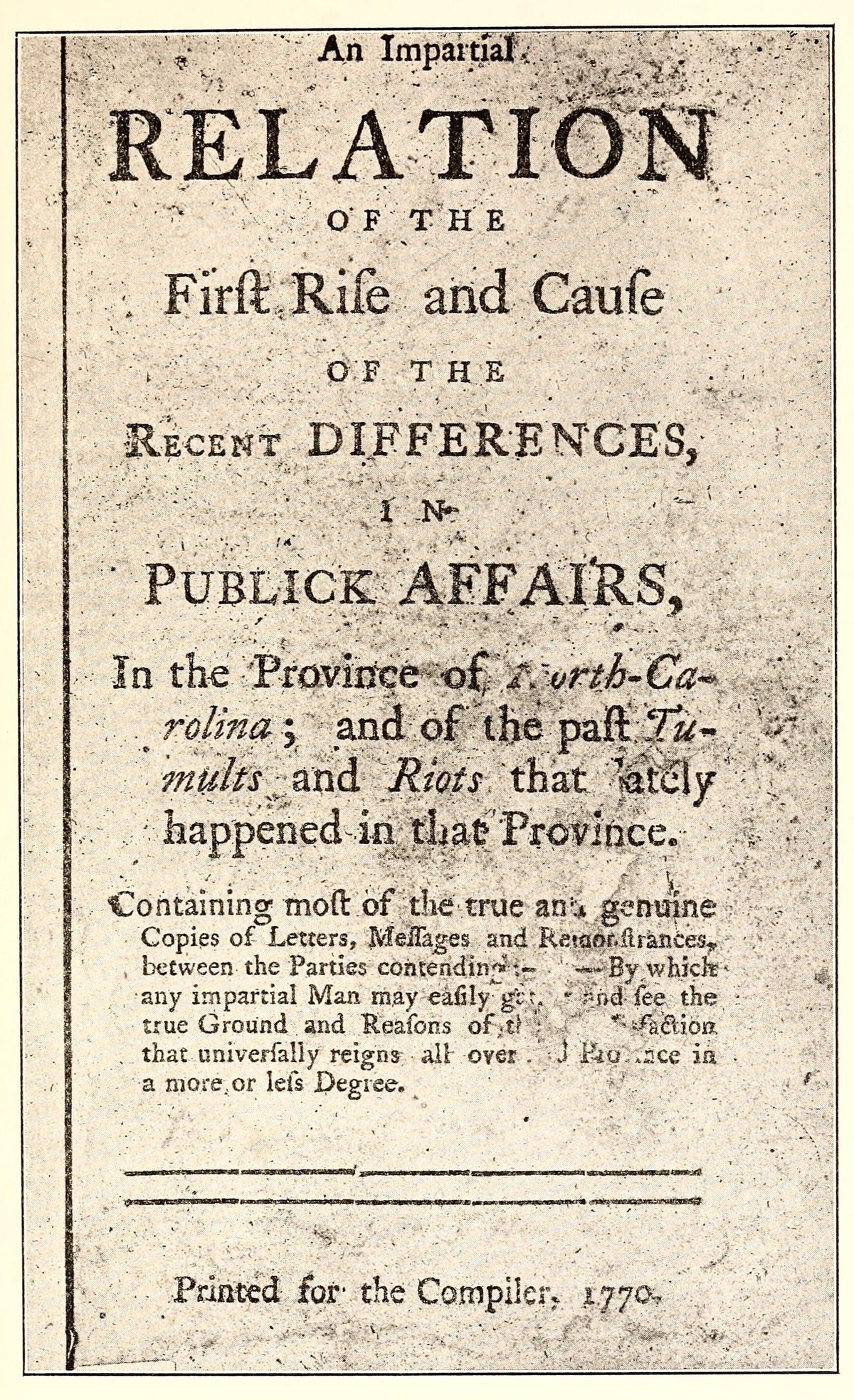
Title page of Herman Husband's An Impartial Relation, 1770

In the chronology

Chronology entries for this event, in date order. See these 20 dated events in the chronology →

  1. A Deep River meeting drafts Regulator Advertisement Number Two Meeting in Herman Husband's neighborhood, settlers wrote a second paper and chose William Cox and William Masset to attend the Maddock's Mill meeting on October 10. It asked the county's assemblymen, vestrymen and officers to come and answer their questions. People: Herman Husband Place: Deep River · Also named: William Cox, William MassetLefler and Wager, Orange County, 1752-1952 (1953), p. 30
  2. Orange County's first Regulator paper invokes the Stamp Act resistance An Orange County notice of August 1766, later called Regulators' Advertisement No. 1, praised the Sons of Liberty for resisting the Stamp Act and asked each neighborhood to send men to a meeting at Maddock's Mill to question local officers. Place: HillsboroughSearch the index · Colonial and State Records of North Carolina, vol. 7, pp. 249-250: Regulators' Advertisement No. 1
  3. Farmers met at Maddock’s Mill to press the county’s officers to account for fees and taxes Delegates from Orange County neighborhoods met at Maddock's Mill to ask their assemblymen and vestrymen how public money was spent. The officers refused to attend, and the meeting resolved that such conferences between voters and their representatives should be held every year. Place: CountywideColonial and State Records of North Carolina, vol. 7, pp. 251-252: Regulators' Advertisement No. 3
  4. James Watson brings Edmund Fanning's answer to the Regulators' meeting at Maddock's Mill When none of the county's officers came to the meeting, Watson arrived alone late in the day with word from Fanning that he considered it an insurrection. The delegates drew up Regulator Advertisement Number Three in his presence; Watson called it just and reasonable and promised to give copies to the county officials. People: James Watson, Edmund Fanning Place: Orange CountySearch the index · Lefler and Wager, Orange County, 1752-1952 (1953), pp. 30-31 · Also: Colonial and State Records of North Carolina 7:251-252, Regulators' Advertisement No. 3, minutes of the meeting of October 10, 1766
  5. Edmund Fanning tells the November court he has answered the farmers' complaints Speaking for the county officers, Fanning rejected the protest and reported that he had written its organizers a reply he expected to end the matter. People: Edmund Fanning Place: HillsboroughLefler and Wager, Orange County, 1752-1952 (1953), p. 31
  6. Sandy Creek men challenge the register's deed fees in the Orange County court Using a copy of the province's revised laws bought jointly by two men, one of them a county justice, two Sandy Creek men copied the lawful fees for registering deeds and objected in court to what they were charged. Threatened with arrest for contempt, they gave up, and the justice who half owned the book was soon put out of his commission. Place: Hillsborough · Also mentions: Sandy CreekInternet Archive: Bassett, The Regulators of North Carolina (1765-1771) (1896), p. 163
  7. Thomas Hart buys Joseph Maddock's mill on the Eno Joseph Maddock, a Quaker who had run the grist mill on the Eno west of Hillsborough since 1755, sold it to Thomas Hart, a friend of Governor William Tryon, who built it up with a sawmill, oil mill, fulling mill, distillery, tannery and other works. This is the mill, known as Hart's Mill, that a British guard held in February 1781. People: Thomas Hart Place: Hart's Mill, Eno River west of Hillsborough · Also named: Joseph Maddock, William TryonNC Department of Natural and Cultural Resources: Hart's Mill (G-122)
  8. Settlers west of the Haw River call Orange County's representatives and vestry to a settlement at the courthouse Inhabitants on the west side of the Haw River addressed Orange County's Assembly men and vestrymen, asking them to fix a day before the next court to meet at the courthouse and settle accounts of taxes and officers' fees, and declaring they would pay no more taxes until they had a full settlement. Place: Orange CountyDocumenting the American South, Colonial and State Records: Regulators' Advertisement No. 5, address from inhabitants near Haw River to the Orange County Vestry and General Assembly representatives, March 22, 1768
  9. Orange farmers draw up Regulator Advertisement Number Four At their second meeting, on April 4, 1768, the Regulators adopted the paper known as Advertisement Number Four, setting out the members' pledges on taxes and officers' fees, attendance at meetings, shared costs and majority rule. The first meeting's paper, Number Five in Husband's numbering, is dated March 22, 1768. Place: Orange CountyLefler and Wager, Orange County, 1752-1952 (1953), p. 31 · Also: Internet Archive: Hermon Husband, An Impartial Relation
  10. Regulators ask Orange County's late sheriff and a vestryman to bring the tax accounts Meeting again, the Regulators asked the former sheriff and a vestryman to meet their committee with lists of taxables, insolvents and public spending, and asked the county's assemblymen to come and show the law for the fees charged on deeds. Two men were chosen to carry the request, but the seizure of a Regulator's mare days later overtook it. Place: Orange CountyInternet Archive: Bassett, The Regulators of North Carolina (1765-1771) (1896), p. 166
  11. A general Regulator meeting agrees to send twelve men to meet county officials at Thomas Lindley's The meeting agreed to send twelve men and then named thirteen, among them Herman Husband, James Hunter and Rednap Howell, to gather at Lindley's on May 11 in hope of meeting representatives of the officers. The arrests of Husband and William Butler broke up the plan. People: Herman Husband, William Butler (Regulator), Rednap Howell, James Hunter Place: Thomas Lindley's · Also named: Thomas LindleyColonial and State Records of North Carolina, vol. 7, pp. 731-732: Regulators' Advertisement No. 8, minutes of the meeting of April 30, 1768 · Also: Lefler and Wager, Orange County, 1752-1952
  12. More than 400 Orange County inhabitants sign a petition to the governor and council At the April 30 meeting the Regulators drew up a petition to the governor and council in the name of the inhabitants of Orange County, to be held back unless the officers failed to settle. Herman Husband, not yet a Regulator, was among more than 400 signers. People: Herman Husband Place: Orange CountyInternet Archive: Bassett, The Regulators of North Carolina (1765-1771) (1896), p. 169
Show all 20 dated events
  1. Regulators meeting at George Sally's appoint a committee of eight to petition Governor Tryon Having agreed after the May confrontation to submit their case to the governor, the Regulators met at George Sally's in Orange County, declared their loyalty to King George and named William Moffitt, William Cox, Harmon Cox, John Low, John Marshall, James Hunter, Rednap Howell and George Hendry to gather the complaints into a petition and to implore the governor's pardon in the most submissive manner. People: James Hunter, Rednap Howell Place: Orange County · Also named: William Moffitt, William Cox, Harmon Cox, John Low, John Marshall, George HendryDocumenting the American South, Colonial and State Records: Regulators' Advertisement No. 10, minutes of a meeting of the Regulators, May 21, 1768
  2. Orange Regulators send their papers to the Regulators of Anson County Asked by the Anson County Regulators how to organize, the Orange Regulators sent them a copy of their May 21 proceedings, to keep them from running into errors, and promised more papers. Bassett thinks this advice helped turn the Anson movement toward petitioning that August. Place: Orange CountyInternet Archive: Bassett, The Regulators of North Carolina (1765-1771) (1896), p. 173
  3. Ralph McNair presses Herman Husband to adopt a petition written by the officers After the May confrontation at Hillsborough, the county officers sent Husband, through Ralph McNair, a petition of their own drafting in which the Regulators would call their conduct illegal and withdraw their charges. McNair warned that Fanning would report the case to Tryon as treason if it was refused, and the Regulators instead named their own committee to lay their papers before the governor. People: Herman Husband, Edmund Fanning, Ralph McNair Place: Orange CountyInternet Archive: Bassett, The Regulators of North Carolina (1765-1771) (1896), p. 170
  4. James Hunter and Rednap Howell present the Regulators' petition to Tryon at Brunswick The petition, Advertisement Number Nine, carried 474 names, 31 of them written in German. Tryon told the Regulators to give up their name and pay their taxes, but he also warned officers against excess fees and had the lawful fees published. People: James Hunter, William Tryon, Rednap Howell Place: BrunswickLefler and Wager, Orange County, 1752-1952 (1953), p. 34
  5. Regulators hear the governor's letter from the sheriff and resolve to petition the Assembly At a Regulator meeting called to answer Tryon's reply, the Orange sheriff read a letter and proclamation telling them to submit to tax collection. The sheriff and his deputy swore the crowd refused and threatened them; Husband said the people only told the sheriff they would take the matter to the Assembly, and the meeting sent Tryon an answer saying so. People: Herman Husband Place: Orange CountyInternet Archive: Bassett, The Regulators of North Carolina (1765-1771) (1896), p. 174 · Also: Internet Archive: Hermon Husband, An Impartial Relation
  6. Eight Regulator leaders meet Governor Tryon at Hillsborough and are refused a committee to examine the county's taxes A week after their letter was delivered, eight principal Regulators met Tryon in Hillsborough and asked that their grievances be settled by a committee reviewing the county's tax accounts. Tryon refused, telling them the law was the only channel for redress, and the next day sent a letter to the inhabitants south of the Haw. People: William Tryon Place: HillsboroughDocumenting the American South, Colonial and State Records: Journal of William Tryon's journey to Hillsborough, including orders to the militia, June 20 to October 2, 1768
  7. Regulators gather within a mile of Hillsborough, face Tryon's militia and disperse With the superior court sitting under guard of more than a thousand militia, armed Regulators appeared within a mile of Hillsborough on September 22: upwards of eight hundred by Tryon's journal, about 3,700 by Husband's Impartial Relation. A council of war set terms: surrender nine leaders, lay down arms and promise to pay taxes. The Regulators asked for the night to answer and by the next morning had dispersed, about thirty coming in to give up their arms. People: William Tryon, Griffith Rutherford Place: HillsboroughDocumenting the American South, Colonial and State Records: Journal of William Tryon's journey to Hillsborough, including orders to the militia, June 20 to October 2, 1768 · Also: Internet Archive: Hermon Husband, An Impartial Relation
  8. A Hillsborough jury finds Edmund Fanning guilty on an indictment In the same superior court term that tried the Regulator leaders, the King's indictment against Edmund Fanning went to a jury on September 27, which found him guilty. The day before, Herman Husband had surrendered William Butler to the court, and both men entered 500 pound bonds to abide its sentence. People: Edmund Fanning, Herman Husband, William Butler (Regulator), Richard Henderson, Maurice Moore, Martin Howard Place: HillsboroughDocumenting the American South, Colonial and State Records: Minutes of the Hillsborough District Superior Court, September 22 to October 1, 1768

Places in this history

Buildings, schools, churches and other sites named in the dated events on this page, the most often named first. The map shows the 1 with a known location.

Map tiles © OpenStreetMap contributors. Site locations from the N.C. State Historic Preservation Office survey, Open Orange, Orange County GIS, OpenStreetMap and a few other published sources named on each site’s page; town and community pins show approximate locations.

All places and the county map →

Indexed works

Related works found in catalogs and archives across North Carolina. Each links to the institution that holds or provides it.

The history of Maddock's Mill - Hillsborough, NC : including owners Thomas Hart, Rev. James Frazier, Jesse Benton, Catlett Campbell

Dunaway, Stewart E. · 2022

History of Maddock's Mill at Hillsborough and of its owners Thomas Hart, Rev. James Frazier, Jesse Benton and Catlett Campbell. Stewart E. Dunaway published it in 2022 through Lulu, 174 pages with illustrations, maps and facsimiles, appending Benton and Hart family histories.

Included because: Its title names this subject.

Start at OCPL

Books in OCPL’s Rebecca B. Wall Local History Collection whose titles, catalog subjects, or descriptions match this event. The Friends’ recommended starting points are labelled. Books marked Wider context cover the broader subject rather than this event itself.

  • Start here · NC 975.602 TROXLER Farming Dissenters: The Regulator Movement in Piedmont North Carolina Troxler, Carole Watterson · 2011

    Carole Watterson Troxler's history of the Regulator movement in Piedmont North Carolina, from land speculation and backcountry resentment through Herman Husband and the Sandy Creek network to the petitions, court proceedings and rioting in Hillsborough and Salisbury, the Battle of Alamance in 1771 and the movement's afterlife in the Revolution. An appendix compiles names in a Regulator context. Published by the North Carolina Department of Cultural Resources in 2011, 221 pages with illustrations, maps and an index.

  • Start here · 975.602 KAR Breaking Loose Together: The Regulator Rebellion in Pre-revolutionary North Carolina Kars, Marjoleine · 2002

    Marjoleine Kars's history of the Regulator Rebellion of 1766 to 1771, the backcountry uprising against corrupt county officials that ended at the Battle of Alamance. Hillsborough, the Orange County seat, was a center of the Regulators' protests and the scene of their 1770 court riot. Published by the University of North Carolina Press in 2002, 286 pages with illustrations and maps.

  • Foundational · NC 975.656 CAM Hillsborough and the Regulators Cameron, Annie Sutton · 1964

    Annie Sutton Cameron's short account of Hillsborough during the Regulator uprising of 1766 to 1771, when backcountry farmers protested colonial officials and courts and Hillsborough, as the seat of Orange County, stood at the center of the conflict. Published by the Orange County Historical Museum in Hillsborough in 1964, 36 pages with illustrations.

Show 6 more
  • Foundational · NC 975.602 DUN The Battle at Lindley's Mill: [a Revolutionary War Battle in Order to Free Governor Burke and Citizens of Hillsborough, N.C. Held as Prisoners by the Tories] Dunaway, Stewart E. · 2009

    Stewart E. Dunaway's account of the Battle of Lindley's Mill, fought in September 1781 after the Loyalist David Fanning raided Hillsborough and carried off Governor Thomas Burke. Burke, Fanning and the Lindley family, whose mill gave the fight its name, are the people at its center, with the Revolutionary campaigns in North Carolina as the frame. Published in 2009.

  • Rebecca Wall Collection · NC 975.6 POW The War of the Regulation and the Battle of Alamance, May 16, 1771 Powell, William Stevens · 1975

    William S. Powell's short account of the War of the Regulation and its end at the Battle of Alamance on May 16, 1771, when Governor Tryon's militia defeated the backcountry Regulators. The fighting took place in what was then Orange County, and Hillsborough, the county seat, had been the center of the Regulators' grievances and riots. Issued by the State Department of Archives and History, 32 pages with illustrations, facsimiles, a portrait and a folding map; this printing is dated 1976.

  • Rebecca Wall Collection · NC 975.602 NEW The Battle of Lindley's Mill Newlin, Algie Innman · 1975

    Algie Innman Newlin's short study of the Battle of Lindley's Mill, the 1781 engagement in which Whig militia caught up with David Fanning's Loyalist column on its way from Hillsborough with the captured governor. Published by the Alamance Historical Association in 1975, 30 pages with maps and a bibliography.

  • Wider context · NC 812 VER Esther Wake, Or, The Spirit of the Regulators: A Play in Four Acts Vermont, Adolph · 1913

    Adolph Vermont's four-act drama of the Regulator uprising, first performed on the University of North Carolina campus by its Summer School Dramatic Club on 4 July 1912. Scenes move from Governor Tryon's palace at New Bern to Orange County, on the Eno, at Hillsborough and on the Alamance battlefield, as the heroine, Esther Wake, pleads for the Regulator gunsmith James Pugh; N. W. Walker's introduction admits she may never have lived. Printed at Raleigh, 1913.

  • Wider context · NC BIO TRYON POW The Correspondence of William Tryon and Other Selected Papers Tryon, William · 1980

    The letters and papers of William Tryon, royal governor of North Carolina until 1771, edited by William S. Powell in two volumes, 1758 to 1767 and 1768 to 1818. They cover the Regulator troubles, from the riots at Hillsborough, the Orange County seat, to the battle of Alamance in 1771 and the hangings that followed. Tryon, builder of the New Bern palace, later governed New York. Division of Archives and History, 1980; indexed.

  • Rebecca Wall Collection · NC 285 ARN David Caldwell Arnett, Ethel Stephens · 1976

    Ethel Stephens Arnett's life of David Caldwell (1725 to 1824), pastor of the Buffalo and Alamance Presbyterian churches in Guilford County, who opened a log college in 1767 and practiced medicine he had taught himself. He was present at the Battle of Alamance in 1771, represented Guilford at the Halifax congress that adopted the state constitution in 1776, and sat in the Hillsborough convention of 1788. Greensboro, 1976, 106 pages with an index.

Research sources

Sources and research tools for this event. Research guide: Follow an event across several accounts.

Background 6

Records of the time

Collections and databases

Local help

Background reading at OCPL

Books from OCPL’s Rebecca B. Wall Local History Collection that provide broader context. They may not discuss Maddock’s Mill organizing, 1766–1768 directly.

Search the Wall Collection for related books →

Picture: Title page of Herman Husband's An Impartial Relation, 1770. Public domain. Herman Husband, An Impartial Relation (1770); facsimile in William K. Boyd, ed., Some Eighteenth Century Tracts Concerning North Carolina (1927); via the Internet Archive

More to discover

Keep Reading Local

The Friends connect people with new library materials, local writers and publishers, and resources documenting Orange County.

Two mice reading back to back against a leaf, with the hand-lettered words Friends of the Orange County Public Library
Illustration by Caldecott Medalist Matthew Cordell, gifted to the Friends 2026