Skip to content

Storyline · 1840–1859

Chapel Hill's congregations build their churches, 1840–1859

Between 1842 and 1859 Chapel Hill's Episcopalians, Presbyterians, Methodists and Baptists built churches in the village, with enslaved people among the builders and the worshippers. From about 1843 the Methodists met above Jesse Hargrave's store in a room Charles F. Deems named Bethesda. People William Mercer Green enslaved worked on the Episcopal church, consecrated as the Chapel of the Holy Cross in 1848 with a wooden gallery for enslaved worshippers. The Presbyterians dedicated a small church in 1849 and the Methodists their first church in 1853. A Baptist branch of Mount Carmel opened its brick meeting house in 1855, and its first baptisms were of five people enslaved by William Barbee. In 1859 the Presbyterians installed their first pastor.

1840–1859 Filed under Churches & Faith 17 dated events

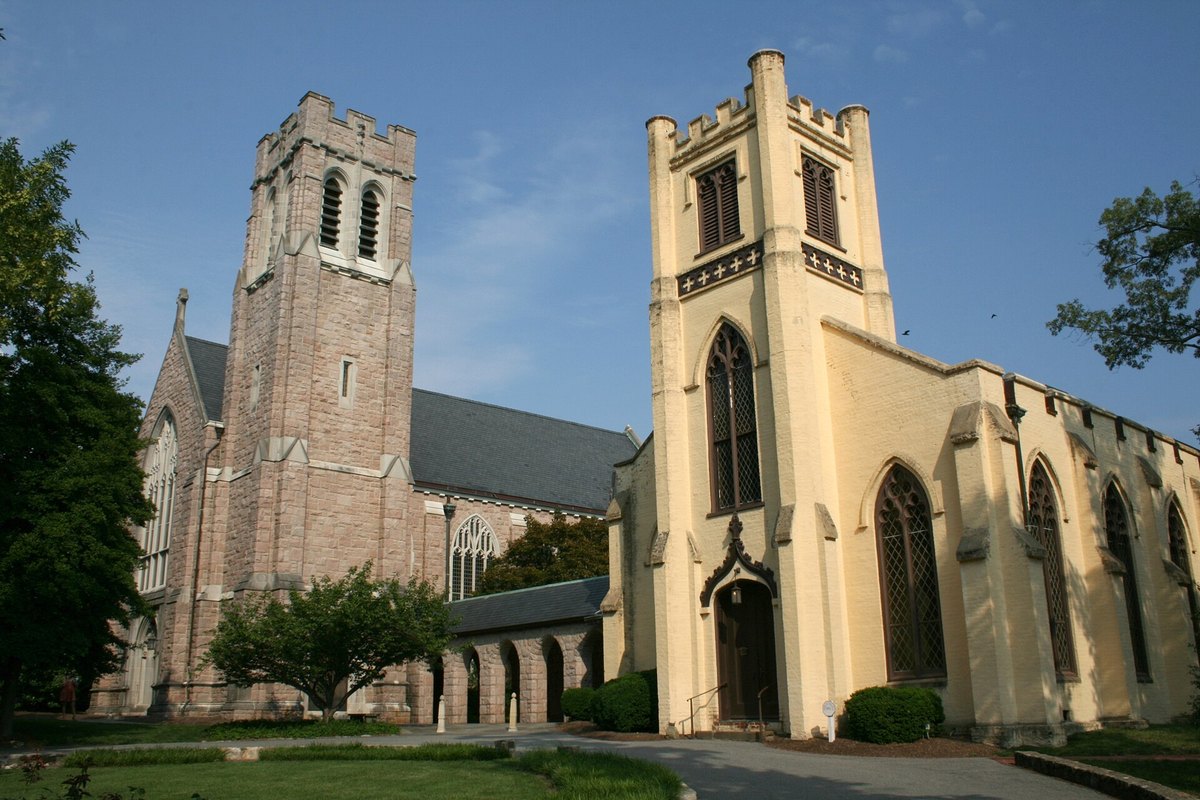
Original Chapel of the Cross (right) and later church (left), Chapel Hill, July 11, 2008
Original Chapel of the Cross (right) and later church (left), Chapel Hill, July 11, 2008Photograph by Ildar Sagdejev; via Wikimedia Commons · CC BY-SA 4.0 · Source

From about 1843 Chapel Hill's Methodists met in the upstairs room of Jesse Hargrave's store on Franklin Street, a former Masonic hall that Charles F. Deems, who preached to them while a professor, named Bethesda. In May 1842 William Mercer Green organized the Church of the Atonement, an Episcopal parish of fifteen communicants. Work began in 1843 on its church on East Franklin Street, designed by Thomas U. Walter. People Green enslaved worked on the building, and Bishop Levi Silliman Ives consecrated it as the Chapel of the Holy Cross on October 19, 1848, with a wooden gallery for enslaved worshippers. In 1846 Professor James Phillips bought the Village Chapel lot for the Presbyterians, and the small church Dabney Cosby built there was dedicated on September 23, 1849. In July 1853 the Methodists dedicated their first church, at Rosemary and Henderson streets, paid for with about $5,000 their pastor had raised around the state. In 1854 Mount Carmel Baptist Church authorized a branch at Chapel Hill; it was constituted on September 15, elected Brantley J. Hackney its first regularly elected pastor that December and opened its brick meeting house on May 6, 1855. Its first baptisms, on June 17, were of five people enslaved by William Barbee. In February 1859 the Presbyterians installed their first pastor, John B. Shearer.

Towns
Chapel Hill
Sites
8
People with pages
11

The events, date by date

Every statement above comes from these dated entries in the chronology. Each links to its source.

  1. Jesse Hargrave opens a general store whose upstairs room serves the Methodists Jesse Hargrave, in Chapel Hill since 1835, had a general store on Franklin Street by 1840, and bought the Yancey house the same year. In the 1840s (from about 1843) the Methodists, who had first met in Miles Davis's house, used the store's upstairs room, a former Masonic hall that Charles Deems named Bethesda. People: Jesse Hargrave Place: Hargrave's store, Franklin Street, Chapel Hill · Also mentions: Franklin StreetSearch the index · Bernard Lee Bryant Jr., Occupants and Structures of Franklin Street, Chapel Hill (1998; Chapel Hill Historical Society, 1999), scan p. 75
  2. Charles F. Deems preaches to Chapel Hill Methodists in the hall he names Bethesda While a professor, Deems preached to the village Methodists, at their invitation, in the upper story of Jesse Hargrave's store, a former Masonic lodge room he named Bethesda. After he left the university in 1848, ministers were regularly appointed to the Chapel Hill charge. People: Charles F. Deems, Jesse Hargrave Place: Chapel HillSearch the index · Documenting the American South: Kemp P. Battle, History of the University of North Carolina, Volume I
  3. William Mercer Green organizes an Episcopal parish in Chapel Hill In May 1842 William Mercer Green presided over the organization of the Church of the Atonement, an Episcopal parish in Chapel Hill with fifteen communicants, which met in members' homes for five years while its church was built. A record of subscribers for building the church, dated 1843, survives in Green's papers. People: William Mercer Green Place: Chapel HillSearch the index · The Chapel of the Cross: Parish Archives
  4. People enslaved by William Mercer Green work on the Church of the Atonement Green contributed to the building through the labor of several people he enslaved and a pair of his mules. He also meant to give a kiln of bricks made on his land, but had the fires put out at midnight on a Saturday to keep the Sabbath, and the half-fired bricks, worth about $250, were lost. People: William Mercer Green Place: Church of the Atonement (Chapel of the Cross), Chapel HillSearch the index · Archibald Henderson, The Church of the Atonement and the Chapel of the Cross at Chapel Hill (1938), scan p. 42
  5. The Episcopal parish begins building the Chapel of the Cross on East Franklin Street A year after organizing, Chapel Hill's Episcopal parish started work in 1843 on its Gothic Revival chapel at 302 East Franklin Street, designed by the architect Thomas U. Walter. The building took until 1848 to finish. Place: Chapel of the Cross, 302 East Franklin Street, Chapel Hill · Also named: Thomas U. Walter · Also mentions: East Franklin StreetSearch the index · NC Digital Collections: Chapel Hill Historic Sites Survey: Final Report (1992), p. 36
  6. Swain reports the Chapel of the Cross walls up to a plan by Thomas U. Walter Writing to Charles Manly, university president David L. Swain noted that the Episcopalians had raised the brick walls of their church and that it was planned by Walter of Philadelphia. The nomination treats this letter as the main evidence that architect Thomas U. Walter designed the chapel, which had long been credited to Richard Upjohn. People: David L. Swain, Charles Manly Place: Chapel of the Cross, East Franklin Street, Chapel Hill · Also named: Thomas U. WalterSearch the index · NC State Historic Preservation Office: Chapel of the Cross, National Register nomination (OR0005), p. 6
  7. James Phillips buys the Village Chapel lot for the Presbyterian church Professor James Phillips, as trustee, bought for $200 the lot where the Union or Village Chapel stood, as a site for the Presbyterian church, on condition that no burials be made there. The old chapel was moved a few hundred yards north, enlarged, and long served as the village public school. People: James Phillips Place: Chapel Hill · Also mentions: Village ChapelSearch the index · Documenting the American South: Kemp P. Battle, History of the University of North Carolina, vol. I (1907), p. 611
  8. Dabney Cosby builds the Presbyterian church on Franklin Street After the university work Cosby built a small Tuscan style church designed by Alexander Jackson Davis for the Chapel Hill Presbyterian congregation, whose members included university president David L. Swain. In March 1848 the congregation member Charles Phillips wrote to Davis that the mason could not match the lilac gray color specified for the outside. The building no longer stands. People: Dabney Cosby, David L. Swain, Charles Phillips, Alexander Jackson Davis Place: Chapel HillSearch the index · North Carolina Architects and Builders, NC State University Libraries: Cosby, Dabney (1779-1862)
  9. The Chapel of the Cross is consecrated Bishop Levi Silliman Ives consecrated the Episcopal church at Chapel Hill as the Chapel of the Holy Cross. Designed by Thomas U. Walter for the parish William Mercer Green organized in 1842, it was built of bricks fired by enslaved people at kilns on Green's farm and included a wooden gallery for enslaved worshippers. People: William Mercer Green Place: Chapel Hill · Also named: Thomas U. WalterSearch the index · The Chapel of the Cross: Parish Archives
  10. The Presbyterian church on Franklin Street is finished and dedicated Built with money and effort from James and Charles Phillips, Elisha Mitchell and President Swain, the small Presbyterian church on the old Grand Avenue ground was completed and formally dedicated. Lucy Phillips Russell, writing from the church records in 1936, said it was dedicated free of debt on Sunday, September 23, 1849, when Rev. John A. Gretter of Greensboro preached the dedicatory sermon. People: James Phillips, Charles Phillips, Elisha Mitchell, David L. Swain Place: Presbyterian Church, East Franklin Street, Chapel Hill · Also named: John A. GretterSearch the index · Bernard Lee Bryant Jr., Occupants and Structures of Franklin Street, Chapel Hill (1998; Chapel Hill Historical Society, 1999), scan p. 91 · Also: Chapel Hill Weekly, April 24, 1936, p. 3
  11. Chapel Hill's Methodists dedicate their first church In July 1853 the Methodist congregation that became University Methodist Church dedicated its first building, at Rosemary and Henderson streets, paid for with about $5,000 that its pastor J. Milton Frost had raised around the state. The congregation had met since about 1840, with Charles F. Deems preaching in the 1840s and Frost stationed there from January 1851. People: Charles F. Deems Place: Chapel Hill · Also named: J. Milton Frost · Also mentions: Rosemary and Henderson streets, University Methodist ChurchSearch the index · University United Methodist Church, Chapel Hill: History · Also: Lefler and Wager, Orange County, 1752-1952; The Daily Tar Heel, October 3, 1975, p. 1
  12. The Chapel Hill Baptist Church is received into the Sandy Creek Association At its constitution on September 15, 1854 the church voted to apply to the Sandy Creek Association and named delegates, and the Association received it at that year's meeting. Place: Chapel Hill Baptist Church, Chapel HillSearch the index · Almonte Charles Howell, A History of the Chapel Hill Baptist Church, 1854-1924 (1945), scan p. 14
Show all 17 dated events
  1. Mount Carmel Baptist Church authorizes a branch church at Chapel Hill A conference of the Mount Carmel church, a country congregation south of the village, voted to set up a branch in Chapel Hill. Howell treats this as the formal start of the Chapel Hill Baptist Church. Place: Mount Carmel Baptist Church, south of Chapel Hill · Also mentions: Chapel Hill Baptist ChurchSearch the index · Almonte Charles Howell, A History of the Chapel Hill Baptist Church, 1854-1924 (1945), scan p. 13
  2. Brantley J. Hackney is elected the first pastor of the Chapel Hill Baptist Church The church elected Brantley James Hackney to preach four times a month at $200 a year, making him its first regularly elected pastor. Place: Chapel Hill Baptist Church, Chapel Hill · Also named: Brantley J. HackneySearch the index · Almonte Charles Howell, A History of the Chapel Hill Baptist Church, 1854-1924 (1945), scan p. 15
  3. The Baptist Church of Chapel Hill opens its first church Services began on Sunday, May 6, 1855 in the brick meeting house, with vestibule, belfry and bell, that the Baptist congregation put up after it organized in September 1854. The building later became the Masonic temple of University Lodge. People: James Pleasant Mason Place: Chapel Hill · Also mentions: University LodgeSearch the index · DigitalNC: The Biblical Recorder, May 10, 1855, p. 2 (Dedication at Chapel Hill) · Also: Lefler and Wager, Orange County, 1752-1952
  4. Five enslaved people are the first baptized into the Chapel Hill Baptist Church The church's first baptisms took place at a new outdoor baptistry by a spring on the McDade place. The candidates were five people enslaved by William Barbee, so the first people immersed into the church in the village were Black. Black members made up about a third of the early church. Place: Outdoor baptistry on the McDade place, Chapel Hill · Also named: William BarbeeSearch the index · Almonte Charles Howell, A History of the Chapel Hill Baptist Church, 1854-1924 (1945), scan p. 18
  5. John B. Shearer becomes the first pastor of the Chapel Hill Presbyterian Church Faculty members had served the church as unpaid stated supplies until the congregation called John B. Shearer, later president of Davidson College, as its first installed pastor. He stayed until June 1862, when he went back to Virginia. Place: Chapel Hill Presbyterian Church, Chapel Hill · Also named: John B. ShearerSearch the index · Cornelia Phillips Spencer, The Presbyterian Church in Chapel Hill (1897), scan p. 13

Places in this storyline

Buildings, schools, churches and other sites named in the dated events on this page, the most often named first. The map shows the 7 with a known location.

Map tiles © OpenStreetMap contributors. Site locations from the N.C. State Historic Preservation Office survey, Open Orange, Orange County GIS, OpenStreetMap and a few other published sources named on each site’s page; town and community pins show approximate locations.

All places and the county map →

People in this storyline

People with a page of their own whom the dated events above name, those named most often first.

Reading on the places and people in this storyline

No indexed work is about this storyline itself yet. These are about the sites and people its dated events name, those named most often first, so they may discuss the storyline only in part. Follow a link to find a copy or view the material.

About Chapel of the Cross · named in 5 of this story’s entries

The Church of the Atonement and the Chapel of the Cross at Chapel Hill

Henderson, Archibald · 1938

Archibald Henderson's history of the Episcopal congregation in Chapel Hill, the Church of the Atonement and the Chapel of the Cross, as the title names them. A short work of Chapel Hill church history and of the Episcopal Church in North Carolina, published in Hartford, Connecticut, by the Church Missions Publishing Company in 1938, 57 pages with illustrations and portraits. One copy carries the author's presentation inscription to the North Carolina State Library.

The first parish register of the Chapel of the Cross (1842-1881)

2024 · Chapel Hill Historical Society

Transcription of the first register kept by Chapel of the Cross, the Episcopal parish on Franklin Street in Chapel Hill, with its entries from 1842 to 1881. Published by the Chapel Hill Historical Society in 2024 with an introduction and a bibliography, 142 pages with illustrations and portraits.

Chapel of the Cross : calendar 1996.

1996 · Chapel of the Cross

Wall calendar for 1996 made by two Chapel of the Cross choristers, Jane Hamborsky and Margaret Middleton, who photographed architectural details of the Gothic Revival church in Chapel Hill. Thomas U. Walter designed the chapel, which went up from 1843 to 1848. Black-and-white photographs, from the Images of North Carolina collection.

The word of love : preaching in the ministry of Stephen Elkins-Williams

Elkins-Williams, Stephen, 1944- · 2015 · iUniverse

Sermons preached by Stephen Elkins-Williams during his ministry at the Chapel of the Cross in Chapel Hill, collected in 329 pages and published by iUniverse in 2015. Bishop Michael B. Curry and the Reverend Tambria Elizabeth Lee contributed forewords. Illustrations accompany the text.

UNC

About University Baptist Church · named in 5 of this story’s entries

Centennial Monograph

Habel, Samuel Tilden · 1954 · The Baptist Church

Samuel Tilden Habel's centennial monograph on the Baptist Church at Chapel Hill, covering its first hundred years from 1854 to 1954. It pairs a narrative of the congregation with membership lists. Published by the church in Chapel Hill in 1954, 58 pages plus sixteen pages of plates with illustrations, portraits and facsimiles.

A History of the Chapel Hill Baptist Church, 1854-1924

Howell, Almonte Charles · 1945

A. C. Howell's history of the Baptist church in Chapel Hill from 1854 to 1924, published in 1945. Thirty-two pages with one plate; the story touches the Baptist State Convention of North Carolina as well as the congregation itself.

University Baptist Church: Pastor and Family: photographs (Chapel Hill Historical Society)

1990

Family portrait from 1990 of H. Mitchell Simpson, pastor of University Baptist Church in Chapel Hill, with his wife and children. From the churches series of the Chapel Hill Historical Society's Prints and Photographs Collection.

Centennial monograph celebrating the first 100 years of the Baptist Church at Chapel Hill

Habel, Samuel Tilden, 1908-1992 · 1954 · Chapel Hill, N. C. : The Baptist Church

Samuel Tilden Habel's history of the Baptist Church at Chapel Hill, written for its hundredth anniversary and published by the church in 1954.

About University Presbyterian Church · named in 3 of this story’s entries

Faith, Grace and Heresy

Pryor, Mark · 2002 · Writer's Showcase

Mark Pryor's biography of the Rev. Charles M. Jones (1906-1993), minister of the Presbyterian church in Chapel Hill. It explores his life in relation to civil rights work, race relations and the religious response to racism in the town. Published by Writer's Showcase, San Jose, in 2002, xii and 398 pages with illustrations.

The first hundred years : the Chapel Hill Presbyterian Church, 1849-1949.

1950 · Charles M. Jones

The Chapel Hill Presbyterian Church marked its centennial with this history, published in 1950 and covering the congregation from 1849 to 1949. Thirty-nine illustrated pages at 23 centimeters. The history also concerns the religious aspects of the Civil War.

Oral history interview with Charles M. Jones, July 21, 1990: interview A-0335, Southern Oral History Program Collection (#4007)

Jones, Charles Miles · 2006 · University Library, UNC-Chapel Hill

The Rev. Charles M. Jones (1906-1993), minister of Chapel Hill's Presbyterian church in the late 1940s, and his wife Dorcas talk with John Egerton in a Southern Oral History Program interview recorded July 21, 1990. Jones spends most of the hour on the disputes his stand on race provoked, when the regional presbytery objected to his conduct of the church, and his dealings with university president Frank Porter Graham. Published online in 2006 by the UNC-Chapel Hill Library in Documenting the American South.

The controversy between Charles Miles Jones and Orange Presbytery, 1952-53 : thesis

Johnston, Edward F., 1879-1919 · 1995 · Thesis for the University of Virginia

A thesis on the controversy between Charles Miles Jones and Orange Presbytery in 1952 and 1953, the dispute that ended his ministry at the Chapel Hill Presbyterian Church. The text was reprinted in 1995 with excerpts from Jones' sermons added for the dedication of the Charles M. Jones Community Building on September 24 of that year. One volume of various pagings, with a portrait.

Wider background: Churches & Faith · the most widely held histories of the theme this storyline is filed under; they may not discuss it

Miss Mary's Money

Jones, H. G. · 2014 · McFarland & Co.

H. G. Jones follows the fortune of Mary Ruffin Smith (1814-1885), the unmarried heiress whose Orange and Chatham County lands passed at her death to the University of North Carolina and the Episcopal Church. Chapters profile her grandfather Francis Jones, then trace the bequest through a quarrel among Episcopalians over Price Creek, the Chapel of the Cross and the university's buildings. A December 1885 New York Times report called the gift money; Jones shows it was land. Published by McFarland in 2014, 231 pages.

Church in the Old Fields: Hawfields Presbyterian Church and Community in North Carolina

Turner, Herbert Snipes · 1962

Herbert Snipes Turner's history of Hawfields Presbyterian Church and its community from 1738 to 1960. Hawfields lies in what is now Alamance County, land that was part of Orange County until 1849, and the book gives a place to Henry Pattillo, the congregation's eighteenth-century minister. Published by the University of North Carolina Press in 1962, 297 pages with illustrations.

Reviewed in The Journal of Southern History (1963).

A Historical Sketch of New Hope Church, in Orange County, N.C

Craig, D. I. · 1891

Rev. D. I. Craig's history of New Hope Church, a Presbyterian congregation in Chapel Hill Township, Orange County, printed at Reidsville in 1891. A closing family history section covers the Strayhorn, Craig, Blackwood and Kirkland families.

Jane Crow: The Life of Pauli Murray

Rosenberg, Rosalind · 2017

Rosalind Rosenberg's 2017 biography of Pauli Murray (1910-1985), lawyer, poet and Episcopal priest, raised in Durham. Its six parts follow a Southern childhood, the move to New York, the 1938 application to the University of North Carolina that was refused because Murray was Black (the chapter is titled 'Members of your race are not admitted'), law school and the coining of the phrase Jane Crow, the Cold War years, the push toward 'an NAACP for women', and a late-life ordination. 494 pages with portraits.

Reviewed in The Journal of Southern History (2018).

Journey to New Hope

Murphy, Barbara A. · 2006

A congregational history of New Hope Presbyterian Church in Orange County, written by Barbara A. Murphy and published in 2006 by Chapel Hill Press. Chapters take up the five successive church buildings, the land itself, the ministers who served, the cemeteries, members who went to war, the church's organization, its music, gifts and memorials, and its outreach to the surrounding community. It also covers Presbyterian experience of the Civil War. 126 pages with illustrations and portraits.

Facing Tomorrow, Understanding Yesterday

1992

A history of Orange United Methodist Church in Chapel Hill since 1832, prepared by the congregation's History Committee and edited by Margaret A. Blanchard with Julia Blackwood, Mildred Stout, Wiley Williams, Kay Creech, Andrea Stark and Shirley Mallard. Published by Taylor Publishing of Dallas in 1992, 161 pages with illustrations, some in color, a facsimile, maps and portraits.

Show 2 more

Binkley: A Congregational History

Gardner, Andrew · 2023 · The University of Tennessee Press

Andrew Gardner's history of Binkley Memorial Baptist Church in Chapel Hill, named for Olin T. Binkley, covering the years between the late 1950s and the 2010s and tracing how a congregation with Southern Baptist roots came to be known for liberal Christianity. Published by the University of Tennessee Press in 2023, 213 pages with illustrations.

An Historical Address Delivered in Saint Matthew's Church, Hillsboro, N.C., on Sunday, August 24, 1924

Cheshire, Joseph Blount · 1925

Address by Bishop Joseph Blount Cheshire at St. Matthew's Church in Hillsborough on 24 August 1924, marking the parish's hundredth anniversary. Printed in Durham in 1925 at the vestry's order, with a foreword by the rector. Cheshire discusses George Micklejohn, William Mercer Green and Moses Ashley Curtis.

Research this storyline

Each dated event above names its source, the place to start. For finding more on an event across newspapers, records and histories, see the research guide Follow an event across several accounts. Ask at the North Carolina Room of the Orange County Public Library for help with local sources.

Cite or share

Friends of the Orange County Public Library. “Chapel Hill's congregations build their churches, 1840–1859.” Orange County Indexed, https://focplnc.org/orange-county-books/storylines/chapel-hill-congregations-1840-1859-storyline-1840/. Accessed October 22, 2026.

How to cite what you find

Suggest a correction or a source →

See these events in the full chronology All storylines

Two mice reading back to back against a leaf, with the hand-lettered words Friends of the Orange County Public Library
Illustration by Caldecott Medalist Matthew Cordell, gifted to the Friends 2026
