Skip to content

Storyline · 1840–1861

Enlarging the antebellum campus, 1840–1861

In 1840 President David L. Swain began the stucco finish on the brick college buildings, and by August 1841, with the session crowded beyond its rooms, the university had contracted for two new dormitory buildings. Swain then brought in the architect Alexander Jackson Davis, who first came to Chapel Hill in 1844. Davis's three-story additions to Old East and Old West, on which the masonry subcontractor Dabney Cosby put enslaved workmen, among them Osborne and his brother Albert, were finished in 1848 with halls for the Dialectic and Philanthropic societies, furnished by the free Black cabinetmaker Thomas Day. Smith Hall followed, named in 1852, and New East and New West, begun in 1858, were ready on July 31, 1861.

1840–1861 Filed under UNC & Campus Life 21 dated events

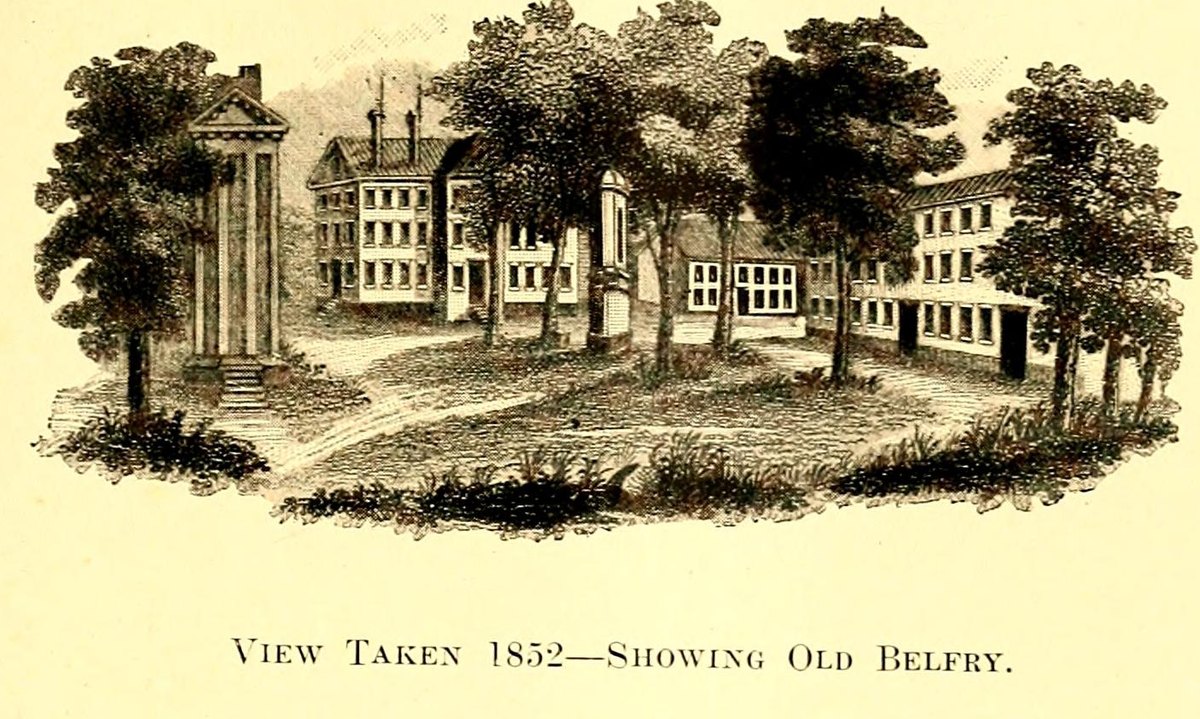
View of the University of North Carolina campus in 1852, showing the old belfry, reproduced in 1907
View of the University of North Carolina campus in 1852, showing the old belfry, reproduced in 1907Kemp P. Battle, History of the University of North Carolina, volume I, 1907; Internet Archive · Public domain · Source

In 1840 President David L. Swain asked the architect David Paton about coating the brick college buildings, beginning their stucco finish, and by August 1841, with the session crowded beyond its rooms, the university had contracted for two new dormitory buildings. In November 1843 Swain authorized Robert Donaldson of New York to invite Alexander Jackson Davis, who first came to Chapel Hill in February 1844. On December 23, 1844 Isaac J. Collier and Kendall B. Waitt won the contract for Davis's three-story additions to Old East and Old West at $9,360 and subcontracted the masonry to Dabney Cosby, who put enslaved workmen on the job: Osborne began the masonry in February 1845, and his brother Albert joined him in May 1846 to plaster the halls. The additions, finished in 1848, held halls and library alcoves for the Dialectic and Philanthropic societies, which had drawn lots for the two sides with woodwork and furniture by the free Black cabinetmaker Thomas Day. From about 1849 gardeners trained in England laid out the grounds with Black laborers, and in 1851 the trees were thinned and the first paved walks built. The societies' request for a building for dances led to Smith Hall, designed by Davis, named in 1852 for Benjamin Smith and the library's home from 1853. In 1858 the trustees funded two new buildings and hired William Percival; New East and New West, begun that June, were ready on July 31, 1861.

Towns
Chapel Hill
Sites
7
People with pages
23

The events, date by date

Every statement above comes from these dated entries in the chronology. Each links to its source.

  1. Swain asks architect David Paton about coating the college buildings In 1840 President David L. Swain wrote to David Paton, the Scottish architect then finishing the State Capitol in Raleigh, about covering the brick college buildings with a tinted mix of cement, lime and water. The coating began the stucco finish the campus buildings wore for the rest of the century. People: David L. Swain, David Paton Place: UNC campus · Also mentions: State CapitolSearch the index · NC Digital Collections: M. Ruth Little, The Town and Gown Architecture of Chapel Hill, 1795-1975 (2004), p. 19
  2. The university's Executive Committee contracts for two new dormitory buildings With the new session crowded beyond its rooms, the university's Executive Committee contracted for two new buildings of eight rooms each to be used as dormitories, which the builders promised to finish by January 1, 1842. Place: University of North Carolina, Chapel HillSearch the index · Hillsborough Recorder, August 5, 1841, p. 3
  3. Swain authorizes Donaldson to bring architect A. J. Davis to the university In a letter from Raleigh dated November 28, 1843, Swain told Donaldson he might invite Alexander Jackson Davis to Chapel Hill to make working drawings and specifications, with $100 for travel. The letter opened Davis's service as the university's architect and planner of its grounds. People: David L. Swain, Alexander Jackson Davis, Robert Donaldson Jr. Place: UNC campus · Also named: Robert DonaldsonSearch the index · NC Digital Collections: M. Ruth Little, The Town and Gown Architecture of Chapel Hill, 1795-1975 (2004), p. 21
  4. Dabney Cosby takes the masonry subcontract for the lengthening of Old East and Old West Chapel Hill contractors Isaac J. Collier and Kendall B. Waitt subcontracted the masonry of the university additions to Cosby, who put enslaved workmen including the brothers Osborne and Albert on the job. Cosby and the architect Alexander Jackson Davis quarrelled over the drawings, and president David L. Swain asked the Hillsborough builder John Berry to look at the brickwork, which Berry reported was defective. People: Dabney Cosby, John Berry, David L. Swain, Alexander Jackson Davis, Isaac J. Collier, Kendall B. Waitt Place: University of North Carolina, Chapel Hill · Also named: Albert, OsborneIn the index: University of North Carolina, Chapel Hill · North Carolina Architects and Builders, NC State University Libraries: Cosby, Dabney (1779-1862)
  5. Alexander Jackson Davis makes his first visit to the university Davis came to Chapel Hill in February 1844, and that year trustee John Motley Morehead met with him and Swain there about the design of a new hall, later Smith Hall. Davis stayed in touch with Swain and the trustees about campus work until the mid-1850s. People: Alexander Jackson Davis, David L. Swain, John Motley Morehead Place: UNC campus · Also mentions: Smith HallSearch the index · NC Digital Collections: M. Ruth Little, The Town and Gown Architecture of Chapel Hill, 1795-1975 (2004), p. 22
  6. The university awards Isaac J. Collier and Kendall B. Waitt the contract for the Old East and Old West additions On December 23, 1844, Collier and Waitt won the contract to build A. J. Davis's three-story brick additions to Old East and Old West, at $9,360. They subcontracted the masonry to Dabney Cosby; the next day trustee secretary Charles Manly asked that they hire his enslaved carpenters. People: Isaac J. Collier, Alexander Jackson Davis, Dabney Cosby, Charles Manly, Kendall B. Waitt Place: University of North Carolina, Chapel HillSearch the index · North Carolina Architects and Builders, NC State University Libraries: Collier, Isaac J. (b. ca. 1810)
  7. Brothers Albert and Osborne, enslaved by Dabney Cosby, plaster the lengthened Old East The additions to Old East and Old West, contracted in December 1844 and finished in 1848, used the labor of Albert and Osborne, brothers enslaved by Dabney Cosby, who plastered the lengthened Old East in 1845 and 1846. Cosby praised Albert's plastering as first-rate work. People: Albert, Osborne, Dabney Cosby, Alexander Jackson Davis Place: Old East, UNCUNC University Archives (For the Record): Slave Labor and Old East
  8. Osborne begins the masonry on the additions to Old East and Old West Dabney Cosby, who held the masonry subcontract for the university additions, sent Osborne to Chapel Hill carrying a letter to the main contractors saying that Osborne would have his mortar made up. Cosby ordered meal and bacon for him and wrote that what Osborne said could be relied on. People: Osborne, Dabney Cosby Place: University of North Carolina, Chapel HillIn the index: University of North Carolina, Chapel Hill · North Carolina Architects and Builders, NC State University Libraries: Albert and Osborne (fl. 1820s-1850s)
  9. Dialectic and Philanthropic societies draw lots for the east and west buildings The trustees had the society presidents, William M. Howerton and Matt W. Ransom, cast lots before Governor Graham, President Swain and Charles Manly; the Philanthropic won the east side and the Dialectic the west, and South Building rooms facing north went to the Phis and those facing south to the Dis. The arrangement lasted until 1868. People: Matt W. Ransom, William A. Graham, David L. Swain, Charles Manly Place: Old East · Also named: William M. HowertonSearch the index · Documenting the American South: Kemp P. Battle, History of the University of North Carolina, vol. I (1907), p. 513
  10. Albert joins his brother Osborne to plaster the halls at the university Cosby sent Albert from Smithfield in Virginia to Chapel Hill, where Osborne was already at work on the additions to Old East and Old West. Albert carried a letter to university president David L. Swain saying he came to help his brother plaster the halls and would judge the sand to be used together with Osborne. People: Albert, Dabney Cosby, David L. Swain Place: University of North Carolina, Chapel Hill · Also named: OsborneIn the index: University of North Carolina, Chapel Hill · UNC Libraries, Slavery and the Making of the University: Dabney Cosby to David L. Swain, 11 May 1846
  11. Free Black cabinetmaker Thomas Day supplies woodwork and furniture for the new society halls Thomas Day, the free Black cabinetmaker of Milton, North Carolina, supplied woodwork and furniture for the halls and libraries of the Dialectic and Philanthropic societies in A. J. Davis's north additions to Old East and Old West. Little names him, with the Virginia builder Dabney Cosby, among the craftsmen who carried out Davis's design. People: Thomas Day, Dabney Cosby Place: Old East and Old West, UNC campusNC Digital Collections: M. Ruth Little, The Town and Gown Architecture of Chapel Hill, 1795-1975 (2004), p. 23
  12. Literary societies move into new halls in the enlarged Old East and Old West The northward extensions of Old East and Old West, designed by A. J. Davis and built by Isaac J. Collier and Kendall B. Waitt for $9,360, were finished in 1848 with debating halls and library alcoves for the two societies. At the Dialectic opening James Mebane, the society's first president in 1795, sat beside the student president, Kemp P. Battle. People: Samuel (Samuel Field) Phillips, Alexander Jackson Davis, Kemp Plummer Battle, Isaac J. Collier, Samuel Field Phillips, James Mebane, Kendall B. Waitt Place: Old EastSearch the index · Documenting the American South: Kemp P. Battle, History of the University of North Carolina, vol. I (1907), p. 513
Show all 21 dated events
  1. The literary societies ask the trustees for a building for dances and alumni meetings The Dialectic and Philanthropic societies petitioned the university trustees to put up a building for dances and alumni gatherings. The request led to Smith Hall, finished in 1850 and later the Playmakers Theatre. Place: Smith Hall (Playmakers Theatre), Cameron Avenue, UNC campus, Chapel HillSearch the index · NC State Historic Preservation Office: Playmakers Theatre, National Register nomination (OR0016), p. 3
  2. English gardeners lay out the campus grounds The trustees began spending $1,000 a year on the still wild campus under gardeners trained in England, first Loader and then Paxton, with Black laborers. They cleared useless trees, macadamized much of Cameron Avenue and the main walks, lined walks with roses and screened the hotel stables with hedges. Place: Chapel Hill · Also mentions: Cameron AvenueSearch the index · Documenting the American South: Kemp P. Battle, History of the University of North Carolina, vol. I (1907), p. 524
  3. Smith Hall is built to Alexander Jackson Davis's design as the university library and ballroom The New York architect Alexander Jackson Davis designed Smith Hall, built from 1850 to 1852 for just over $10,300 and named for the trustee and former governor Benjamin Smith. It served as library and ballroom and is now the Playmakers Theatre. People: Alexander Jackson Davis, Benjamin Smith Place: Chapel Hill · Also mentions: Smith HallSearch the index · UNC Names in Brick and Stone: PlayMakers Theater · Also: The Daily Tar Heel, February 2, 1982, p. 1
  4. Campus grove is thinned and paved walks laid Until 1851 the campus was forest with only the underbrush cleared, fenced off from the Raleigh road by rails and a hedgerow and used to pasture the president's cattle. In that year the trees were thinned and the first paved walks were built. Place: Chapel HillSearch the index · Documenting the American South: Kemp P. Battle, History of the University of North Carolina, vol. I (1907), p. 614
  5. Trustees honor Benjamin Smith by naming the new hall for him In 1852 the trustees gave the new library and ballroom building the name of Benjamin Smith of Brunswick, whose gift of 20,000 acres of Tennessee land at the board's first meeting was the first donation to the university. People: Benjamin Smith Place: Smith Hall, University of North Carolina, Chapel HillSearch the index · Kemp P. Battle, An Address on the History of the Buildings of the University of North Carolina (1883), scan p. 16 · Also: The Daily Tar Heel, February 2, 1982, p. 1
  6. University library moved from South Building to Smith Hall The university's books were taken from the president's lecture room in South Building to the new Smith Hall, and Hubbard, Charles Phillips and the librarian were told to prepare a catalogue. At the start of the Civil War the books were stored in a room of the East Building. People: Charles Phillips, Fordyce M. Hubbard Place: Smith HallSearch the index · Documenting the American South: Kemp P. Battle, History of the University of North Carolina, vol. I (1907), p. 634
  7. A. J. Davis returns to Chapel Hill with designs for new and enlarged college buildings With the dormitories overflowing, Swain asked the faculty and trustees in 1855 for leave to build new residence halls, and the university turned again to Davis, who visited in the summer of 1856 and offered several designs. When the trustees acted in 1858 they hired William Percival instead. People: Alexander Jackson Davis, David L. Swain, William Percival Place: UNC campusSearch the index · NC Digital Collections: M. Ruth Little, The Town and Gown Architecture of Chapel Hill, 1795-1975 (2004), p. 29
  8. University trustees fund two new buildings and work on the chapel The university trustees appropriated money to enlarge and improve the chapel and to build two new buildings, needed because students were renting rooms in the village. An architect was preparing plans, and work was to start when the weather allowed. Place: University of North Carolina, Chapel HillSearch the index · Hillsborough Recorder, February 10, 1858, p. 2
  9. New East and New West are built to William Percival's design To house more students, the university built two dormitories with classrooms and debating society halls on either side of Old East and Old West, to designs by the English architect William Percival, with Thomas Coates as contractor. Work began in June 1858, and the faculty announced on July 31, 1861 that the buildings were ready to occupy. People: William Percival Place: Chapel Hill · Also named: Thomas CoatesSearch the index · NCpedia: Percival, William · Also: Battle, History of the University, vol. I, pp. 659-660, 724, 827; The Daily Tar Heel, April 15, 1981, p. 1

Places in this storyline

Buildings, schools, churches and other sites named in the dated events on this page, the most often named first. The map shows the 5 with a known location.

Map tiles © OpenStreetMap contributors. Site locations from the N.C. State Historic Preservation Office survey, Open Orange, Orange County GIS, OpenStreetMap and a few other published sources named on each site’s page; town and community pins show approximate locations.

All places and the county map →

People in this storyline

People with a page of their own whom the dated events above name, those named most often first.

Reading on the places and people in this storyline

No indexed work is about this storyline itself yet. These are about the sites and people its dated events name, those named most often first, so they may discuss the storyline only in part. Follow a link to find a copy or view the material.

About Old East · named in 10 of this story’s entries

Opening ceremonies of the bicentennial observance, October 11 and 12, 1993

1993 · The University

A portfolio of programs from the opening ceremonies of the University of North Carolina bicentennial, staged in Chapel Hill on October 11 and 12, 1993. It includes the program for the rededication of Old East, the university's first building, and the citations for the 1993 distinguished alumna and alumnus. Illustrated, and published by the university itself.

UNC

Letter from Edward K. Graham, President of the University of North Carolina to Grand Master Alexander Boyd Andrews

2016

Edward K. Graham, president of the University of North Carolina, wrote to Grand Master Alexander Boyd Andrews asking him to appear in Masonic regalia at University Day in 1916. At that ceremony the Grand Lodge of North Carolina gave back to the university the brass plaque taken from the East Building cornerstone.

Old East, University of N.C., Chapel Hill N.C.

Wootten-Moulton Studio

Wootten-Moulton Studio postcard of Old East, the oldest building and a men's dormitory on the University of North Carolina campus in Chapel Hill, made between about 1915 and 1940. A single photomechanical print in postcard format, 9 by 14 cm.

Old East, UNC-Chapel Hill, circa 1973

Morton, Hugh M. · 1973

Hugh Morton's color view of Old East, the dormitory on the UNC campus in Chapel Hill, made about 1973. Old East is the oldest building of a state university in the United States. One 4 x 5 inch color sheet film transparency.

About Old West · named in 9 of this story’s entries

Old West, Chapel Hill - U of N.C.

1922

Photographic postcard of Old West, one of the earliest buildings on the University of North Carolina campus, sent in 1922. The writer, Mrs. Barr, tells friends that most of the campus buildings are now new and that she is enjoying the summer roses and the quiet.

Old West, UNC-Chapel Hill

1914

Old West dormitory at the University of North Carolina, on a real photo postcard from 1914. The sender, who signs T. B., mentions hearing about his exams and urges a friend to write soon.

New West and Old West, University of North Carolina, Chapel Hill, N. C.

1906

New West and Old West dormitories at the University of North Carolina, on a real photo postcard of about 1906. The writer marked his room on the front and mailed it to Luella Speas of Lewisville in Forsyth County.

Old West Building and Well, Chapel Hill, N.C.

Old West and the well beside it at the University of North Carolina, on an undated card. It belongs to the North Carolina postcards from UNC at Chapel Hill.

About Smith Hall (Playmakers Theatre) · named in 5 of this story’s entries

The principle [sic] library buildings of the University of North Carolina at Chapel Hill in context

Chen, Robin S. D. · 2005

A 2005 study by Robin S. D. Chen tracing the principal library buildings of the University of North Carolina at Chapel Hill from 1853 to 1984: Smith Hall, the Carnegie Library, the Louis Round Wilson Library and the Walter Royal Davis Library. Academic library architecture is the subject throughout, set against buildings elsewhere in the United States. 65 leaves.

UNC

Playmakers Theatre at the University of North Carolina at Chapel Hill joins the United States Postal Service historic preservation postal card series.

1993 · USPS

A philatelic souvenir from the University of North Carolina bicentennial: a single printed sheet cut to hold the nineteen cent Playmakers Theatre postal card, which the Postal Service issued in its historic preservation series. The card was designed by Bob Timberlake and cancelled with a bicentennial postmark dated September 15, 1993. Playmakers Theatre itself stands on the university campus in Chapel Hill.

UNC

Playmakers Theatre postal card : University of North Carolina, September 14, 1993, Chapel Hill, NC

1993 · U.S. Postal Service

Program for the September 14, 1993 ceremony dedicating a United States Postal Service postal card picturing Playmakers Theatre at the University of North Carolina, together with a card bearing the first day of issue postmark from Chapel Hill. Designed by Bob Timberlake, the card marked the university's bicentennial in the Postal Service's Historic Preservation series. One folded sheet in color.

UNC

A rededication of the Playmakers Theatre : a national historic landmark built in 1851, remodeled in 1924, restored in 1981 : at the University of North Carolina at Chapel Hill, 8:30 p.m. Saturday, September 11, 1982.

1982 · The University of North Carolina at Chapel Hill

Program for the rededication of Playmakers Theatre at the University of North Carolina on the evening of September 11, 1982, after the restoration finished the year before. The title gives the building's dates: a national historic landmark put up in 1851 and remodeled in 1924. Six unnumbered pages with two illustrations and a portrait.

UNC
Wider background: UNC & Campus Life · the most widely held histories of the theme this storyline is filed under; they may not discuss it

Carolina Basketball: A Century of Excellence

Lucas, Adam · 2010 · University of North Carolina Press

Adam Lucas marks one hundred years of basketball at the University of North Carolina in this illustrated history, published by UNC Press in 2010 in association with the athletics department. Chapters follow the program from the game's arrival on campus and the 'White Phantoms' of the Southern Conference through the founding of the ACC, the 1957 season, Dean Smith's changes to the game and the title seasons of 1982, 1993, 2005 and 2009, closing with a century of statistics. 289 pages.

The Blue Divide: Duke, North Carolina, and the Battle on Tobacco Road

Moore, Johnny; Chansky, Art · 2014 · Triumph Books

The Duke and North Carolina basketball rivalry written together by Johnny Moore and Art Chansky, the latter a sports reporter who has followed it since his student days at UNC. The book opens with the 2014 season and moves through recruiting battles old and new, 'Black and Blue Sunday', 'Blood and Roses', and chapters on the rivalry's heroes, leaders and teachers, with a foreword by Jay Bilas and a photo gallery. Published by Triumph Books in 2014, 289 pages.

Miss Mary's Money

Jones, H. G. · 2014 · McFarland & Co.

H. G. Jones follows the fortune of Mary Ruffin Smith (1814-1885), the unmarried heiress whose Orange and Chatham County lands passed at her death to the University of North Carolina and the Episcopal Church. Chapters profile her grandfather Francis Jones, then trace the bequest through a quarrel among Episcopalians over Price Creek, the Chapel of the Cross and the university's buildings. A December 1885 New York Times report called the gift money; Jones shows it was land. Published by McFarland in 2014, 231 pages.

The Chronicles of the Bicentennial Observance of the University of North Carolina at Chapel Hill

Tepper, Steven J. · 1998

Steven J. Tepper's chronicle of how the University of North Carolina marked its bicentennial in 1993 and 1994. An appendix reprints the University Day speeches of October 12, 1993, given by Paul Hardin, James B. Hunt Jr., C.D. Spangler, William C. Friday, Charles Kuralt and President Bill Clinton, plus bicentennial addresses by Li Lu, Francis S. Collins and Richard J. Richardson. Published by the university in Chapel Hill, 1998; 284 pages.

Show 6 more

William Friday

Link, William A. · 1995

Biography of William C. Friday, president of the University of North Carolina system, by historian William A. Link, published by UNC Press in 1995 with the subtitle power, purpose, and American higher education. It covers Friday's career and the history of the university at Chapel Hill and statewide. Part of the Rebecca B. Wall Local History Collection.

Chapel Hill in Plain Sight

Athas, Daphne · 2010 · Eno Publishers

Twelve essays by novelist Daphne Athas (1923-2020) on the Chapel Hill she knew across the twentieth century. Subjects include Carrboro as 'the Paris of the Piedmont', philosopher Horace Williams, Betty Smith writing in Chapel Hill, Junius Scales, Ab Abernethy and the Intimate Bookshop, Richard Wright's visit, and a set of Chapel Hill murders. Published 2010, 243 pages with illustrations.

What it means to be a Tar Heel: Roy Williams and North Carolina's greatest players

Fowler, Scott · 2010 · Triumph Books

Scott Fowler gathers recollections from Carolina basketball players, decade by decade from the 1950s to the 2000s, organized around Roy Williams and the question in the title. Contributors include Lennie Rosenbluth, Larry Brown, Billy Cunningham, Charlie Scott, Phil Ford, James Worthy, Brad Daugherty, Eric Montross, Vince Carter, Antawn Jamison, Raymond Felton and Sean May, each entry giving position and playing years. Published 2010 by Triumph Books of Chicago, 270 pages, here as an e-book.

The Campus of the First State University

Henderson, Archibald · 1949

Archibald Henderson's history of the campus of the University of North Carolina at Chapel Hill, its buildings and grounds from the founding in the 1790s onward. Henderson, a professor of mathematics and a prolific historian of the university, wrote it in the years around the university's sesquicentennial. Published by the University of North Carolina Press in 1949, 412 pages with illustrations and bibliographical footnotes.

Reviewed in The Journal of Southern History (1949), South Atlantic Quarterly (1950).

The Woman Who Rang the Bell: The Story of Cornelia Spencer Phillips

Russell, Charles Phillips · 1949

Charles Phillips Russell's biography of Cornelia Phillips Spencer (1825-1908), the Chapel Hill writer remembered for ringing the bell of South Building when the university reopened in 1875 after its closure during Reconstruction. It doubles as a history of Chapel Hill and the university. Published by the University of North Carolina Press in 1949, 293 pages with illustrations.

Reviewed in Journal of American History (1949).

Research this storyline

Each dated event above names its source, the place to start. For finding more on an event across newspapers, records and histories, see the research guide Follow an event across several accounts. Ask at the North Carolina Room of the Orange County Public Library for help with local sources.

Cite or share

Friends of the Orange County Public Library. “Enlarging the antebellum campus, 1840–1861.” Orange County Indexed, https://focplnc.org/orange-county-books/storylines/antebellum-campus-storyline-1840/. Accessed October 22, 2026.

How to cite what you find

Suggest a correction or a source →

See these events in the full chronology All storylines

Two mice reading back to back against a leaf, with the hand-lettered words Friends of the Orange County Public Library
Illustration by Caldecott Medalist Matthew Cordell, gifted to the Friends 2026