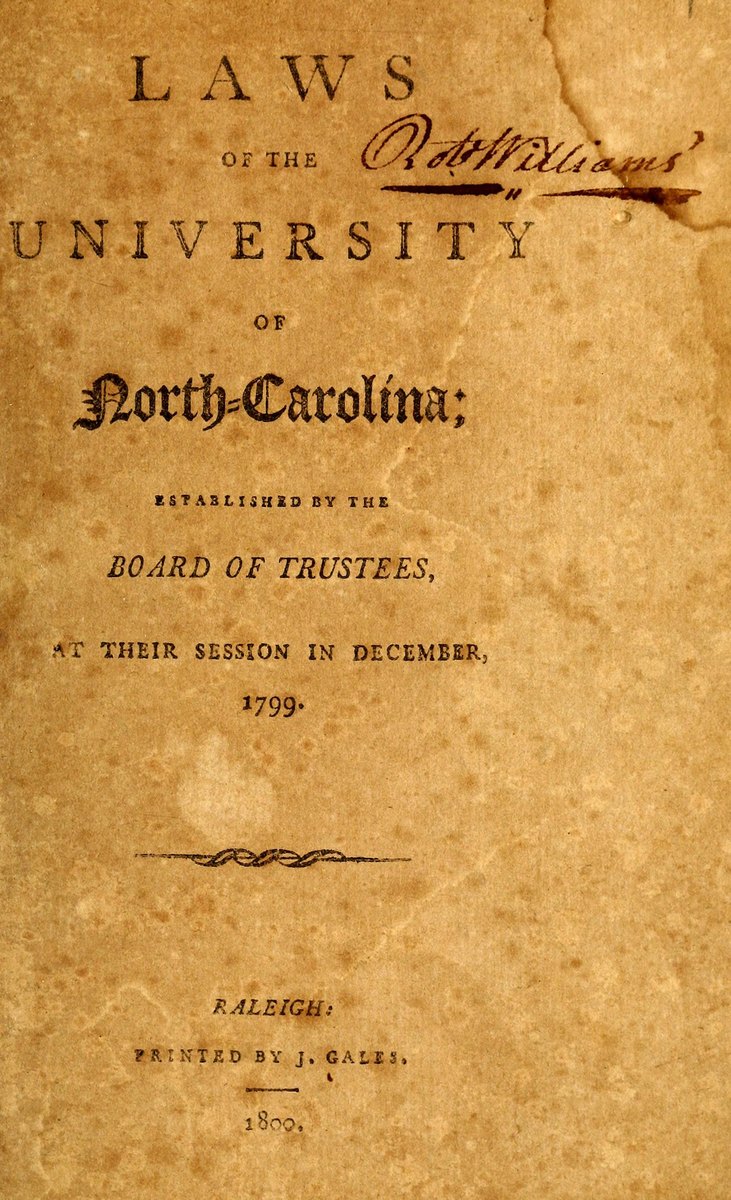
In the term before the 1799 commencement students beat principal Gillaspie, waylaid and stoned tutor William E. Webb and threatened Joseph Caldwell and Archibald Murphey, and exercises stopped for a week. Three leaders were dismissed, the faculty offered to resign, and by November Caldwell was chosen again to head the university. Complaints about the food at Steward's Hall had helped fuel the uprising, and in 1801 steward Pleasant Henderson's house was stoned. After a duel in the spring of 1803 Samuel G. Hopkins was expelled for fighting and John H. Hawkins for acting as second, and the trustees ordered that anyone in a duel be expelled and handed to the civil authorities. At the 1804 commencement ball Hyder Ally Davie stabbed Henry Chambers of Salisbury in the neck with a penknife, and the trustees, among them William R. Davie and William Polk, tried the case in the chapel the next day.
In 1805 a trustees' law made student monitors swear to report every breach of the rules. About forty-five students signed a remonstrance and left, and on September 3 Henderson wrote to trustee Walter Alves urging the board to act. The board repealed the law unanimously in December, but few of the seceders came back. In 1807 the trustees barred anyone expelled from another college and sent the ordinance to every college president in the country. In 1808 the faculty suspended John R. Stokes and Elias Foord for refusing to sign a milder version of a petition over the commons food. After an outbreak in 1811 every senior but John A. Ramsey forfeited his diploma, and the commencement conferred only an honorary A.B. on him.
In January 1814, after night raids on President Chapman's stable, cart and gate, Caldwell asked justice Pleasant Henderson for a general warrant; refused, he named five students, and a hearing questioned the student body under oath. On September 18, 1816 senior William B. Shepard spoke Republican passages Chapman had struck from his oration, students backed him, and the trustees expelled Shepard and George C. Dromgoole. In October someone left a brass door knob filled with powder at tutor John Patterson's door; a student dropped it moments before it went off, and no one was hurt. In December 1817 the trustees ordered the faculty to prosecute the offenders in the courts for "the late outrages on the buildings of the University & grove." In September 1818 three drunken students broke into a village kitchen, beat an enslaved man there and insulted the man who held him and his family, and were suspended for four months. In February 1819, after Walker Anderson's Washington's Birthday oration, a dinner ended in fighting and a peacemaker was stabbed in the arm, and the students had to hand in six pistols and two dirks.
Reading on the places and people in this storyline
No indexed work is about this storyline itself yet. These are about the sites and people its dated events name, those named most often first, so they may discuss the storyline only in part. Follow a link to find a copy or view the material.
A meeting of the citizens of Hillsborough was held on Friday the 30th instant, to adopt resolutions expressive of their feelings on occasion of the death of the late Rev. Dr. Caldwell, president of the university.
1835
Resolutions adopted by a meeting of Hillsborough citizens on Friday 30 January 1835, on the death of Joseph Caldwell, president of the University of North Carolina, who died that year. Signed at the end by W. J. Bingham as secretary and dated 31 January 1835. Printed at Hillsborough, it is a single sheet of civic mourning from Orange County.
University of North Carolina at Chapel Hill, Morehead Planetarium and Science Center
North Carolina ECHO (Project) · 2002
Exhibit text on Joseph Caldwell, founder of the Caldwell Observatory at UNC and the university's first president, photographed at the Morehead Planetarium on 30 May 2002 for the North Carolina ECHO project.
NC Digital Collections record courtesy of the North Carolina Department of Natural and Cultural Resources.
The two Caldwell monuments on the campus of the University of North Carolina
Battle, Kemp P. (Kemp Plummer), 1831-1919 · 1902
Kemp P. Battle's 1902 account of the two monuments to Joseph Caldwell, the university's first president, on the Chapel Hill campus. Battle lived from 1831 to 1919. Detached from the December 1902 University of North Carolina Magazine and signed by Battle, it was published by the Dialectic and Philanthropic Literary Societies.
Oration on the life and character of the Rev. Jos. Caldwell, D.D. late president of the University of North Carolina : delivered at the request of the executive committee, before the trustees, the faculty and the students in Person Hall, on the 24th of June, 1835
Anderson, Walker, 1801-1857 · 1835
Walker Anderson's oration on Joseph Caldwell, the University of North Carolina's first president, given in Person Hall on 24 June 1835 before the trustees, faculty and students at the executive committee's request. J. Gales and Son printed it in Raleigh the same year.
Plan of the Village of Chapel Hill on a scale of 200 yards to an Inch--Copy from a Plot in the Possession of William Pannill which was taken from the Plot of John Craig, Esq.
1817
Hand-drawn plan of the village of Chapel Hill in 1817 at 200 yards to the inch, copied from a plot owned by William Pannill that was itself taken from John Craig's survey. It locates the University of North Carolina and names neighboring landowners, among them Joseph Caldwell, William Hooper, Pleasant Henderson and James Hogg.
Henderson, Major Pleasant: photographs (Chapel Hill Historical Society)
Photograph of a drawn likeness of Major Pleasant Henderson, the first steward of the University of North Carolina, undated. From the UNC Faculty and Administration binder in the Chapel Hill Historical Society's Prints and Photographs Collection.
About William Polk · named in 3 of this story’s entries
Senate Joint Resolutions (August 12-19)
North Carolina. General Assembly · 1778
Joint resolutions of the North Carolina Senate from 12 to 19 August 1778, 47 images. They include setting up a Board of Auditors, paying Thomas Owen, a rejected plan to let county courts call out militia against Tories, and leave for Col. Ebenezer Folson to sell public guns. Hillsborough figures in the session's business.
NC Digital Collections record courtesy of the North Carolina Department of Natural and Cultural Resources.
Memoir of Hon. Archibald D. Murphey : late a judge of the Superior Court of North Carolina
Graham, William A. (William Alexander), 1804-1875 · 1860 · Dialectic and Philanthropic Societies
A memoir of Archibald D. Murphey, late a judge of the Superior Court of North Carolina, who died in 1832. William A. Graham wrote it, and the Dialectic and Philanthropic Societies published it at Chapel Hill in 1860 after it appeared in the August number of the North Carolina University Magazine.
Archibald Debow Murphey (1777-1832) Papers
Murphey, Archibald D. (Archibald De Bow), 1777-1832 · 1797
Papers of Archibald D. Murphey, the Orange County lawyer, state senator, superior court judge and historian, 1797 to 1852. Many of the letters are ones William Henry Hoyt gathered for his two-volume edition of Murphey's papers, published in Raleigh in 1914. Topics include court cases, internal improvements, the western lands, the university trustees, and friends in Louisiana and the Mississippi Territory in 1811 and 1812. State Archives of North Carolina, PC.12.
Miscellaneous Collection
State Archives of North Carolina. Private Manuscripts Archivists · 1689
The State Archives' Miscellaneous Collection: letters, deeds, land grants, surveys, wills, leases and other single items dating from 1689 to 2017, some as photocopies or transcripts from other repositories. Writers and subjects vary widely, governors and generals among them, and Orange County figures among the many places touched.
Wider background: UNC & Campus Life · the most widely held histories of the theme this storyline is filed under; they may not discuss it
Carolina Basketball: A Century of Excellence
Lucas, Adam · 2010 · University of North Carolina Press
Adam Lucas marks one hundred years of basketball at the University of North Carolina in this illustrated history, published by UNC Press in 2010 in association with the athletics department. Chapters follow the program from the game's arrival on campus and the 'White Phantoms' of the Southern Conference through the founding of the ACC, the 1957 season, Dean Smith's changes to the game and the title seasons of 1982, 1993, 2005 and 2009, closing with a century of statistics. 289 pages.
Chapel Hill Murder and Mayhem
Jackson, Rick · 2023
Rick Jackson's true crime history of Chapel Hill, published by The History Press in 2023, in 28 short chapters. Cases include the Efland bank robbery, the execution of John Henry Breeze, the unsolved murder of Suellen Evans, the killing at the Internationalist Bookstore and the death of Eve Carson.
The Blue Divide: Duke, North Carolina, and the Battle on Tobacco Road
Moore, Johnny; Chansky, Art · 2014 · Triumph Books
The Duke and North Carolina basketball rivalry written together by Johnny Moore and Art Chansky, the latter a sports reporter who has followed it since his student days at UNC. The book opens with the 2014 season and moves through recruiting battles old and new, 'Black and Blue Sunday', 'Blood and Roses', and chapters on the rivalry's heroes, leaders and teachers, with a foreword by Jay Bilas and a photo gallery. Published by Triumph Books in 2014, 289 pages.
Miss Mary's Money
Jones, H. G. · 2014 · McFarland & Co.
H. G. Jones follows the fortune of Mary Ruffin Smith (1814-1885), the unmarried heiress whose Orange and Chatham County lands passed at her death to the University of North Carolina and the Episcopal Church. Chapters profile her grandfather Francis Jones, then trace the bequest through a quarrel among Episcopalians over Price Creek, the Chapel of the Cross and the university's buildings. A December 1885 New York Times report called the gift money; Jones shows it was land. Published by McFarland in 2014, 231 pages.
The Chronicles of the Bicentennial Observance of the University of North Carolina at Chapel Hill
Tepper, Steven J. · 1998
Steven J. Tepper's chronicle of how the University of North Carolina marked its bicentennial in 1993 and 1994. An appendix reprints the University Day speeches of October 12, 1993, given by Paul Hardin, James B. Hunt Jr., C.D. Spangler, William C. Friday, Charles Kuralt and President Bill Clinton, plus bicentennial addresses by Li Lu, Francis S. Collins and Richard J. Richardson. Published by the university in Chapel Hill, 1998; 284 pages.
Game Changers
Chansky, Art · 2016
Art Chansky's 2016 account of Dean Smith, Charlie Scott and the years that changed Chapel Hill as a Southern college town. Scott was the first Black scholarship player in the Carolina basketball program. Topics include civil rights, racism in sports and the university's twentieth-century history.
Show 6 more
William Friday
Link, William A. · 1995
Biography of William C. Friday, president of the University of North Carolina system, by historian William A. Link, published by UNC Press in 1995 with the subtitle power, purpose, and American higher education. It covers Friday's career and the history of the university at Chapel Hill and statewide. Part of the Rebecca B. Wall Local History Collection.
Light on the Hill
Snider, William D. · 1992
William D. Snider's history of the University of North Carolina at Chapel Hill, published by the University of North Carolina Press in 1992. It runs 370 pages with illustrations, a bibliography and an index.
Reviewed in History of Education Quarterly (1993), The Journal of Southern History (1993).
Chapel Hill in Plain Sight
Athas, Daphne · 2010 · Eno Publishers
Twelve essays by novelist Daphne Athas (1923-2020) on the Chapel Hill she knew across the twentieth century. Subjects include Carrboro as 'the Paris of the Piedmont', philosopher Horace Williams, Betty Smith writing in Chapel Hill, Junius Scales, Ab Abernethy and the Intimate Bookshop, Richard Wright's visit, and a set of Chapel Hill murders. Published 2010, 243 pages with illustrations.
What it means to be a Tar Heel: Roy Williams and North Carolina's greatest players
Fowler, Scott · 2010 · Triumph Books
Scott Fowler gathers recollections from Carolina basketball players, decade by decade from the 1950s to the 2000s, organized around Roy Williams and the question in the title. Contributors include Lennie Rosenbluth, Larry Brown, Billy Cunningham, Charlie Scott, Phil Ford, James Worthy, Brad Daugherty, Eric Montross, Vince Carter, Antawn Jamison, Raymond Felton and Sean May, each entry giving position and playing years. Published 2010 by Triumph Books of Chicago, 270 pages, here as an e-book.
The Campus of the First State University
Henderson, Archibald · 1949
Archibald Henderson's history of the campus of the University of North Carolina at Chapel Hill, its buildings and grounds from the founding in the 1790s onward. Henderson, a professor of mathematics and a prolific historian of the university, wrote it in the years around the university's sesquicentennial. Published by the University of North Carolina Press in 1949, 412 pages with illustrations and bibliographical footnotes.
Reviewed in The Journal of Southern History (1949), South Atlantic Quarterly (1950).
The Woman Who Rang the Bell: The Story of Cornelia Spencer Phillips
Russell, Charles Phillips · 1949
Charles Phillips Russell's biography of Cornelia Phillips Spencer (1825-1908), the Chapel Hill writer remembered for ringing the bell of South Building when the university reopened in 1875 after its closure during Reconstruction. It doubles as a history of Chapel Hill and the university. Published by the University of North Carolina Press in 1949, 293 pages with illustrations.
Reviewed in Journal of American History (1949).