Skip to content

Storyline · 1973–1992

The town, the University and paying for the buses, 1973–1992

Chapel Hill voters approved bonds and a tax for town buses in 1973, and from 1974 the University bought bus passes to pay for campus service. In 1976 and 1977 the town and the University bargained over the price as night service was cut and partly restored, UNC stopped giving free passes with parking permits and the Faculty Council declined to back the system. In 1977 shared-ride taxis replaced the night buses, and the University signed its contract only after a dispute over them. The council raised fares or pass prices each year from 1980 to 1984, beginning with a 62.5 percent rise to meet fuel and operating costs, and student pass sales fell by almost half after the 1980 increase. In 1986, fearing federal cuts to the buses, the town raised its transportation tax to 7 cents. Fares rose again in 1990. In 1992, after a federal cut left the system about $600,000 short, the state gave it $400,000.

1973–1992 Part of From campus buses to Chapel Hill Transit, 1968–1990 29 dated events

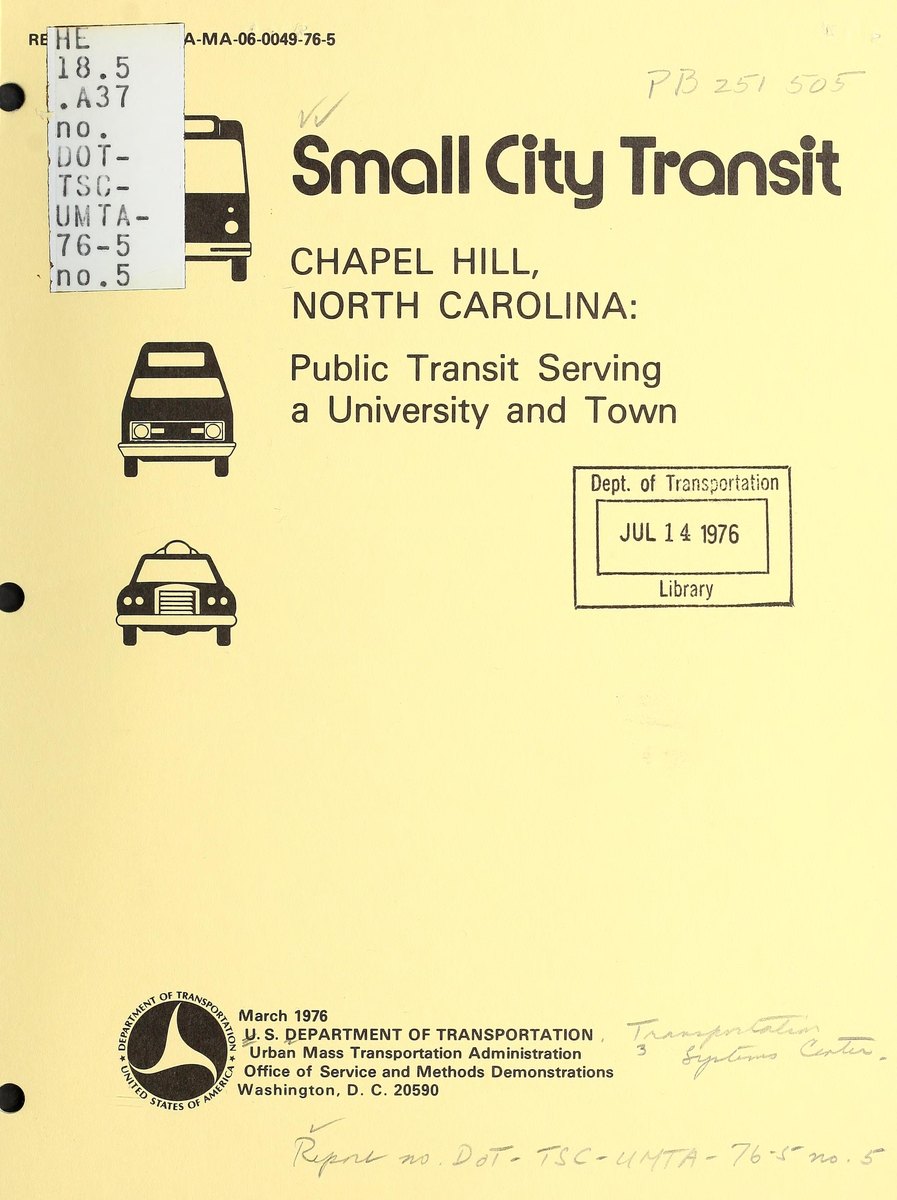
Federal report on Chapel Hill transit serving the university and town, March 1976
Federal report on Chapel Hill transit serving the university and town, March 1976United States Department of Transportation, Transportation Systems Center; Internet Archive · Public domain · Source

On February 20, 1973 Chapel Hill voters approved $350,000 in bonds for buses and facilities, 3,366 to 1,739, and a property tax of up to 10 cents per $100 to cover the system's expected losses, 3,242 to 1,856. On March 25, 1974 the Board of Aldermen voted 5 to 1 for a contract under which the University would pay $300,000 the first year for campus service and shuttles to commuter lots at Horace Williams Airport and University Mall, raised by selling bus passes to students and employees. On April 12 the trustees approved it for the system due to start August 1 and adopted a parking plan that roughly halved the permits sold and bundled a bus pass with each permit.

On March 22, 1976 the aldermen approved the principles of the next year's agreement: the University would buy $360,000 in passes instead of the $509,000 the town had asked and would stop giving a pass with each parking permit, and to cover an 11 percent rise in operating costs night service would end after 7 p.m. on all town routes but the U campus route, which would shut down at 11:30 p.m. instead of 1:30 a.m. After student leaders protested the earlier U shutdown as a danger to women, Vice Chancellor Claiborne Jones said on April 1 that the University would buy another $6,200 in passes to keep the route running to 1:30 a.m. With summer ridership down about 65 percent, the system dropped the S and A routes for the summer on May 15 and laid off 21 drivers on May 21. On June 14 the aldermen raised the bus tax from 7.5 cents to the full 10 cents, restoring rush-hour service on two routes, night service to 9:30 p.m. on most routes and more Sunday service. From July 1, after the town raised its price to the University for a pass from $30 to $40, UNC charged $18 for a bus pass bought with a parking permit and $36 without one.

That November, after Mayor James Wallace called the system's $500,000 yearly loss unacceptable, more than 50 student leaders backed keeping a high level of service even at higher parking fees, and a Student Government petition had about 2,000 signatures by November 30. The Faculty Council tabled chairman E. Maynard Adams's resolution for continuing the system on November 19, and on February 18, 1977 it defeated, 22 to 16, a resolution supporting the chancellor's efforts toward a full-service system. On June 13 the aldermen adopted a $946,125 bus budget. After a month-long dispute in which the town sought $400,000 and the University offered $338,000, the aldermen accepted Wallace's compromise 4 to 3, and on July 25 Vice Chancellor Claiborne S. Jones announced that the University would pay $366,000, the same as the year before, with the town paying the difference and promising not to cut service to University riders.

On August 22 the town replaced its night buses with shared-ride taxis for bus-pass holders, weeknights from 7 p.m. to midnight; they carried about 40 riders a night, against about 190 on the night buses the fall before. Vice Chancellor John Temple refused on September 6 to sign the contract because of the change, but on September 30 he signed a letter of agreement from Town Manager Kurt Jenne: the University would buy at least $366,200 in passes for Chapel Hill and $30,200 for Carrboro, and the taxis would be evaluated by October 31 and changed if they averaged fewer than 100 riders a night. With the taxis carrying about 50 to 75, the town said in November that pass holders would ride them free from November 16, the town paying the cab company's 25-cent surcharge.

On May 26, 1980 the Town Council voted 8 to 1 to raise Chapel Hill Transit's pass prices and fares by 62.5 percent from July 1 to meet rising fuel and operating costs, setting a 12-month pass at $79, a nine-month pass at $65 and the adult fare at 35 cents; Joe Straley, who had proposed smaller increases, cast the only vote against, and Student Government protested that a bus pass would now cost more than a campus parking permit. That fall, with the students' price for an academic-year pass up from $36 to $60, students bought 47 percent fewer of them, and overall pass sales fell from about 4,400 in fall 1979 to 3,200, though ridership rose 4 percent from July to December; the University had paid the town $650,000 for bus service the year before. On June 22, 1981 the council voted 7 to 2 to raise the cash fare to 40 cents and the year pass to $90 from July 1, with route changes for August. Because the 1980 census put Chapel Hill and Carrboro in the Durham urbanized area, the towns were to move on April 1, 1982 from federal Section 18 transit aid for non-urban areas to Section 5 urban aid, with Durham receiving the money and sharing it through a metropolitan planning organization the two towns would join.

On July 16, 1982, under the council's 1982–83 budget, fares went from 40 cents for every ride to 40 cents in normal hours and 50 cents at peak hours, and the student bus pass rose from $95 to $112; in March 1983 transit staff told the Transportation Board that fares might rise again if federal aid fell short. The $12.7 million budget the council adopted on June 27, 1983, with no tax increase, raised the 12-month adult full-service pass from $112.50 to $135 and the nine-month pass to $109.75, while single fares stayed at 50 cents at peak hours and 40 cents off-peak. On May 29, 1984, on Town Manager David Taylor's recommendation, the council voted unanimously to raise off-peak fares from 40 to 50 cents for adults and from 20 to 25 cents for older riders, youths and people with disabilities; council members Marilyn Boulton and Jonathan Howes noted the transportation board's fear of lost riders, and Mayor Joe Nassif said the council had chosen to raise fares gradually. By August 1986, fearing federal cuts to Chapel Hill Transit, the town had raised its transportation tax 1.5 cents to 7 cents per $100 of valuation, which, with Congress blocking the cuts, left a surplus of about $140,000.

By July 1990 Chapel Hill Transit had raised its fare for trips around the University from 25 to 30 cents and on other town routes from 50 to 60 cents; ridership, more than 2.5 million the year before, still rose that July. By November 12, 1991 the commissioners of Orange, Durham and Wake counties had unanimously approved a $5 yearly tax on vehicle registrations to pay the operating costs of the two-year-old Triangle Transit Authority, expected to raise $2.8 million in 1992-93 for expanded bus service and, in the long run, perhaps light rail. Commissioner Verla Insko said a tax on rental cars, the original proposal, would have been fairer, and the Chapel Hill Town Council was asked to give $9,000 toward the authority's coming budget. On March 10, 1992, after the Federal Transit Administration cut its allocation on the reasoning that the growing urban area's fares should cover more of the cost, the Carrboro aldermen authorized town officials to ask the state for help with a $600,000 shortfall in the Chapel Hill transit system. Carrboro's share of the gap was $85,000, to be met otherwise by higher fares or property taxes or by cutting routes, hours or staff. By April 7 transportation director Bob Godding said the state would give the bus system $400,000 after the federal government moved Chapel Hill into a larger size class with less federal aid, leaving the budget about $120,000 short, and the council was weighing fare increases, among them raising trolley fares from 10 cents to 25 cents.

Towns
Chapel Hill, Carrboro
Sites
1
People with pages
7

The events, date by date

Every statement above comes from these dated entries in the chronology. Each links to its source.

  1. Chapel Hill voters approve bonds and a tax for a town bus system In a light turnout of about 30 percent, Chapel Hill voters approved $350,000 in bonds for buses and facilities, 3,366 to 1,739, and a property tax of up to 10 cents per $100 to cover the system's expected losses, 3,242 to 1,856. Both questions carried every precinct, with the widest margins in the student precincts of Country Club and East Franklin. Place: Chapel Hill · Also mentions: Country ClubSearch the index · The Daily Tar Heel, February 21, 1973, p. 1
  2. Chapel Hill aldermen approve the University's $300,000 contract for the town bus system After a week of bargaining with UNC administrators, the Board of Aldermen voted 5-1 to approve the expanded community bus plan, under which the University would pay $300,000 the first year, up from $250,000, for campus service and shuttles to commuter lots at Horace Williams Airport and University Mall, paid for by selling bus passes to students and employees. Alderman Sid Rancer voted no because he wanted a three-year contract; changes to campus and airport routes would need both parties' consent, and the trustees still had to approve the contract on April 12. Place: Municipal Building, Chapel Hill · Also named: Sid Rancer · Also mentions: Horace Williams Airport, University MallSearch the index · The Daily Tar Heel, March 26, 1974, p. 1
  3. UNC trustees commit $300,000 a year in bus passes to Chapel Hill's new transit system and adopt a new campus parking plan The trustees approved a contract committing the University to buy $300,000 in passes from the town bus system due to start August 1, in return for buses on two campus routes and shuttles to fringe lots at University Mall and Horace Williams Airport. They also adopted, with seven amendments, a parking plan that roughly halved the permits sold and bundled a bus pass with each $54 academic-year permit, and voted $1.75 million from the telephone reserve to retire the telephone company's bonds ahead of its sale. People: N. Ferebee Taylor Place: UNC Board of Trustees meeting, Chapel Hill · Also mentions: Horace Williams Airport, University MallSearch the index · The Daily Tar Heel, April 15, 1974, p. 1
  4. Chapel Hill aldermen approve a University bus-pass agreement that cuts night and Sunday service The Chapel Hill Board of Aldermen approved the principles of next year's bus agreement with the University, which would buy $360,000 in passes instead of the $509,000 the town had asked and would stop giving a bus pass with each parking permit. To cover an 11 percent rise in operating costs, the agreement ended night service after 7 p.m. on all town routes but the U campus route, moved the U route's shutdown from 1:30 a.m. to 11:30 p.m., cut back the S route and dropped Sunday service except on the F and U routes. Place: Chapel HillSearch the index · The Daily Tar Heel, March 24, 1976, p. 1
  5. The University buys more bus passes to keep late-night U route service after student protests After student leaders protested the planned 11:30 p.m. shutdown of the U bus between the library and South Campus as a danger to women, and the town admitted it had put the cost of the last two hours at about $45,000 instead of $6,200, Vice Chancellor Claiborne Jones said the University would buy another $6,200 in passes to keep the route running to 1:30 a.m. Night service on the town routes still ended at 7 p.m. Place: Chapel Hill · Also named: Claiborne Jones · Also mentions: South CampusSearch the index · The Daily Tar Heel, April 2, 1976, p. 1
  6. Chapel Hill's buses drop two routes for the summer and lay off 21 drivers With summer ridership down about 65 per cent, the Chapel Hill bus system began a summer schedule on May 15 that dropped the S (South Campus) and A (Airport Road) routes and cut night service, and on May 21 laid off 21 drivers, which had not been needed the summer before. Place: Chapel Hill · Also mentions: South Campus, Airport RoadSearch the index · The Daily Tar Heel, June 3, 1976, p. 3
  7. Chapel Hill aldermen raise the bus tax to the full 10 cents and restore bus service The Chapel Hill Board of Aldermen voted to levy the full 10-cent tax authorized by the bus referendum, up from 7.5 cents, adding $70,785 and bringing the bus system's budget to $995,150. The money restored rush-hour service on the D and N routes, night service to 9:30 p.m. on most routes and more Sunday service, and paid for another mechanic; adult passes were set at $40. Place: Chapel HillSearch the index · The Daily Tar Heel, June 17, 1976, p. 9
  8. UNC stops giving free bus passes with campus parking permits From July 1, 1976, the University charged $18 for a bus pass bought with a parking permit and $36 without one, ending the free passes it had given permit holders since the town bus system began, after Chapel Hill raised the price it charged the University for a pass from $30 to $40. The University budgeted $360,000 for bus passes for the year. Place: Chapel HillSearch the index · The Daily Tar Heel, June 3, 1976, p. 3
  9. UNC student leaders launch a petition backing bus service even at higher parking fees More than 50 UNC student leaders met and backed keeping a high level of Chapel Hill bus service even if it meant higher parking fees, after Mayor James Wallace called the system's $500,000 yearly loss unacceptable. Student Government then circulated a petition to the chancellor, the mayor and the aldermen that by November 30 had about 2,000 signatures. Place: Saunders Hall, University, Chapel Hill · Also named: James C. Wallace, James WallaceSearch the index · The Daily Tar Heel, November 12, 1976, p. 1
  10. UNC's Faculty Council tables a resolution backing the town bus system The UNC Faculty Council voted by more than two to one to table chairman E. Maynard Adams's resolution that the Chapel Hill bus system should be continued, saying it lacked information. The council approved a proposed Doctor of Public Health program in nutrition and sent it to the Board of Governors. People: E. M (Elie Maynard) Adams Place: University, Chapel HillSearch the index · The Daily Tar Heel, November 22, 1976, p. 1
  11. UNC's Faculty Council turns down a resolution backing a full-service bus system By a 22-16 vote the Faculty Council defeated a resolution by Population Center director Thomas L. Hall, written with three other faculty members and student transportation director Paul Arne, that would have supported the chancellor's efforts toward a full-service Chapel Hill bus system and listed concerns including cheaper bus passes, a sliding scale for campus parking and bus service to Carrboro. Some members said the council was not the place for political action on the buses, and economist Roger W. Waud urged raising parking fees instead of subsidizing buses. Place: University, Chapel Hill · Also named: Thomas L. Hall, Paul Arne, Roger W. WaudSearch the index · The Daily Tar Heel, February 21, 1977, p. 1
  12. Chapel Hill aldermen adopt a $946,125 transportation budget As part of the 1977-78 town budget, the Chapel Hill Board of Aldermen approved $946,125 for the bus system, below both the transportation board's $1,027,600 and Town Manager Kurt Jenne's $995,000. The town also offered $25,000 toward a fall experiment with more peak-hour service on three routes if the University put up $85,000. Place: Chapel Hill · Also named: Kurt JenneSearch the index · The Daily Tar Heel, June 16, 1977, p. 8
Show all 29 dated events
  1. UNC accepts Chapel Hill's compromise on paying for the buses Vice Chancellor Claiborne S. Jones announced that the University would pay $366,000 toward the 1977-78 Chapel Hill bus budget, the same as the year before, ending a month-long dispute in which the town sought $400,000 and the University offered $338,000. Mayor James C. Wallace had offered the compromise and the aldermen had accepted it 4-3, with the town paying the difference and promising not to cut service to University riders. Place: Chapel Hill · Also named: Claiborne S. Jones, James C. WallaceSearch the index · The Daily Tar Heel, July 28, 1977, p. 4
  2. Chapel Hill Transit replaces its night buses with a shared-ride taxi service Chapel Hill ended fixed-route night bus service and began a shared-ride taxi service for bus-pass holders, run weeknights from 7 p.m. to midnight with cabs hired from Carolina Cab Co. Riders called an hour ahead and paid 25 to 75 cents. The taxis carried about 40 riders a night, against about 190 on the night buses the fall before. Place: Chapel HillSearch the index · The Daily Tar Heel, September 13, 1977, p. 1
  3. UNC refuses to sign the town bus contract until night service is restored Vice Chancellor John Temple said the University would not sign its bus service contract with Chapel Hill, under which it was to pay about $400,000, because the town's final proposal dropped fixed-route night buses in favor of shared-ride taxis. The dispute left the summer compromise reached through Mayor James C. Wallace unsigned into late September. Place: Chapel Hill · Also named: John Temple, James C. WallaceSearch the index · The Daily Tar Heel, September 7, 1977, p. 1
  4. UNC signs its bus contract with Chapel Hill, accepting night taxis for a trial Vice Chancellor John L. Temple signed a letter of agreement from Town Manager Kurt Jenne ending months of talks: the University would buy at least $366,200 in bus passes for service in Chapel Hill and $30,200 for Carrboro in 1977-78. The shared-ride taxis that had replaced night buses would be evaluated by Oct. 31 and changed if they averaged fewer than 100 riders a night. Place: Chapel Hill · Also named: John L. Temple, Kurt J. Jenne, Kurt JenneSearch the index · The Daily Tar Heel, October 4, 1977, p. 1
  5. Chapel Hill drops the surcharge on its shared-ride night taxis With the shared-ride taxis that had replaced night bus service carrying about 50 to 75 riders a night, short of the 100 set in the town's contract with the University, Transportation Director Bob Godding confirmed that bus pass holders would ride free between bus stops from November 16, with the town paying the cab company the 25-cent surcharge instead. Place: Chapel Hill · Also named: Bob GoddingSearch the index · The Daily Tar Heel, November 11, 1977, p. 1
  6. The Chapel Hill Town Council raises bus pass prices and fares by 62.5 percent The council voted 8 to 1 to raise Chapel Hill Transit's pass prices and fares by 62.5 percent from July 1, setting a 12-month pass at $79, a nine-month pass at $65 and the adult fare at 35 cents to meet rising fuel and operating costs. Joe Straley, who had proposed smaller increases, cast the only vote against; Student Government protested that a bus pass would now cost more than a campus parking permit. People: Joe Straley, Jonathan Howes, R. D. Smith Place: Municipal Building, Chapel HillSearch the index · The Daily Tar Heel, May 29, 1980, p. 6
  7. UNC student bus pass sales fall by nearly half after a price rise A University Traffic Office report showed students bought 47 percent fewer academic-year bus passes in fall 1980 after the price rose from $36 to $60; overall pass sales fell from about 4,400 in fall 1979 to 3,200. Chapel Hill Transit ridership still rose 4 percent from July to December 1980; the University had paid the town $650,000 for bus service the year before. Place: Chapel Hill · Also mentions: Chapel Hill TransitSearch the index · The Daily Tar Heel, February 6, 1981, p. 1
  8. Chapel Hill raises bus fares to 40 cents and reshapes its routes The Town Council voted 7 to 2 to raise Chapel Hill Transit's cash fare from 35 to 40 cents from July 1 and the year pass from $79 to $90, and approved route changes for August: the A route rerouted, the K express to Kroger Plaza dropped, and more D, G and evening FL service. Place: Municipal Building, Chapel Hill · Also mentions: Kroger PlazaSearch the index · The Daily Tar Heel, June 25, 1981, p. 5
  9. The 1980 census puts Chapel Hill and Carrboro in the Durham urbanized area, changing their transit funding Because the 1980 census placed Chapel Hill and Carrboro in the Durham urbanized area, the towns were to move from federal Section 18 transit aid for non-urban areas to Section 5 urban aid on April 1, 1982, with Durham receiving the money and sharing it through a metropolitan planning organization the two towns would join. Place: Chapel Hill and CarrboroSearch the index · The Daily Tar Heel, January 27, 1982, p. 3
  10. Chapel Hill Transit charges 50 cents for peak-hour rides Under a Town Council increase in the 1982-83 budget, Chapel Hill Transit fares rose on July 16, 1982, from 40 cents for every ride to 40 cents in normal hours and 50 cents at peak hours, and the student bus pass went from $95 to $112. In March 1983 transit staff told the Transportation Board fares might rise again if federal aid fell short. Place: Chapel Hill · Also mentions: Chapel Hill TransitSearch the index · The Daily Tar Heel, March 18, 1983, p. 3
  11. Chapel Hill adopts a $12.7 million budget with no tax increase and dearer bus passes On June 27, 1983, the Chapel Hill Town Council adopted a $12.7 million budget for 1983-84 with no tax increase, as Town Manager David Taylor had proposed in May with staff positions reshuffled rather than cut. The budget raised the price of Chapel Hill Transit full-service passes, the 12-month adult pass from $112.50 to $135 and the nine-month pass to $109.75, while single fares stayed at 50 cents at peak hours and 40 cents off-peak. Place: Municipal Building, Chapel Hill · Also named: David Taylor · Also mentions: Chapel Hill TransitSearch the index · The Daily Tar Heel, August 29, 1983, p. 5
  12. Chapel Hill raises off-peak bus fares despite its transportation board's warning The Chapel Hill Town Council voted unanimously to raise off-peak bus fares from 40 to 50 cents for adults and from 20 to 25 cents for older riders, youths and people with disabilities, on Town Manager David Taylor's recommendation. Council members Marilyn Boulton and Jonathan Howes noted the transportation board's fear of lost riders; Mayor Joe Nassif said the council chose to raise fares gradually. People: Jonathan Howes Place: Town Council, Chapel Hill · Also named: David Taylor, Marilyn Boulton, Joe NassifSearch the index · The Daily Tar Heel, May 31, 1984, p. 1
  13. Chapel Hill raises its transportation tax 1.5 cents to 7 cents Fearing federal cuts to Chapel Hill Transit, the town raised its transportation tax 1.5 cents to 7 cents per $100 of valuation, which with Congress blocking the cuts left a surplus of about $140,000. Place: Chapel Hill · Also mentions: Chapel Hill TransitSearch the index · The Daily Tar Heel, August 21, 1986, p. 5
  14. Chapel Hill Transit raises its bus fares Chapel Hill Transit raised its fare for trips around the University from 25 to 30 cents and on other town routes from 50 to 60 cents; ridership, more than 2.5 million the year before, still rose that July. Place: Chapel Hill · Also mentions: Chapel Hill TransitSearch the index · The Daily Tar Heel, September 4, 1990, p. 2
  15. Orange County commissioners approve a $5 vehicle registration tax for the Triangle Transit Authority Commissioners in Orange, Durham and Wake counties unanimously approved a $5 yearly tax on vehicle registrations to pay the operating costs of the two-year-old Triangle Transit Authority, expected to raise $2.8 million in 1992-93 for expanded bus service and, in the long run, perhaps light rail. Commissioner Verla Insko said a tax on rental cars, the original proposal, would have been fairer, and the Chapel Hill Town Council was asked to give $9,000 toward the authority's coming budget. Place: Orange County · Also named: Verla InskoSearch the index · The Daily Tar Heel, November 12, 1991, p. 1
  16. Carrboro aldermen seek state aid to cover a $600,000 transit shortfall The Carrboro Board of Aldermen authorized town officials to ask the state for help with a $600,000 shortfall in the Chapel Hill transit system after the Federal Transit Administration cut its allocation on the reasoning that the growing urban area's fares should cover more of the cost. Carrboro's share of the gap was $85,000, to be met otherwise by higher fares or property taxes or by cutting routes, hours or staff. People: Alex Zaffron, Jacquelyn Gist Place: Town Hall, CarrboroSearch the index · The Daily Tar Heel, March 12, 1992, p. 3
  17. Chapel Hill Transit receives a $400,000 state subsidy after a federal funding cut Transportation director Bob Godding said the state would give the bus system $400,000 after the federal government moved Chapel Hill into a larger size class with less federal aid, leaving the budget about $120,000 short; the council was weighing fare increases, including raising trolley fares from 10 cents to 25 cents. Place: Chapel Hill · Also named: Bob GoddingSearch the index · The Daily Tar Heel, April 8, 1992, p. 3

Places in this storyline

Buildings, schools, churches and other sites named in the dated events on this page, the most often named first.

All places and the county map →

People in this storyline

People with a page of their own whom the dated events above name, those named most often first.

Reading on the places and people in this storyline

No indexed work is about this storyline itself yet. These are about the sites and people its dated events name, those named most often first, so they may discuss the storyline only in part. Follow a link to find a copy or view the material.

About Chapel Hill Transit · named in 8 of this story’s entries

Town of Chapel Hill transit development program update, 1981-1986

Chapel Hill (N.C.) · 1981 · Town of Chapel Hill

Update to the Town of Chapel Hill's transit development program, covering 1981 through 1986 and published by the town in 1981. It sets out local transit and transportation planning for those years.

UNC

Town of Chapel Hill, transit development plan, 1979-1984

Chapel Hill (N.C.) · 1979 · Town of Chapel Hill

The Town of Chapel Hill's transit development plan for 1979 through 1984, dated July 1979 on the cover and published by the town. It covers buses, Chapel Hill Transit and local transit planning.

UNC

Public response to the Chapel Hill bus system

Gilbert, Gorman, 1943-; Foerster, James F.; University of North Carolina at Chapel Hill. Department of City and Regional Planning · 1975 · Dept. of City and Regional Planning, University of North Carolina

Survey report on how riders and residents viewed the Chapel Hill bus system, prepared by Gorman Gilbert and James F. Foerster for the Department of City and Regional Planning at the University of North Carolina in 1975. The final report of a transit evaluation project, and it deals with public opinion on bus lines in Chapel Hill.

UNC

Technical and feasibility study of public mass transportation service for the Chapel Hill-Carboro-UNCCH, North Carolina urban area : prepared for the towns of Chapel Hill and Carrboro, North Carolina, the C-CH-UNCCH Joint Public Transportation Commission, and the UNC Student Government

Kimley-Horn and Associates · 1972 · Kimley-Horn Associates

Feasibility study for public mass transportation in the Chapel Hill, Carrboro and University of North Carolina area, prepared in September 1972 by Kimley-Horn and Associates of Raleigh for the two towns, the joint transportation commission and the university student government. Seventy eight pages with illustrations. It records how bus service for the towns and the campus was first costed and planned.

UNC

About Jonathan Howes · named in 2 of this story’s entries

Talk by Jonathan Howes, 1998 (Chapel Hill Historical Society cassette)

1998

Jonathan Howes, a former mayor of Chapel Hill who served in Governor Hunt's cabinet and later worked in the UNC chancellor's office on urban planning, gave this illustrated talk on the past and future of the Chapel Hill campus. Cassette, 1998.

Wider background: Roads, Rail & Transportation · the most widely held histories of the theme this storyline is filed under; they may not discuss it

Orange County, N.C. bridge records 1787-1865

Dunaway, Stewart E. · 2013

Stewart E. Dunaway's compilation of Orange County road and bridge papers concerning county bridges between 1787 and 1865. It reproduces documents in facsimile, with maps and partial transcriptions, and provides names useful for genealogical research. First compiled in two volumes in 2008, then combined and updated, this 2013 edition has 253 pages, 28 cm.

Farewell forever, old road to Durham : lessons from the history of transportation planning in the North Carolina Piedmont

Chilton, Mark · 2012 · Hand Made Books

Mark Chilton's short history of transportation planning in the North Carolina Piedmont, drawing lessons from earlier projects. Subjects include the Cape Fear Navigation Company and river navigation, and the railroads of Chapel Hill and Carrboro, including the State University Railroad Company whose spur brought trains to the two towns. Chilton was mayor of Carrboro when the book appeared. Published by Hand Made Books, Carrboro, 2012, 92 pages with illustrations, maps and portraits.

Orange County, N.C. Road Records

Dunaway, Stewart E. · 2008

Three volumes of historic Orange County road records compiled by Stewart E. Dunaway and self-published through Lulu.com in 2008, with maps. The documents, reproduced as facsimiles and sometimes transcribed, include petitions for new roads, requests for road upkeep, bridge records and papers explaining why roads were rerouted. Road petitions name the householders along a route. The third volume also gathers records connected with Cyrus Guy's lynching in Orange County in 1869.

Orange County, North Carolina, road records

Dunaway, Stewart E. · 2009

Three volumes of Orange County road records assembled by Stewart E. Dunaway from the original petitions, orders and maps at the North Carolina State Archives, reproduced in facsimile with partial transcriptions. Volume 1 covers 1786 to 1820, volume 2 1820 to 1849 and volume 3 1850 to 1883. The papers document the laying out and upkeep of county roads and name the residents involved. June 2009 update, distributed through Lulu, 28 cm.

Orange County, North Carolina Lost Deeds Records (1752-1769,1793)

Dunaway, Stewart E. · 2013

Stewart E. Dunaway's 2013 compilation of Orange County deed records outside the regular deed books, covering 1752 to 1769 and 1793. The loose papers include road petitions and cartway orders, providing material for county history, genealogy and the history of roads.

Orange County, N.C., road records. Volume I, 1786-1820

Dunaway, Stewart E. · 2010 · S.E. Dunaway

Stewart E. Dunaway's first volume of Orange County road records, reproducing documents and maps from the North Carolina State Archives for the years 1786 to 1820, with partial transcriptions, an index and a list of overseers. Road papers name the landowners along each route. Self-published in 2010, 348 pages.

UNC
Show 6 more

Freedom riders : 1961 and the struggle for racial justice

Arsenault, Raymond · 2006 · Oxford University Press

Raymond Arsenault's history of the 1961 Freedom Rides and the campaign against segregated interstate travel in the South. Published by Oxford University Press in 2006. Its North Carolina material reaches Chapel Hill, Durham, Greensboro and Charlotte, which is where the Orange County connection lies, and the wider subject is African American civil rights work, segregation in transportation and race relations through the twentieth century.

UNC

A taste of heaven : a collection of recipes

Cross Roads Baptist Church (Hillsborough, N.C.) · 2005 · Morris Press Cookbooks

Community cookbook from Cross Roads Baptist Church in Hillsborough, printed by Morris Press Cookbooks in 2005 in a three-ring binder. Recipes are credited to their contributors. The book includes Southern cooking, church history and material on the Family House of Chapel Hill. 124 pages of recipes plus front and back matter, with color illustrations.

UNC

Interviews With Residents on Fish Dam Road

Liles, Joe · 2004

Joe Liles's interviews with longtime residents of Fish Dam Road, an old rural road in Durham County, recorded in 2004, with subjects tied to both Durham and Orange counties. The interviewees are Charles Scott Harkey, Mary Scarlett Jones, Boyce Link and John Scarlett, all born between 1912 and 1920, and the topics include country life, the road's history and the Duke Power Company.

Footsteps on Franklin St. : a bicentennial celebration of life on the hill.

2003 · Chapel Hill news

Franklin Street through two centuries, gathered in a 24 page illustrated supplement the Chapel Hill News published on April 10, 1994 for the town's bicentennial. Topics include the street itself, town history and social life and customs. It belongs with the other bicentennial publications of 1993 and 1994 that treat the commercial center of Chapel Hill.

UNC

Occupants and Structures of Franklin Street, Chapel Hill, North Carolina at 5-Year Intervals, 1793-1998

Bryant, Bernard Lee · 1999 · Chapel Hill Historical Society

Bernard Lee Bryant's compilation of who occupied each structure on Franklin Street in Chapel Hill at five-year intervals from 1793 to 1998, issued by the Chapel Hill Historical Society in 1999 as a photocopy of his original computer printout on cotton paper. 191 leaves.

UNC

Skipper of the "Carrboro Limited" for 42 years

Holder, Glenn, 1906- · 1931

Glenn Holder's 1931 profile of Captain Fred Smith, who spent forty-two years as skipper of the train known as the 'Carrboro Limited' between Carrboro and Chapel Hill. Detached from the March 1931 issue of the university's Alumni Review, the piece recounts Chapel Hill railroad history. Smith lived from 1858 to 1939.

UNC

Research this storyline

Each dated event above names its source, the place to start. For finding more on an event across newspapers, records and histories, see the research guide Follow an event across several accounts. Ask at the North Carolina Room of the Orange County Public Library for help with local sources.

Cite or share

Friends of the Orange County Public Library. “The town, the University and paying for the buses, 1973–1992.” Orange County Indexed, https://focplnc.org/orange-county-books/storylines/paying-for-the-buses-storyline-1973/. Accessed October 22, 2026.

How to cite what you find

Suggest a correction or a source →

See these events in the full chronology All storylines

Two mice reading back to back against a leaf, with the hand-lettered words Friends of the Orange County Public Library
Illustration by Caldecott Medalist Matthew Cordell, gifted to the Friends 2026