
University Inn in Chapel Hill
Black-and-white photograph of the University Inn in Chapel Hill on fire in 1921, with a crowd of onlookers gathered to watch the hotel burn. From the Images of North Carolina collection.
Storyline · 1799–1994
By 1799 John Taylor Sr. had put up a tavern on Franklin Street, and the lot stayed in the hotel trade as the Eagle Hotel, the Chapel Hill Hotel and the University Inn. Nancy Hilliard added an annex for President Polk's 1847 visit. The University agreed to buy the inn in 1906, fire destroyed its main building in 1921 and Graham Memorial took the site, and in 1993 and 1994 UNC archaeologists dug up its foundations.
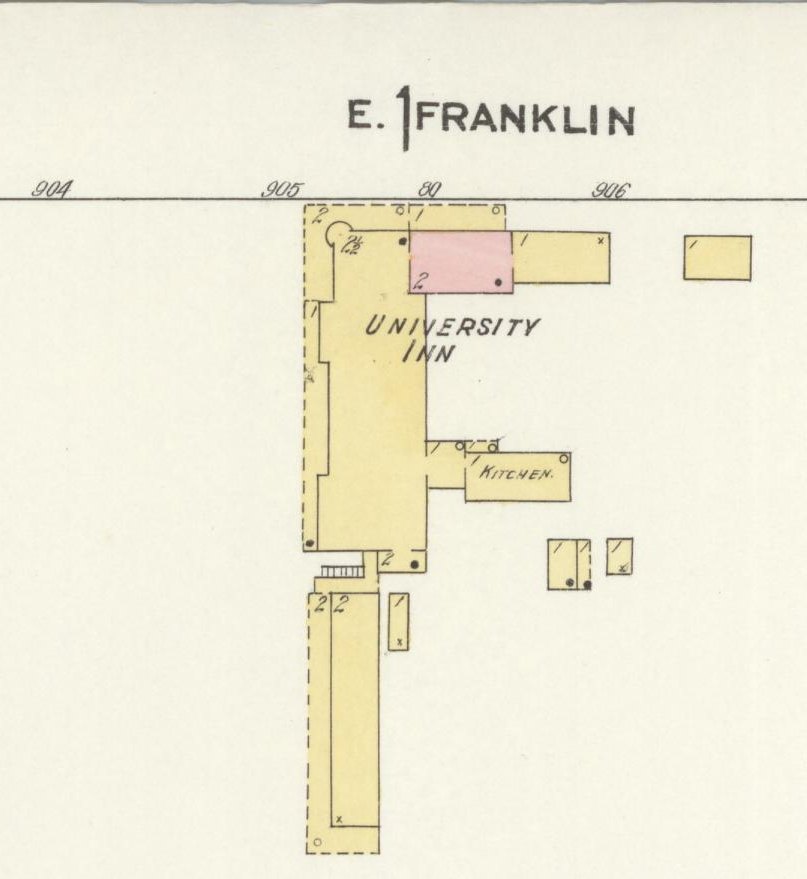
John Taylor Sr., a former steward, bought Lot 13 on Franklin Street in 1796 and by 1799 had put up a tavern on it. The lot stayed in the hotel trade for decades as Alsobrook's hotel, the Watts Hotel, the Eagle Hotel and the Union Hotel. In 1846 Lucy Watts sold the hotel and the land beside it to Nancy Hilliard, already known as a Chapel Hill hotel keeper. For President James K. Polk's visit to the 1847 commencement Hilliard added a stuccoed two-story wing with a battlemented porch in a medieval manner, on the site of today's Graham Memorial; Dabney Cosby likely built it.
Between 1869 and 1873 David McCauley bought the Union Hotel and renamed it the Chapel Hill Hotel. In 1892, with money from W. G. Peckham, a New York lawyer, John H. Watson and his partner W. W. Pickard tore down the old hotel except for the Polk apartment, rebuilt it and added a large new section called the University Inn Annex. At their June 1906 meeting the University trustees agreed to buy the University Inn for $19,700 to use for dormitories; the two-acre lot had sold for $200 in 1792. Pickard kept the hotel until early 1908, when the University put Addison Lambeth in charge. Fire on November 30, 1921 destroyed the main building and left 42 student roomers without quarters, but students on the roof with a hose saved the 1847 annex. Wreckers tore down the last of the old inn in early January 1924 to clear the site for Graham Memorial.
On September 2, 1993 the anthropology department began a Bicentennial excavation on the lawn between Graham Memorial and Franklin Street, seeking traces of the Eagle Hotel. By mid-September student excavators had found pottery, a pewter button, a large cent of a type last minted in 1857 and what might be a foundation trench, and by April 1994 anthropology professor Steve Davis and a teaching assistant had found the foundations of the tavern and hotel and a stone drain. The dig ended on May 27 after about ten months, having recovered more than 30,000 artifacts, among them coins and tokens as old as 1816-1819, gun flints, a writing slate, pig and cow bones and human teeth that Davis thought might point to a tavern dentist. The site was then filled back in.
Every statement above comes from these dated entries in the chronology. Each links to its source.
Buildings, schools, churches and other sites named in the dated events on this page, the most often named first. The map shows them all.
Map tiles © OpenStreetMap contributors. Site locations from the N.C. State Historic Preservation Office survey, Open Orange, Orange County GIS, OpenStreetMap and a few other published sources named on each site’s page; town and community pins show approximate locations.
People with a page of their own whom the dated events above name, those named most often first.
No indexed work is about this storyline itself yet. These are about the sites and people its dated events name, those named most often first, so they may discuss the storyline only in part. Follow a link to find a copy or view the material.
Black-and-white photograph of the University Inn in Chapel Hill on fire in 1921, with a crowd of onlookers gathered to watch the hotel burn. From the Images of North Carolina collection.
R. P. Stephen Davis Jr. of UNC's Research Laboratories of Archaeology spoke to the Chapel Hill Historical Society in 1999 on excavations on the campus at the sites of the Eagle Hotel and the poor house. Cassette.
Chapel Hill Hotel and its annex, with their porches, on a PCK Series postcard from Piedmont Supply Co., printed in Germany about 1905 to 1915. The writer's message on the back concerns travel plans: staying over in Shoskie and asking to be fetched with the horse on the afternoon of the 27th.
Portraits of W. W. Pickard and Betty Pickard, owners of the University Inn in Chapel Hill, dated 1900. One photograph in the Chapel Hill Historical Society's Prints and Photographs Collection.
A guide for students to Graham Memorial, the union building at the University of North Carolina, issued in 1974 by the union's board of directors in volumes of 19 centimeters with illustrations. It is a periodical about student unions in Chapel Hill. It sets out what the building offered undergraduates in the mid 1970s.
A serial publication of the board of directors of Graham Memorial, the student union at the University of North Carolina, issued in volumes of 19 centimeters with illustrations. The 1966 issue is signed at the end by Mayne Albright as director. Topics include student unions in Chapel Hill and the buildings of the university.
A single sheet folded to three unnumbered pages with one illustration, issued by the University of North Carolina and dated January 29, 1932, on the Graham Memorial Student Union at Chapel Hill. Topics include student unions in the town and the buildings of the university. Brief as it is, the leaflet marks a date in the building's early life.
Printed material on the Graham Memorial Building at the University of North Carolina, issued at Chapel Hill in 1924. Topics include college buildings, memorials and university planning in the town. One of several pieces surviving from the years when the student building was under discussion on the campus.
Undated portrait of Nancy Hilliard, one photograph in the Chapel Hill Historical Society's Prints and Photographs Collection (CHHS.002).
Lucile Noell Dula's guidebook to Hillsborough and its historic buildings, published by Pelican in 1989. It pairs a tour of the town with notes on its history, in 128 illustrated pages with a bibliography. Part of the Wall Local History Collection.
Robert Watson Winston's biography of Henry Horace Williams (1858-1940), who taught philosophy at the University of North Carolina for half a century, subtitled gadfly of Chapel Hill. Published by the University of North Carolina Press in 1942, 309 pages with frontispiece and portraits; this copy is autographed. Topics include educators in Chapel Hill and the university's history.
Reviewed in Social Forces (1943).
Margaret Ruth Little-Stokes's survey of Chapel Hill's town and campus buildings from 1795 to 1975, published by the Preservation Society of Chapel Hill in 2006. Chapters run from the first campus buildings through David Swain's romantic campus to midcentury modernism, followed by area surveys of the campus, east and west Chapel Hill, downtown, Northside and the suburbs.
Maurice M. Bursey's biography of Francis Preston Venable (1856 to 1934), chemist and president of the University of North Carolina, published by the Chapel Hill Historical Society in 1989. It also covers the history of the university's chemistry department. Illustrated, 111 pages, with bibliographies.
Reviewed in Isis (1992).
Architectural and historical inventory of Carrboro by Claudia Roberts Brown, published in 1983 by the Carrboro Appearance Commission and the town. The 48-page survey, with illustrations and maps, documents the town's historic buildings and their conservation.
John V. Allcott's history of the architecture of the University of North Carolina campus across two centuries, from the first buildings of the 1790s to the 1980s, published by the Chapel Hill Historical Society in 1986. A 108-page illustrated survey with a bibliography. Allcott taught art history at the university.
A history of the buildings on the University of North Carolina campus by John V. Allcott and JJ Bauer, published by the Chapel Hill Historical Society in 2019. It follows campus construction from the 1790s forward: the plans behind each building campaign, the architects, and the university figures who pushed projects through. 132 pages with photographs, maps and plans.
Jill Ridky-Blackburn's history of Coker Hills, a neighborhood in Chapel Hill, published by the Chapel Hill Historical Society in 2016. Chapters describe the land before the subdivision, the Coker who gave it its name, how the neighborhood began, the architects, builders and houses that shaped it, its legacy, memories of growing up there and the residents' later advocacy. Subjects include historic buildings in Chapel Hill. 242 pages with illustrations, portraits and a map.
Sarah Brandes Madry's history of the Old Well at the University of North Carolina at Chapel Hill, treating both its architecture and the ideas attached to it. It takes in drinking fountains and water use in Chapel Hill and the university's history, with a chapter on Edwin Anderson Alderman, the president under whom the well took its present form in 1897, and one on water at the university. Published by iUniverse in 2003, 399 pages with illustrations.
Allen Alexander Lloyd's history of Hillsborough from the town's founding in 1754 to 1966, published by the author in Hillsborough in 1966. 306 pages with illustrations, maps and portraits, dedicated to the best interest of our town. Topics include Hillsborough's history and biography, its historic buildings and Orange County history.
Brian Burns's collection of lesser-known episodes from Chapel Hill's past, published by The History Press of Charleston, South Carolina, in 2023. Topics include the town's history, its buildings and structures, and the history of civil rights in Chapel Hill. 158 pages with illustrations and portraits.
Kemp P. Battle's University Day address of 1883, delivered as president of the University of North Carolina on the day marking the laying of the Old East cornerstone. Battle goes building by building through the Chapel Hill campus, telling how each was named and why it stands where it does. Fifteen pages. Electronic edition issued 2005 by the UNC University Library for Documenting the American South.
Each dated event above names its source, the place to start. For finding more on an event across newspapers, records and histories, see the research guide Follow an event across several accounts. Ask at the North Carolina Room of the Orange County Public Library for help with local sources.
Friends of the Orange County Public Library. “The Eagle Hotel and University Inn site, 1799–1994.” Orange County Indexed, https://focplnc.org/orange-county-books/storylines/eagle-hotel-site-storyline-1799/. Accessed October 22, 2026.
