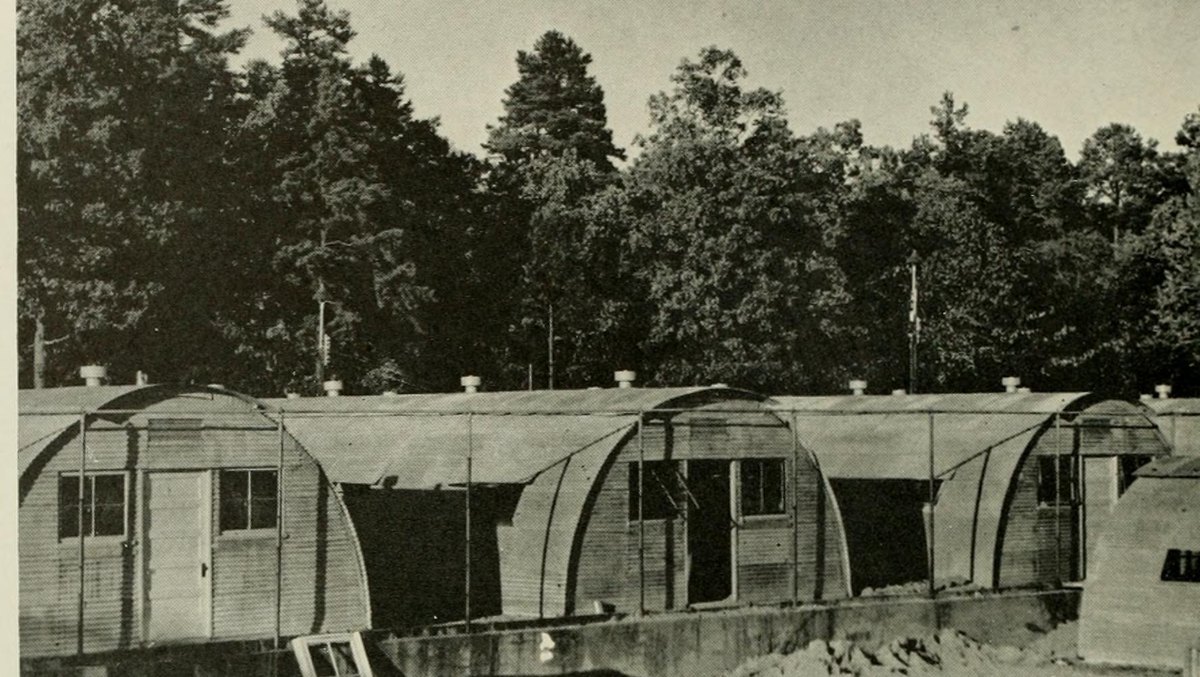
As returning veterans pushed enrollment to about 6,800 in 1946, the federal government put up the prefabricated houses of Victory Village on 65 acres of UNC's south campus, and about 350 student families came to live there. In 1952 the Victory Village Board of Aldermen, the elected council of the married-student housing, organized a day care center, which in 1967 cared for about 60 children of student parents and some University staff. UNC began the first large demolition of the village in 1961, tearing down its 96 two-story structures. The trustees allotted the whole site to the expanding health affairs complex, and the University closed eight units in August 1965; in February 1966 the Daily Tar Heel reported that 13 more would close that June, with no low-rent housing planned to replace them. That month the state deeded six acres of the tract to Medical Research Properties Inc. for a research building, and the University's business manager said the rest of the units would be torn down as space was needed. A fire in March 1967 destroyed a prefab house at 102 King Street, already scheduled for demolition that June, while the student family living there was away. In December 1968 campus buses began running through Odum and Victory villages. In June 1970 the University evicted twelve student families to clear ground for a hospital construction parking lot, and in February 1971 it announced that 34 more apartments would be torn down in 1972 for hospital parking, the village having dwindled from 456 apartments to 133. According to M. Ruth Little, brick married-student apartments called Odum Village took Victory Village's place by about 1977.
By October 3, 1988 Betty Boling had become UNC's child care coordinator, which the Daily Tar Heel called the first staff position at the University devoted solely to child care on a permanent basis. UNC then ran no child care program directly beyond providing the building and some grounds care for the Victory Village Day Care Center, which enrolled about 65 children and had about 120 families waiting. On April 7, 1989 about 35 parents, children, students and faculty members marched with signs from the Pit to South Building to call attention to child care needs at the University, presented flowers and balloons to Vice Chancellor Garland Hershey, who spoke for the center, and heard a Student Congress resolution backing its expansion. The center, in a World War II barracks building, served 64 children, three-fourths of them students' children, and its director said the University had agreed to put in a new floor after the center spent $25,000 on upkeep in five years. That summer UNC signed a $19,000 contract with Child Care Networks for a one-year pilot of "enhanced referrals" that matched employees and full-time students with day-care centers that had openings; Victory Village reported long waiting lists, and the county's day-care coordinator said local care cost more than anywhere else in the state. On April 16, 1991 the board of the Victory Village Day Care Center, where 70 percent of the children's parents were UNC students, voted to raise monthly fees from July 1 to $395 for infants and $381 for children 2 to 5, citing food and wage costs. In June 1992 Mary Bridgers, who had directed the center for nearly 30 years, retired; Vice Chancellor Donald Boulton credited her with building it into one of the area's finest child care centers.
Reading on the places and people in this storyline
No indexed work is about this storyline itself yet. These are about the sites and people its dated events name, those named most often first, so they may discuss the storyline only in part. Follow a link to find a copy or view the material.
Victory Village: photographs (Chapel Hill Historical Society)
1948
Victory Village, the postwar student housing at UNC, in five photographs from 1948 to 1950. They show houses among trees, the backs of the houses in winter and a house with a car parked outside. From the Chapel Hill Historical Society's Prints and Photographs Collection (CHHS.002).
Victory Village (Chapel Hill Historical Society vertical file)
Victory Village, the University of North Carolina's housing for student veterans and their families after the Second World War, in newspaper clippings and photocopied articles. Undated folder, Chapel Hill Historical Society vertical files.
To whom it may concern: an experience in the North Carolina Memorial Hospital
Coates, Albert · 1968
Albert Coates's personal narrative of his stay in North Carolina Memorial Hospital in Chapel Hill after a stroke, published by the University of North Carolina in 1968. Topics include cerebrovascular disease patients and their rehabilitation, hospital care in Chapel Hill and Coates himself, the founder of the university's Institute of Government. 30 pages; also titled What the NC Memorial Hospital Meant to Me.
Jubilee: a 50-year illustrated retrospective, North Carolina Memorial Hospital, UNC School of Medicine
Broom, Dick · 2002
Illustrated look back at fifty years of North Carolina Memorial Hospital and the UNC School of Medicine, with stories by Dick Broom edited by Lynn Wooten. Published by the Medical Foundation of N.C. in 2002, 93 pages with color illustrations and portraits.
EDP application controls audit report, UNC Hospitals, payroll and patient accounting systems
North Carolina · 1998 · The Office
A 19-page audit report issued in Raleigh in January 1998 by a North Carolina state office, reviewing the electronic data processing controls of the payroll and patient accounting systems at UNC Hospitals in Chapel Hill. Subjects include evaluation of the hospitals and of electronic data processing departments in Chapel Hill. A slim government document for those tracking the hospital's administration in the 1990s.
Caring stories from the University of North Carolina Hospitals, Chapel Hill.
1993 · The Hospitals
Anecdotes from the University of North Carolina Hospitals in Chapel Hill, gathered in an unpaged illustrated volume whose colophon is dated September 1993. The pieces are short recollections of care given and received. Issued by the hospitals, 22 cm.
James E. Wadsworth papers, 1909-1995.
Wadsworth, James E. (James Edgar), 1909-1995 · 1942
Papers of James E. Wadsworth (1909-1995), about a thousand items in two linear feet spanning 1909 to 1995, part of the Southern Historical Collection at UNC, collection 5075. Wadsworth worked in university housing, and topics include dormitories and student housing at Chapel Hill, the Navy Pre-Flight School that trained there, Morehead Planetarium, and public television in North Carolina.
Wider background: UNC & Campus Life · the most widely held histories of the theme this storyline is filed under; they may not discuss it
Carolina Basketball: A Century of Excellence
Lucas, Adam · 2010 · University of North Carolina Press
Adam Lucas marks one hundred years of basketball at the University of North Carolina in this illustrated history, published by UNC Press in 2010 in association with the athletics department. Chapters follow the program from the game's arrival on campus and the 'White Phantoms' of the Southern Conference through the founding of the ACC, the 1957 season, Dean Smith's changes to the game and the title seasons of 1982, 1993, 2005 and 2009, closing with a century of statistics. 289 pages.
Chapel Hill Murder and Mayhem
Jackson, Rick · 2023
Rick Jackson's true crime history of Chapel Hill, published by The History Press in 2023, in 28 short chapters. Cases include the Efland bank robbery, the execution of John Henry Breeze, the unsolved murder of Suellen Evans, the killing at the Internationalist Bookstore and the death of Eve Carson.
The Blue Divide: Duke, North Carolina, and the Battle on Tobacco Road
Moore, Johnny; Chansky, Art · 2014 · Triumph Books
The Duke and North Carolina basketball rivalry written together by Johnny Moore and Art Chansky, the latter a sports reporter who has followed it since his student days at UNC. The book opens with the 2014 season and moves through recruiting battles old and new, 'Black and Blue Sunday', 'Blood and Roses', and chapters on the rivalry's heroes, leaders and teachers, with a foreword by Jay Bilas and a photo gallery. Published by Triumph Books in 2014, 289 pages.
Miss Mary's Money
Jones, H. G. · 2014 · McFarland & Co.
H. G. Jones follows the fortune of Mary Ruffin Smith (1814-1885), the unmarried heiress whose Orange and Chatham County lands passed at her death to the University of North Carolina and the Episcopal Church. Chapters profile her grandfather Francis Jones, then trace the bequest through a quarrel among Episcopalians over Price Creek, the Chapel of the Cross and the university's buildings. A December 1885 New York Times report called the gift money; Jones shows it was land. Published by McFarland in 2014, 231 pages.
The Chronicles of the Bicentennial Observance of the University of North Carolina at Chapel Hill
Tepper, Steven J. · 1998
Steven J. Tepper's chronicle of how the University of North Carolina marked its bicentennial in 1993 and 1994. An appendix reprints the University Day speeches of October 12, 1993, given by Paul Hardin, James B. Hunt Jr., C.D. Spangler, William C. Friday, Charles Kuralt and President Bill Clinton, plus bicentennial addresses by Li Lu, Francis S. Collins and Richard J. Richardson. Published by the university in Chapel Hill, 1998; 284 pages.
Game Changers
Chansky, Art · 2016
Art Chansky's 2016 account of Dean Smith, Charlie Scott and the years that changed Chapel Hill as a Southern college town. Scott was the first Black scholarship player in the Carolina basketball program. Topics include civil rights, racism in sports and the university's twentieth-century history.
Show 6 more
William Friday
Link, William A. · 1995
Biography of William C. Friday, president of the University of North Carolina system, by historian William A. Link, published by UNC Press in 1995 with the subtitle power, purpose, and American higher education. It covers Friday's career and the history of the university at Chapel Hill and statewide. Part of the Rebecca B. Wall Local History Collection.
Light on the Hill
Snider, William D. · 1992
William D. Snider's history of the University of North Carolina at Chapel Hill, published by the University of North Carolina Press in 1992. It runs 370 pages with illustrations, a bibliography and an index.
Reviewed in History of Education Quarterly (1993), The Journal of Southern History (1993).
Chapel Hill in Plain Sight
Athas, Daphne · 2010 · Eno Publishers
Twelve essays by novelist Daphne Athas (1923-2020) on the Chapel Hill she knew across the twentieth century. Subjects include Carrboro as 'the Paris of the Piedmont', philosopher Horace Williams, Betty Smith writing in Chapel Hill, Junius Scales, Ab Abernethy and the Intimate Bookshop, Richard Wright's visit, and a set of Chapel Hill murders. Published 2010, 243 pages with illustrations.
What it means to be a Tar Heel: Roy Williams and North Carolina's greatest players
Fowler, Scott · 2010 · Triumph Books
Scott Fowler gathers recollections from Carolina basketball players, decade by decade from the 1950s to the 2000s, organized around Roy Williams and the question in the title. Contributors include Lennie Rosenbluth, Larry Brown, Billy Cunningham, Charlie Scott, Phil Ford, James Worthy, Brad Daugherty, Eric Montross, Vince Carter, Antawn Jamison, Raymond Felton and Sean May, each entry giving position and playing years. Published 2010 by Triumph Books of Chicago, 270 pages, here as an e-book.
The Campus of the First State University
Henderson, Archibald · 1949
Archibald Henderson's history of the campus of the University of North Carolina at Chapel Hill, its buildings and grounds from the founding in the 1790s onward. Henderson, a professor of mathematics and a prolific historian of the university, wrote it in the years around the university's sesquicentennial. Published by the University of North Carolina Press in 1949, 412 pages with illustrations and bibliographical footnotes.
Reviewed in The Journal of Southern History (1949), South Atlantic Quarterly (1950).
The Woman Who Rang the Bell: The Story of Cornelia Spencer Phillips
Russell, Charles Phillips · 1949
Charles Phillips Russell's biography of Cornelia Phillips Spencer (1825-1908), the Chapel Hill writer remembered for ringing the bell of South Building when the university reopened in 1875 after its closure during Reconstruction. It doubles as a history of Chapel Hill and the university. Published by the University of North Carolina Press in 1949, 293 pages with illustrations.
Reviewed in Journal of American History (1949).