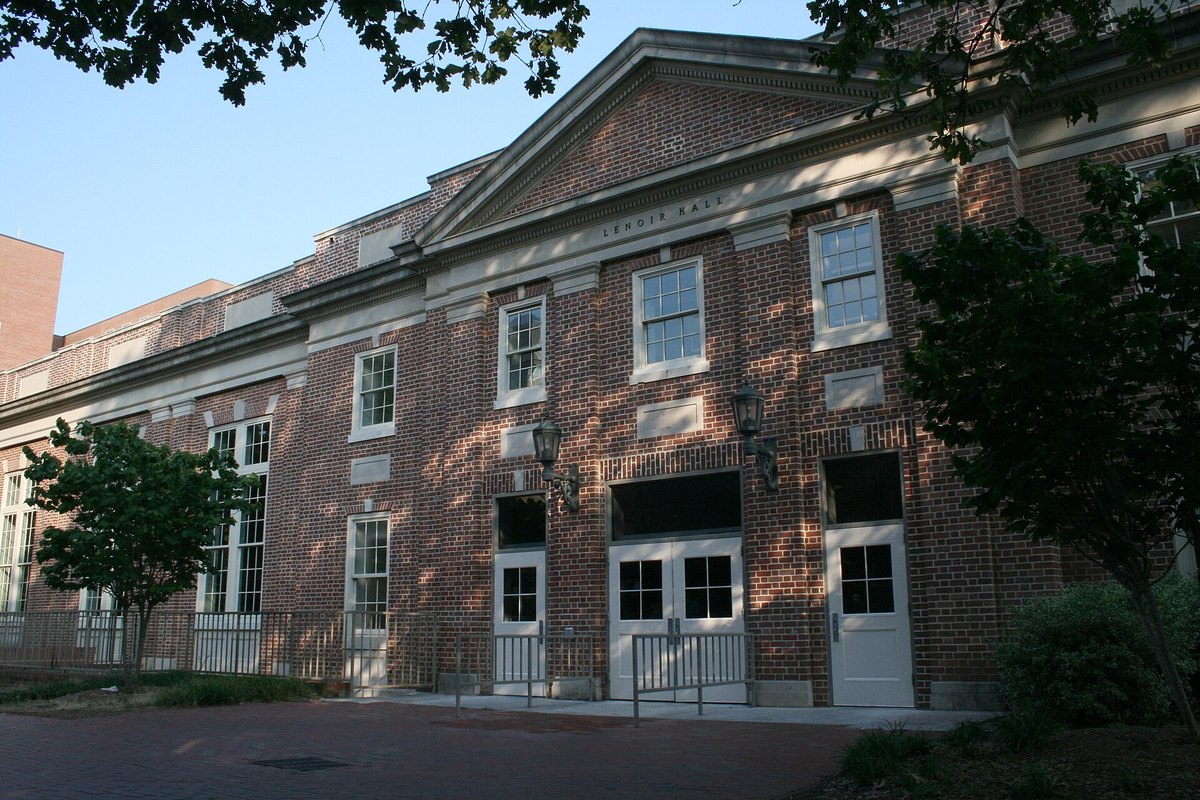
On May 19, 1969, two months after settling the spring strike, the University signed a contract with SAGA Food Services, ending its own management of campus dining; SAGA laid off many temporary and part-time workers within weeks, which set up the second strike that autumn. After SAGA quit in May 1970, the University signed Servomation-Mathias of Baltimore on July 31 to run dining at Chase Hall, the Carolina Union, Spencer Hall and the Pine Room, and Lenoir Hall's cafeteria would not reopen; Mary Smith, president of the workers' association, said laid-off SAGA workers could not learn where to apply for the 79 openings. After a Student Government study found Servomation's service unsatisfactory, ARA Services took over the dining halls on May 19, 1980, keeping on many former Servomation workers. For 1981-82 ARA made its declining-balance card, bought with a $450 or $600 deposit, the only meal plan and added a salad bar at Chase Cafeteria; about 1,700 students signed on.
On April 23, 1982 the trustees' Student Affairs Committee approved a $3.37 million plan to rebuild campus food service: students living on campus would buy a $100 meal ticket each semester, Chase Cafeteria would close in May with its second floor redone for the Carolina Union and Air Force ROTC, and Lenoir Hall's first floor would become a cafeteria by 1984, all paid for by a $10-a-semester student fee. Chase closed at the end of May, the dining service citing the planned renovations and few breakfast and lunch customers, and South Campus residents, many of them Black, complained that they now had to walk to North Campus to eat. On August 10, on the state Insurance Department's recommendation after several dormitory cooking fires, UNC barred hot plates, deep fat fryers, electric fry pans and similar appliances from residence hall rooms; the rule, set over the summer without most students present, drew protest from Student Government and residents. On November 19 acting housing director Jody Harpster set a $25 fine for a first offense and eviction for a second use of a banned appliance, and Student Government objected that the ban had been made permanent without its review. By February 7, 1983 acting Vice Chancellor Harold Wallace had approved $150,000 for a three-year project to upgrade dormitory kitchens.
On October 15, 1982 the Board of Governors approved $808,000 to remake Chase's second floor for the Air Force ROTC and Carolina Union offices and to begin rebuilding the first floor for dining, the loan to be repaid from food service receipts. On January 10, 1983, by a unanimous mail ballot, the trustees approved a plan that for the first time included a full renovation of Chase Cafeteria along with Lenoir Hall and the Carolina Union, with the $10 fee and the required $100 meal ticket. For 1983-84 Chapel Hill students also paid $10 more a semester in a debt retirement fee for renovating Lenoir Hall's dining facilities. Work began on October 10, 1983 on a $3 million project to spread University Dining Services over two floors of Lenoir Hall, and the same day the second floor of Chase Hall, renovated for $650,000 as a South Campus student union, passed final inspection; the work followed 1982 recommendations of the Food Service Advisory Committee, made when the Chase cafeteria was losing about $1,500 a week. The South Union, with games, television, snack machines and meeting rooms, opened there on August 27, 1984, the first day of classes. The Black Student Movement and ROTC had first call on its meeting rooms, and a cafeteria was still planned for the first floor.
On January 22, 1985 ARA opened The Commons in the renovated lower level of Lenoir Hall, the former Pine Room, with a grill, a pizza parlor and a sweet shop, seating 600 against the Pine Room's 450. On March 19 a Student Government report by BSM president Sherrod Banks and two other student leaders charged that administrators had pushed the $100 mandatory meal plan, due that fall, through despite five years of opposition and had distorted earlier food-service studies. It also argued that the dormitory cooking ban had been tied to building support for the plan, while the dean of student affairs said the ban was for safety. Black Ink argued that the plan would fall hardest on Black students, more than 90 percent of whom lived in South Campus dormitories. Students led by Fetzer Mills and former Residence Hall Association president Mark Stafford formed the Committee Against the Meal Plan (CAMP), and on April 16, after a noon rally in the Pit, about 200 students marched on South Building. Two days later about 2,500 students voted in a nonbinding referendum, at least 91 percent of them against each part of the plan. On April 26 the trustees set the referendum aside and kept the plan for the fall, allowing a full board plan for North and South Campus residents alike if it proved too little to run Chase Cafeteria.
On April 7, 1986 a report by Student Government, the Black Student Movement, the Labor Support Group and the Residence Hall Association called for ending ARA's contract, citing a February referendum and employees' accounts of firings of workers with disabilities, withheld raises and pay of $4 to $5 an hour after 10 to 15 years at Lenoir, and asked that the next contract give food service employees a grievance procedure; ARA's campus director denied the charges. On April 25 state purchasing officials announced that Marriott had been chosen over ARA, SAGA and two other bidders to run campus food service from June 30, and the state's report noted ARA's poor standing with student leaders.
Reading on the places and people in this storyline
No indexed work is about this storyline itself yet. These are about the sites and people its dated events name, those named most often first, so they may discuss the storyline only in part. Follow a link to find a copy or view the material.
About Lenoir Hall · named in 5 of this story’s entries
The coming of consciousness : UNC food workers' strikes, 1969
Meroney, Millicent · 1986
Millicent Meroney's 1986 Duke honors paper on the 1969 strikes by food service workers at the University of North Carolina, an episode in the town's race relations and its civil rights history. Eighty leaves of typescript with a bibliography, covering labor unions in food service, the strikes and lockouts themselves, and university employees at Chapel Hill.
Lenoir Dining Hall: photographs (Chapel Hill Historical Society)
1980
Two 1980 photographs of Lenoir Dining Hall at the University of North Carolina: students gathered in the Pit and outside the building, and staff among empty tables inside. From the Chapel Hill Historical Society's Prints and Photographs Collection, CHHS.002.
UNC-Chapel Hill dining hall, circa 1939
Morton, Hugh M. · 1940
Faculty member E. J. Woodhouse drinks from a coffee cup outside the University Dining Hall cafeteria at UNC-Chapel Hill, about 1940, beneath a sign saying state law bars the hall from serving the general public. Hugh Morton took the picture, and a tight crop appeared in the 1941 Yackety Yack.
N.C. people : C. Fordham.
1988 · North Carolina Public Television
Episode of the North Carolina People television program, broadcast in 1988 by North Carolina Public Television as program number 1750 and recorded here as a 29 minute videocassette. The guest is Christopher C. Fordham III, chancellor of the University of North Carolina at Chapel Hill.
Office of Chancellor of the University of North Carolina at Chapel Hill: Carol L. Folt records, 2013-2018
University of North Carolina at Chapel Hill. Office of the Chancellor · 2013
Chancellor's office records from the tenure of Carol L. Folt at Chapel Hill, 2013 to 2018, 8 linear feet in the University Archives at UNC, collection 40024. Topics include university administration and educational fund raising, curriculum planning, health occupations schools and medical education, and race relations and college integration in North Carolina. Holden Thorp and Christopher C. Fordham also appear.
Watts Hill Alumni Center groundbreaking
Morton, Hugh M. · 1989
Groundbreaking for the George Watts Hill Alumni Center at UNC-Chapel Hill on 13 May 1989. The group includes Ralph Strayhorn, George Watts Hill, Doug Dibbert, trustees chairman Robert C. Eubanks and Tom Lambeth, with Paul Hardin and Christopher C. Fordham also pictured. Hugh Morton photograph.
Fordham, Christopher and Robin Hadley: photographs (Chapel Hill Historical Society)
1985
Chancellor Christopher C. Fordham III posed with the scholar Robin Hadley in 1985. A single print among the UNC Faculty and Administration photographs of the Chapel Hill Historical Society, CHHS.002.
Wider background: UNC & Campus Life · the most widely held histories of the theme this storyline is filed under; they may not discuss it
Carolina Basketball: A Century of Excellence
Lucas, Adam · 2010 · University of North Carolina Press
Adam Lucas marks one hundred years of basketball at the University of North Carolina in this illustrated history, published by UNC Press in 2010 in association with the athletics department. Chapters follow the program from the game's arrival on campus and the 'White Phantoms' of the Southern Conference through the founding of the ACC, the 1957 season, Dean Smith's changes to the game and the title seasons of 1982, 1993, 2005 and 2009, closing with a century of statistics. 289 pages.
Chapel Hill Murder and Mayhem
Jackson, Rick · 2023
Rick Jackson's true crime history of Chapel Hill, published by The History Press in 2023, in 28 short chapters. Cases include the Efland bank robbery, the execution of John Henry Breeze, the unsolved murder of Suellen Evans, the killing at the Internationalist Bookstore and the death of Eve Carson.
The Blue Divide: Duke, North Carolina, and the Battle on Tobacco Road
Moore, Johnny; Chansky, Art · 2014 · Triumph Books
The Duke and North Carolina basketball rivalry written together by Johnny Moore and Art Chansky, the latter a sports reporter who has followed it since his student days at UNC. The book opens with the 2014 season and moves through recruiting battles old and new, 'Black and Blue Sunday', 'Blood and Roses', and chapters on the rivalry's heroes, leaders and teachers, with a foreword by Jay Bilas and a photo gallery. Published by Triumph Books in 2014, 289 pages.
Miss Mary's Money
Jones, H. G. · 2014 · McFarland & Co.
H. G. Jones follows the fortune of Mary Ruffin Smith (1814-1885), the unmarried heiress whose Orange and Chatham County lands passed at her death to the University of North Carolina and the Episcopal Church. Chapters profile her grandfather Francis Jones, then trace the bequest through a quarrel among Episcopalians over Price Creek, the Chapel of the Cross and the university's buildings. A December 1885 New York Times report called the gift money; Jones shows it was land. Published by McFarland in 2014, 231 pages.
The Chronicles of the Bicentennial Observance of the University of North Carolina at Chapel Hill
Tepper, Steven J. · 1998
Steven J. Tepper's chronicle of how the University of North Carolina marked its bicentennial in 1993 and 1994. An appendix reprints the University Day speeches of October 12, 1993, given by Paul Hardin, James B. Hunt Jr., C.D. Spangler, William C. Friday, Charles Kuralt and President Bill Clinton, plus bicentennial addresses by Li Lu, Francis S. Collins and Richard J. Richardson. Published by the university in Chapel Hill, 1998; 284 pages.
Game Changers
Chansky, Art · 2016
Art Chansky's 2016 account of Dean Smith, Charlie Scott and the years that changed Chapel Hill as a Southern college town. Scott was the first Black scholarship player in the Carolina basketball program. Topics include civil rights, racism in sports and the university's twentieth-century history.
Show 6 more
William Friday
Link, William A. · 1995
Biography of William C. Friday, president of the University of North Carolina system, by historian William A. Link, published by UNC Press in 1995 with the subtitle power, purpose, and American higher education. It covers Friday's career and the history of the university at Chapel Hill and statewide. Part of the Rebecca B. Wall Local History Collection.
Light on the Hill
Snider, William D. · 1992
William D. Snider's history of the University of North Carolina at Chapel Hill, published by the University of North Carolina Press in 1992. It runs 370 pages with illustrations, a bibliography and an index.
Reviewed in History of Education Quarterly (1993), The Journal of Southern History (1993).
Chapel Hill in Plain Sight
Athas, Daphne · 2010 · Eno Publishers
Twelve essays by novelist Daphne Athas (1923-2020) on the Chapel Hill she knew across the twentieth century. Subjects include Carrboro as 'the Paris of the Piedmont', philosopher Horace Williams, Betty Smith writing in Chapel Hill, Junius Scales, Ab Abernethy and the Intimate Bookshop, Richard Wright's visit, and a set of Chapel Hill murders. Published 2010, 243 pages with illustrations.
What it means to be a Tar Heel: Roy Williams and North Carolina's greatest players
Fowler, Scott · 2010 · Triumph Books
Scott Fowler gathers recollections from Carolina basketball players, decade by decade from the 1950s to the 2000s, organized around Roy Williams and the question in the title. Contributors include Lennie Rosenbluth, Larry Brown, Billy Cunningham, Charlie Scott, Phil Ford, James Worthy, Brad Daugherty, Eric Montross, Vince Carter, Antawn Jamison, Raymond Felton and Sean May, each entry giving position and playing years. Published 2010 by Triumph Books of Chicago, 270 pages, here as an e-book.
The Campus of the First State University
Henderson, Archibald · 1949
Archibald Henderson's history of the campus of the University of North Carolina at Chapel Hill, its buildings and grounds from the founding in the 1790s onward. Henderson, a professor of mathematics and a prolific historian of the university, wrote it in the years around the university's sesquicentennial. Published by the University of North Carolina Press in 1949, 412 pages with illustrations and bibliographical footnotes.
Reviewed in The Journal of Southern History (1949), South Atlantic Quarterly (1950).
The Woman Who Rang the Bell: The Story of Cornelia Spencer Phillips
Russell, Charles Phillips · 1949
Charles Phillips Russell's biography of Cornelia Phillips Spencer (1825-1908), the Chapel Hill writer remembered for ringing the bell of South Building when the university reopened in 1875 after its closure during Reconstruction. It doubles as a history of Chapel Hill and the university. Published by the University of North Carolina Press in 1949, 293 pages with illustrations.
Reviewed in Journal of American History (1949).