In November 1990 the Chapel Hill-Carrboro school board approved plans to build four new schools before 2000, and in February 1991 it asked the Chapel Hill Town Council to plan school sites, athletic fields, pools and other facilities for shared town and school use to save money. By January 31, 1992 the board had approved a contract to buy about 40 acres between Old Fayetteville Road and Hillsborough Road, near Barrington Hills, for a future middle or elementary school, paying the owners $30,000 to hold the land at a total price of $900,000 until a bond referendum later that year. In mid-February the board's attorney called it the favored site of six studied, and the Carrboro aldermen began discussing what a school there would need.
On April 15 the school board hosted the aldermen to talk over a 740-student middle school planned between Hillsborough and Old Fayetteville roads near Carrboro Community Park if a $52 million school bond passed in November. Assistant superintendent Neil Pedersen proposed sharing sports and library space with the town and later building an elementary school on the same site; Alderman Hilliard Caldwell, who lived nearby, said residents would oppose a service road onto Hillsborough Road. By October 15 the system counted 6,784 students, and state projections put enrollment above 7,000 the next year and above 8,000 by 1996–97, with Orange County enrollment growing 26.6 percent in five years; officials cited the figures for the bond. On November 3, 1992 Orange County voters approved the $52 million bond to build a new middle school and a new high school for the Chapel Hill-Carrboro schools, a new middle school for the Orange County Schools and technology upgrades. With 36 of 42 precincts reporting, 21,226 had voted for it and 16,018 against, with the northern precincts opposed.
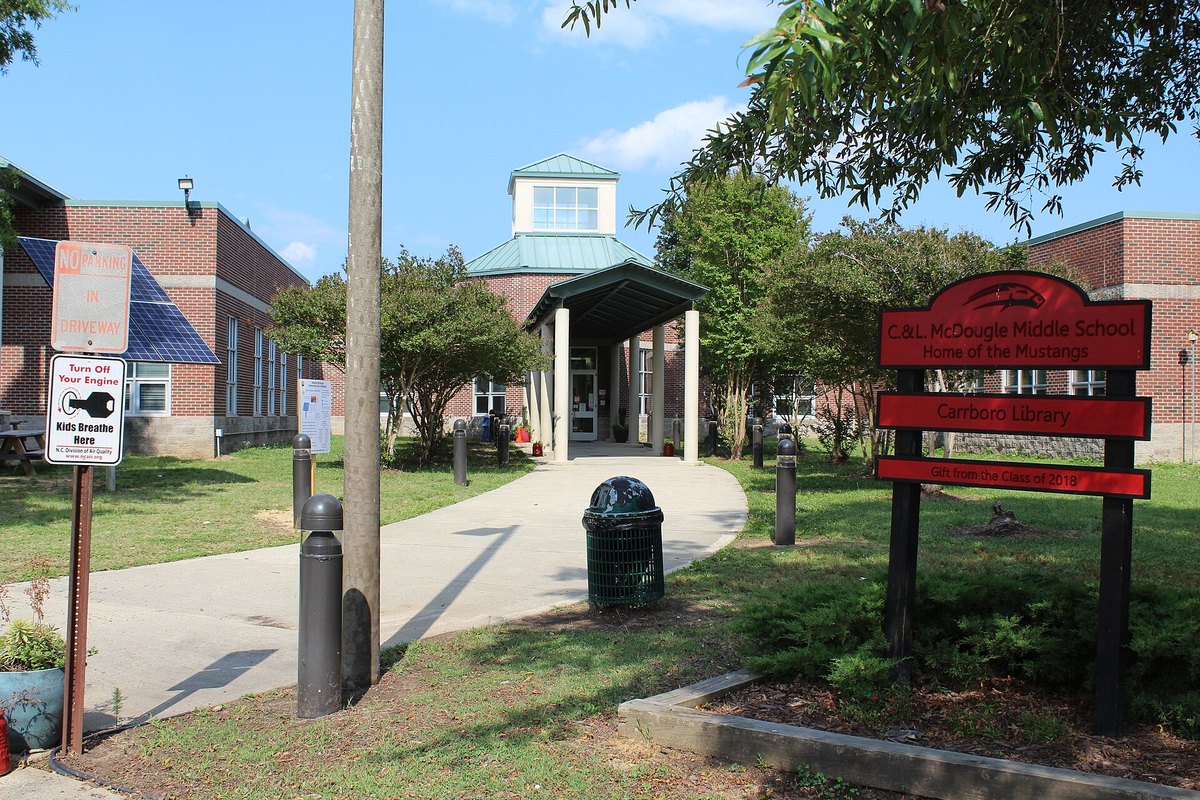
By July 15, 1993 the school board had chosen a 72-acre site on Weaver Dairy Road for a new high school to be paid for from the 1992 bond. In February 1994 the design of the district's new middle school in Carrboro, built around separate grade-level houses, was named one of 12 Projects of Distinction by the Council of Educational Facility Planners; school spokeswoman Kim Hoke said it was the district's first new school in 20 years. On March 7 the board tentatively named it the Charles A. and Lucile McDougle Middle School, for two Black educators: Charles McDougle had been the only principal of Lincoln High School, and Lucile McDougle had taught in the district. On March 28 the Town Council approved the plan for the second high school at Weaver Dairy and Sunrise roads after neighbors pressed concerns about traffic and parking. McDougle Middle School opened on August 23, the district's first school named for Black people, the Daily Tar Heel said, and was dedicated on November 6. On September 22 the board formed a committee chaired by board member Mark Royster to redraw attendance lines ahead of the planned 1996 opening of the new high school and a new elementary school, and on November 17, with the high school's construction bid about $3.8 million over its $22 million budget, it dropped the auditorium, the outdoor stadium and track and other features and kept negotiating with the contractor.
Reading on the places and people in this storyline
No indexed work is about this storyline itself yet. These are about the sites and people its dated events name, those named most often first, so they may discuss the storyline only in part. Follow a link to find a copy or view the material.
More than a mentoring program : attacking institutional racism
Meyer, Graig M. · 2018 · Information Age Publishing
Graig M. Meyer's 2018 account, written with George Noblit, of a youth mentoring program in the Chapel Hill-Carrboro City Schools that set out to attack institutional racism and close racial achievement gaps. Chapters lay out an antiracist mentoring model, racial identity development, advocacy at the system level, staffing and leadership, and a culture of continuous improvement. Published by Information Age Publishing, 211 pages, online.
Oral history interview with Sam Holton, March 28, 2001: interview K-0206, Southern Oral History Program Collection (#4007)
Holton, Samuel M. · 2007 · University Library, UNC-Chapel Hill
Samuel M. Holton (1922-2010) sat on Chapel Hill's school board during desegregation. Elected in 1968 after a term as PTA president, he took office as racial tension rose after Martin Luther King Jr. was assassinated. Talking with Jenny Matthews in March 2001, he describes the board's decisions on integrating the Chapel Hill-Carrboro City Schools and the conflicts that came with them. Runs about eighty minutes; electronic edition issued by the UNC library in 2007 through Documenting the American South.
Oral history interview with Edwin Caldwell, March 2, 2001: interview K-0202, Southern Oral History Program Collection (#4007)
Caldwell, Edwin · 2006 · University Library, UNC-Chapel Hill
Edwin Caldwell, Jr. reviews a life in Chapel Hill politics in a three-hour Southern Oral History Program interview recorded March 2, 2001, by Oliver White. A skilled organizer, Caldwell worked in the campaign that made Howard Lee the town's first Black mayor in 1969, ran for office more than once without winning, and became a local political power. The conversation also covers race relations, the Chapel Hill-Carrboro school board and the Church of Reconciliation. Published online in 2006 in Documenting the American South.
The effects of desegregation on selected variables in the Chapel Hill city school system
Prichard, Paul Newton, 1935- · 1969
Paul Newton Prichard's 1969 study of what desegregation changed in the Chapel Hill city school system, measured against academic achievement and other selected variables. Topics include school integration and achievement in the town, and a bibliography runs to page 115. Written during the district's own desegregation years, which makes it a contemporary source as well as a study.
After Ten Years: A Portrait of a Joint School/Public Library: The Carrboro Branch Library & the McDougle Schools' Media Center
2005
A 2005 look at the joint library shared by the Carrboro Branch Library and the McDougle Schools media center, written ten years after the two operations were combined. It examines a shared public library and school facility in North Carolina.
Factors in a collaborative inquiry partnership group affecting perceptions of team and organizational learning outcomes in a professional development school
Mebane, Dorothy J. · 2000
Dorothy J. Mebane's 2000 dissertation on a collaborative inquiry partnership group and what its members perceived about team and organizational learning in a professional development school. McDougle Middle School in Chapel Hill is the case study site, concerning college and school cooperation and for laboratory schools in the town. The bibliography runs on leaves 105 to 117.
Wider background: Schools & Education · the most widely held histories of the theme this storyline is filed under; they may not discuss it
William Friday
Link, William A. · 1995
Biography of William C. Friday, president of the University of North Carolina system, by historian William A. Link, published by UNC Press in 1995 with the subtitle power, purpose, and American higher education. It covers Friday's career and the history of the university at Chapel Hill and statewide. Part of the Rebecca B. Wall Local History Collection.
The Woman Who Rang the Bell: The Story of Cornelia Spencer Phillips
Russell, Charles Phillips · 1949
Charles Phillips Russell's biography of Cornelia Phillips Spencer (1825-1908), the Chapel Hill writer remembered for ringing the bell of South Building when the university reopened in 1875 after its closure during Reconstruction. It doubles as a history of Chapel Hill and the university. Published by the University of North Carolina Press in 1949, 293 pages with illustrations.
Reviewed in Journal of American History (1949).
Hark the Sound of Tar Heel Voices
Barefoot, Daniel W. · 2008
Daniel W. Barefoot arranges first-hand recollections of the University of North Carolina by decade, from the 'infant university' of the 1790s through the Civil War years when promise turned to despair, the rebuilding of the 1870s, the 'frosh' life of the 1880s, wartime fame in the 1940s, the controversies of the 1960s and the bicentennial of the 1990s. Thomas Wolfe's student years appear among the voices. Published by John F. Blair of Winston-Salem in 2008, 257 pages.
The Story of the Institute of Government, The University of North Carolina at Chapel Hill
Coates, Albert McKinley · 1981
Albert Coates's own account of the Institute of Government at the University of North Carolina, which he founded, subtitled 'out of a classroom in Chapel Hill' and published in 1981. The 303 pages trace the institute's history and its role in educating North Carolina's public officials.
Blood on the Old Well
Emery, Sarah Watson · 1963
Sarah Watson Emery's 1963 book on the University of North Carolina, concerned with communism on the Chapel Hill campus and with academic freedom in 1960 and 1961. Published by Prospect House in Dallas, 240 pages with illustrations.
Horace Williams
Winston, Sr., Robert Watson · 1942 · The University of North Carolina press
Robert Watson Winston's biography of Henry Horace Williams (1858-1940), who taught philosophy at the University of North Carolina for half a century, subtitled gadfly of Chapel Hill. Published by the University of North Carolina Press in 1942, 309 pages with frontispiece and portraits; this copy is autographed. Topics include educators in Chapel Hill and the university's history.
Reviewed in Social Forces (1943).
Show 6 more
To Drink from the Well: The Struggle for Racial Equality at the Nation’s Oldest University
Kapur, Geeta · 2021
Geeta Kapur's history of race at the University of North Carolina at Chapel Hill, from the enslaved labor that built the campus through desegregation and the Black student protests that followed. Twelve chapters, with a foreword by William Barber II, move from the founding era and the Great Depression controversies to the state's response to integration and the turmoil of later decades; North Carolina Central University also figures. Published 2021 by Blair in Durham.
Communists on Campus
Billingsley, William J. · 1999 · University of Georgia Press
William J. Billingsley's history of the Speaker Ban Law, the 1963 North Carolina statute that barred known Communists from speaking on state campuses, and the fight over it at the University of North Carolina in Chapel Hill. The subtitle sets the scope: race, politics and the public university in sixties North Carolina. It treats academic freedom, anti-communist movements and free speech in the state. University of Georgia Press, 1999, 308 pages with eight pages of plates.
Reviewed in Academe (2000), The American Historical Review (2001), The Journal of Southern History (2001), Journal of American History (2001), The Journal of Politics (2001).
Frank Porter Graham and the 1950 Senate Race in North Carolina
Pleasants, Julian M.; Burns, Augustus M., III · 1990 · UNC Press
Julian M. Pleasants and Augustus M. Burns III on the 1950 Democratic Senate primary in North Carolina, in which Frank Porter Graham, the former president of the University of North Carolina, lost to Willis Smith after a campaign marked by race-baiting. Primaries, elections and race relations in the state are its subjects. Published by UNC Press in 1990, 356 pages with illustrations.
Reviewed in Choice Reviews Online (1991), The American Historical Review (1991), Journal of American History (1991), The Journal of Southern History (1992).
Francis Preston Venable of the University of North Carolina
Bursey, Maurice M. · 1989 · Chapel Hill Historical Society
Maurice M. Bursey's biography of Francis Preston Venable (1856 to 1934), chemist and president of the University of North Carolina, published by the Chapel Hill Historical Society in 1989. It also covers the history of the university's chemistry department. Illustrated, 111 pages, with bibliographies.
Reviewed in Isis (1992).
Old Days in Chapel Hill
Chamberlain, G. Hope Summerell · 1926
Hope Summerell Chamberlain's life and letters of Cornelia Phillips Spencer (1825 to 1908), published in 1926, which doubles as a picture of Chapel Hill and the university in the nineteenth century. It runs 325 pages with illustrations and portraits.
Fire and Stone: The Making of the University of North Carolina under Presidents Edward Kidder Graham and Harry Woodburn Chase
Covington, Jr., Howard E. · 2018
Howard E. Covington Jr.'s history of how the University of North Carolina took shape under Presidents Edward Kidder Graham (1876 to 1918) and Harry Woodburn Chase (1883 to 1955), published by the University Library in 2018. The 528-page account covers campus history in the early twentieth century and includes portraits.
Reviewed in The Journal of Southern History (2020).
NC Digital Collections record courtesy of the North Carolina Department of Natural and Cultural Resources.