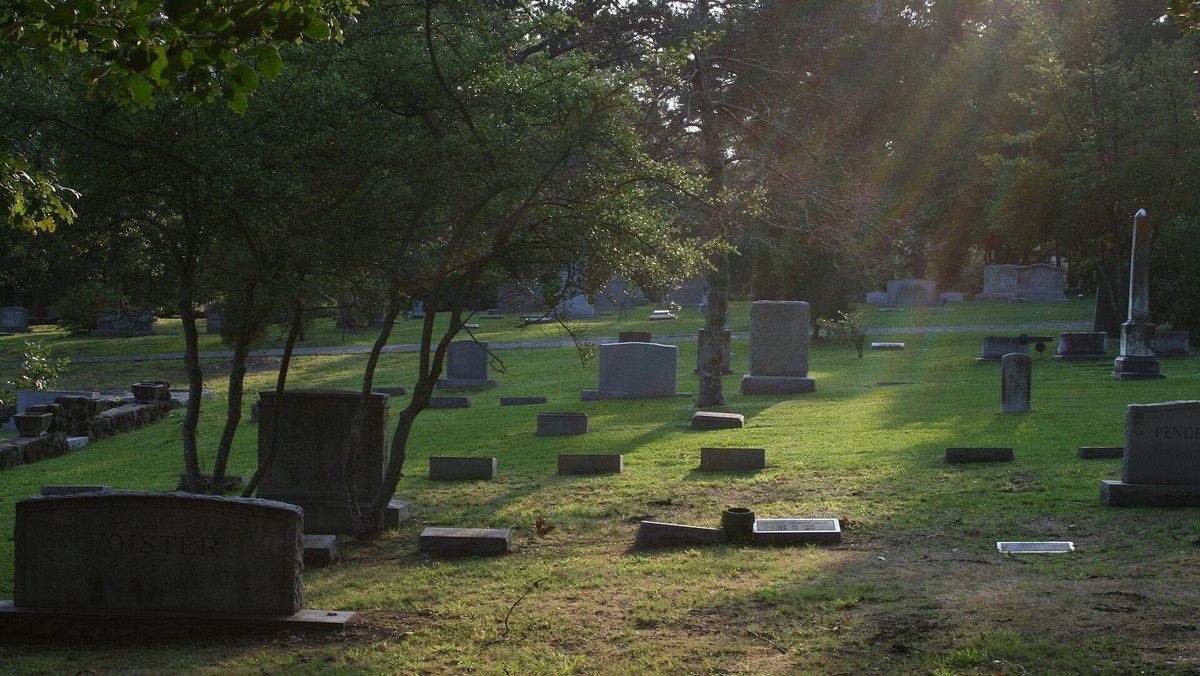
In a letter of November 11, 1960 to J. A. Branch of the university business office, university attorney J. A. Williams reported no sign that the trustees had ever conveyed the land of the Old Chapel Hill Cemetery to the town. On the night of November 27, 1974 vandals broke or pushed over forty or fifty gravestones, and police patrolled for a week; cemetery committee chair Shirley Marshall then faulted the town for ignoring earlier requests about ownership and repairs. In 1982 the University, citing poor upkeep, proposed taking control of the cemetery from the town and extending it into the wooded grove on its east side for about 185 new graves, but it dropped the plan after opposition in the neighborhoods east of the campus.
On April 22, 1985 Rebecca Clark of Chapel Hill's Black community showed the Town Council slides of sunken graves, broken walls, trash and overturned markers. The council named a task force, which called for a phased master plan. On November 12 the council told Town Manager David Taylor to take whatever steps were needed to keep cars out, acting on a letter from Chapel Hill Preservation Society president Mary Arthur Stoudemire, who said well over 100 cars had parked on graves during the Clemson game on November 9; police counted about 30. Council member R. D. Smith proposed chains and a cable at the entrances. On Thanksgiving night, 1985, vandals smashed about 30 tombstones.
In July 1987, after the task force found that the town would care for the cemetery better, Governor James Martin and the Council of State settled who was responsible for it, letting Chapel Hill budget money for its upkeep. UNC property officer Grace Wagoner said a 1929 agreement had let the town keep it up by selling lots until they ran out in the mid-1950s. The master plan, revised by landscape architect David Swanson, first called for settling the cemetery's ownership. On October 12, 1987 the council voted 8 to 0 to accept the task force's proposal for the seven-acre cemetery: landscaping and lighting, repairs to rock walls, sidewalks, fences and grave markers, and operation by the public works department. Council member David Godschalk put the capital cost at about $290,000, with about $50,000 a year to run it and three new town employees.
By November 1988 the town had begun the work, spread over five years, under a master plan by the architects Hunter, Reynolds and Jewell, pruning and removing sick or leaning trees behind Connor and Winston residence halls, with sidewalks, monuments, turf, structures and signs to follow; a new gazebo and lawn came later. A quitclaim deed dated February 22, 1989 released the University's and the state's rights in the cemetery to the town, settling a question of ownership open since the 1920s.
On November 30, 1992, opening UNC's Kwanzaa week, students and other campus members held a candlelight vigil and march in honor of the Africans and African Americans buried in the cemetery, whom a Black Student Movement organizer called the unknown dead. In December the Collegiate Black Caucus began organizing students as Students for the Improvement of our Ancestry to demand that the town keep its promise, as the caucus gave it, to spend $250,000 over five years restoring the cemetery, especially its Black sections, where broken stones and sunken graves remained; the town had told a longtime advocate the work would take four more years. On January 14, 1993 a state committee put the cemetery on the Study List after staff answered a member's question about how it differed from other town burial grounds: its clearly bounded older sections and the importance of those buried there met the test for cemeteries. The National Park Service listed the Old Chapel Hill Cemetery in the National Register of Historic Places on June 3, 1994.