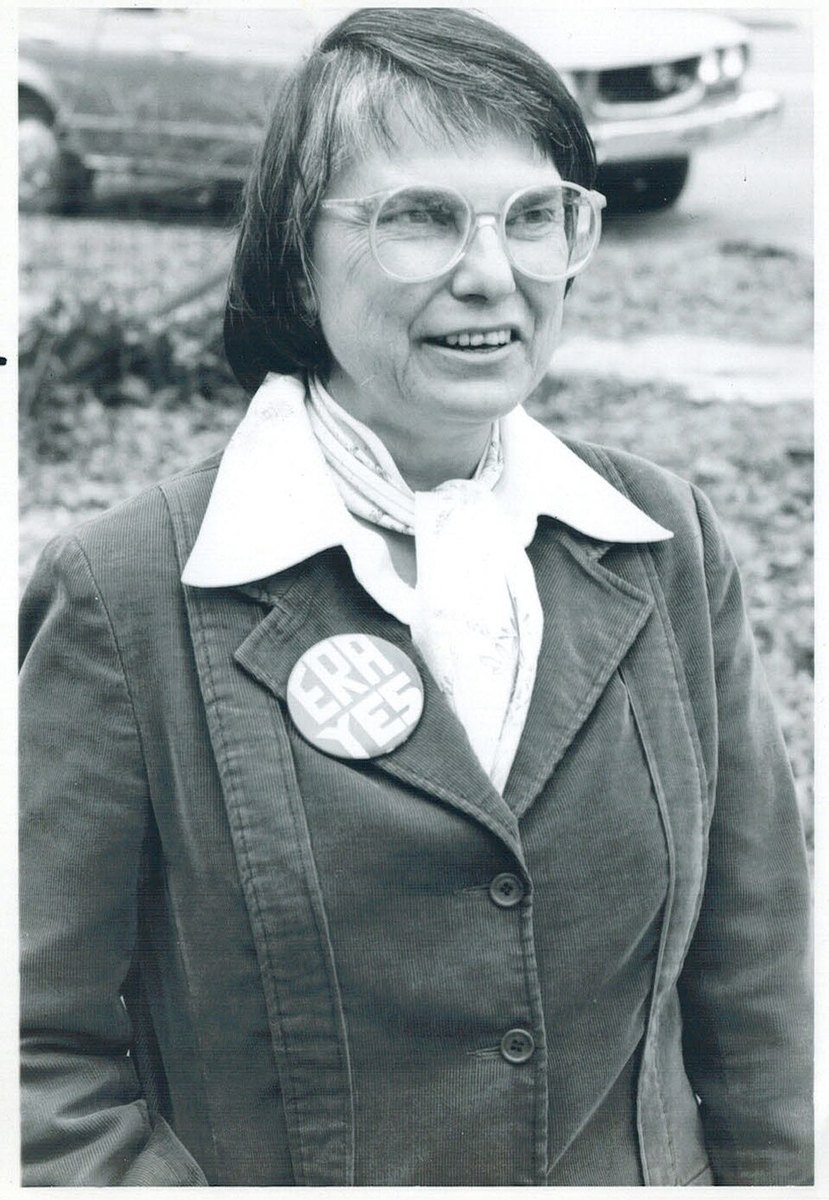
At Mayor Howard Lee's request, the Chapel Hill Board of Aldermen voted unanimously on March 3, 1975 to support the Equal Rights Amendment, then before the General Assembly, and the next day Lee was among the supporters introduced at the House committee's hearing in Raleigh. On September 18 and 19, 1976 the Orange and Chatham County Coalition of North Carolinians for the Equal Rights Amendment opened its drive for ratification in the coming General Assembly with a weekend rally, planning to raise money, educate the public and supply speakers to counties without a coalition; the UNC Association for Women Students agreed to work with it. On April 21, 1977 about 40 supporters from the Association for Women Students, the Carolina Gay Association and the Women's International League for Peace and Freedom marched and chanted outside Gerrard Hall while the Dialectic and Philanthropic Societies unveiled a bust of former Sen. Sam J. Ervin Jr., who had spoken against the amendment before the state Senate defeated it; Albert Coates, who introduced Ervin, later wrote that the chanting drowned out the speeches. About 200 people came to a rally in the Pit on January 23, 1978, during the association's Women's Festival, with a keynote by Miriam Slifkin, former president of the Chapel Hill chapter of the National Organization for Women, and on October 30 state Sen. Kathy Sebo of Guilford County told another Pit rally that the amendment was "alive and well" and would return to the General Assembly in 1979. By September 1980 a new campus group, Carolina Students for Freedom, had begun working to block North Carolina's ratification of the amendment, while the Association for Women Students worked for it. On February 9, 1981 the Carolina Union Forum Committee and the association brought NOW founder Betty Friedan and Stop ERA chairman Phyllis Schlafly to debate the amendment in Memorial Hall before a sold-out, largely pro-Friedan crowd, with WXYC broadcasting it live. Friedan urged the audience to win ratification in North Carolina by June 1982; Schlafly called the ERA an idea whose time had passed.
Reading on the places and people in this storyline
No indexed work is about this storyline itself yet. These are about the sites and people its dated events name, those named most often first, so they may discuss the storyline only in part. Follow a link to find a copy or view the material.
The Dialectic and Philanthropic Societies: virtus, libertas et scientia, 1795
Brigman, Brian · 1988
Brian Brigman's short illustrated pamphlet on the Dialectic and Philanthropic Societies, the debating societies founded at the University of North Carolina in 1795, with the Latin phrase virtus, libertas et scientia in its subtitle. Published by the societies themselves in Chapel Hill in 1988, eleven unnumbered pages with portraits.
The Dialectic and Philanthropic Societies portraits, 1795-1868
Reckford, Joseph K. L. · 1981 · Univ. of NC
Joseph K. L. Reckford's honors essay in American Studies at the University of North Carolina, submitted in 1981, reproduces the portraits acquired between 1795 and 1868 by the Dialectic and Philanthropic Societies, the university's two debating societies, and adds selected biographical data on the sitters. 211 pages with a short bibliography.
"And they talked. Always they talked" : 215 years of the Dialectic and Philanthropic Societies
Cherry, Kevin · 2011 · University of North Carolina at Chapel Hill
Kevin Cherry's lecture on 215 years of the Dialectic and Philanthropic Societies, the student debating societies at the University of North Carolina, delivered on April 7, 2011 in Wilson Library for the Gladys Hall Coates University History Lecture series. Seventeen pages as published online, covering student oratory and society life at Chapel Hill from the 1790s onward.
The growth of the library of the Philanthropic Society at the University of North Carolina, Chapel Hill, 1797-1822
Murphy, Evangeline Burbank, 1947- · 1979 · University of North Carolina at Chapel Hill
Evangeline Burbank Murphy traces the growth of the library built up by the Philanthropic Society at the University of North Carolina between 1797 and 1822, in a thesis the university issued in 1979. Subjects include academic libraries in Chapel Hill and the society and the university library of the 1793 to 1962 period. Seventy three leaves.
Wider background: Women's Lives & History · the most widely held histories of the theme this storyline is filed under; they may not discuss it
To Free A Family
Nathans, Sydney · 2012 · Harvard University Press
Sydney Nathans's biography of Mary Walker, an enslaved woman from Orange County who escaped to the North in the mid nineteenth century and spent the following decades in Cambridge, Massachusetts, working to free the family she had left behind. Chapter titles trace her flight, her years among Northern friends, a rescue plot, a long silence, and the reunion that gives the book its close. Published 2012 by Harvard University Press, 330 pages with 20 pages of plates, illustrations and maps.
Reviewed in Choice Reviews Online (2012), Civil War Book Review (2012).
Miss Mary's Money
Jones, H. G. · 2014 · McFarland & Co.
H. G. Jones follows the fortune of Mary Ruffin Smith (1814-1885), the unmarried heiress whose Orange and Chatham County lands passed at her death to the University of North Carolina and the Episcopal Church. Chapters profile her grandfather Francis Jones, then trace the bequest through a quarrel among Episcopalians over Price Creek, the Chapel of the Cross and the university's buildings. A December 1885 New York Times report called the gift money; Jones shows it was land. Published by McFarland in 2014, 231 pages.
The Woman Who Rang the Bell: The Story of Cornelia Spencer Phillips
Russell, Charles Phillips · 1949
Charles Phillips Russell's biography of Cornelia Phillips Spencer (1825-1908), the Chapel Hill writer remembered for ringing the bell of South Building when the university reopened in 1875 after its closure during Reconstruction. It doubles as a history of Chapel Hill and the university. Published by the University of North Carolina Press in 1949, 293 pages with illustrations.
Reviewed in Journal of American History (1949).
Old Days in Chapel Hill
Chamberlain, G. Hope Summerell · 1926
Hope Summerell Chamberlain's life and letters of Cornelia Phillips Spencer (1825 to 1908), published in 1926, which doubles as a picture of Chapel Hill and the university in the nineteenth century. It runs 325 pages with illustrations and portraits.
Selected Papers of Cornelia Phillips Spencer
Spencer, Cornelia Phillips · 1953
Selected writings of Cornelia Phillips Spencer (1825 to 1908), the Chapel Hill writer who campaigned for the university's reopening after Reconstruction, published by the University of North Carolina Press in 1953. The 753 pages touch on Chapel Hill life, education and the university in the nineteenth century.
Reviewed in The Journal of Southern History (1954).
Jane Crow: The Life of Pauli Murray
Rosenberg, Rosalind · 2017
Rosalind Rosenberg's 2017 biography of Pauli Murray (1910-1985), lawyer, poet and Episcopal priest, raised in Durham. Its six parts follow a Southern childhood, the move to New York, the 1938 application to the University of North Carolina that was refused because Murray was Black (the chapter is titled 'Members of your race are not admitted'), law school and the coining of the phrase Jane Crow, the Cold War years, the push toward 'an NAACP for women', and a late-life ordination. 494 pages with portraits.
Reviewed in The Journal of Southern History (2018).
Show 6 more
Well worth a shindy : the architectural and philosophical history of the Old Well at the University of North Carolina at Chapel Hill
Madry, Sarah Brandes · 2003 · iUniverse
Sarah Brandes Madry's history of the Old Well at the University of North Carolina at Chapel Hill, treating both its architecture and the ideas attached to it. It takes in drinking fountains and water use in Chapel Hill and the university's history, with a chapter on Edwin Anderson Alderman, the president under whom the well took its present form in 1897, and one on water at the university. Published by iUniverse in 2003, 399 pages with illustrations.
Mrs. Lincoln and Mrs. Keckly: The Remarkable Story of the Friendship Between a First Lady and a Former Slave
Fleischner, Jennifer · 2003 · Broadway Books
Jennifer Fleischner's double biography of Mary Todd Lincoln and Elizabeth Keckley, the dressmaker who had been enslaved, including years in Hillsborough, before buying her freedom and becoming the First Lady's confidante. Published by Broadway Books in New York in 2003, 372 pages with illustrations and a map. Topics include enslaved women in Hillsborough and the United States, dressmakers and women's friendships in the nineteenth century.
The Book of Burwell Students
Engstrom, Mary Claire · 1979 · Historic Hillsborough Commission
Mary Claire Engstrom's biographical register of the young women who attended the Burwell School in Hillsborough, subtitled lives of educated women in the antebellum South. The school was kept by Margaret Anna Burwell and her husband, and the book bears on women's education in nineteenth-century North Carolina. Published by the Historic Hillsborough Commission, 1979, 256 pages with illustrations and portraits.
The last ninety days of the war in North-Carolina
Spencer, Cornelia Phillips · 2005 · University Library, UNC-Chapel Hill
Cornelia Phillips Spencer's account of the closing weeks of the Civil War in North Carolina, reissued in 2005 as an electronic edition by the University Library at UNC-Chapel Hill. Topics include the 1865 campaigns, Sherman's march through the Carolinas, Stoneman's raid, and the history of Chapel Hill and the university in the nineteenth century, where Spencer, 1825 to 1908, spent her working life.
More than petticoats
Cohn, Scotti · 2000 · TwoDot
Scotti Cohn's short biographies of notable North Carolina women, including Harriet Jacobs, Charlotte Hawkins Brown, Annie Lowrie Alexander and Cornelia Phillips Spencer of Chapel Hill. Published by Twodot in 2000, 198 pages with illustrations.
First Women of Orange County
1994 · Orange County Women's History Month Committee
A Women's History Month project of 1993 and 1994 from the Orange County Women's History Month Committee, profiling women who were firsts in the county. Published in Chapel Hill in 1994, 13 pages plus unnumbered leaves with illustrations, facsimiles and portraits.